
Utility Private Fifth Generation (5G) Network Slicing Market Report 2026
Global Outlook – By Component (Hardware, Software, Services), By Deployment Mode (On-Premises, Cloud), By Network Type (Standalone, Non-Standalone), By Application (Smart Grid, Remote Monitoring, Asset Management, Field Area Network, Other Applications), By End User (Electric Utilities, Water Utilities, Gas Utilities, Other End-Users) – Market Size, Trends, Strategies, and Forecast to 2030
Utility Private Fifth Generation (5G) Network Slicing Market Overview
• Utility Private Fifth Generation (5G) Network Slicing market size has reached to $1.32 billion in 2025 • Expected to grow to $4.7 billion in 2030 at a compound annual growth rate (CAGR) of 29% • Growth Driver: Growing Adoption Of Private 5G Networks Fueling The Growth Of The Market Due To The Need For Secure, Reliable, And Performance-Guaranteed Connectivity For Critical Utility Operations • Market Trend: 5G Private Networks and Deterministic Slicing Enable Large-Scale Smart Grid Deployment • North America was the largest region in 2025 and Asia-Pacific is the fastest growing region.What Is Covered Under Utility Private Fifth Generation (5G) Network Slicing Market?
Utility private fifth generation (5G) network slicing refers to the deployment of a dedicated private 5G wireless network for utility operators such as electricity, water, gas, and renewable energy providers in which the network is logically segmented into multiple isolated network slices, each engineered to meet specific operational requirements for latency, reliability, bandwidth, and security. These slices enable utilities to support diverse mission-critical and non-critical use cases such as smart grid control, substation automation, real-time monitoring, predictive maintenance, and workforce connectivity over a single private 5G infrastructure while ensuring service-level assurance and operational resilience. The main components of utility private fifth generation (5G) network slicing are hardware, software, and services. Hardware refers to the physical infrastructure, including routers, switches, and 5G-enabled devices, required to deploy and operate private 5G network slices. These solutions are implemented through different deployment modes, including on-premises and cloud, and support various network types, such as standalone and non-standalone. They are used across multiple applications, including smart grid, remote monitoring, asset management, field area network, and other applications, and serve diverse end-users, including electric utilities, water utilities, gas utilities, and other end-users.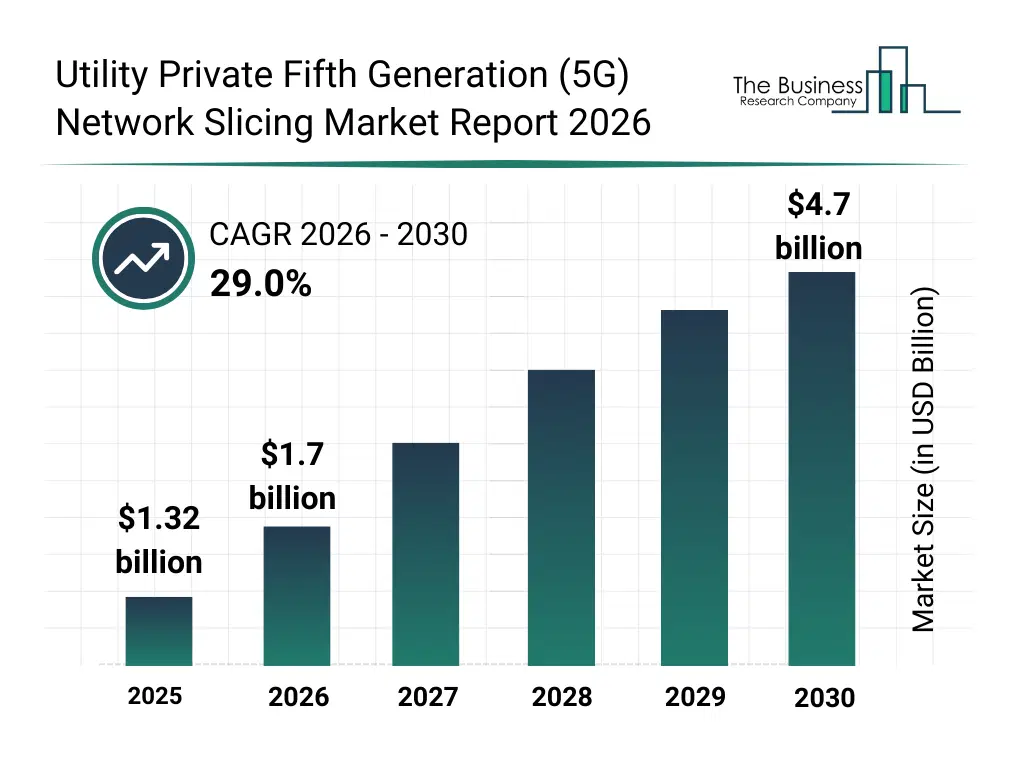
What Is The Utility Private Fifth Generation (5G) Network Slicing Market Size and Share 2026?
The utility private fifth generation (5g) network slicing market size has grown exponentially in recent years. It will grow from $1.32 billion in 2025 to $1.7 billion in 2026 at a compound annual growth rate (CAGR) of 28.7%. The growth in the historic period can be attributed to increase in smart grid modernization projects, growth in renewable energy infrastructure investments, expansion of industrial wireless communication needs, rising utility automation initiatives, demand for secure critical infrastructure networks.What Is The Utility Private Fifth Generation (5G) Network Slicing Market Growth Forecast?
The utility private fifth generation (5g) network slicing market size is expected to see exponential growth in the next few years. It will grow to $4.7 billion in 2030 at a compound annual growth rate (CAGR) of 29.0%. The growth in the forecast period can be attributed to surge in private spectrum allocation policies, increasing adoption of edge computing in utilities, expansion of real time asset monitoring requirements, rising cybersecurity compliance mandates, growing investments in resilient digital infrastructure. Major trends in the forecast period include private 5g network deployment expansion in utilities, growth in mission critical low latency communication networks, increasing adoption of network virtualization and orchestration, rising demand for secure utility connectivity infrastructure, integration of multi slice architecture for diverse utility operations.
Global Utility Private Fifth Generation (5G) Network Slicing Market Segmentation
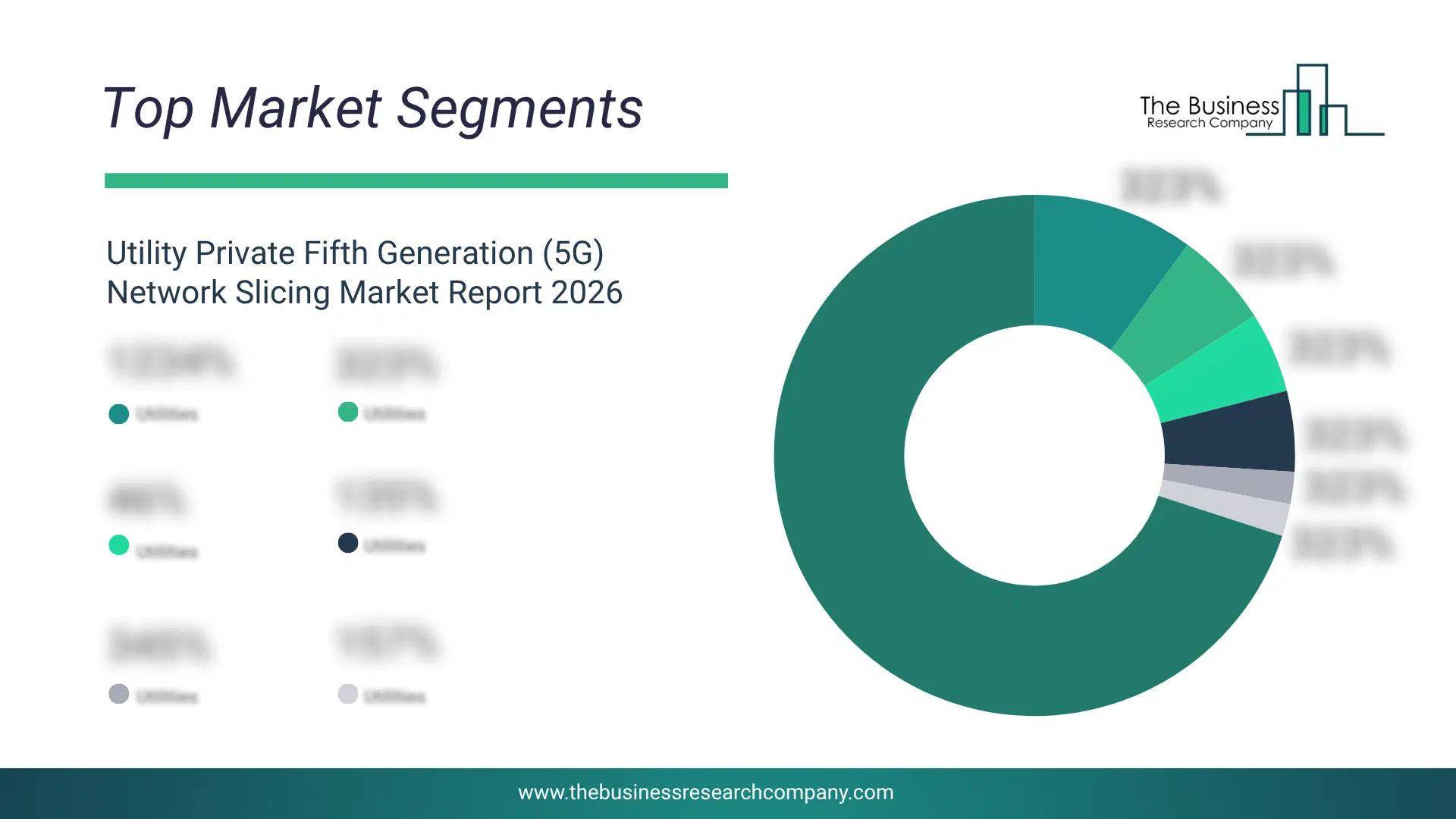
1) By Component: Hardware, Software, Services 2) By Deployment Mode: On-Premises, Cloud 3) By Network Type: Standalone, Non-Standalone 4) By Application: Smart Grid, Remote Monitoring, Asset Management, Field Area Network, Other Applications 5) By End User: Electric Utilities, Water Utilities, Gas Utilities, Other End-Users Subsegments: 1) By Hardware: Radio Access Network Equipment, Core Network Processing Equipment, Edge Computing Hardware, Network Security Hardware 2) By Software: Network Slice Orchestration Software, Network Management And Monitoring Software, Security And Policy Control Software, Analytics And Optimization Software 3) By Services: Network Design And Planning Services, System Integration And Deployment Services, Managed Network Operation Services, Maintenance And Technical Support ServicesWhat Is The Driver Of The Utility Private Fifth Generation (5G) Network Slicing Market?
The growing adoption of private 5G networks by utilities is expected to propel the growth of the utility private 5G network slicing market going forward. A private 5G network refers to a dedicated 5G network deployed for a single enterprise or utility, providing secure, high-performance, and fully controlled connectivity, often with network slicing for mission-critical applications. The rising adoption of private 5G networks by utilities is driven by the need for secure and reliable communication. Utility private 5G network slicing supports the growing adoption of private 5G networks by utilities by enabling dedicated, secure, and performance-guaranteed network segments for critical operations such as grid control, monitoring, and automation. For instance, in December 2024, according to The Office of Communications, a UK-based government regulatory body, as of July 2024, fewer than 30 fully operational commercial private mobile networks had been deployed by mobile network operators (MNOs), representing an increase of 11 compared to 2023. These networks utilize 4G, 5G, or hybrid technologies and primarily operate within the 3.4–4.2 GHz and 2.6 GHz frequency bands. Therefore, the growing adoption of private 5G networks by utilities is driving the growth of the utility private 5G network slicing market.Key Players In The Global Utility Private Fifth Generation (5G) Network Slicing Market
Major companies operating in the utility private fifth generation (5g) network slicing market are Samsung Electronics Co. Ltd., Verizon Communications Inc., AT&T Inc., Dell Technologies Inc., International Business Machines Corporation, Cisco Systems Inc., Vodafone Group Plc, Qualcomm Technologies Inc., Hewlett Packard Enterprise Company, Telefonaktiebolaget LM Ericsson, NEC Corporation, Nokia Corporation, ZTE Corporation, DISH Network Corporation, Orange S.A. (Orange Business Services), T-Systems International GmbH, Ceragon Networks Ltd., KORE Wireless Group Inc., Parallel Wireless Inc., Baicells Technologies Inc., Celona Inc., Nybsys Inc., Firecell SAS, Radio Software Research Foundation (RSRF), and Highway 9 Networks Inc.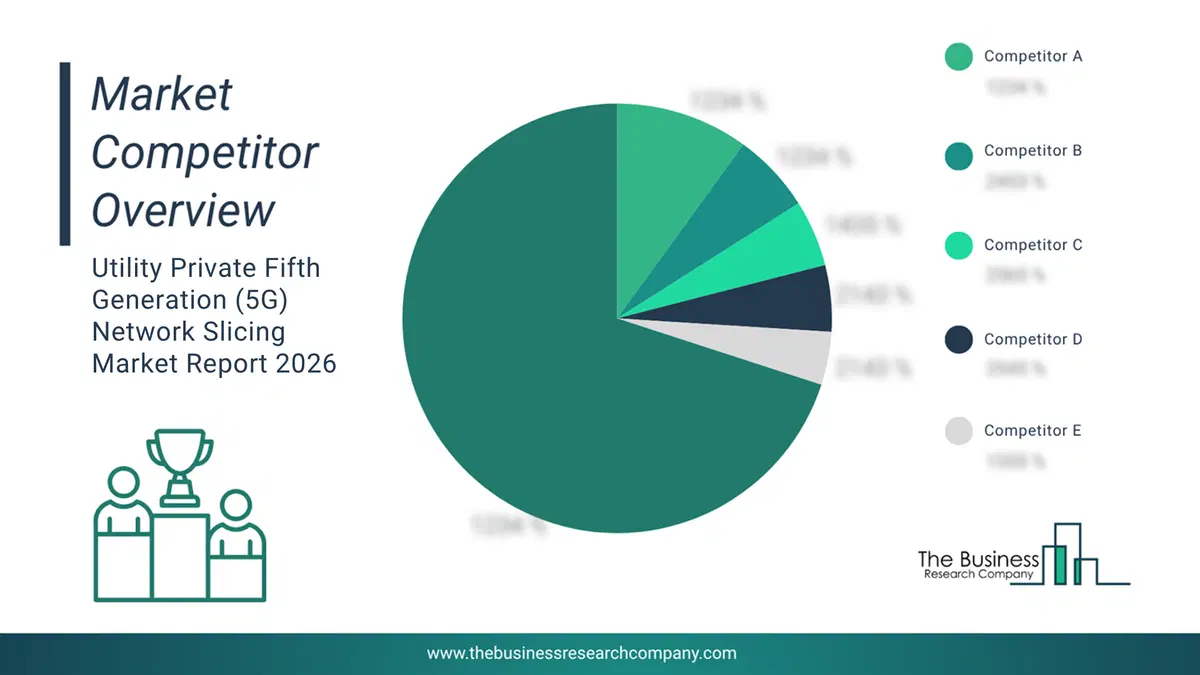
This chart is for illustrative purposes; the full report includes a detailed competitor analysis and comprehensive overview of the top 10 companies in the market.
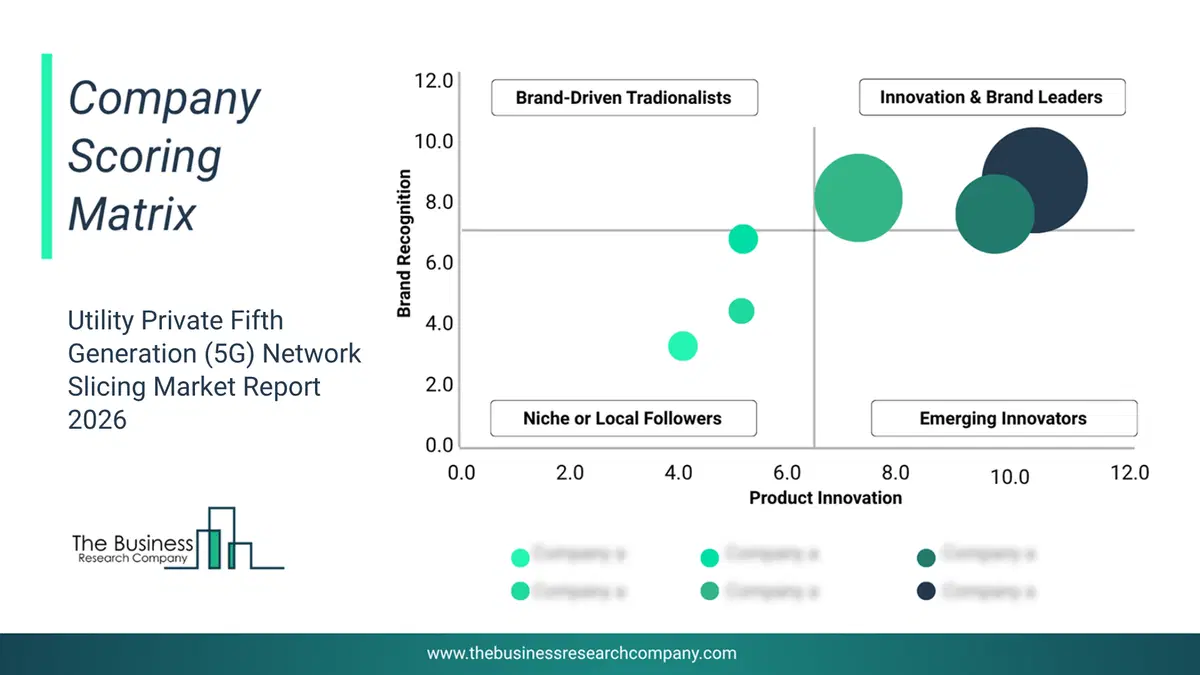
This chart maps companies by product innovation and brand strength, with bubble size indicating relative revenue, helping identify market leaders, challengers, and niche players. This is an illustrative chart; the full report provides a complete and accurate competitive analysis.
Global Utility Private Fifth Generation (5G) Network Slicing Market Trends and Insights
Major companies operating in the utility private 5G network slicing market are focusing on technology advancements, such as deterministic network slicing for utility applications, to deliver ultra-low latency, guaranteed reliability, and secure, isolated connectivity for mission-critical smart grid operations. Deterministic network slicing for utility applications refers to a 5G capability that ensures ultra-low latency, high reliability, and isolated connectivity for mission-critical smart grid operations. For instance, in January 2024, China United Network Communications Group Co., Ltd., a China-based integrated telecommunications operator, in collaboration with the State Grid Corporation of China and Huawei Technologies Co., Ltd., launched a 300,000-connection 5G smart grid initiative. The project leverages 5G private networks, RedCap technology, and deterministic network slicing to enable cost-effective, large-scale smart grid applications, including electric power consumption data collection, distributed photovoltaic (PV) integration, and converged power distribution terminals. This infrastructure provides ultra-low latency, high reliability, and secure connectivity for mission-critical utility operations, while supporting China’s carbon peak and carbon neutrality goals and facilitating adaptation to evolving energy systems and emerging power services.What Are Latest Mergers And Acquisitions In The Utility Private Fifth Generation (5G) Network Slicing Market?
In November 2024, Nokia Corporation, a Finland-based telecommunications and information technology company, partnered with Southern California Edison (SCE) to enable secure, high-capacity, and mission-critical connectivity for utility operations by leveraging CBRS spectrum, cloud-native 5G core technology, and network slicing to support real-time grid monitoring, distributed energy resource management, emergency response, and automation. Southern California Edison is a US-based electric utility company serving millions of customers and focused on grid modernization and the transition to a carbon-free energy future.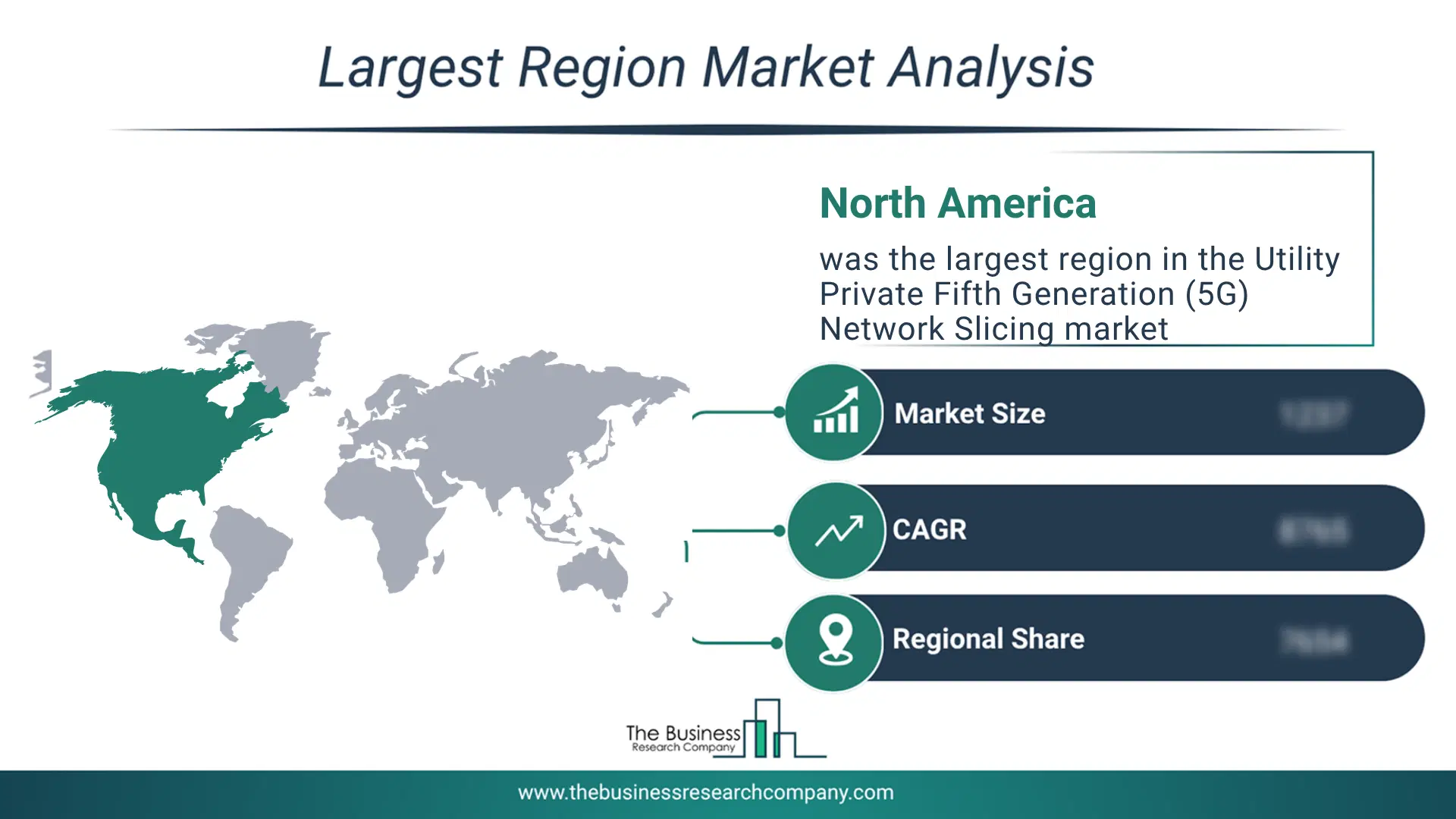
Regional Outlook
North America was the largest region in the utility private 5G network slicing market in 2025. Asia-Pacific is expected to be the fastest-growing region in the forecast period. The regions covered in this market report are Asia-Pacific, South East Asia, Western Europe, Eastern Europe, North America, South America, Middle East, Africa. The countries covered in this market report are Australia, Brazil, China, France, Germany, India, Indonesia, Japan, Taiwan, Russia, South Korea, UK, USA, Canada, Italy, Spain.What Defines the Utility Private Fifth Generation (5G) Network Slicing Market?
The utility private fifth generation (5G) network slicing market consists of revenues earned by entities by providing services such as spectrum planning and licensing support, radio access network deployment, network slicing configuration, core network virtualization, secure connectivity services, and network orchestration and automation. The market value includes the value of related goods sold by the service provider or included within the service offering. The utility private fifth-generation (5G) network slicing market also includes sales of field workforce solutions, substation sensor networks, private 5G for power plants, and remote pump station control. Values in this market are ‘factory gate’ values, that is, the value of goods sold by the manufacturers or creators of the goods, whether to other entities (including downstream manufacturers, wholesalers, distributors, and retailers) or directly to end customers. The value of goods in this market includes related services sold by the creators of the goods.How is Market Value Defined and Measured?
The market value is defined as the revenues that enterprises gain from the sale of goods and/or services within the specified market and geography through sales, grants, or donations in terms of the currency (in USD unless otherwise specified). The revenues for a specified geography are consumption values that are revenues generated by organizations in the specified geography within the market, irrespective of where they are produced. It does not include revenues from resales along the supply chain, either further along the supply chain or as part of other products.
This chart presents market attractiveness based on a quantitative evaluation of growth, competition, strategic alignment, and risk, offering a clear view of opportunity areas for decision-making. This chart is for illustrative purposes; the full report contains the complete analysis.

This chart highlights the Total Addressable Market (TAM) by estimating the maximum revenue opportunity using an assumption-driven approach, supporting strategic planning and opportunity sizing across markets. The chart is illustrative; the full report provides a more comprehensive analysis.
What Key Data and Analysis Are Included in the Utility Private Fifth Generation (5G) Network Slicing Market Report 2026?
The utility private fifth generation (5g) network slicing market research report is one of a series of new reports from The Business Research Company that provides market statistics, including industry global market size, regional shares, competitors with the market share, detailed market segments, market trends and opportunities, and any further data you may need to thrive in the utility private fifth generation (5g) network slicing industry. The market research report delivers a complete perspective of everything you need, with an in-depth analysis of the current and future state of the industry.Utility Private Fifth Generation (5G) Network Slicing Market Report Forecast Analysis
| Report Attribute | Details |
|---|---|
| Market Size Value In 2026 | $1.7 billion |
| Revenue Forecast In 2030 | $4.7 billion |
| Growth Rate | CAGR of 28.7% from 2026 to 2030 |
| Base Year For Estimation | 2025 |
| Actual Estimates/Historical Data | 2020-2025 |
| Forecast Period | 2026 - 2030 - 2030 |
| Market Representation | Revenue in USD Billion and CAGR from 2026 to 2030 |
| Segments Covered | Component, Deployment Mode, Network Type, Application, End User |
| Regional Scope | Asia-Pacific, Western Europe, Eastern Europe, North America, South America, Middle East, Africa |
| Country Scope | The countries covered in the report are Australia, Brazil, China, France, Germany, India, Indonesia, Japan, Taiwan, Russia, South Korea, UK, USA, Canada, Italy, Spain. |
| Key Companies Profiled | Samsung Electronics Co. Ltd., Verizon Communications Inc., AT&T Inc., Dell Technologies Inc., International Business Machines Corporation, Cisco Systems Inc., Vodafone Group Plc, Qualcomm Technologies Inc., Hewlett Packard Enterprise Company, Telefonaktiebolaget LM Ericsson, NEC Corporation, Nokia Corporation, ZTE Corporation, DISH Network Corporation, Orange S.A. (Orange Business Services), T-Systems International GmbH, Ceragon Networks Ltd., KORE Wireless Group Inc., Parallel Wireless Inc., Baicells Technologies Inc., Celona Inc., Nybsys Inc., Firecell SAS, Radio Software Research Foundation (RSRF), and Highway 9 Networks Inc. |
| Customization Scope | Request for Customization |
| Pricing And Purchase Options | Explore Purchase Options |