
Vacuum Insulation Market Report 2026
Global Outlook – By Type (Flat Panel, Special Shape Panel), By Raw Material (Plastics, Metals), By Core Material (Silica, Fiberglass, Other Core Materials), By End-User Industry (Construction, Cooling And Freezing Devices, Logistics, Other End-User Industries) – Market Size, Trends, Strategies, and Forecast to 2030
Vacuum Insulation Market Overview
• Vacuum Insulation market size has reached to $10.78 billion in 2025 • Expected to grow to $17.04 billion in 2030 at a compound annual growth rate (CAGR) of 9.6% • Growth Driver: The Construction Industry's Expansion Driving Vacuum Insulation Market Growth • Market Trend: Innovative Partnership To Enhance Vacuum Insulating Glass Technology • Asia-Pacific was the largest region in 2025 and North America is the fastest growing region.What Is Covered Under Vacuum Insulation Market?
Vacuum insulation refers to an insulation service that is used to provide better insulation performance than conventional insulation materials and to transport heat-sensitive products in extreme conditions and high temperatures. It is a flat element consisting of an open porous core material that withstands the external load caused by atmospheric pressure and a gas-tight envelope to maintain the required vacuum quality. The main types of vacuum insulation are flat-panel and special-shape panels. Flat panels are used for optimized temperature insulation that is based on the principle of the thermos flask. The various raw materials include plastics, metals, and core materials such as silica, fiberglass, and other core materials. These are used in construction, cooling and freezing devices, logistics, and other end-user industries.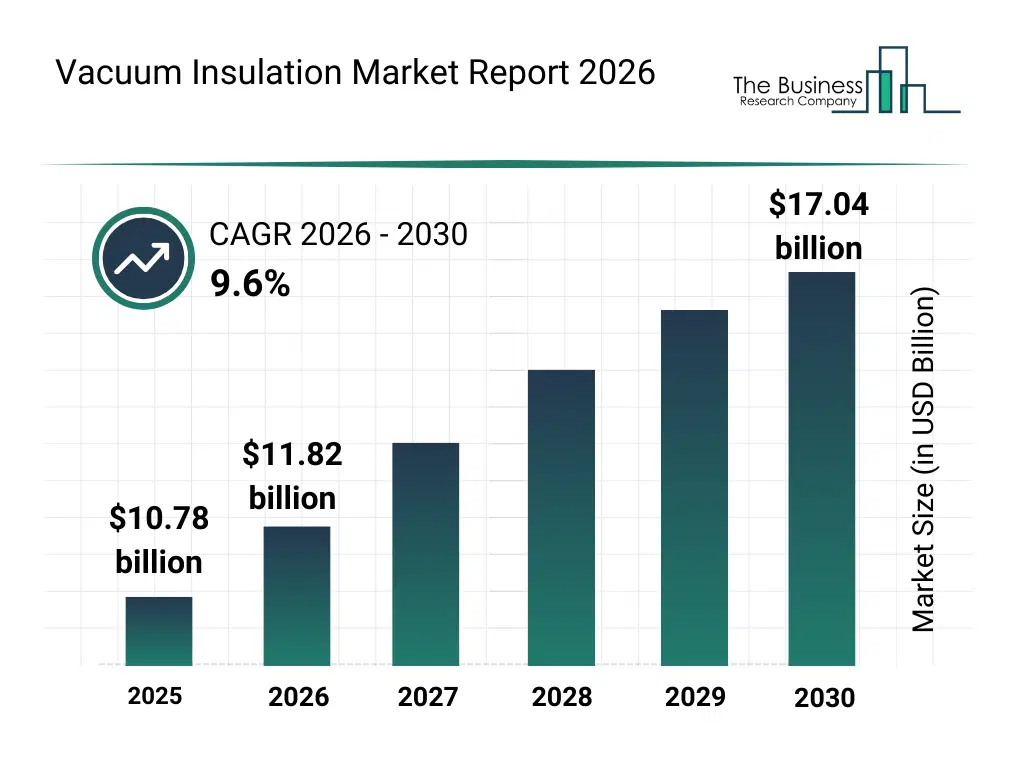
What Is The Vacuum Insulation Market Size and Share 2026?
The vacuum insulation market size has grown strongly in recent years. It will grow from $10.78 billion in 2025 to $11.82 billion in 2026 at a compound annual growth rate (CAGR) of 9.7%. The growth in the historic period can be attributed to growth in construction insulation demand, expansion of refrigeration and freezing equipment, adoption of silica-based insulation cores, increasing use of high-performance materials, demand for temperature-controlled logistics.What Is The Vacuum Insulation Market Growth Forecast?
The vacuum insulation market size is expected to see strong growth in the next few years. It will grow to $17.04 billion in 2030 at a compound annual growth rate (CAGR) of 9.6%. The growth in the forecast period can be attributed to increasing adoption in green building projects, rising demand from electric vehicle thermal systems, expansion of pharmaceutical cold chain infrastructure, growing focus on ultra-thin insulation solutions, increasing investments in advanced insulation materials. Major trends in the forecast period include increasing adoption of high-performance thermal insulation panels, rising demand for energy-efficient building materials, growing use of vacuum insulation in cold chain logistics, expansion of custom-shaped insulation solutions, enhanced focus on space-saving insulation designs.
Global Vacuum Insulation Market Segmentation
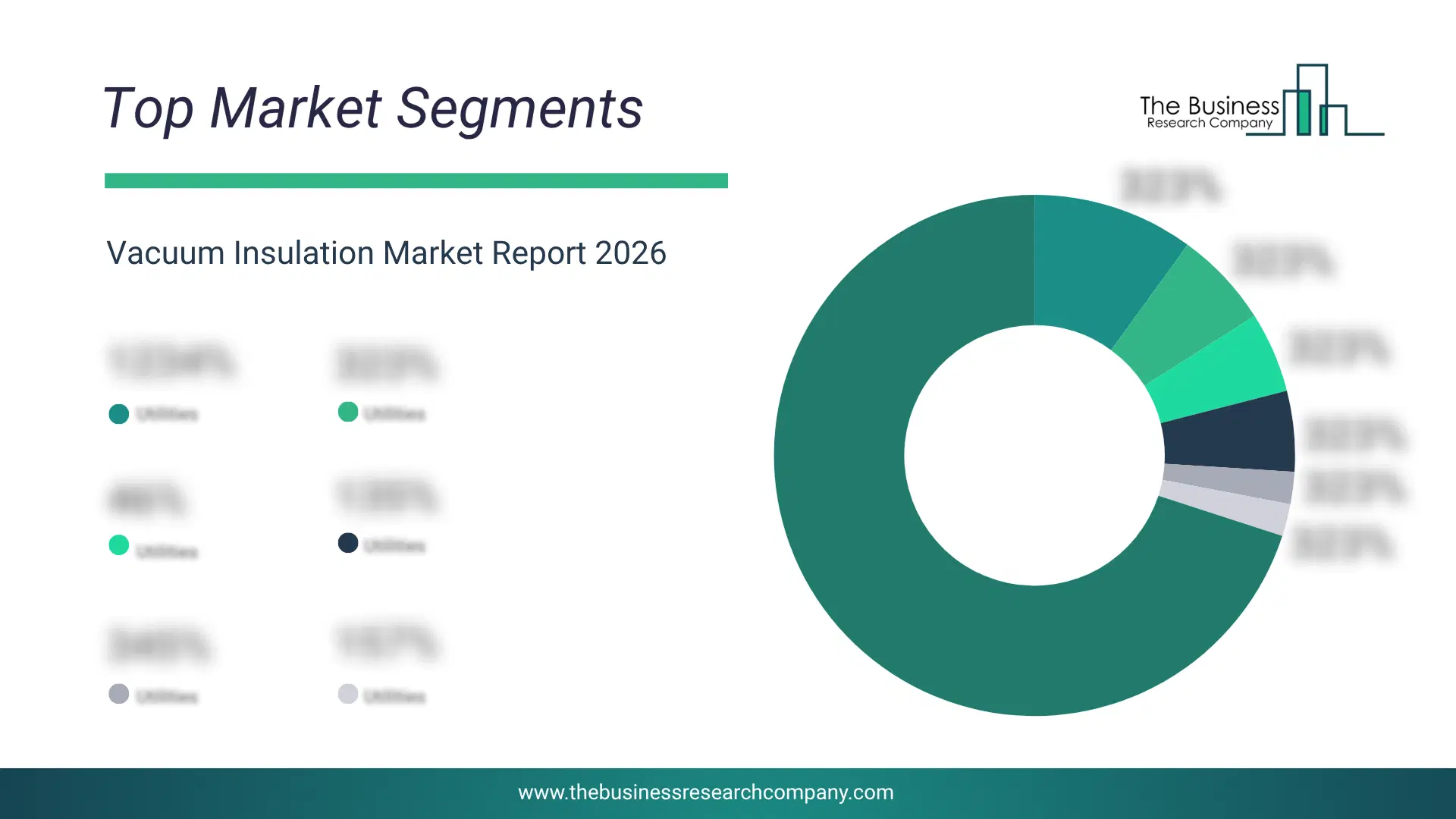
1) By Type: Flat Panel, Special Shape Panel 2) By Raw Material: Plastics, Metals 3) By Core Material: Silica, Fiberglass, Other Core Materials 4) By End-User Industry: Construction, Cooling And Freezing Devices, Logistics, Other End-User Industries Subsegments: 1) By Flat Panel: Standard Flat Panels, Custom Flat Panels 2) By Special Shape Panel: Cylindrical Panels, Corner Panels, Specialty Custom ShapesWhat Is The Driver Of The Vacuum Insulation Market?
The expansion of the construction industry is expected to propel the growth of the vacuum insulation market going forward. The construction industry encompasses various activities related to designing, planning, and constructing buildings, infrastructure, and other physical structures. Vacuum insulation in the construction industry provides highly efficient thermal insulation by creating a vacuum between panels, reducing heat transfer, and improving energy efficiency in buildings. This technology helps maintain comfortable indoor temperatures while lowering energy consumption. For instance, in June 2023, according to the U.S. Census Bureau and the U.S. Department of Housing and Urban Development, US-based government administrations, in May 2023, privately owned home starts were occurring at a seasonally adjusted annual pace of 1, 631, 000, representing an increase of 21.7% in the revised April 2023 prediction of 1, 340, 000 and 5.7% in the May 2022 rate of 1, 543, 000. The number of privately owned home completions in May 2023 was 1, 518, 000 on a seasonally adjusted yearly basis, representing an increase of 5.0% over the May 2022 rate of 1, 446, 000 and 9.5% above the revised April 2023 estimate of 1, 386, 000. Therefore, the expansion of the construction industry is driving the growth of the vacuum insulation industry.Key Players In The Global Vacuum Insulation Market
Major companies operating in the vacuum insulation market are BASF SE, Evonik Industries AG, Dow, Saint-Gobain, Kingspan Group, Morgan Advanced Materials, Panasonic Corporation, LG Hausys, Va-Q-tec AG, Svenska Aerogel AB, Aspen Aerogels Inc, Knauf Insulation, Owens Corning, Mitsubishi Chemical Group, Sumitomo Chemical, Nitto Denko Corporation, Recticel Group, Johns Manville, Unifrax, Cabot Corporation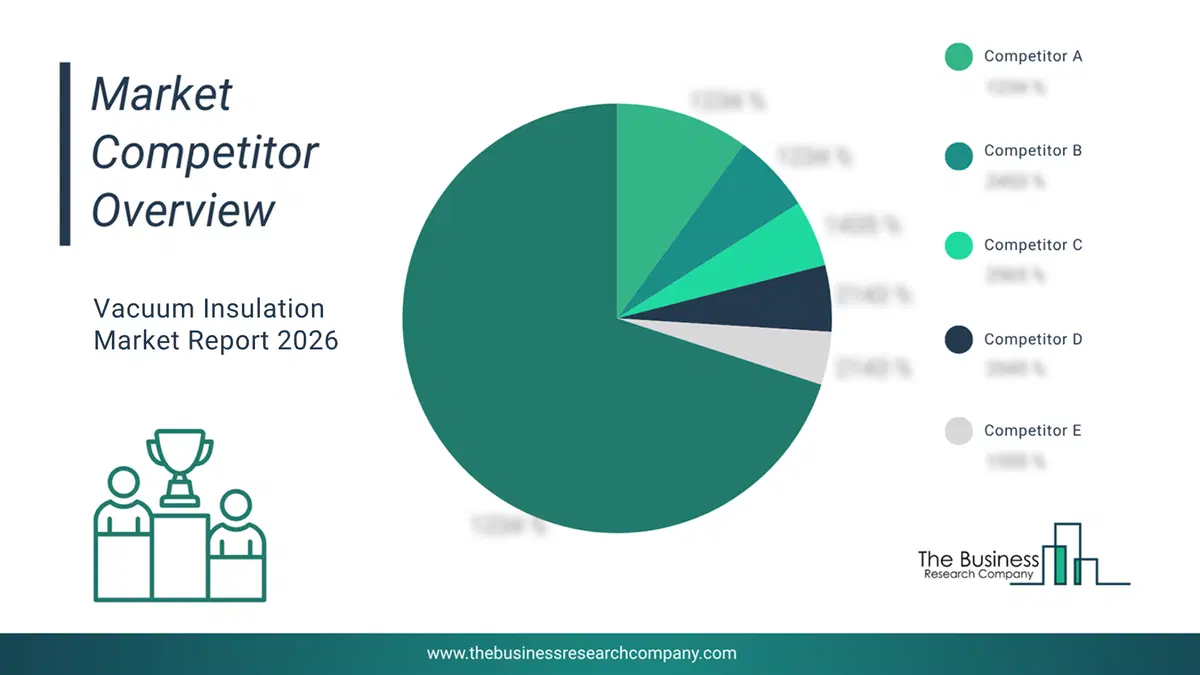
This chart is for illustrative purposes; the full report includes a detailed competitor analysis and comprehensive overview of the top 10 companies in the market.
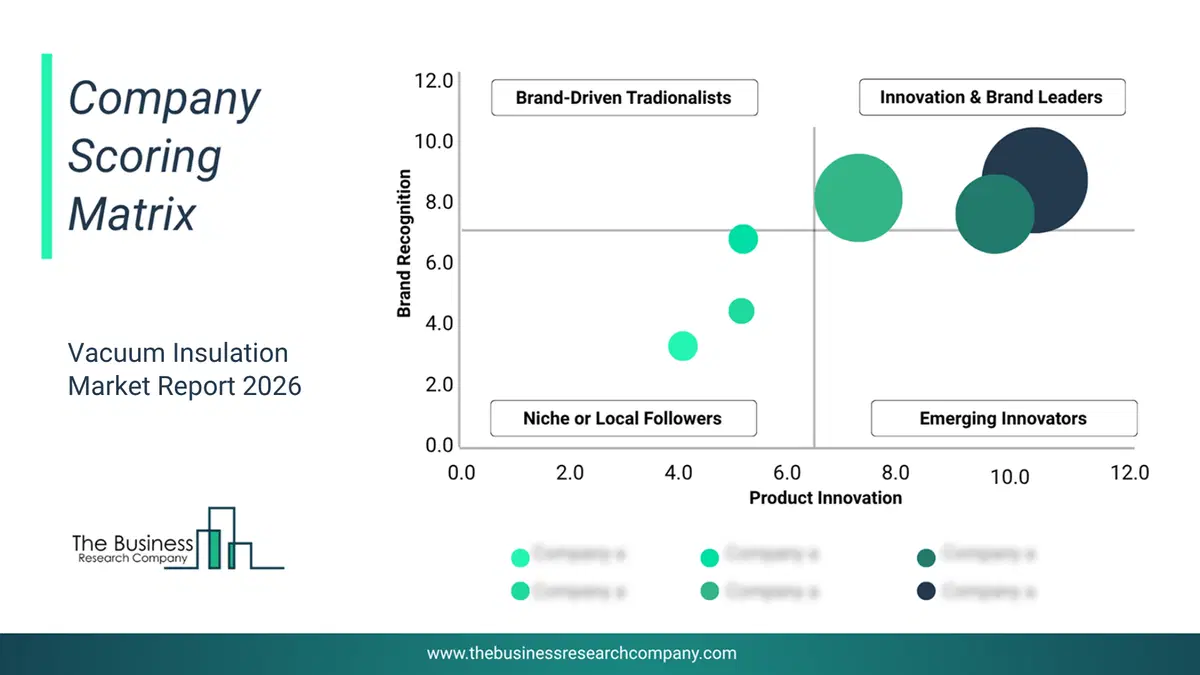
This chart maps companies by product innovation and brand strength, with bubble size indicating relative revenue, helping identify market leaders, challengers, and niche players. This is an illustrative chart; the full report provides a complete and accurate competitive analysis.
Global Vacuum Insulation Market Trends and Insights
Major companies operating in the vacuum insulation market are focused on introducing innovative insulating glass to gain a competitive edge in the market. Vacuum Insulating Glass (VIG) is an architectural glass that uses vacuum technology to create an insulating glass unit (IGU) with exceptional insulation performance. For instance, in February 2024, Kolbe Windows & Doors, a US-based manufacturer of windows and doors, partnered with LuxWall, a US-based provider of energy-efficient glass solutions. The partnership aims to launch vacuum-insulating glass (VIG) technology, specifically the Enthermal design, as a high-efficiency option for residential use. This collaboration provides energy-conscious customers with innovative and aesthetically pleasing glass solutions that significantly reduce heat gain and loss. By utilizing LuxWall's advanced VIG technology, they enhance glass performance for both new constructions and renovations. Together, they strive to meet the increasing demand for superior quality and energy efficiency in glass products.What Are Latest Mergers And Acquisitions In The Vacuum Insulation Market?
In July 2024, the Fenzi Group, an Italy-based glass processing industry, acquired Thermoseal for an undisclosed amount. The acquisition enables Fenzi to integrate Thermoseal's innovative products into its portfolio, strengthening its position in the IG components market. This strategic move is set to promote collaboration and innovation in the glass processing sector, reflecting Fenzi’s dedication to excellence. Thermoseal is a UK-based manufacturer of insulated glass.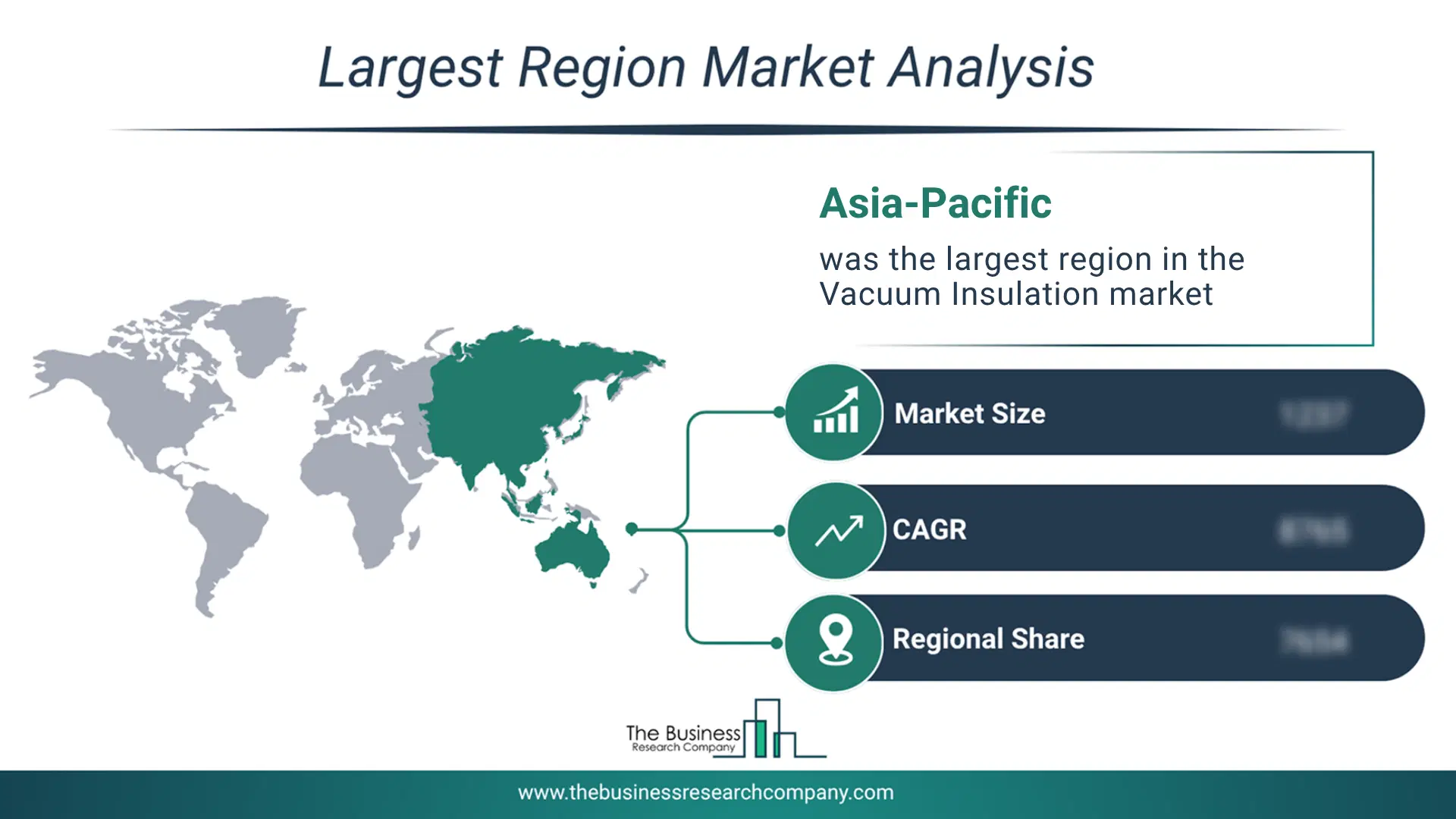
Regional Outlook
Asia-Pacific was the largest region in the vacuum insulation market share in 2025. North America is expected to be the fastest-growing region in the forecast period. The regions covered in this market report are Asia-Pacific, South East Asia, Western Europe, Eastern Europe, North America, South America, Middle East, Africa. The countries covered in this market report are Australia, Brazil, China, France, Germany, India, Indonesia, Japan, Taiwan, Russia, South Korea, UK, USA, Canada, Italy, Spain.What Defines the Vacuum Insulation Market?
The vacuum insulation market includes revenues earned by preventing heat loss through conduction. The market value includes the value of related goods sold by the service provider or included within the service offering. Only goods and services traded between entities or sold to end consumers are included.How is Market Value Defined and Measured?
The market value is defined as the revenues that enterprises gain from the sale of goods and/or services within the specified market and geography through sales, grants, or donations in terms of the currency (in USD unless otherwise specified). The revenues for a specified geography are consumption values that are revenues generated by organizations in the specified geography within the market, irrespective of where they are produced. It does not include revenues from resales along the supply chain, either further along the supply chain or as part of other products.
This chart presents market attractiveness based on a quantitative evaluation of growth, competition, strategic alignment, and risk, offering a clear view of opportunity areas for decision-making. This chart is for illustrative purposes; the full report contains the complete analysis.

This chart highlights the Total Addressable Market (TAM) by estimating the maximum revenue opportunity using an assumption-driven approach, supporting strategic planning and opportunity sizing across markets. The chart is illustrative; the full report provides a more comprehensive analysis.
What Key Data and Analysis Are Included in the Vacuum Insulation Market Report 2026?
The vacuum insulation market research report is one of a series of new reports from The Business Research Company that provides market statistics, including Market Report 2026?global market size, regional shares, competitors with the market share, detailed market segments, market trends and opportunities, and any further data you may need to thrive in the vacuum insulation Market Report 2026? The market research report delivers a complete perspective of everything you need, with an in-depth analysis of the current and future state of the Market Report 2026?Vacuum Insulation Market Report Forecast Analysis
| Report Attribute | Details |
|---|---|
| Market Size Value In 2026 | $11.82 billion |
| Revenue Forecast In 2030 | $17.04 billion |
| Growth Rate | CAGR of 9.7% from 2026 to 2030 |
| Base Year For Estimation | 2025 |
| Actual Estimates/Historical Data | 2020-2025 |
| Forecast Period | 2026 - 2030 |
| Market Representation | Revenue in USD Billion and CAGR from 2026 to 2030 |
| Segments Covered | Type, Raw Material, Core Material, End-User Industry |
| Regional Scope | Asia-Pacific, Western Europe, Eastern Europe, North America, South America, Middle East, Africa |
| Country Scope | The countries covered in the report are Australia, Brazil, China, France, Germany, India, Indonesia, Japan, Taiwan, Russia, South Korea, UK, USA, Canada, Italy, Spain. |
| Key Companies Profiled | BASF SE, Evonik Industries AG, Dow, Saint-Gobain, Kingspan Group, Morgan Advanced Materials, Panasonic Corporation, LG Hausys, Va-Q-tec AG, Svenska Aerogel AB, Aspen Aerogels Inc, Knauf Insulation, Owens Corning, Mitsubishi Chemical Group, Sumitomo Chemical, Nitto Denko Corporation, Recticel Group, Johns Manville, Unifrax, Cabot Corporation |
| Customization Scope | Request for Customization |
| Pricing And Purchase Options | Explore Purchase Options |