

Value-Based Care Service Market Report 2026
Global Outlook – By Model (Pay For Performance, Patient-Centered Medical Home, Shared Savings, Shared Risk, Bundled Payment, Capitation Models), By Payers (Medicare, Medicaid, Commercial Insurance, Other Payers), By Providers (Home Health Care, Institutional Care, Hospital Therapy, Other Providers), By End-Users (Hospitals And Clinics, Insurance Companies, Government, Other End-Users) - Market Size, Trends, Strategies, and Forecast to 2030
Value-Based Care Service Market Overview
• Value-Based Care Service market size has reached to $4.14 billion in 2025 • Expected to grow to $6.57 billion in 2030 at a compound annual growth rate (CAGR) of 9.6% • Growth Driver: Rising Focus On Population Health Management Driving The Market Growth Due To Emphasis On Preventive Care And Cost Reduction • Market Trend: Technological Advancements Drive Better Patient Outcomes And Improved Healthcare Efficiency • North America was the largest region in 2025 and Asia-Pacific is the fastest growing region.What Is Covered Under Value-Based Care Service Market?
Value-based care service is a healthcare delivery model that incentivizes providers to improve patient outcomes and overall health quality by emphasizing preventive care, coordinated treatment, and evidence-based practices while linking reimbursement to measurable performance metrics rather than the volume of services provided. It enhances patient satisfaction, reduces healthcare costs, and improves clinical efficiency by fostering proactive disease management, minimizing hospital readmissions, and promoting interdisciplinary collaboration across the healthcare continuum. The main types of models in value-based care service are pay for performance, patient-centered medical home, shared savings, shared risk, bundled payment, and capitation models. Pay for Performance is a healthcare reimbursement model that financially incentivizes providers based on the quality, efficiency, and outcomes of care delivered, rather than the volume of services, by linking payments to predefined performance metrics such as patient satisfaction, preventive care, and clinical effectiveness. These include payers such as Medicare, Medicaid, commercial insurance, and others, which are provided by home health care, institutional care, hospital therapy, and others, having end-users such as hospitals and clinics, insurance companies, government, and others.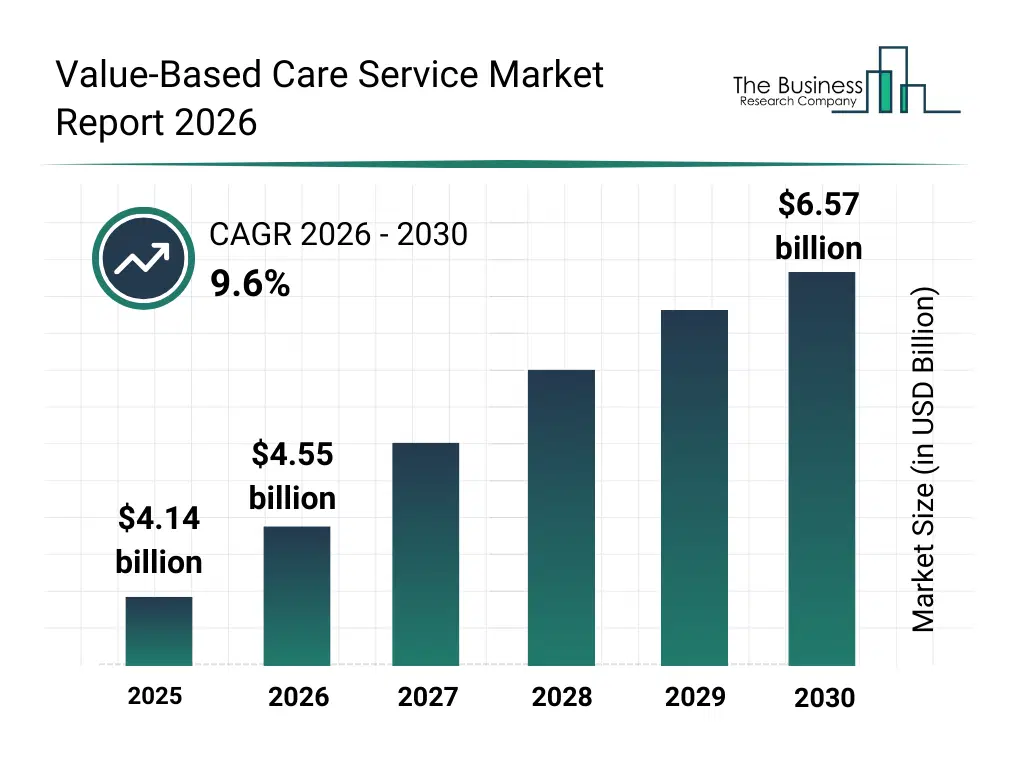
What Is The Value-Based Care Service Market Size and Share 2026?
The value-based care service market size has grown strongly in recent years. It will grow from $4.14 billion in 2025 to $4.55 billion in 2026 at a compound annual growth rate (CAGR) of 9.9%. The growth in the historic period can be attributed to growth of chronic disease prevalence, increasing healthcare expenditure pressures, early adoption of integrated care frameworks, expansion of managed care services, rising focus on patient satisfaction metrics.What Is The Value-Based Care Service Market Growth Forecast?
The value-based care service market size is expected to see strong growth in the next few years. It will grow to $6.57 billion in 2030 at a compound annual growth rate (CAGR) of 9.6%. The growth in the forecast period can be attributed to expansion of population health management initiatives, increasing use of digital care coordination platforms, rising adoption of risk-sharing service models, growing investments in preventive healthcare services, stronger alignment of payer-provider incentives. Major trends in the forecast period include increasing adoption of coordinated care delivery models, rising focus on preventive and chronic care services, expansion of performance-linked care programs, growing integration of multidisciplinary care teams, enhanced emphasis on patient-centric service design.
Global Value-Based Care Service Market Segmentation
1) By Model: Pay For Performance, Patient-Centered Medical Home, Shared Savings, Shared Risk, Bundled Payment, Capitation Models 2) By Payers: Medicare, Medicaid, Commercial Insurance, Other Payers 3) By Providers: Home Health Care, Institutional Care, Hospital Therapy, Other Providers 4) By End-Users: Hospitals And Clinics, Insurance Companies, Government, Other End-Users Subsegments: 1) By Pay For Performance: Hospital-Based Pay for Performance, Physician-Based Pay for Performance, Pharmacy-Based Pay for Performance, Nursing and Post-Acute Care Pay for Performance, Population Health-Based Pay for Performance 2) By Patient-Centered Medical Home: Independent Patient-Centered Medical Homes, Hospital-Based Patient-Centered Medical Homes, Payer-Led Patient-Centered Medical Homes, Specialty-Specific Patient-Centered Medical Homes, Multi-Payer Patient-Centered Medical Homes 3) By Shared Savings: One-Sided Shared Savings, Two-Sided Shared Savings, Medicare Shared Savings Programs, Commercial Shared Savings Programs, Medicaid Shared Savings Programs 4) By Shared Risk: Partial Risk Sharing, Full Risk Sharing, Upside-Only Risk Models, Downside Risk Models, Provider-Sponsored Risk Arrangements 5) By Bundled Payment: Retrospective Bundled Payments, Prospective Bundled Payments, Condition-Specific Bundled Payments, Procedure-Based Bundled Payments, Multi-Payer Bundled Payments 6) By Capitation Models: Full Capitation, Partial Capitation, Primary Care Capitation, Specialty Care Capitation, Global CapitationWhat Is The Driver Of The Value-Based Care Service Market?
The increasing focus on population health management is expected to propel the growth of the value-based care service market going forward. Population health management is a proactive healthcare approach that focuses on improving the health outcomes of a defined population by leveraging data analytics, preventive care, care coordination, and evidence-based interventions to manage chronic diseases, reduce health disparities, and enhance overall well-being. The increasing focus on population health management is due to the need to improve overall health outcomes while controlling healthcare costs. Healthcare providers identify and manage common health risks, promote preventive care, and better manage chronic conditions by addressing health at the population level. Value-based care services play a pivotal role in this transition by aligning financial incentives with health outcomes, fostering multidisciplinary collaboration, and emphasizing preventive measures and long-term patient engagement to enhance population health management efforts. For instance, in April 2023, according to the Bureau of Labor Statistics, a US-based federal agency, the employment of medical and health services managers is expected to increase by 29% between 2023 and 2033, significantly outpacing the average growth rate of all occupations. Therefore, the increasing focus on population health management is driving the growth of the value-based care service industry.Key Players In The Global Value-Based Care Service Market
Major companies operating in the value-based care service market are UnitedHealth Group Incorporated, Cigna Healthcare, Anthem Insurance Companies Inc. (Elevance Health), Kaiser Permanente, Humana Inc., Blue Cross and Blue Shield of Minnesota, VillageMD, MVP Health Care, Agilon Health Inc., Oak Street Health, Privia Health Group Inc., Evolent Health, ChenMed LLC, Aledade Inc., Somatus Inc., Equality Health LLC, Wellvana Health LLC, Tandigm Health, Aetna Inc.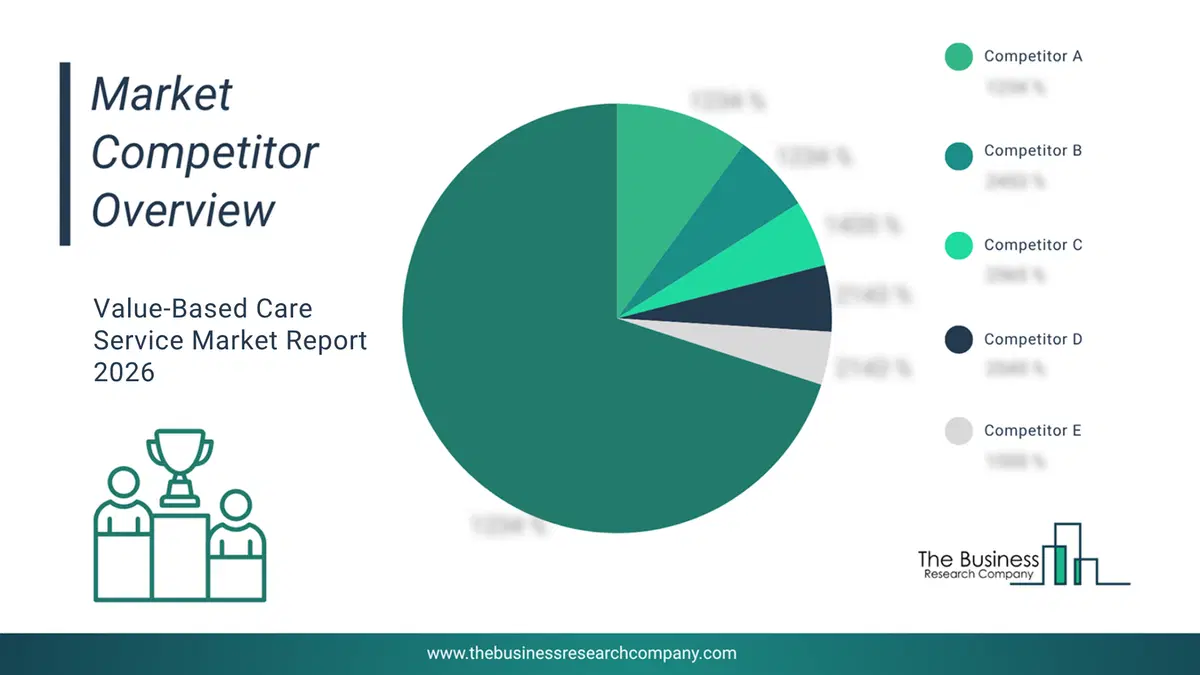
This chart is for illustrative purposes; the full report includes a detailed competitor analysis and comprehensive overview of the top 10 companies in the market.
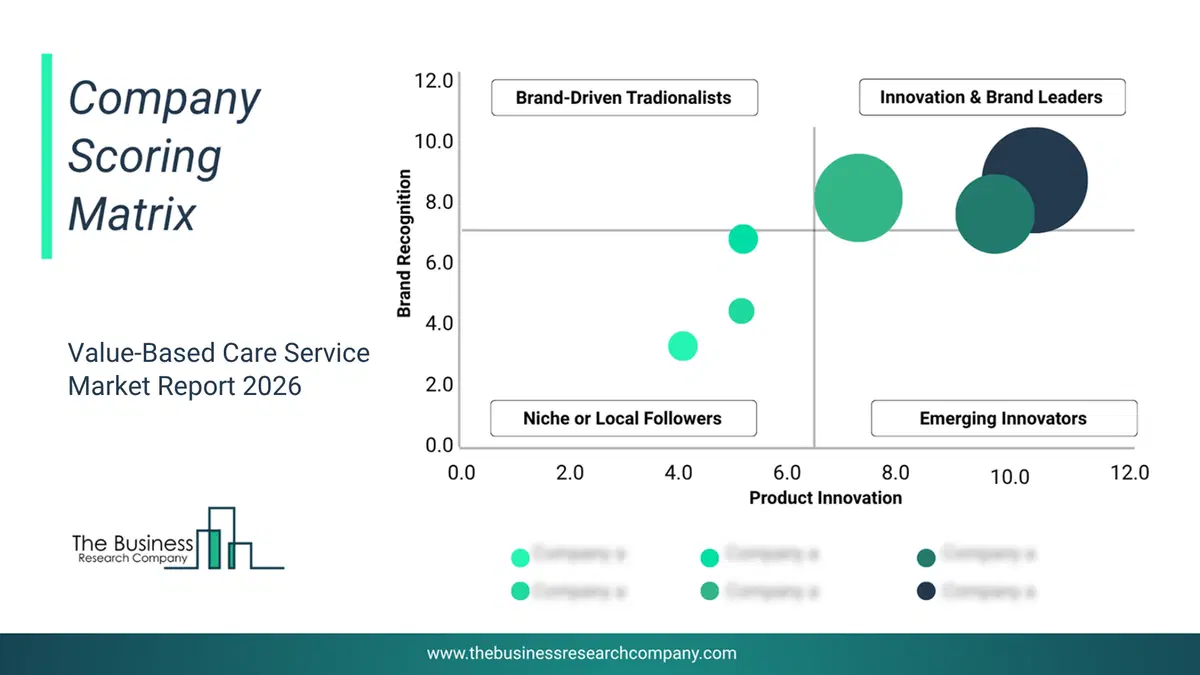
This chart maps companies by product innovation and brand strength, with bubble size indicating relative revenue, helping identify market leaders, challengers, and niche players. This is an illustrative chart; the full report provides a complete and accurate competitive analysis.
Global Value-Based Care Service Market Trends and Insights
Major companies operating in the value-based care service market are focusing on developing innovative solutions, such as healthcare analytics, to improve outcomes and efficiency. Healthcare analytics uses information about patients and treatments to help doctors and hospitals make better decisions and improve care. It helps value-based care services by using patient information to choose the best care, improve health outcomes, and reduce unnecessary costs. For instance, in October 2023, Milliman MedInsight, a US-based healthcare analytics and data solutions company, unveiled an enhanced Value-Based Care Platform designed to help healthcare organizations perform better under value-based care models. The upgraded platform provided advanced tools to analyze patient data, track health outcomes, manage costs, and improve care coordination. It enabled doctors, hospitals, and health plans to make better decisions by identifying effective treatments, using resources efficiently, and delivering higher-quality care.What Are Latest Mergers And Acquisitions In The Value-Based Care Service Market?
In May 2024, Cityblock Health, a US-based healthcare company, partnered with Sunshine Health to enhance patient-centered, coordinated, and outcome-driven healthcare delivery. The partnership aims to create a value-driven healthcare model for Medicaid beneficiaries by integrating primary care, behavioral health, and social support services, using multidisciplinary teams and advanced technology to improve patient engagement, outcomes, and efficiency while reducing avoidable hospitalizations and emergency visits. Sunshine Health is a US-based managed care organization that offers value-based care services.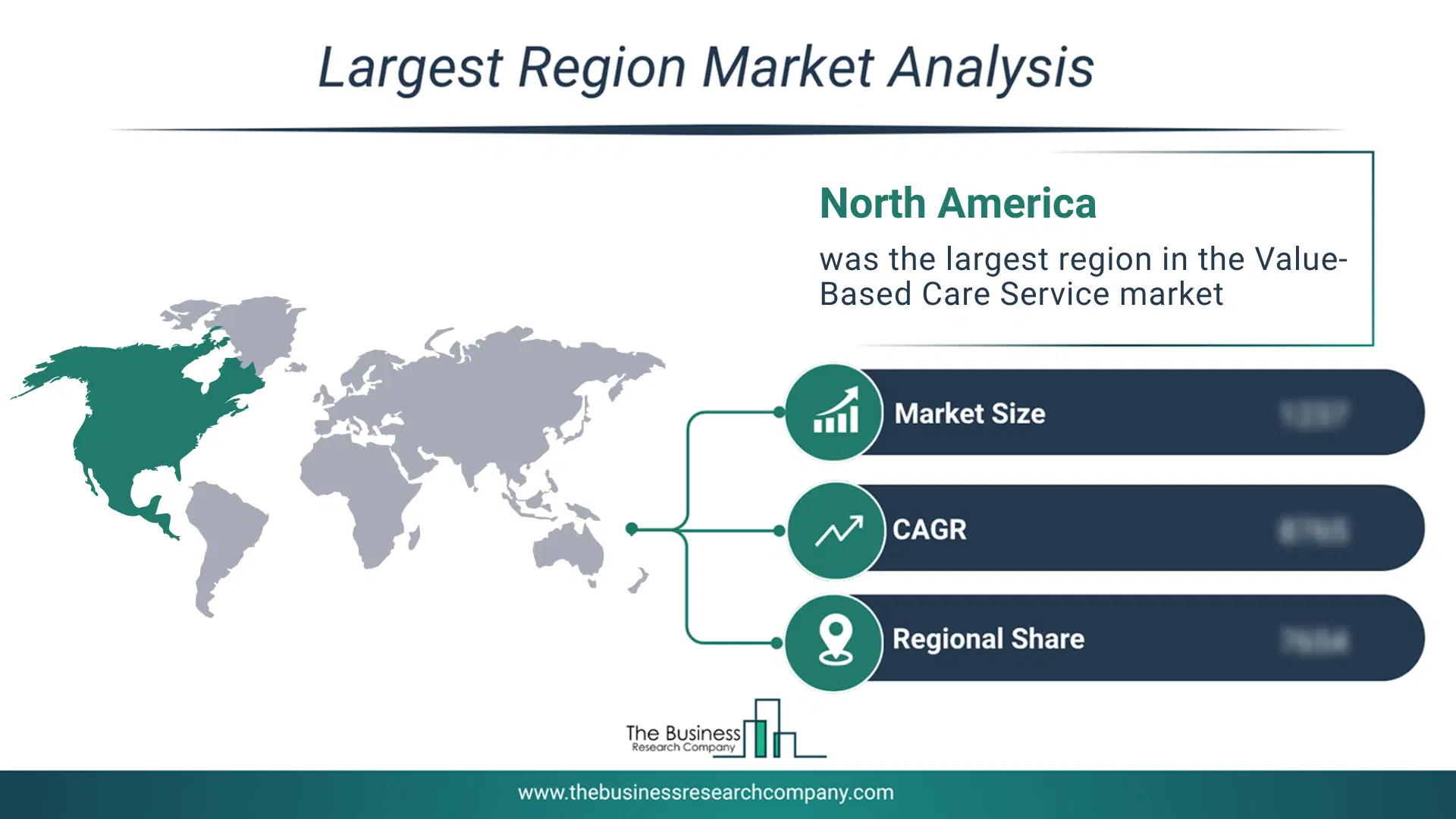
Regional Outlook
North America was the largest region in the value-based care service market in 2025. Asia-Pacific is expected to be the fastest-growing region in the forecast period. The regions covered in this market report are Asia-Pacific, South East Asia, Western Europe, Eastern Europe, North America, South America, Middle East, Africa. The countries covered in this market report are Australia, Brazil, China, France, Germany, India, Indonesia, Japan, Taiwan, Russia, South Korea, UK, USA, Canada, Italy, Spain.What Defines the Value-Based Care Service Market?
The value-based care service market includes revenues earned by entities by providing preventive care, chronic disease management, care coordination, patient education, and wellness support services and related telehealth services, remote patient monitoring, and post-acute care services. The market value includes the value of related goods sold by the service provider or included within the service offering. Only goods and services traded between entities or sold to end consumers are included.How is Market Value Defined and Measured?
The market value is defined as the revenues that enterprises gain from the sale of goods and/or services within the specified market and geography through sales, grants, or donations in terms of the currency (in USD unless otherwise specified). The revenues for a specified geography are consumption values that are revenues generated by organizations in the specified geography within the market, irrespective of where they are produced. It does not include revenues from resales along the supply chain, either further along the supply chain or as part of other products.
This chart presents market attractiveness based on a quantitative evaluation of growth, competition, strategic alignment, and risk, offering a clear view of opportunity areas for decision-making. This chart is for illustrative purposes; the full report contains the complete analysis.

This chart highlights the Total Addressable Market (TAM) by estimating the maximum revenue opportunity using an assumption-driven approach, supporting strategic planning and opportunity sizing across markets. The chart is illustrative; the full report provides a more comprehensive analysis.
What Key Data and Analysis Are Included in the Value-Based Care Service Market Report 2026?
The value-based care service market research report is one of a series of new reports from The Business Research Company that provides market statistics, including industry global market size, regional shares, competitors with the market share, detailed market segments, market trends and opportunities, and any further data you may need to thrive in the value-based care service industry. The market research report delivers a complete perspective of everything you need, with an in-depth analysis of the current and future state of the industry.Value-Based Care Service Market Report Forecast Analysis
| Report Attribute | Details |
|---|---|
| Market Size Value In 2026 | $4.55 billion |
| Revenue Forecast In 2030 | $6.57 billion |
| Growth Rate | CAGR of 9.6% from 2026 to 2030 |
| Base Year For Estimation | 2025 |
| Actual Estimates/Historical Data | 2020-2025 |
| Forecast Period | 2026 - 2030 |
| Market Representation | Revenue in USD Billion and CAGR from 2026 to 2030 |
| Segments Covered | Model, Payers, Providers, End-Users |
| Regional Scope | Asia-Pacific, Western Europe, Eastern Europe, North America, South America, Middle East, Africa |
| Country Scope | The countries covered in the report are Australia, Brazil, China, France, Germany, India, Indonesia, Japan, Taiwan, Russia, South Korea, UK, USA, Canada, Italy, Spain |
| Key Companies Profiled | UnitedHealth Group Incorporated, Cigna Healthcare, Anthem Insurance Companies Inc. (Elevance Health), Kaiser Permanente, Humana Inc., Blue Cross and Blue Shield of Minnesota, VillageMD, MVP Health Care, Agilon Health Inc., Oak Street Health, Privia Health Group Inc., Evolent Health, ChenMed LLC, Aledade Inc., Somatus Inc., Equality Health LLC, Wellvana Health LLC, Tandigm Health, Aetna Inc. |
| Customization Scope | Request for Customization |
| Pricing And Purchase Options | Explore Purchase Options |