

Vector-Borne Disease Surveillance Artificial Intelligence (AI) Market Report 2026
Global Outlook – By Component (Software, Hardware, Services), By Deployment Mode (Cloud-Based, On-Premises), By Application (Malaria Surveillance, Dengue Surveillance, Zika Virus Monitoring, Lyme Disease Tracking, Other Applications), By End-User (Government Agencies, Healthcare Providers, Research Institutes, Other End Users) – Market Size, Trends, Strategies, and Forecast to 2030
Vector-Borne Disease Surveillance Artificial Intelligence (AI) Market Overview
• Vector-Borne Disease Surveillance Artificial Intelligence (AI) market size has reached to $1.6 billion in 2025 • Expected to grow to $4.01 billion in 2030 at a compound annual growth rate (CAGR) of 20.2% • Growth Driver: The Rising Incidence Of Vector-Borne Diseases The Growth Of The Market Due To Increasing Disease Spread And Awareness • Market Trend: Technology Advancements In Real-Time Vector Prediction For The Vector-Borne Disease Surveillance AI • North America was the largest region in 2025 and Asia-Pacific is the fastest growing region.What Is Covered Under Vector-Borne Disease Surveillance Artificial Intelligence (AI) Market?
Vector borne disease surveillance artificial intelligence (AI) refers to the use of artificial intelligence technologies to monitor, predict, and manage the spread of diseases transmitted by vectors such as mosquitoes, ticks, and other insects. It leverages data from environmental, climatic, and epidemiological sources to detect patterns and forecast outbreaks more accurately. The system enables faster decision-making and more effective interventions by analyzing complex datasets in real time. The main components of vector-borne disease surveillance artificial intelligence (AI) include software, hardware, and services. Software refers to AI-enabled platforms that collect, analyze, and predict the spread of vector-borne diseases using real-time data. These systems can be deployed in cloud-based or on-premises modes. They are applied in malaria surveillance, dengue surveillance, Zika virus monitoring, Lyme disease tracking, and other applications, and are used by end users including government agencies, healthcare providers, research institutes, and other end users.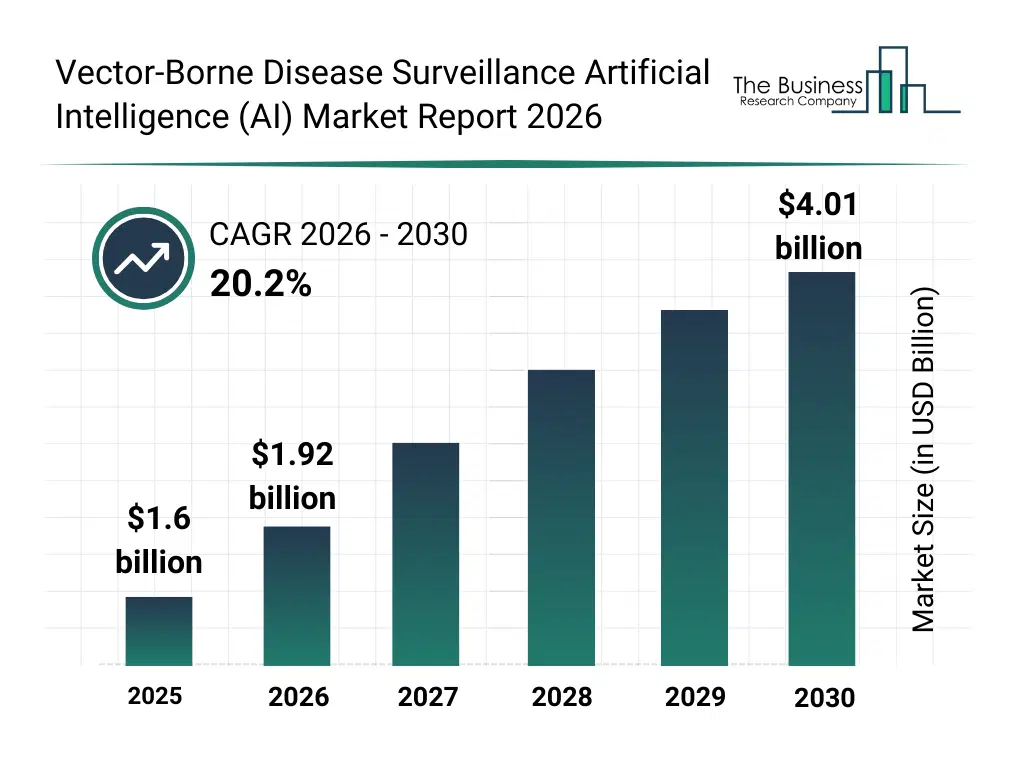
What Is The Vector-Borne Disease Surveillance Artificial Intelligence (AI) Market Size and Share 2026?
The vector-borne disease surveillance artificial intelligence (AI) market size has grown rapidly in recent years. It will grow from $1.6 billion in 2025 to $1.92 billion in 2026 at a compound annual growth rate (CAGR) of 19.9%. The growth in the historic period can be attributed to increase in vector borne disease outbreaks, expansion of public health surveillance programs, growth in geospatial health data, global health monitoring initiatives, adoption of digital disease reporting.What Is The Vector-Borne Disease Surveillance Artificial Intelligence (AI) Market Growth Forecast?
The vector-borne disease surveillance artificial intelligence (AI) market size is expected to see exponential growth in the next few years. It will grow to $4.01 billion in 2030 at a compound annual growth rate (CAGR) of 20.2%. The growth in the forecast period can be attributed to AI based epidemic forecasting demand, climate change driven vector spread, smart sensor surveillance networks, cross border health data platforms, predictive public health planning. Major trends in the forecast period include AI driven outbreak prediction models, climate linked vector risk mapping, automated species identification systems, real time epidemiological dashboards, integrated multi source surveillance platforms.
Global Vector-Borne Disease Surveillance Artificial Intelligence (AI) Market Segmentation
1) By Component: Software; Hardware; Services 2) By Deployment Mode: Cloud-Based; On-Premises 3) By Application: Malaria Surveillance; Dengue Surveillance; Zika Virus Monitoring; Lyme Disease Tracking; Other Applications 4) By End-User: Government Agencies; Healthcare Providers; Research Institutes; Other End Users Subsegments: 1) By Software: Predictive Analytics Software; Data Management Software; Visualization Software; Reporting and Dashboard Software; Geospatial Mapping Software 2) By Hardware: Sensors and Detection Devices; Wearable Monitoring Devices; Surveillance Cameras; Data Storage Devices; Networking Devices 3) By Services: Consulting Services; Implementation Services; Maintenance and Support Services; Training and Education Services; Integration ServicesWhat Is The Driver Of The Vector-Borne Disease Surveillance Artificial Intelligence (AI) Market?
The rising incidence of vector-borne diseases is expected to drive the growth of the vector-borne disease surveillance artificial intelligence (AI) market in the coming years. Vector-borne diseases are illnesses caused by pathogens transmitted by vectors such as mosquitoes, ticks, and fleas, and they represent a growing public health burden worldwide. The increasing prevalence of these diseases is driven by factors such as climate change, urbanization, population mobility, and expanding vector habitats, which have contributed to wider geographic spread and more frequent outbreaks. AI-powered vector-borne disease surveillance addresses these challenges by enabling real-time data integration, early outbreak detection, predictive modeling, and more efficient allocation of public health resources. According to the Pan American Health Organization (PAHO), as reported by the UK Health Security Agency in June 2024, the Region of the Americas recorded 9,386,082 dengue cases, including 4,630,669 confirmed cases, and 4,529 deaths between 1 January and 18 June 2024—representing a 103.29% increase compared to the same period in 2023. Therefore, the rising incidence of vector-borne diseases is driving the growth of the vector-borne disease surveillance artificial intelligence (AI) industry.Key Players In The Global Vector-Borne Disease Surveillance Artificial Intelligence (AI) Market
Major companies operating in the vector-borne disease surveillance artificial intelligence (AI) market are Amazon Web Services Inc., Microsoft Corporation, International Business Machines Corporation, Siemens Healthineers AG, Plexus Health Surveillance, SAS Institute Inc., Palantir Technologies Inc., Informatica LLC, Vector Surveillance System, Environmental Systems Research Institute Inc., Cloudera Inc., HealthMap, GIDEON Informatics, Metabiota Inc., EcoHealth Alliance Inc., BlueDot Inc., BioSense Technologies, Artificial Intelligence in Medical Epidemiology, Vector Technology & Management Consulting Group, Aira Matrix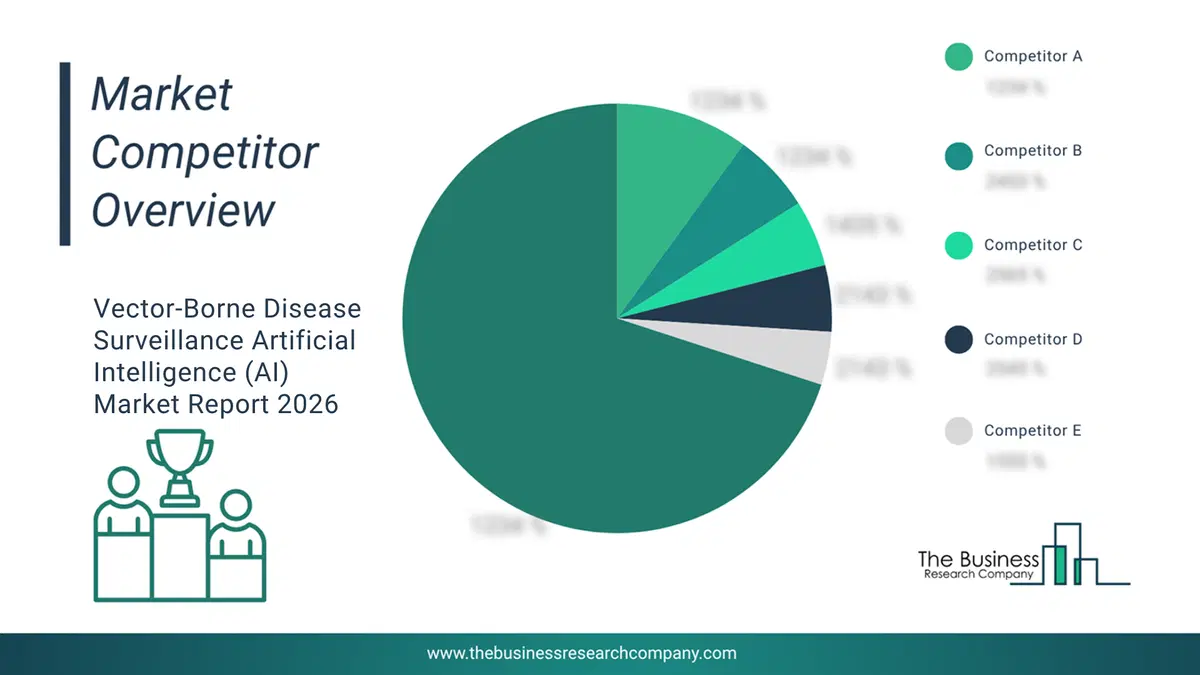
This chart is for illustrative purposes; the full report includes a detailed competitor analysis and comprehensive overview of the top 10 companies in the market.
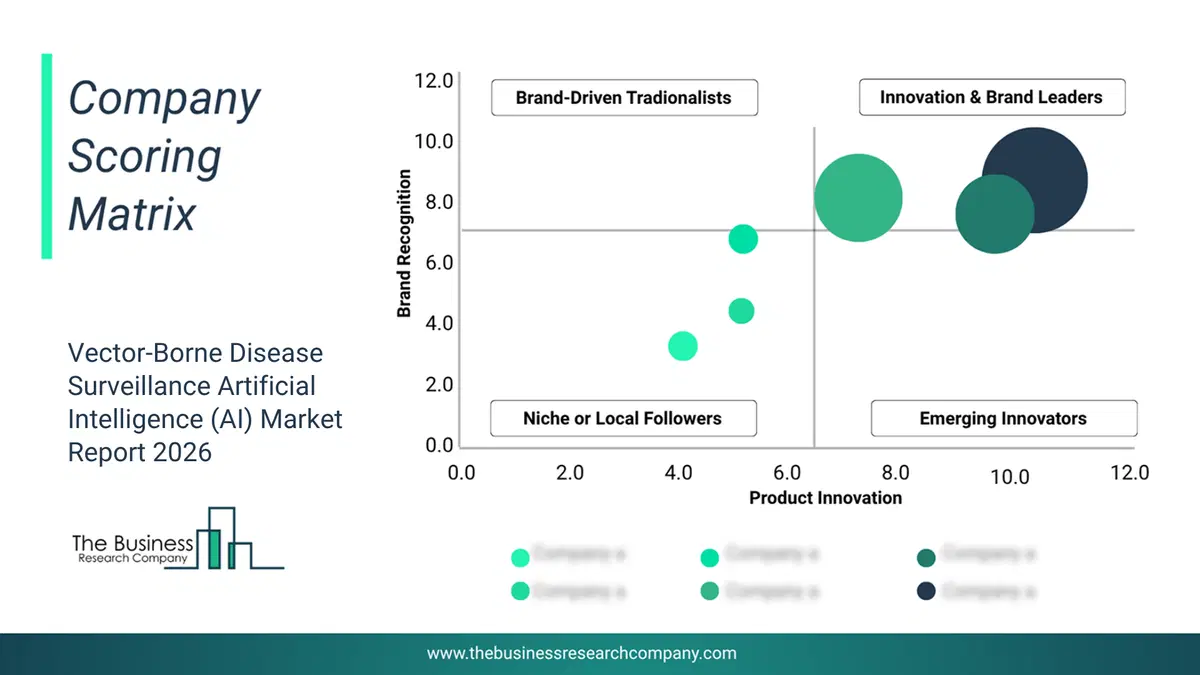
This chart maps companies by product innovation and brand strength, with bubble size indicating relative revenue, helping identify market leaders, challengers, and niche players. This is an illustrative chart; the full report provides a complete and accurate competitive analysis.
Global Vector-Borne Disease Surveillance Artificial Intelligence (AI) Market Trends and Insights
Major companies operating in the vector-borne disease surveillance AI market are focusing on technology advancements in real-time vector prediction, such as AI-powered smart surveillance systems, to gain a competitive advantage through improved outbreak forecasting, targeted intervention capabilities, and enhanced public health decision-making. These systems integrate artificial intelligence with Internet-of-Things sensors and analytics to monitor mosquito populations, detect species and environmental conditions, and trigger alerts for targeted interventions, enabling more precise and timely public health responses compared to traditional methods. For instance, in July 2025, the Andhra Pradesh Municipal Administration and Urban Development Department, a public sector urban development entity in India, introduced the Smart Mosquito Surveillance System (SMoSS). The Smart Mosquito Surveillance System (SMoSS) offers an AI-driven, real-time monitoring platform to track mosquito populations in high-risk urban areas. It integrates smart sensors, traps, drones, and IoT infrastructure to collect continuous field data and generate heat maps identifying mosquito breeding and infestation hotspots.What Are Latest Mergers And Acquisitions In The Vector-Borne Disease Surveillance Artificial Intelligence (AI) Market?
In June 2025, bioMérieux, a France-based provider of in vitro diagnostic solutions, acquired the assets of Day Zero Diagnostics for an undisclosed amount. Through this acquisition, BioMérieux aims to strengthen its next-generation sequencing and machine learning capabilities to provide rapid identification and antibiotic resistance profiles for infectious diseases, which is critical for real-time surveillance of emerging pathogens. Day Zero Diagnostics is a US-based provider of machine learning-driven genome sequencing solutions for rapid pathogen detection.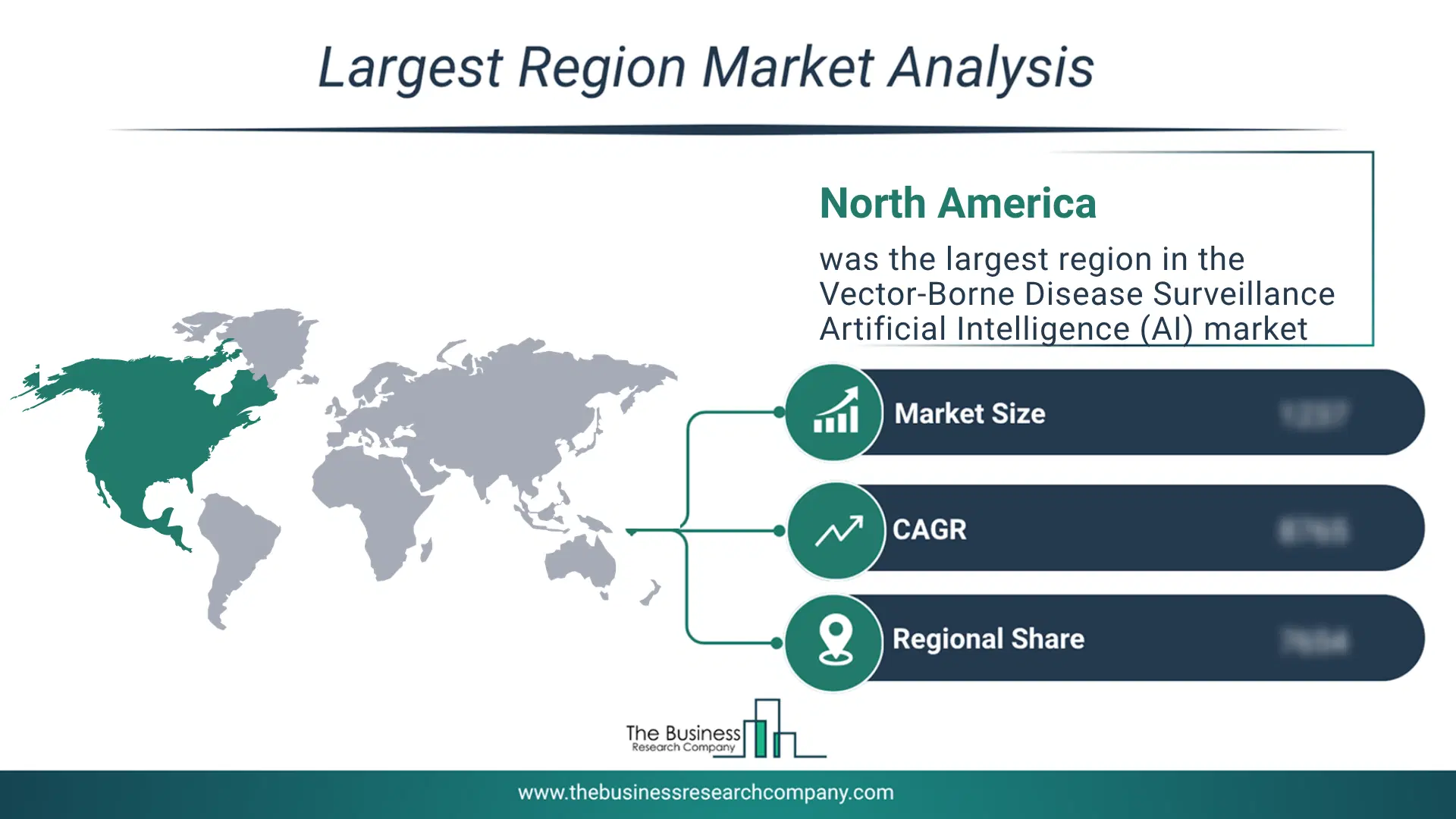
Regional Insights
North America was the largest region in the vector-borne disease surveillance Artificial Intelligence (AI) market in 2025. Asia-Pacific is expected to be the fastest-growing region in the forecast period. The regions covered in this market report are Asia-Pacific, South East Asia, Western Europe, Eastern Europe, North America, South America, Middle East, Africa. The countries covered in this market report are Australia, Brazil, China, France, Germany, India, Indonesia, Japan, Taiwan, Russia, South Korea, UK, USA, Canada, Italy, Spain.What Defines the Vector-Borne Disease Surveillance Artificial Intelligence (AI) Market?
The vector borne disease surveillance artificial intelligence (AI) market consists of revenues earned by entities by providing services such as real-time vector monitoring, outbreak prediction, data analysis and modeling, risk assessment, reporting and visualization, early warning alerts, decision support, public health intervention planning, predictive analytics, and surveillance system integration. The vector borne disease surveillance artificial intelligence (AI) market also includes sales of AI-powered species identification tools, smart surveillance & monitoring platforms, risk forecasting systems, community reporting apps, and pathogen detection platforms. Values in this market are ‘factory gate’ values, that is, the value of goods sold by the manufacturers or creators of the goods, whether to other entities (including downstream manufacturers, wholesalers, distributors, and retailers) or directly to end customers. The value of goods in this market includes related services sold by the creators of the goods.How is Market Value Defined and Measured?
The market value is defined as the revenues that enterprises gain from the sale of goods and/or services within the specified market and geography through sales, grants, or donations in terms of the currency (in USD unless otherwise specified). The revenues for a specified geography are consumption values that are revenues generated by organizations in the specified geography within the market, irrespective of where they are produced. It does not include revenues from resales along the supply chain, either further along the supply chain or as part of other products.
This chart presents market attractiveness based on a quantitative evaluation of growth, competition, strategic alignment, and risk, offering a clear view of opportunity areas for decision-making. This chart is for illustrative purposes; the full report contains the complete analysis.

This chart highlights the Total Addressable Market (TAM) by estimating the maximum revenue opportunity using an assumption-driven approach, supporting strategic planning and opportunity sizing across markets. The chart is illustrative; the full report provides a more comprehensive analysis.
What Key Data and Analysis Are Included in the Vector-Borne Disease Surveillance Artificial Intelligence (AI) Market Report 2026?
The vector-borne disease surveillance artificial intelligence (ai) market research report is one of a series of new reports from The Business Research Company that provides market statistics, including industry global market size, regional shares, competitors with the market share, detailed market segments, market trends and opportunities, and any further data you may need to thrive in the vector-borne disease surveillance artificial intelligence (ai) industry. The market research report delivers a complete perspective of everything you need, with an in-depth analysis of the current and future state of the industry.Vector-Borne Disease Surveillance Artificial Intelligence (AI) Market Report Forecast Analysis
| Report Attribute | Details |
|---|---|
| Market Size Value In 2026 | $1.92 billion |
| Revenue Forecast In 2030 | $4.01 billion |
| Growth Rate | CAGR of 20.2% from 2026 to 2030 |
| Base Year For Estimation | 2025 |
| Actual Estimates/Historical Data | 2020-2025 |
| Forecast Period | 2026 - 2030 |
| Market Representation | Revenue in USD Billion and CAGR from 2026 to 2030 |
| Segments Covered | Component, Deployment Mode, Application, End-User |
| Regional Scope | Asia-Pacific, Western Europe, Eastern Europe, North America, South America, Middle East, Africa |
| Country Scope | The Countries Covered In This Market Report Are Australia, Brazil, China, France, Germany, India, Indonesia, Japan, Taiwan, Russia, South Korea, Uk, Usa, Canada, Italy, Spain. |
| Key Companies Profiled | Amazon Web Services Inc., Microsoft Corporation, International Business Machines Corporation, Siemens Healthineers AG, Plexus Health Surveillance, SAS Institute Inc., Palantir Technologies Inc., Informatica LLC, Vector Surveillance System, Environmental Systems Research Institute Inc., Cloudera Inc., HealthMap, GIDEON Informatics, Metabiota Inc., EcoHealth Alliance Inc., BlueDot Inc., BioSense Technologies, Artificial Intelligence in Medical Epidemiology, Vector Technology & Management Consulting Group, Aira Matrix |
| Customization Scope | Request for Customization |
| Pricing And Purchase Options | Explore Purchase Options |