

Vehicle Cameras Market Report 2026
Global Outlook – By Type (Viewing Camera, Sensing Camera), By Vehicle Type (Passenger Vehicles, Light Commercial Vehicles, Heavy Commercial Vehicles, Electric Vehicles, Autonomous Vehicles), By Technology (Digital Camera Systems, Analog Camera Systems, High Dynamic Range Cameras, Infrared Cameras, Artificial Intelligence Enabled Cameras), By Application (Parking Assistance, Blind Spot Detection, Driver Monitoring System, Lane Departure Warning, Other Applications), By End User (Automotive Original Equipment Manufacturers, Fleet Operators, Transportation And Logistics Companies, Insurance Providers, Mobility Service Providers) – Market Size, Trends, Strategies, and Forecast to 2030
Vehicle Cameras Market Overview
• Vehicle Cameras market size has reached to $9.14 billion in 2025 • Expected to grow to $16.15 billion in 2030 at a compound annual growth rate (CAGR) of 12% • Growth Driver: Growth In Electric Vehicles Fueling The Growth Of The Market Due To Rising Environmental Concerns • Market Trend: Advanced Multi-Camera Monitoring Solutions Transform Commercial Fleet Management • North America was the largest region in 2025 and Asia-Pacific is the fastest growing region.What Is Covered Under Vehicle Cameras Market?
Vehicle cameras are electronic imaging devices integrated into vehicles to capture and transmit visual data of the vehicle's surroundings or interior in real time. They enhance driving safety, improve situational awareness, and support various automotive functions by providing accurate visual information for monitoring and decision-making. The main types of vehicle cameras include viewing camera and sensing camera. Viewing cameras refer to onboard camera systems that provide drivers with real-time visual information around the vehicle to improve visibility, maneuverability, and driving safety. These cameras are installed in passenger vehicles, light commercial vehicles, heavy commercial vehicles, electric vehicles, and autonomous vehicles and utilize technologies including digital camera systems, analog camera systems, high dynamic range cameras, infrared cameras, and artificial intelligence enabled cameras. The various applications involved are parking assistance, blind spot detection, driver monitoring system, lane departure warning, and others, and they are utilized by end users including automotive original equipment manufacturers, fleet operators, transportation and logistics companies, insurance providers, and mobility service providers.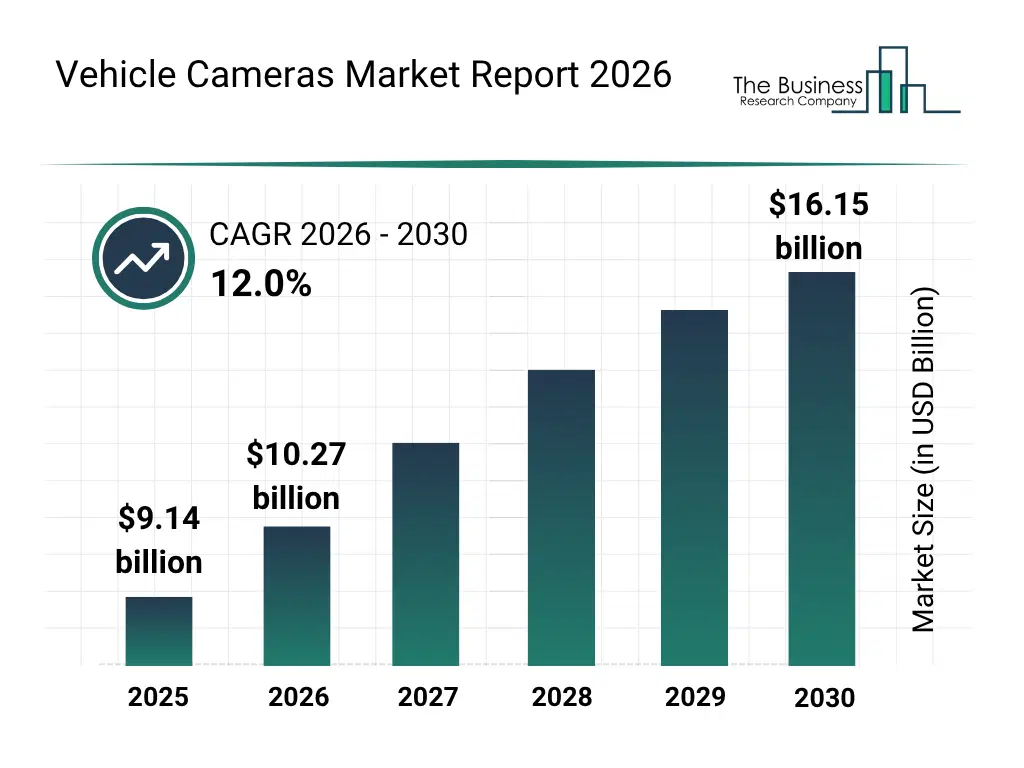
What Is The Vehicle Cameras Market Size and Share 2026?
The vehicle cameras market size has grown rapidly in recent years. It will grow from $9.14 billion in 2025 to $10.27 billion in 2026 at a compound annual growth rate (CAGR) of 12.4%. The growth in the historic period can be attributed to increasing focus on automotive safety regulations, growing adoption of advanced driver assistance systems, rising demand for parking assistance technologies, increasing production of passenger and commercial vehicles, growing consumer preference for enhanced driving convenience.What Is The Vehicle Cameras Market Growth Forecast?
The vehicle cameras market size is expected to see rapid growth in the next few years. It will grow to $16.15 billion in 2030 at a compound annual growth rate (CAGR) of 12.0%. The growth in the forecast period can be attributed to increasing deployment of autonomous driving technologies, rising adoption of AI enabled vehicle cameras, growing demand for connected vehicle solutions, increasing integration of advanced sensing systems in vehicles, growing expansion of electric and smart mobility platforms. Major trends in the forecast period include increasing adoption of advanced vehicle camera systems, growing demand for enhanced driver safety solutions, rising integration of multi-camera vehicle monitoring systems, increasing development of high resolution automotive imaging technologies, growing demand for improved vehicle visibility and awareness systems.
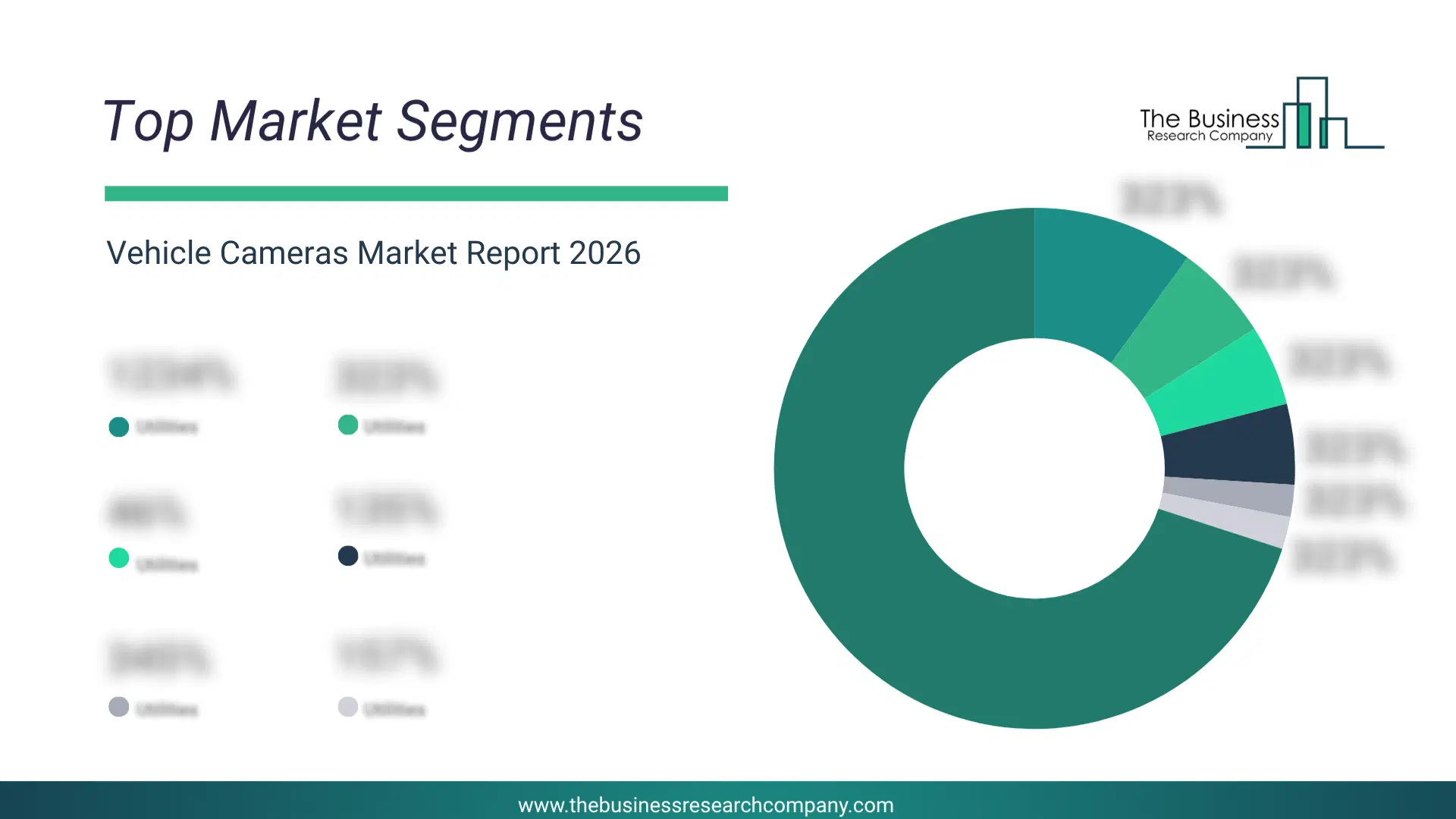
Global Vehicle Cameras Market Segmentation
2) By Vehicle Type: Passenger Vehicles, Light Commercial Vehicles, Heavy Commercial Vehicles, Electric Vehicles, Autonomous Vehicles 3) By Technology: Digital Camera Systems, Analog Camera Systems, High Dynamic Range Cameras, Infrared Cameras, Artificial Intelligence Enabled Cameras 4) By Application: Parking Assistance, Blind Spot Detection, Driver Monitoring System, Lane Departure Warning, Other Applications 5) By End User: Automotive Original Equipment Manufacturers, Fleet Operators, Transportation And Logistics Companies, Insurance Providers, Mobility Service Providers Subsegments: 1) By Viewing Camera: Rear View Cameras, Front View Cameras, Side View Cameras, Surround View Cameras, Interior View Cameras 2) By Sensing Camera: Driver Monitoring Cameras, Occupant Monitoring Cameras, Lane Detection Cameras, Traffic Sign Recognition Cameras, Night Vision CamerasWhat Is The Driver Of The Vehicle Cameras Market?
The growth in electric vehicles (EVs) is expected to propel the growth of the vehicle cameras market going forward. Electric vehicles are automobiles powered wholly or partially by electricity stored in rechargeable batteries and use electric motors instead of conventional internal combustion engines for propulsion. The growth in electric vehicles is due to rising environmental concerns, as increasing awareness of climate change, air pollution, and greenhouse gas emissions is encouraging consumers, businesses, and governments to adopt cleaner and more sustainable transportation alternatives. Growth in electric vehicle adoption is driving demand for vehicle cameras, as electric vehicles increasingly integrate advanced driver assistance systems (ADAS), parking assistance, and safety monitoring technologies that rely on camera-based systems. For instance, in January 2025, according to Cox Automotive, a US-based system software company, in 2024, full-year electric vehicle sales totaled 1.3 million, marking a 7.3% rise compared to the revised figures for 2023. Therefore, the growth in electric vehicles (EVs) is driving the growth of the vehicle cameras industry.Key Players In The Global Vehicle Cameras Market
Major companies operating in the vehicle cameras market are Ambarella Inc., Aptiv PLC, Aumovio SE, Denso Corporation, e-con Systems India Private Limited, FORVIA SE, Gentex Corporation, Jabil Inc., Magna International Inc., MCNEX Co. Ltd., OMNIVISION, Panasonic Holdings Corporation, Ricoh Company Ltd., Robert Bosch GmbH, Samsung Electro-Mechanics Co. Ltd., Smart Eye AB, Stonkam Co. Ltd., Stoneridge Inc., Teledyne FLIR, Valeo SE, ZF Friedrichshafen AG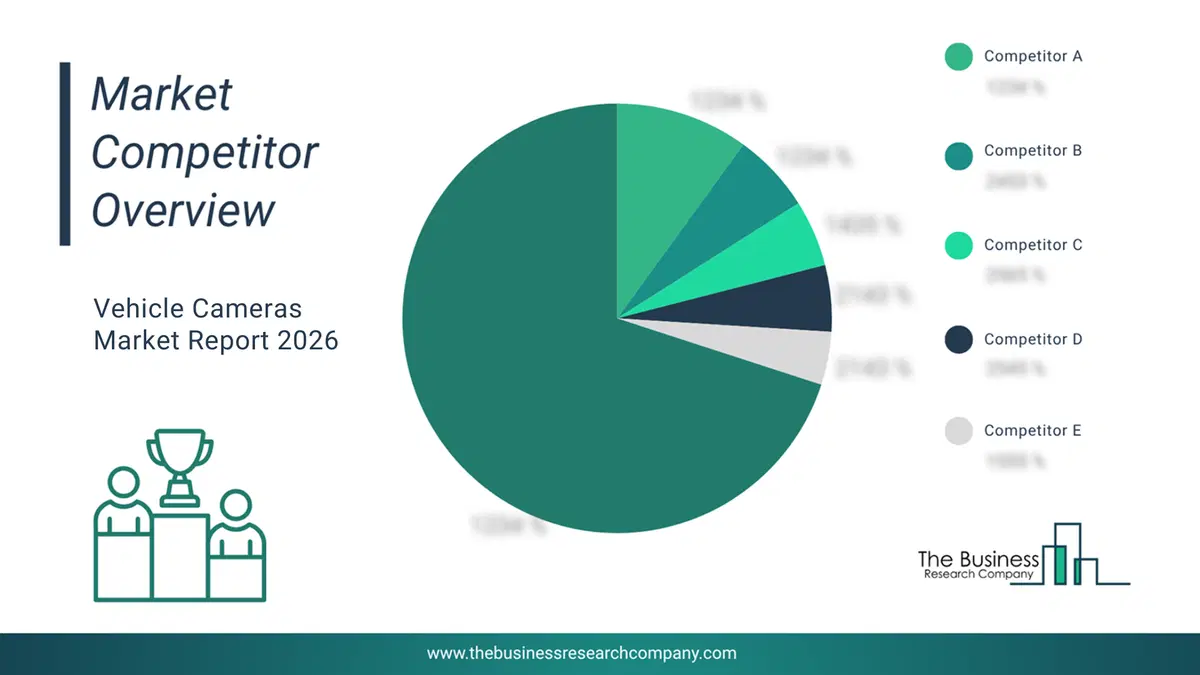
This chart is for illustrative purposes; the full report includes a detailed competitor analysis and comprehensive overview of the top 10 companies in the market.
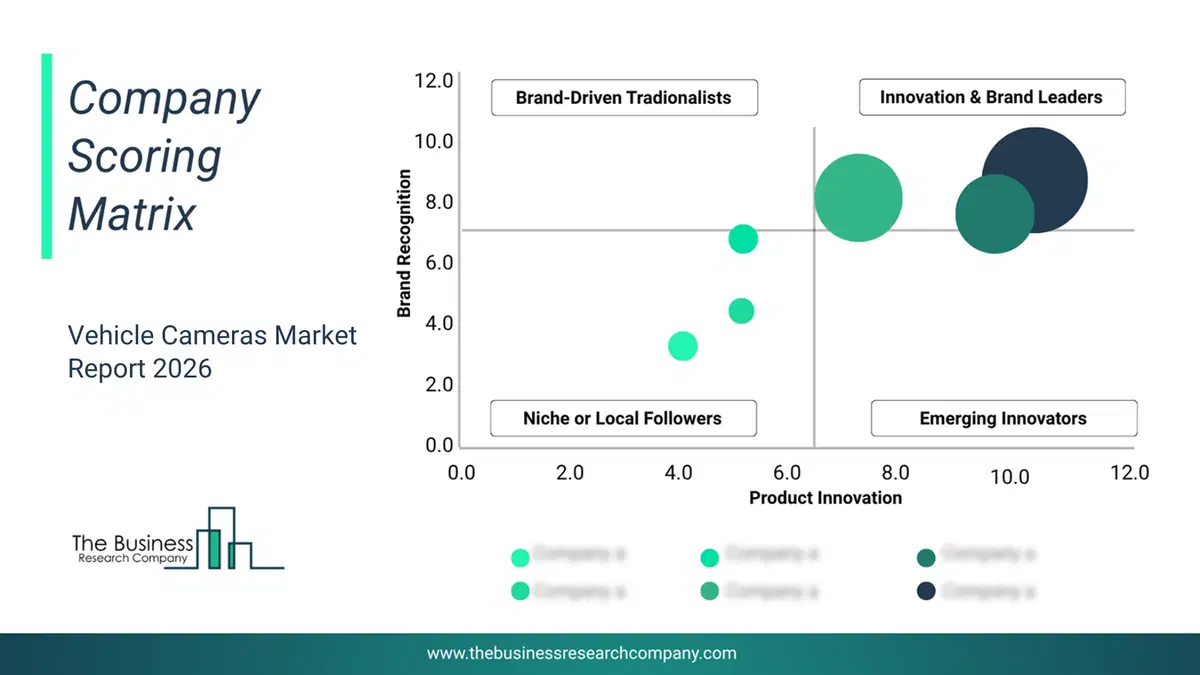
This chart maps companies by product innovation and brand strength, with bubble size indicating relative revenue, helping identify market leaders, challengers, and niche players. This is an illustrative chart; the full report provides a complete and accurate competitive analysis.
Global Vehicle Cameras Market Trends and Insights
Major companies operating in the vehicle cameras market are focusing on developing innovative platforms, such as AI-powered multi-camera dashcam platforms, to enhance fleet visibility, improve driver safety, and reduce accident risks through real-time monitoring and advanced analytics. AI-powered multi-camera dashcam platforms are integrated vehicle monitoring systems that combine multiple cameras with artificial intelligence capabilities to provide comprehensive visual coverage and automated incident detection, offering a more advanced alternative to traditional single-camera dashcams that provide limited fields of view and fewer analytical capabilities. For instance, in July 2025, Teletrac Navman US Ltd., a US-based software-as-a-service company, launched the Multi IQ Camera, a cloud-based, AI-powered dashcam solution designed for large commercial vehicles. The platform can connect up to five cameras positioned across the vehicle, including cab-interior, side, rear, cargo-area, and undercarriage cameras, alongside built-in dual-front and driver-facing cameras to provide 360-degree visibility. It uses advanced AI analytics to detect drowsiness, distracted driving, risky driving behaviour, and potential collisions, recording events in high definition for driver coaching and evidentiary purposes. Additionally, the solution integrates with the TN360 fleet management platform to deliver real-time insights that enhance operational efficiency, improve safety, and protect fleet operators against false claims.What Are Latest Mergers And Acquisitions In The Vehicle Cameras Market?
In January 2024, Nationwide Fleet Installations Ltd., a UK-based fleet management solutions provider, acquired Avian Fleet for an undisclosed amount. With this acquisition, Nationwide Fleet Installations aims to strengthen its engineering capabilities, double its UK-wide coverage, and enhance its ability to provide integrated telematics and vehicle technology installation services to fleet operators seeking improved safety, efficiency, and sustainability solutions. Avian Fleet is a UK-based fleet management solutions provider that offers camera solutions for telematics, vehicle tracking, and driver safety.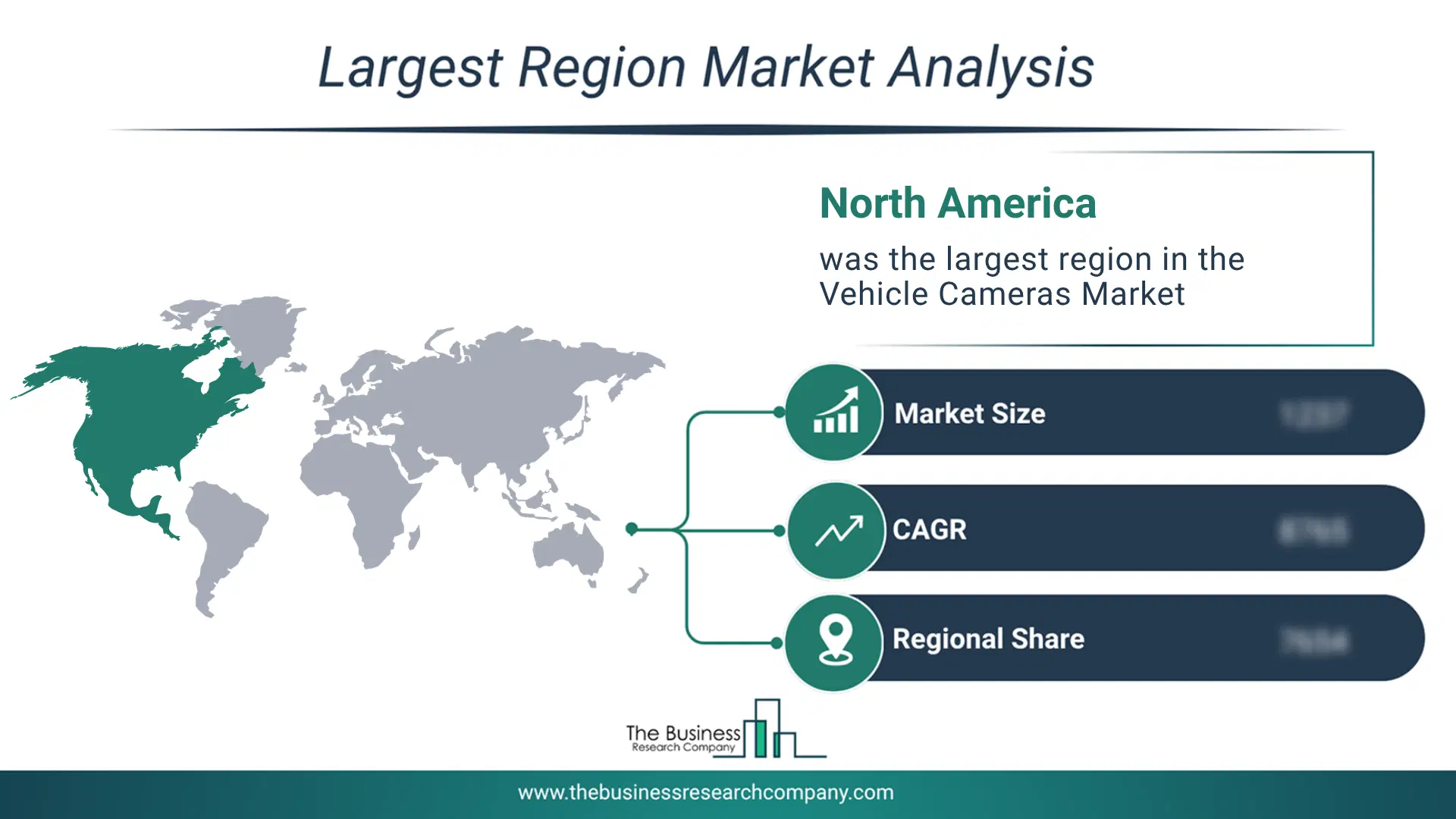
Regional Outlook/Insights
North America was the largest region in the vehicle cameras market in 2025. Asia-Pacific is expected to be the fastest-growing region in the forecast period. The regions covered in this market report are Asia-Pacific, South East Asia, Western Europe, Eastern Europe, North America, South America, Middle East, Africa. The countries covered in this market report are Australia, Brazil, China, France, Germany, India, Indonesia, Japan, Taiwan, Russia, South Korea, UK, USA, Canada, Italy, Spain.What Defines the Vehicle Cameras Market?
The vehicle cameras market consists of sales of rear-view cameras, front-view cameras, side-view cameras, and driver monitoring cameras. Values in this market are ‘factory gate’ values, that is, the value of goods sold by the manufacturers or creators of the goods, whether to other entities (including downstream manufacturers, wholesalers, distributors, and retailers) or directly to end customers. The value of goods in this market includes related services sold by the creators of the goods.How is Market Value Defined and Measured?
The market value is defined as the revenues that enterprises gain from the sale of goods and/or services within the specified market and geography through sales, grants, or donations in terms of the currency (in USD unless otherwise specified). The revenues for a specified geography are consumption values that are revenues generated by organizations in the specified geography within the market, irrespective of where they are produced. It does not include revenues from resales along the supply chain, either further along the supply chain or as part of other products.
This chart presents market attractiveness based on a quantitative evaluation of growth, competition, strategic alignment, and risk, offering a clear view of opportunity areas for decision-making. This chart is for illustrative purposes; the full report contains the complete analysis.

This chart highlights the Total Addressable Market (TAM) by estimating the maximum revenue opportunity using an assumption-driven approach, supporting strategic planning and opportunity sizing across markets. The chart is illustrative; the full report provides a more comprehensive analysis.
What Key Data and Analysis Are Included in the Vehicle Cameras Market Report 2026?
The vehicle cameras market research report is one of a series of new reports from The Business Research Company that provides vehicle cameras market statistics, including vehicle cameras industry global market size, regional shares, competitors with a vehicle cameras market share, detailed vehicle cameras market segments, market trends and opportunities, and any further data you may need to thrive in the vehicle cameras industry. This vehicle cameras market research report delivers a complete perspective of everything you need, with an in-depth analysis of the current and future scenario of the industry.Vehicle Cameras Market Report Forecast Analysis
| Report Attribute | Details |
|---|---|
| Market Size Value In 2026 | $10.27 billion |
| Revenue Forecast In 2030 | $16.15 billion |
| Growth Rate | CAGR of 12% from 2026 to 2030 |
| Base Year For Estimation | 2025 |
| Actual Estimates/Historical Data | 2020-2025 |
| Forecast Period | 2026 - 2030 |
| Market Representation | Revenue in USD Billion and CAGR from 2026 to 2030 |
| Segments Covered | Type, Vehicle Type, Technology, Application, End User |
| Regional Scope | Asia-Pacific, Western Europe, Eastern Europe, North America, South America, Middle East, Africa |
| Country Scope | The countries covered in the report are Australia, Brazil, China, France, Germany, India, Indonesia, Japan, Taiwan, Russia, South Korea, UK, USA, Canada, Italy, Spain. |
| Key Companies Profiled | Ambarella Inc., Aptiv PLC, Aumovio SE, Denso Corporation, e-con Systems India Private Limited, FORVIA SE, Gentex Corporation, Jabil Inc., Magna International Inc., MCNEX Co. Ltd., OMNIVISION, Panasonic Holdings Corporation, Ricoh Company Ltd., Robert Bosch GmbH, Samsung Electro-Mechanics Co. Ltd., Smart Eye AB, Stonkam Co. Ltd., Stoneridge Inc., Teledyne FLIR, Valeo SE, ZF Friedrichshafen AG |
| Customization Scope | Request for Customization |
| Pricing And Purchase Options | Explore Purchase Options |