
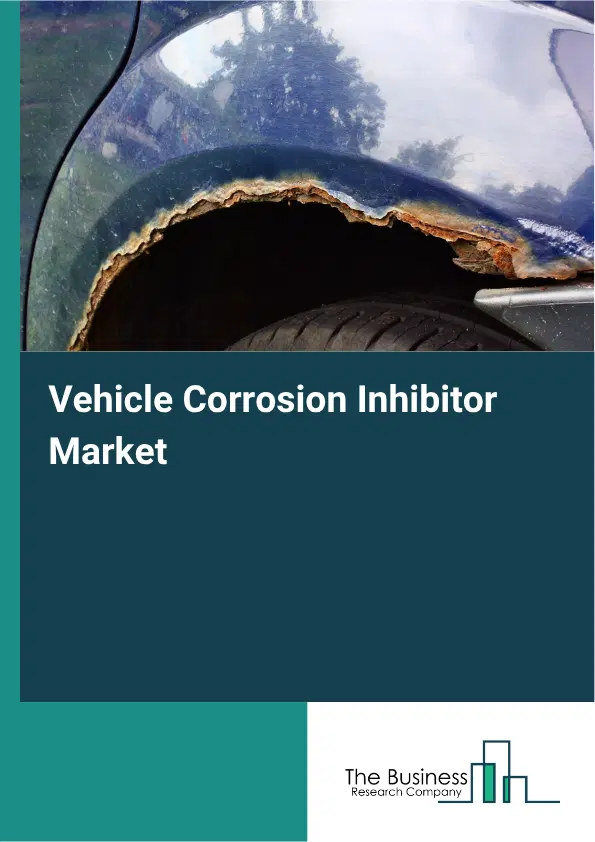
Vehicle Corrosion Inhibitor Market Report 2026
Global Outlook – By Product Type (Water-Based, Oil-Based, Solvent-Based, Other Product Types), By Form (Liquid, Aerosol, Gel, Other Forms), By Vehicle Type (Passenger Cars, Light Commercial Vehicles, Heavy Commercial Vehicles, Electric Vehicles), By Distribution Channel (Original Equipment Manufacturers, Aftermarket, Online Retail, Other Distribution Channels), By Application (Passenger Vehicles, Commercial Vehicles, Other Applications) – Market Size, Trends, Strategies, and Forecast to 2035
Vehicle Corrosion Inhibitor Market Overview
• Vehicle Corrosion Inhibitor market size has reached to $5.05 billion in 2025 • Expected to grow to $6.8 billion in 2030 at a compound annual growth rate (CAGR) of 6.2% • Growth Driver: Surge In Automotive Production Fueling The Growth Of The Market Due To Rising Global Vehicle Manufacturing And Component Demand • Market Trend: Development Of Next-Generation Organic Corrosion Inhibitors For Automotive Applications • North America was the largest region in 2025 and Asia-Pacific is the fastest growing region.What Is Covered Under Vehicle Corrosion Inhibitor Market?
Vehicle corrosion inhibitors are chemical substances or protective formulations designed to prevent or slow down the degradation of metal surfaces caused by oxidation and environmental exposure. These inhibitors work by forming a protective barrier on the surface of vehicle components, thereby reducing the interaction between metal and corrosive elements such as moisture, oxygen, and road salts. They help enhance the durability, structural integrity, and lifespan of automotive parts by minimizing rust formation and corrosion-related damage over time. The main product types of vehicle corrosion inhibitor include water-based, oil-based, solvent-based, and other product types. Water-based refer to protective chemical formulations designed to prevent rust and corrosion on vehicle components using water-soluble compounds. These products are available in forms such as liquid, aerosol, gel, and other forms and are designed for vehicle types including passenger cars, light commercial vehicles, heavy commercial vehicles, and electric vehicles. They are distributed through original equipment manufacturers, aftermarket, online retail, and other distribution channels and the key applications of passenger vehicles, commercial vehicles, and others.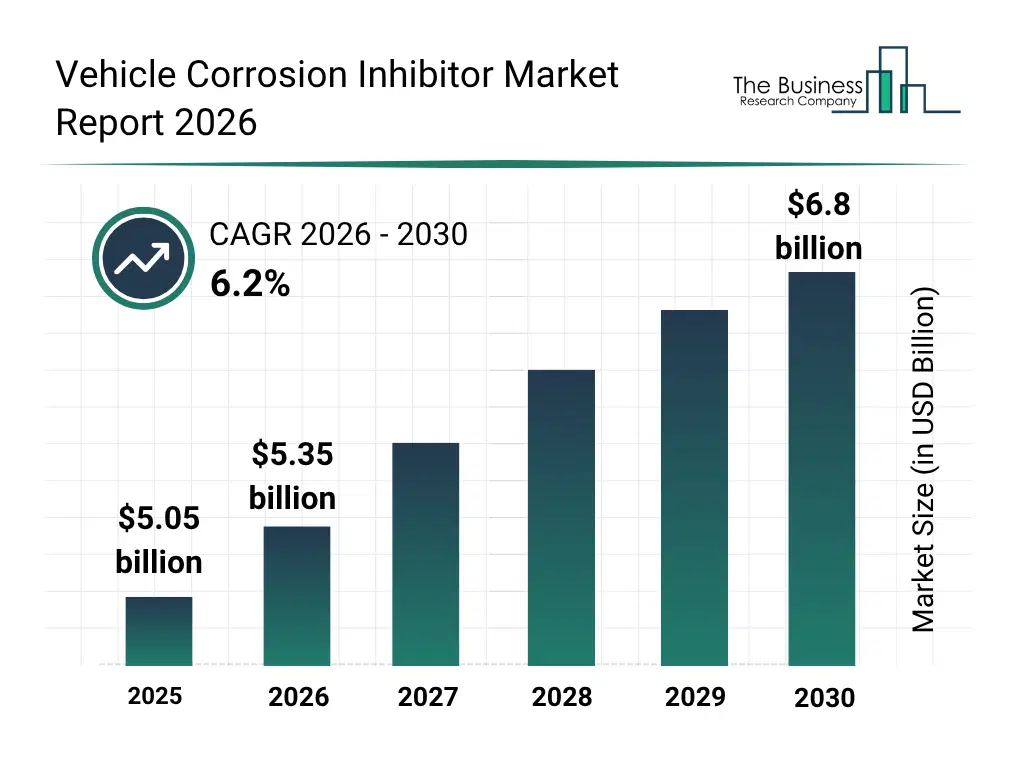
What Is The Vehicle Corrosion Inhibitor Market Size and Share 2026?
The vehicle corrosion inhibitor market size has grown strongly in recent years.It will grow from $5.05 billion in 2025 to $5.35 billion in 2026 at a compound annual growth rate (CAGR) of 5.9%. The growth in the historic period can be attributed to rising vehicle exposure to harsh environmental conditions, increasing road salt usage in cold regions, growth in automotive manufacturing, demand for improved vehicle durability, expansion of aftermarket vehicle maintenance products.What Is The Vehicle Corrosion Inhibitor Market Growth Forecast?
The vehicle corrosion inhibitor market size is expected to see strong growth in the next few years.It will grow to $6.8 billion by 2030 at a compound annual growth rate (CAGR) of 6.2%. The growth in the forecast period can be attributed to development of smart self-healing corrosion coatings, integration of IoT-based corrosion monitoring systems, rising adoption of electric vehicle lightweight materials, increased use of sustainable bio-based inhibitors, expansion of predictive maintenance in fleet operations.Major trends in the forecast period include Eco-friendly water-based corrosion inhibitor adoption, nano-technology enhanced anti-corrosion coatings, extended-life multi-metal corrosion protection formulations, smart monitoring-enabled corrosion prevention systems, increased use of bio-based and non-toxic corrosion inhibitor chemicals.
Global Vehicle Corrosion Inhibitor Market Segmentation
1) By Product Type: Water-Based, Oil-Based, Solvent-Based, Other Product Types 2) By Form: Liquid, Aerosol, Gel, Other Forms 3) By Vehicle Type: Passenger Cars, Light Commercial Vehicles, Heavy Commercial Vehicles, Electric Vehicles 4) By Distribution Channel: Original Equipment Manufacturers, Aftermarket, Online Retail, Other Distribution Channels 5) By Application: Passenger Vehicles, Commercial Vehicles, Other Applications Subsegments: 1) By Water-Based: Organic Water-Based Corrosion Inhibitor, Inorganic Water-Based Corrosion Inhibitor, Hybrid Water-Based Corrosion Inhibitor, Nitrite Based Water Corrosion Inhibitor 2) By Oil-Based: Rust Preventive Oil-Based Inhibitor, Oil Soluble Corrosion Inhibitor, Protective Film Forming Oil Inhibitor, Heavy Duty Oil-Based Corrosion Inhibitor 3) By Solvent-Based: Volatile Solvent-Based Corrosion Inhibitor, Film Forming Solvent-Based Inhibitor, Quick Drying Solvent-Based Inhibitor, Protective Coating Solvent-Based Inhibitor 4) By Other Product Types: Vapor Phase Corrosion Inhibitor, Powder Form Corrosion Inhibitor, Gel Based Corrosion Inhibitor, Multi Metal Corrosion InhibitorWhat Is The Driver Of The Vehicle Corrosion Inhibitor Market?
The growing automotive production is expected to propel the growth of the vehicle corrosion inhibitor industry going forward.The expansion of automotive production is driven by increasing urbanization, rising disposable incomes, and growing demand for both personal and commercial transportation.Vehicle corrosion inhibitors support automotive production by protecting metal components from rust and degradation, enhancing vehicle durability, and ensuring compliance with quality and safety standards.For instance, in March 2025, according to the European Automobile Manufacturers’ Association, a Belgium-based automotive industry organization, car production reached 75.5 million units in 2024, compared to approximately 76 million units in 2023, reflecting sustained high levels of automotive manufacturing and continued demand for vehicle components.Therefore, the growing automotive production is driving the growth of the vehicle corrosion inhibitor industry.Key Players In The Global Vehicle Corrosion Inhibitor Market
Major companies operating in the vehicle corrosion inhibitor market are The Sherwin-Williams Company, PPG Industries Inc., Evonik Industries AG, Sika AG, DuPont de Nemours Inc., Akzo Nobel N. V., RPM International Inc., LANXESS AG, The Lubrizol Corporation, The Chemours Company, Axalta Coating Systems Ltd., Kansai Paint Co. Ltd., FUCHS SE, Ashland Inc., Quaker Houghton, NOF Corporation, Afton Chemical Corporation, Valvoline Inc., Chemetall GmbH, Cortec Corporation, Daubert Chemical Company Inc., Northern Technologies International Corporation, Armor Protective Packaging, DINOL GmbH, Bilt-Hamber Laboratories, Corrosion Technologies LLCGlobal Vehicle Corrosion Inhibitor Market Trends and Insights
Major companies operating in the vehicle corrosion inhibitor market are focusing on developing innovative solutions, such as smart-release corrosion inhibitor technologies, to address the growing demand for high-performance, durable, and efficient corrosion protection in automotive applications. Smart-release corrosion inhibitors are advanced materials that release active inhibiting agents in a controlled manner when triggered by environmental factors such as moisture or pH changes, enabling targeted protection and extending the lifespan of metal components compared to conventional inhibitors. For instance, in November 2024, ICL Group Ltd., an Israel-based specialty chemicals company, launched HALOX 680, a smart-release corrosion inhibitor introduced at CHINACOAT 2024. The product is based on a heterocyclic organic compound designed to enhance corrosion protection by responding to corrosive conditions and releasing inhibitors directly at affected sites. It helps prevent cathodic delamination, improves coating adhesion on metal substrates, and is compatible with both water-based and solvent-based coating systems. Additionally, it offers improved durability, extended protection cycles, and reduced material usage, supporting both performance efficiency and sustainability.What Are Latest Mergers And Acquisitions In The Vehicle Corrosion Inhibitor Market?
In February 2024, Henkel AG & Co. KGaA, a Germany-based manufacturing and technology company, acquired Seal for Life Industries LLC for an undisclosed amount. With this acquisition, Henkel aimed to strengthen its maintenance, repair, and overhaul (MRO) portfolio by enhancing its capabilities in advanced protective coating and sealing technologies, thereby expanding its corrosion protection solutions across industrial and automotive applications. Seal for Life Industries LLC is a US-based manufacturing company that specializes in providing protective corrosion prevention systems used to extend the lifespan of metal assets and infrastructure.Regional Insights
North America was the largest region in the vehicle corrosion inhibitor market in 2025. Asia-Pacific is expected to be the fastest-growing region in the forecast period. The regions covered in this market report are Asia-Pacific, South East Asia, Western Europe, Eastern Europe, North America, South America, Middle East and Africa. The countries covered in this market report are Australia, Brazil, China, France, Germany, India, Indonesia, Japan, Taiwan, Russia, South Korea, UK, USA, Canada, Italy, Spain.What Defines the Vehicle Corrosion Inhibitor Market?
The vehicle corrosion inhibitors market consists of sales of volatile corrosion inhibitor film, volatile corrosion inhibitor paper, VCI emitters, metal pretreatment solutions, and polyurethane protective coatings. Values in this market are ‘factory gate’ values, that is, the value of goods sold by the manufacturers or creators of the goods, whether to other entities (including downstream manufacturers, wholesalers, distributors, and retailers) or directly to end customers. The value of goods in this market includes related services sold by the creators of the goods.What is the Market Assessment and Strategic Outlook for the Vehicle Corrosion Inhibitor Industry?
The vehicle corrosion inhibitor market research report is one of a series of new reports from The Business Research Company that provides market statistics, including industry global market size, regional shares, competitors with the market share, detailed market segments, market trends and opportunities, and any further data you may need to thrive in the vehicle corrosion inhibitor industry. The market research report delivers a complete perspective of everything you need, with an in-depth analysis of the current and future state of the industry.What is the Market Assessment and Strategic Outlook for the Vehicle Corrosion Inhibitor Market Report 2026?
The vehicle corrosion inhibitor market research report is one of a series of new reports from The Business Research Company that provides vehicle corrosion inhibitor market statistics, including vehicle corrosion inhibitor industry global market size, regional shares, competitors with a vehicle corrosion inhibitor market share, detailed vehicle corrosion inhibitor market segments, market trends and opportunities, and any further data you may need to thrive in the vehicle corrosion inhibitor industry. This vehicle corrosion inhibitor market research report delivers a complete perspective of everything you need, with an in-depth analysis of the current and future scenario of the industry.Vehicle Corrosion Inhibitor Market Report Forecast Analysis
| Report Attribute | Details |
|---|---|
| Market Size Value In 2026 | $5.35 billion |
| Revenue Forecast In 2035 | $6.8 billion |
| Growth Rate | CAGR of 6.2% from 2026 to 2035 |
| Base Year For Estimation | 2025 |
| Actual Estimates/Historical Data | 2020-2025 |
| Forecast Period | 2026 - 2030 - 2035 |
| Market Representation | Revenue in USD Billion and CAGR from 2026 to 2035 |
| Segments Covered | Product Type, Form, Vehicle Type, Distribution Channel, Application |
| Regional Scope | Asia-Pacific, Western Europe, Eastern Europe, North America, South America, Middle East, Africa |
| Country Scope | The countries covered in the report are Australia, Brazil, China, France, Germany, India, Indonesia, Japan, Taiwan, Russia, South Korea, UK, USA, Canada, Italy, Spain. |
| Key Companies Profiled | The Sherwin-Williams Company, PPG Industries Inc., Evonik Industries AG, Sika AG, DuPont de Nemours Inc., Akzo Nobel N. V., RPM International Inc., LANXESS AG, The Lubrizol Corporation, The Chemours Company, Axalta Coating Systems Ltd., Kansai Paint Co. Ltd., FUCHS SE, Ashland Inc., Quaker Houghton, NOF Corporation, Afton Chemical Corporation, Valvoline Inc., Chemetall GmbH, Cortec Corporation, Daubert Chemical Company Inc., Northern Technologies International Corporation, Armor Protective Packaging, DINOL GmbH, Bilt-Hamber Laboratories, Corrosion Technologies LLC |
| Customization Scope | Request for Customization |
| Pricing And Purchase Options | Explore Purchase Options |