
Vehicle-to-Grid Technology Market Report 2026
Global Outlook – By Component (Electric Vehicle Supply Equipment (EVSE), Home Energy Management (HEM) System, Smart Meters, Software Solutions), By Charging Type (Unidirectional Charging, Bidirectional Charging), By Vehicle Type (Battery Electric Vehicle (BEV), Plug-In Hybrid Electric Vehicle (PHEV), Fuel Cell Electric Vehicle (FCEV)), By Application (Reactive Power, Baseload Power, Spinning Reserves, Peak Power Sales, Other Applications) – Market Size, Trends, Strategies, and Forecast to 2030
Vehicle-to-Grid Technology Market Overview
• Vehicle-to-Grid Technology market size has reached to $5.11 billion in 2025 • Expected to grow to $14.07 billion in 2030 at a compound annual growth rate (CAGR) of 22.2% • Growth Driver: Charging Infrastructure Expansion Is A Catalyst For Accelerated Growth In The Vehicle-To-Grid Technology Market • Market Trend: Strategic Collaborations Drive Innovation In The Vehicle-To-Grid Technology Market • North America was the largest region in 2025.What Is Covered Under Vehicle-to-Grid Technology Market?
Vehicle-to-grid technology refers to a smart charging method that enables car batteries to replenish the electrical grid. It allows EVs to export unused battery capacity back to the grid, filling gaps in renewable energy generation ratios. The main components of vehicle-to-grid technology are electric vehicle supply equipment (EVSE), home energy management (HEM) system, smart meters and software solutions. Electric vehicle supply equipment (EVSE) refers to charging stations that are used to supply electrical power for plug-in electric vehicle charging. The various charging types involved are unidirectional charging and bidirectional charging which are used in vehicle type such as charge battery electric vehicles (BEV), plug-in hybrid electric vehicles (PHEV), and fuel cell electric vehicles (FCEV), that are applied through reactive power, baseload power, spinning reserves, peak power sales, and others.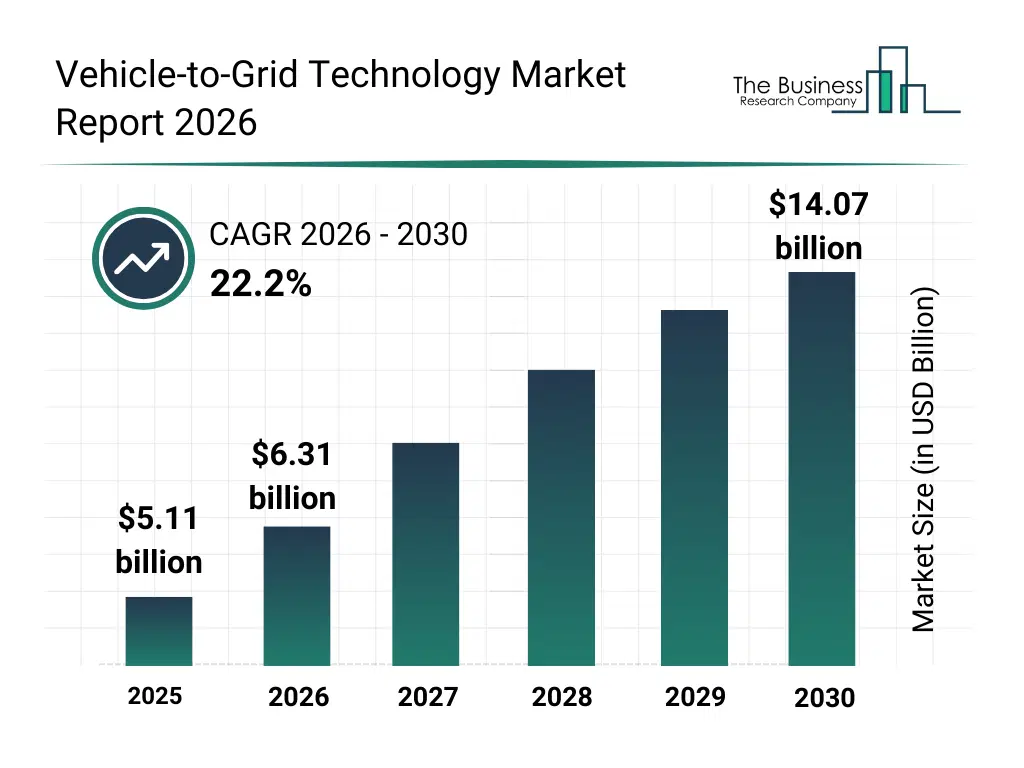
What Is The Vehicle-to-Grid Technology Market Size and Share 2026?
The vehicle-to-grid technology market size has grown exponentially in recent years. It will grow from $5.11 billion in 2025 to $6.31 billion in 2026 at a compound annual growth rate (CAGR) of 23.4%. The growth in the historic period can be attributed to increasing adoption of evs, growth of renewable energy generation, rising energy storage requirements, early government incentives, deployment of smart meters.What Is The Vehicle-to-Grid Technology Market Growth Forecast?
The vehicle-to-grid technology market size is expected to see exponential growth in the next few years. It will grow to $14.07 billion in 2030 at a compound annual growth rate (CAGR) of 22.2%. The growth in the forecast period can be attributed to expansion of bidirectional charging infrastructure, integration with grid-scale energy management, rising demand for peak shaving solutions, growth in smart city and microgrid projects, adoption of advanced v2g software analytics. Major trends in the forecast period include bidirectional ev charging solutions, v2g energy management platforms, integration of renewable energy sources, peak power and spinning reserve optimization, home energy management system integration.
Global Vehicle-to-Grid Technology Market Segmentation
1) By Component: Electric Vehicle Supply Equipment (EVSE), Home Energy Management (HEM) System, Smart Meters, Software Solutions 2) By Charging Type: Unidirectional Charging, Bidirectional Charging 3) By Vehicle Type: Battery Electric Vehicle (BEV), Plug-In Hybrid Electric Vehicle (PHEV), Fuel Cell Electric Vehicle (FCEV) 4) By Application: Reactive Power, Baseload Power, Spinning Reserves, Peak Power Sales, Other Applications Subsegments: 1) By Electric Vehicle Supply Equipment (EVSE): Level 1 Chargers, Level 2 Chargers, DC Fast Chargers 2) By Home Energy Management (HEM) System: Energy Monitoring Systems, Demand Response Systems, Battery Storage Integration 3) By Smart Meters: Advanced Metering Infrastructure (AMI) Meters, Bidirectional Smart Meters 4) By Software Solutions: V2G Management Platforms, Data Analytics Software, Integration And Communication SoftwareWhat Is The Driver Of The Vehicle-to-Grid Technology Market?
The growing charging infrastructure is expected to propel the growth of the vehicle-to-grid technology market going forward. Charging infrastructure refers to the network of charging stations and related equipment that enables the charging of electric vehicles (EVs). Vehicle-to-grid technology is used in charging infrastructure to contribute to grid reliability, resilience, load management, peak shaving, enhanced renewable energy integration, reduced carbon footprint, sustainability, and can incentivize more people to adopt electric vehicles. For instance, in January 2023, according to Twilio Inc. a US-based cloud communications platform, by 2030, there would be 12.9 million publicly accessible EV charging stations. Therefore, the growing charging infrastructure is driving the growth of the vehicle-to-grid technology industry.Key Players In The Global Vehicle-to-Grid Technology Market
Major companies operating in the vehicle-to-grid technology market are Volkswagen AG; Toyota Corporation; Ford Motor Company; MercGroup AG; General Motors Company; Bayerische Motoren Werke AG (BMW); HyundAI Motor Co Ltd.; Robert Bosch GmbH; Nissan Motor Co Ltd.; BYD Company Limited; Audi AG; Volvo Group AB; Mitsubishi Electric Corporation; Jaguar Land Rover Automotive plc; NIO Inc.; Li Auto Inc.; XPeng Inc.; Rivian Automotive Inc.; Polestar AB; Lucid Motors Inc.; Fisker Inc.; Lordstown Motors Corp; Canoo Inc.; Arrival Ltd.; Proterra Inc.; Faraday Future Inc.
This chart is for illustrative purposes; the full report includes a detailed competitor analysis and comprehensive overview of the top 10 companies in the market.
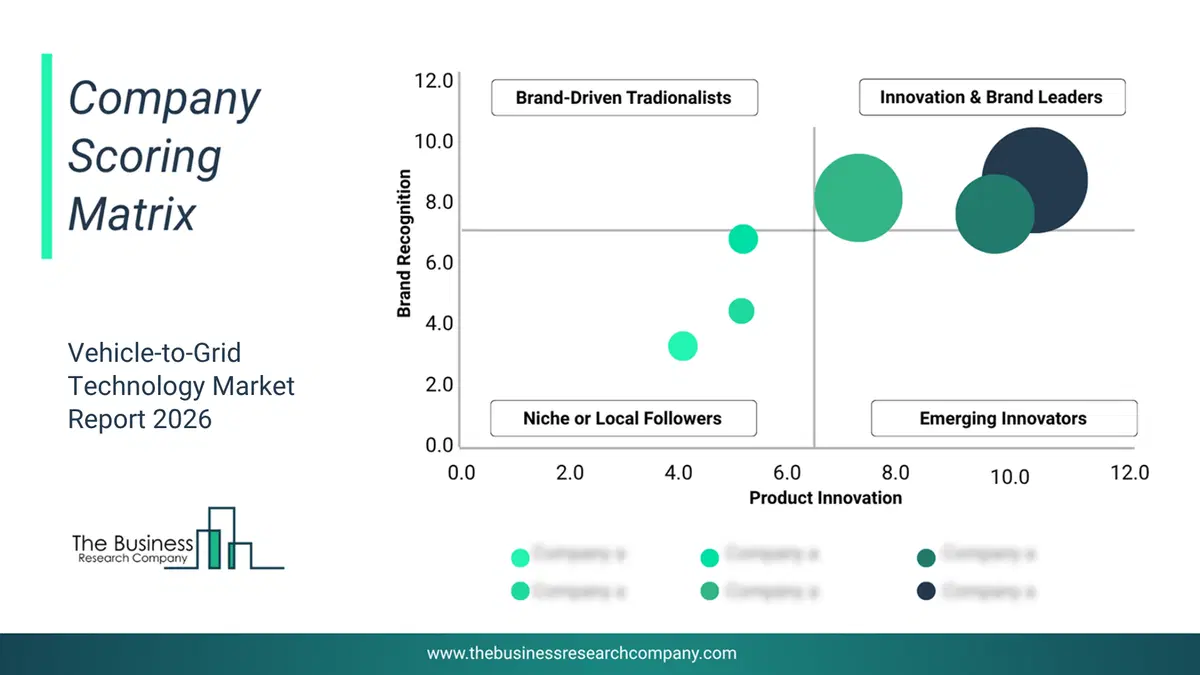
This chart maps companies by product innovation and brand strength, with bubble size indicating relative revenue, helping identify market leaders, challengers, and niche players. This is an illustrative chart; the full report provides a complete and accurate competitive analysis.
Global Vehicle-to-Grid Technology Market Trends and Insights
Major companies operating in the vehicle-to-grid technology market are forming partnerships to develop new products and strengthen their positions in the market. Collaborations and partnerships in the vehicle-to-grid technology market foster innovation, leverage complementary expertise, and accelerate the development and commercialization of advanced therapies by combining resources and capabilities. For instance, in November 2023, Toyota Motor Corporation, a Japan-based automotive manufacturer partnered with San Diego Gas & Electric Company (SDG&E), a US-based regulated public utility that provides natural gas and electricity services. Through this partnership, energy use will be optimized as we investigate the use of grid-to-power electric vehicles (EVs) that can return to the grid when needed. This partnership is aiming to identify areas of overlap between the demands of BEV owners and grid requirements.What Are Latest Mergers And Acquisitions In The Vehicle-to-Grid Technology Market?
In April 2025, Nuvve Holding Corp., a US-based company specializing in vehicle-to-grid (V2G) technology and grid modernization, acquired Fermata Energy LLC for approximately $0.000659 billion. Through this acquisition, Nuvve aims to accelerate the deployment of intelligent bidirectional energy solutions by integrating Fermata Energy’s V2G platform, optimization, and forecasting capabilities with Nuvve’s AI-driven grid intelligence and V2G hardware, enhancing services for fleets, utilities, and vehicle-to-grid applications. Fermata Energy LLC is a US-based company providing V2G platforms and solutions for electric vehicles and energy grid integration.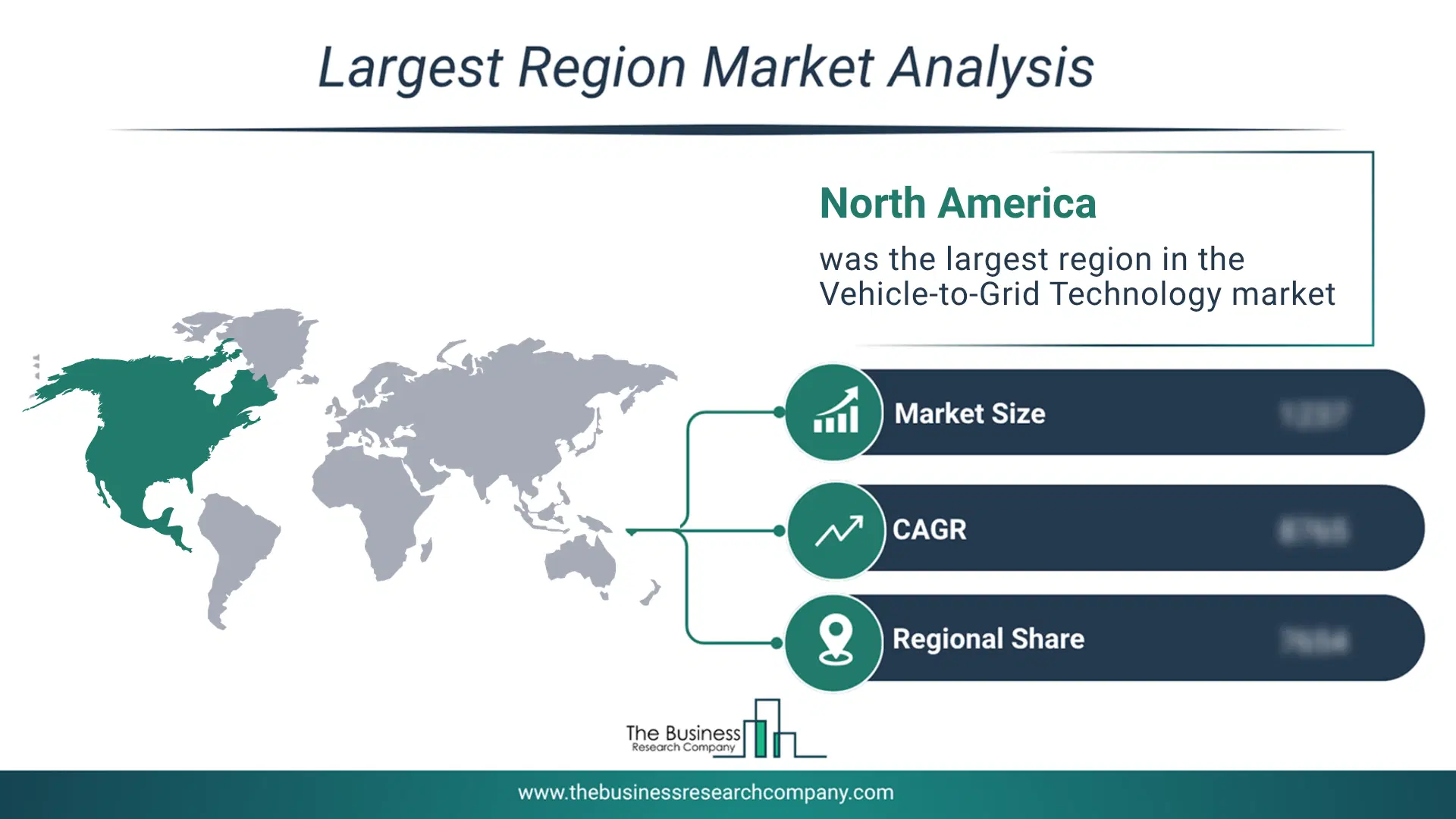
Regional Insights
North America was the largest region in the vehicle-to-grid technology market in 2025. The regions covered in this market report are Asia-Pacific, South East Asia, Western Europe, Eastern Europe, North America, South America, Middle East, Africa. The countries covered in this market report are Australia, Brazil, China, France, Germany, India, Indonesia, Japan, Taiwan, Russia, South Korea, UK, USA, Canada, Italy, SpainWhat Defines the Vehicle-to-Grid Technology Market?
The vehicle-to-grid technology market includes revenues earned by entities by providing vehicle-to-home, vehicle-to-building, and regular smart charging services. The market value includes the value of related goods sold by the service provider or included within the service offering. The vehicle-to-grid technology market also includes sales of direct current charger devices and alternating current charger devices. Values in this market are ‘factory gate’ values, that is, the value of goods sold by the manufacturers or creators of the goods, whether to other entities (including downstream manufacturers, wholesalers, distributors, and retailers) or directly to end customers. The value of goods in this market includes related services sold by the creators of the goods. The IT market is segmented into IT services, computer hardware, telecom, and software products.How is Market Value Defined and Measured?
The market value is defined as the revenues that enterprises gain from the sale of goods and/or services within the specified market and geography through sales, grants, or donations in terms of the currency (in USD unless otherwise specified). The revenues for a specified geography are consumption values that are revenues generated by organizations in the specified geography within the market, irrespective of where they are produced. It does not include revenues from resales along the supply chain, either further along the supply chain or as part of other products.
This chart presents market attractiveness based on a quantitative evaluation of growth, competition, strategic alignment, and risk, offering a clear view of opportunity areas for decision-making. This chart is for illustrative purposes; the full report contains the complete analysis.

This chart highlights the Total Addressable Market (TAM) by estimating the maximum revenue opportunity using an assumption-driven approach, supporting strategic planning and opportunity sizing across markets. The chart is illustrative; the full report provides a more comprehensive analysis.
What Key Data and Analysis Are Included in the Vehicle-to-Grid Technology Market Report 2026?
The vehicle-to-grid technology market research report is one of a series of new reports from The Business Research Company that provides market statistics, including industry global market size, regional shares, competitors with the market share, detailed market segments, market trends and opportunities, and any further data you may need to thrive in the vehicle-to-grid technology industry. The market research report delivers a complete perspective of everything you need, with an in-depth analysis of the current and future state of the industry.Vehicle-to-Grid Technology Market Report Forecast Analysis
| Report Attribute | Details |
|---|---|
| Market Size Value In 2026 | $6.31 billion |
| Revenue Forecast In 2030 | $14.07 billion |
| Growth Rate | CAGR of 22.2% from 2026 to 2030 |
| Base Year For Estimation | 2025 |
| Actual Estimates/Historical Data | 2020-2025 |
| Forecast Period | 2026 - 2030 |
| Market Representation | Revenue in USD Billion and CAGR from 2026 to 2030 |
| Segments Covered | Component, Charging Type, Vehicle Type, Application |
| Regional Scope | Asia-Pacific, Western Europe, Eastern Europe, North America, South America, Middle East, Africa |
| Country Scope | The Countries Covered In This Market Report Are Australia, Brazil, China, France, Germany, India, Indonesia, Japan, Taiwan, Russia, South Korea, Uk, Usa, Canada, Italy, Spain. |
| Key Companies Profiled | Volkswagen AG, Toyota Corporation, Ford Motor Company, MercGroup AG, General Motors Company, Bayerische Motoren Werke AG (BMW), HyundAI Motor Co Ltd., Robert Bosch GmbH, Nissan Motor Co Ltd., BYD Company Limited, Audi AG, Volvo Group AB, Mitsubishi Electric Corporation, Jaguar Land Rover Automotive plc, NIO Inc., Li Auto Inc., XPeng Inc., Rivian Automotive Inc., Polestar AB, Lucid Motors Inc., Fisker Inc., Lordstown Motors Corp, Canoo Inc., Arrival Ltd., Proterra Inc., Faraday Future Inc. |
| Customization Scope | Request for Customization |
| Pricing And Purchase Options | Explore Purchase Options |