
Ventricular Fibrillation Market Report 2026
Global Outlook – By Treatment (Cardiopulmonary Resuscitation (CPR), Defibrillation, Medication, Catheter Ablation, Left Cardiac Sympathetic Denervation), By Diagnostic Techniques (Electrocardiogram, Electrophysiology Study), By End-User (Hospitals, Ambulatory Surgical Centers, Specialty Clinics, Other End-users) – Market Size, Trends, Strategies, and Forecast to 2030
Ventricular Fibrillation Market Overview
• Ventricular Fibrillation market size has reached to $6.51 billion in 2025 • Expected to grow to $8.56 billion in 2030 at a compound annual growth rate (CAGR) of 5.5% • Growth Driver: The Rising Burden of Cardiovascular Diseases Fueling Market Growth Due to Increasing Global Mortality and Disease Severity • Market Trend: Technological Advancements In AI Algorithms For Ventricular Fibrillation Detection • North America was the largest region in 2025.What Is Covered Under Ventricular Fibrillation Market?
Ventricular fibrillation refers to a type of abnormal heart rhythm where the lower chambers of the heart ventricles contract in a very rapid and uncoordinated manner, leading to a lack of blood pumping to the rest of the body. This condition is a life-threatening emergency that requires immediate medical attention and is often fatal if not treated quickly. The treatment of ventricular fibrillation includes cardiopulmonary resuscitation (CPR), defibrillation, medication, catheter ablation, and left cardiac sympathetic denervation. CPR, or cardiopulmonary resuscitation, is a life-saving technique involving chest compressions and rescue breaths to restore blood circulation and breathing when someone's heart or breathing has stopped. Various diagnostic techniques, including electrocardiograms, blood tests, echocardiograms, electrophysiology studies, and x-rays, and are used by various end-users, including hospitals, ambulatory surgical centers, specialty clinics, and others.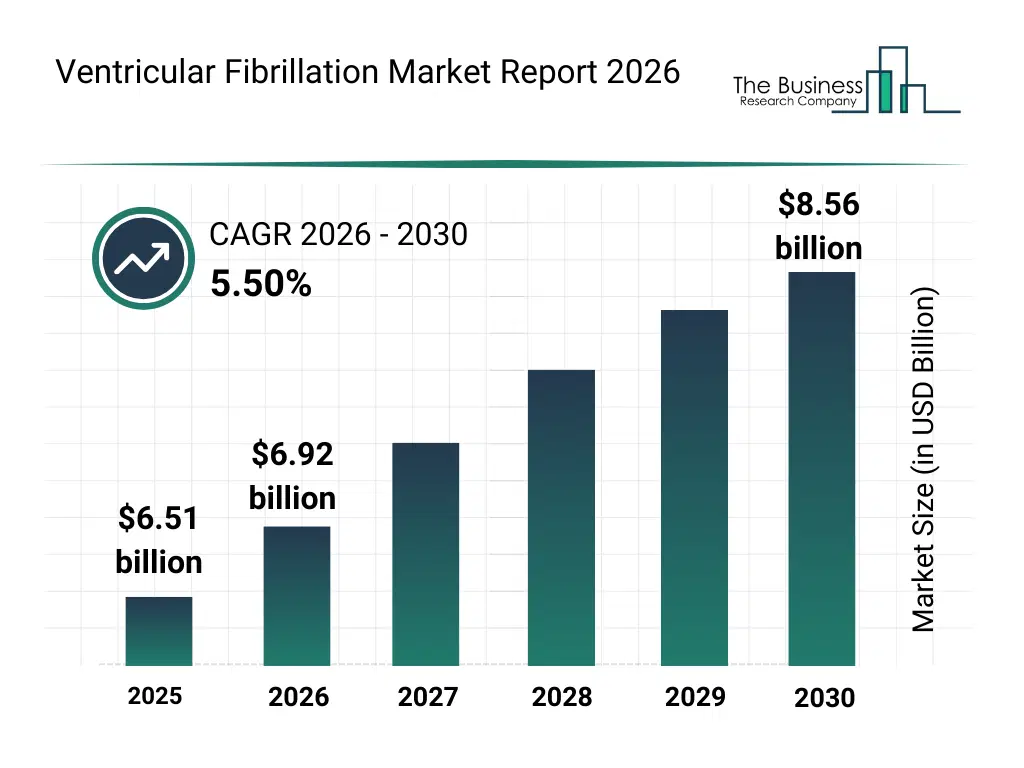
What Is The Ventricular Fibrillation Market Size and Share 2026?
The ventricular fibrillation market size has grown strongly in recent years. It will grow from $6.51 billion in 2025 to $6.92 billion in 2026 at a compound annual growth rate (CAGR) of 6.2%. The growth in the historic period can be attributed to rising incidence of sudden cardiac arrest, expansion of emergency medical services, increased availability of defibrillation devices, improvements in cardiopulmonary resuscitation techniques, growth of hospital-based cardiac care.What Is The Ventricular Fibrillation Market Growth Forecast?
The ventricular fibrillation market size is expected to see strong growth in the next few years. It will grow to $8.56 billion in 2030 at a compound annual growth rate (CAGR) of 5.5%. The growth in the forecast period can be attributed to increasing deployment of public access defibrillators, rising investments in cardiac monitoring technologies, expansion of minimally invasive cardiac treatments, growing integration of ai-driven arrhythmia detection, increased focus on survival outcome improvement. Major trends in the forecast period include increasing adoption of advanced defibrillation technologies, rising use of automated external defibrillators, growing integration of real-time cardiac monitoring, expansion of emergency cardiac care infrastructure, enhanced focus on rapid response systems.
Global Ventricular Fibrillation Market Segmentation
1) By Treatment: Cardiopulmonary Resuscitation (CPR), Defibrillation, Medication, Catheter Ablation, Left Cardiac Sympathetic Denervation 2) By Diagnostic Techniques: Electrocardiogram, Electrophysiology Study 3) By End-User: Hospitals, Ambulatory Surgical Centers, Specialty Clinics, Other End-users Subsegments: 1) By Cardiopulmonary Resuscitation (CPR): Manual Chest Compressions, Mechanical Chest Compressions 2) By Defibrillation: Automated External Defibrillators (AEDs), Implantable Cardioverter Defibrillators (ICDs), External Defibrillators 3) By Medication: Antiarrhythmic Drugs, Beta-Blockers, Vasopressors 4) By Catheter Ablation: Radiofrequency Ablation, Cryoablation, Laser Ablation 5) By Left Cardiac Sympathetic Denervation: Surgical Procedure for Sympathetic Denervation, Endoscopic Denervation TechniquesWhat Is The Driver Of The Ventricular Fibrillation Market?
The growing prevalence of cardiovascular diseases (CVD) is expected to propel the growth of the ventricular fibrillation market going forward. Cardiovascular diseases are a group of disorders affecting the heart and blood vessels, including coronary artery disease, hypertension, heart failure, and life-threatening arrhythmias such as ventricular fibrillation. The rise in CVD cases is driven by factors such as sedentary lifestyles, poor diet, obesity, smoking, stress, and aging populations. Ventricular fibrillation represents one of the most severe complications of CVD, often leading to sudden cardiac arrest and significantly increasing mortality risk. For instance, in January 2024, according to the American Heart Association, a US-based non-profit organization, the age-adjusted death rate from cardiovascular disease increased to 233.3 per 100,000 in 2024, up 4.0% from 224.4 per 100,000 in 2023. Therefore, the rising burden of cardiovascular diseases is driving the growth of the ventricular fibrillation industry.Key Players In The Global Ventricular Fibrillation Market
Major companies operating in the ventricular fibrillation market are Abbott Laboratories, Medtronic plc, GE HealthCare Technologies Inc., Boston Scientific Corporation, Philips Healthcare, St. Jude Medical Inc., Mindray Medical International Limited, ZOLL Medical Corporation, Biotronik, Nihon Kohden Corporation, LivaNova, Fukuda Denshi Co. Ltd., Laerdal Medical Corporation, Schiller AG, Physio-Control, Cardiac Science Corporation, CU Medical Systems Inc., Defibtech LLC, Progetti Srl, HeartSine Technologies
This chart is for illustrative purposes; the full report includes a detailed competitor analysis and comprehensive overview of the top 10 companies in the market.
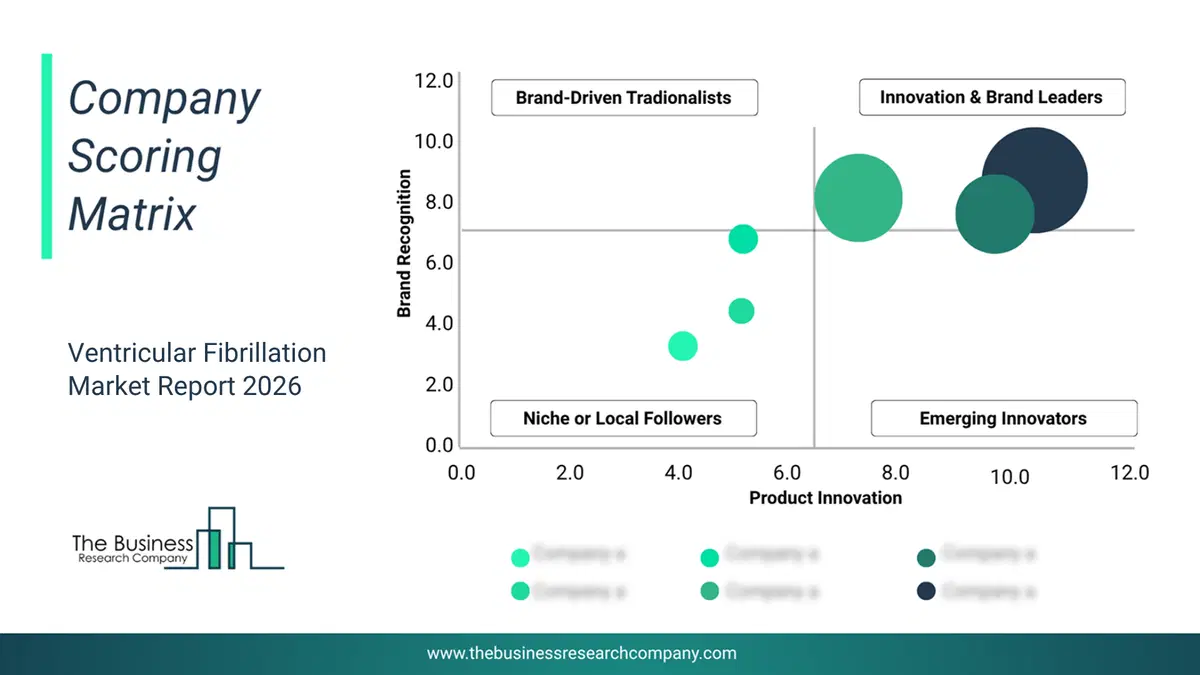
This chart maps companies by product innovation and brand strength, with bubble size indicating relative revenue, helping identify market leaders, challengers, and niche players. This is an illustrative chart; the full report provides a complete and accurate competitive analysis.
Global Ventricular Fibrillation Market Trends and Insights
Major companies operating in the ventricular fibrillation market are focusing on developing innovative technologies, such as advanced artificial intelligence (AI) algorithms, to enhance the accuracy and efficiency of cardiac diagnostics. AI algorithms are instructions that enable machines to analyze data, perform tasks, and make decisions. This significantly improves the accuracy of atrial fibrillation (AF) detection, a leading precursor to stroke, by enhancing the specificity and sensitivity of consumer ECG devices. For instance, in January 2024, PulseAI, an Ireland-based medical technology company, developed a cutting-edge AI algorithm designed to enhance the accuracy and efficiency of ECG diagnostics. This innovative technology utilizes machine learning to analyze electrocardiogram readings, detecting even subtle patterns and anomalies that may indicate cardiovascular disease or other conditions. By streamlining the analysis process and reducing interpretation errors, PulseAI's algorithm aims to improve patient outcomes and revolutionize the field of cardiac care.What Are Latest Mergers And Acquisitions In The Ventricular Fibrillation Market?
In April 2023, Abbott, a US-based medical device company, acquired Cardiovascular Systems Inc. for an undisclosed amount. The acquisition allows Abbott to expand its vascular device offerings and provide more tools to help patients with complex cardiovascular conditions. Cardiovascular Systems Inc. is a US-based company specializing in developing and commercializing innovative solutions for treating vascular and coronary disease.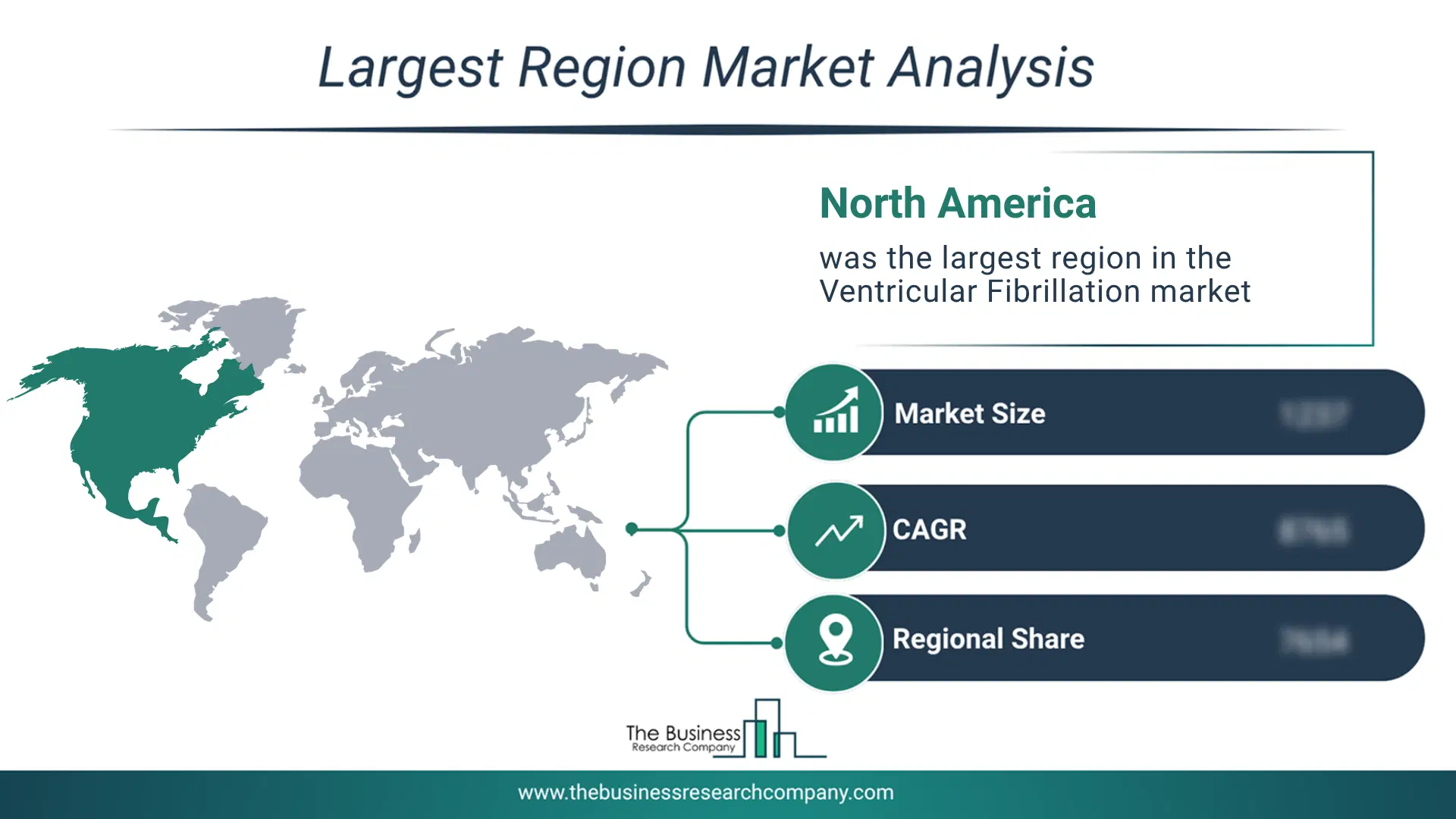
Regional Outlook
North America was the largest region in the ventricular fibrillation market in 2025. The regions covered in this market report are Asia-Pacific, South East Asia, Western Europe, Eastern Europe, North America, South America, Middle East, Africa. The countries covered in this market report are Australia, Brazil, China, France, Germany, India, Indonesia, Japan, Taiwan, Russia, South Korea, UK, USA, Canada, Italy, SpainWhat Defines the Ventricular Fibrillation Market?
The ventricular fibrillation market consists of revenues earned by entities by providing services such as ventricular fibrillation diagnostics, treatment, management, and support services for hospital and clinic applications. The market value includes the value of related goods sold by the service provider or included within the service offering. The ventricular fibrillation market also includes sales of automated external defibrillators, cardiac monitors, and electrocardiogram (ECG) machines. Values in this market are ‘factory gate’ values, that is the value of goods sold by the manufacturers or creators of the goods, whether to other entities (including downstream manufacturers, wholesalers, distributors and retailers) or directly to end customers. The value of goods in this market includes related services sold by the creators of the goods.How is Market Value Defined and Measured?
The market value is defined as the revenues that enterprises gain from the sale of goods and/or services within the specified market and geography through sales, grants, or donations in terms of the currency (in USD unless otherwise specified). The revenues for a specified geography are consumption values that are revenues generated by organizations in the specified geography within the market, irrespective of where they are produced. It does not include revenues from resales along the supply chain, either further along the supply chain or as part of other products.
This chart presents market attractiveness based on a quantitative evaluation of growth, competition, strategic alignment, and risk, offering a clear view of opportunity areas for decision-making. This chart is for illustrative purposes; the full report contains the complete analysis.

This chart highlights the Total Addressable Market (TAM) by estimating the maximum revenue opportunity using an assumption-driven approach, supporting strategic planning and opportunity sizing across markets. The chart is illustrative; the full report provides a more comprehensive analysis.
What Key Data and Analysis Are Included in the Ventricular Fibrillation Market Report 2026?
The ventricular fibrillation market research report is one of a series of new reports from The Business Research Company that provides market statistics, including industry global market size, regional shares, competitors with the market share, detailed market segments, market trends and opportunities, and any further data you may need to thrive in the ventricular fibrillation industry. The market research report delivers a complete perspective of everything you need, with an in-depth analysis of the current and future state of the industry.Ventricular Fibrillation Market Report Forecast Analysis
| Report Attribute | Details |
|---|---|
| Market Size Value In 2026 | $6.92 billion |
| Revenue Forecast In 2030 | $8.56 billion |
| Growth Rate | CAGR of 5.5% from 2026 to 2030 |
| Base Year For Estimation | 2025 |
| Actual Estimates/Historical Data | 2020-2025 |
| Forecast Period | 2026 - 2030 |
| Market Representation | Revenue in USD Billion and CAGR from 2026 to 2030 |
| Segments Covered | Treatment, Diagnostic Techniques, End-User |
| Regional Scope | Asia-Pacific, Western Europe, Eastern Europe, North America, South America, Middle East, Africa |
| Country Scope | The countries covered in the report are Australia, Brazil, China, France, Germany, India, Indonesia, Japan, Taiwan, Russia, South Korea, UK, USA, Canada, Italy, Spain. |
| Key Companies Profiled | Abbott Laboratories, Medtronic plc, GE HealthCare Technologies Inc., Boston Scientific Corporation, Philips Healthcare, St. Jude Medical Inc., Mindray Medical International Limited, ZOLL Medical Corporation, Biotronik, Nihon Kohden Corporation, LivaNova, Fukuda Denshi Co. Ltd., Laerdal Medical Corporation, Schiller AG, Physio-Control, Cardiac Science Corporation, CU Medical Systems Inc., Defibtech LLC, Progetti Srl, HeartSine Technologies |
| Customization Scope | Request for Customization |
| Pricing And Purchase Options | Explore Purchase Options |