
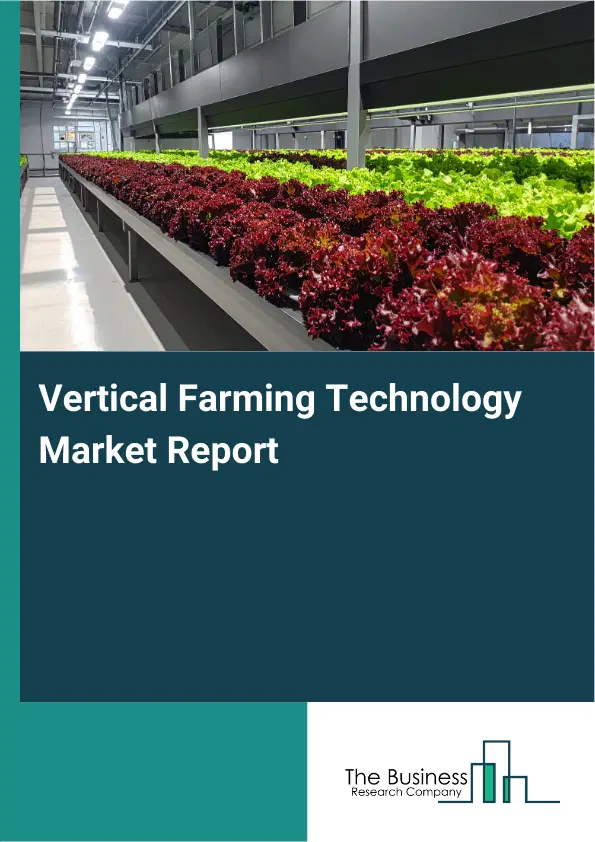
Vertical Farming Technology Market Report 2026
Global Outlook – By Type (Indoor Farming, Outdoor Farming), By Installation Type (On-Site Installed, Pre-Installed), By Growing Technology (Hydroponic And Aeroponic Farming, Aquaponic Farming), By Application (Vegetable Cultivation, Fruit Planting, Other Applications), By End User (Agricultural Industry, Restaurants And Other Food Services, Home Users) – Market Size, Trends, Strategies, and Forecast to 2030
Vertical Farming Technology Market Overview
• Vertical Farming Technology market size has reached to $7.84 billion in 2025 • Expected to grow to $24.03 billion in 2030 at a compound annual growth rate (CAGR) of 25% • Growth Driver: Increasing Demand For Sustainable Agricultural Methods Drives Market Due To Resource Efficiency And Environmental Benefits • Market Trend: Inflatable Aeroponic Systems Redefine Sustainable Farming In Urban And Arid Regions • North America was the largest region in 2025 and Asia-Pacific is the fastest growing region.What Is Covered Under Vertical Farming Technology Market?
Vertical farming technology is an agricultural method that involves growing crops in stacked layers or vertically inclined surfaces, often in controlled indoor environments. This technology utilizes hydroponics, aeroponics, and aquaponics to grow plants without soil, maximizing space and water efficiency. Vertical farming technology enables year-round production, reduces land use, and can be implemented in urban areas, making it a sustainable solution for food production. The main types of vertical farming technology are indoor farming and outdoor farming. Indoor farming, a key aspect of vertical farming technology, involves controlled-environment agriculture within enclosed spaces to optimize resource efficiency, enable year-round cultivation, and maximize crop yield regardless of external climate conditions. It is on-site installed and pre-installed using growing technology such as hydroponic and aeroponic farming and aquaponic farming. The applications of this technology are vegetable cultivation, fruit planting, and others having end users such as the agricultural industry, restaurants and other food services, and home users.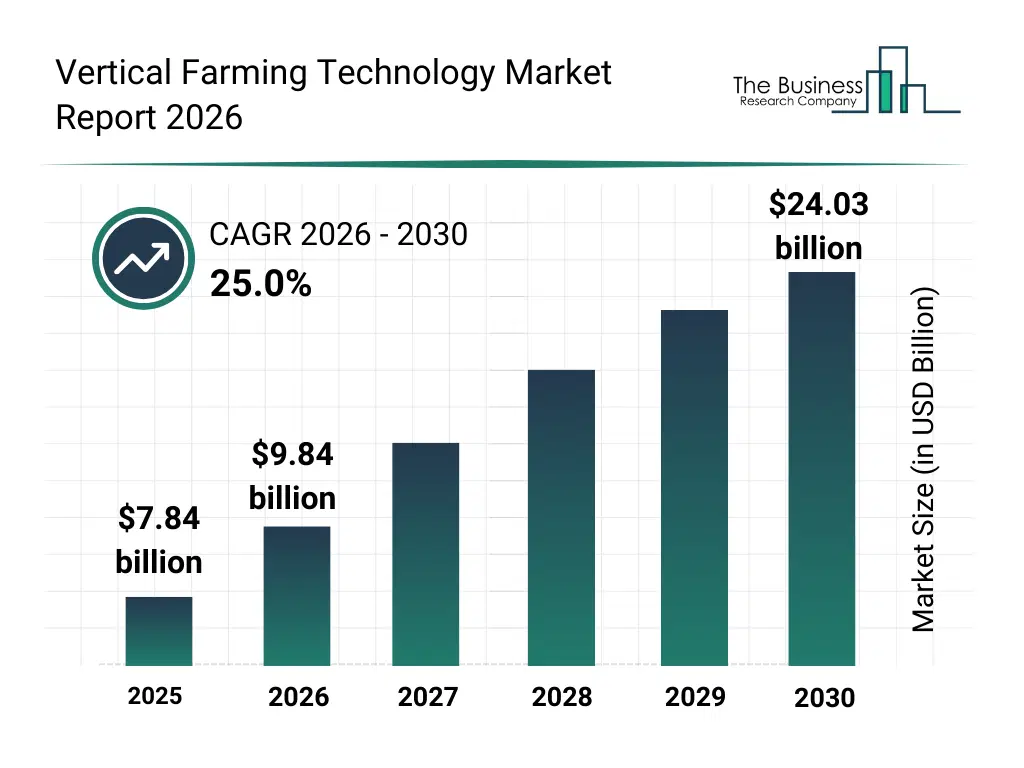
What Is The Vertical Farming Technology Market Size and Share 2026?
The vertical farming technology market size has grown exponentially in recent years. It will grow from $7.84 billion in 2025 to $9.84 billion in 2026 at a compound annual growth rate (CAGR) of 25.5%. The growth in the historic period can be attributed to increasing urban population density, early adoption of hydroponic systems, demand for pesticide-free produce, limited arable land availability, growth in greenhouse farming.What Is The Vertical Farming Technology Market Growth Forecast?
The vertical farming technology market size is expected to see exponential growth in the next few years. It will grow to $24.03 billion in 2030 at a compound annual growth rate (CAGR) of 25.0%. The growth in the forecast period can be attributed to expansion of sustainable food systems, rising demand for high-yield indoor production, increasing investment in smart farming technologies, growth in urban commercial farms, focus on climate-resilient food production. Major trends in the forecast period include growing adoption of stacked crop cultivation, rising use of hydroponic and aeroponic growing techniques, expansion of controlled indoor farming systems, increasing focus on water-efficient cultivation, rising demand for urban food production.
Global Vertical Farming Technology Market Segmentation
1) By Type: Indoor Farming, Outdoor Farming 2) By Installation Type: On-Site Installed, Pre-Installed 3) By Growing Technology: Hydroponic And Aeroponic Farming, Aquaponic Farming 4) By Application: Vegetable Cultivation, Fruit Planting, Other Applications 5) By End User: Agricultural Industry, Restaurants And Other Food Services, Home Users Subsegments: 1) By Indoor Farming: Hydroponics, Aeroponics, Aquaponics, Soil-Based Vertical Farming, Hybrid Vertical Farming 2) By Outdoor Farming: Rooftop Farming, Container Farming, Greenhouse Vertical FarmingWhat Is Driver Of The Vertical Farming Technology Market?
The increasing demand for sustainable agricultural methods is expected to drive the vertical farming technology market going forward. Sustainable agricultural methods are practices designed to meet the food needs of the present without compromising the ability of future generations to meet their own needs. These methods focus on preserving the environment, conserving resources, and promoting social and economic equity. The rising demand for sustainable agricultural methods is fueled by the need to minimize environmental harm, conserve water and land resources, enhance food security, combat climate change, reduce chemical dependency, and promote long-term agricultural productivity. The vertical farming technology contributes significantly to the growing demand for sustainable agrarian methods by enabling high-density crop production in urban settings, utilizing less land, conserving water, reducing carbon emissions, minimizing pesticide use, and promoting year-round cultivation, all while enhancing resource efficiency and supporting local food systems. For instance, in December 2024, according to the Department for Environment, Food & Rural Affairs, a UK-based government department, across the UK, the land area covered by Agri-Environment Schemes (AES) for sustainable agriculture grew to 5.87 million hectares in 2023. Therefore, the increasing demand for sustainable agricultural methods drives the vertical farming technology industry.Key Players In The Global Vertical Farming Technology Market
Major companies operating in the vertical farming technology market are Signify Holding, Swegreen, Bowery Farming Inc., SPREAD Co. Ltd., Plenty Unlimited Inc., Lufa Farms, IGS Ltd., AeroFarms LLC, Freight Farms Inc., MIRAI Official HP, SANANBIO, Vertical Future Ltd., Grow Pod Solutions, Sky Greens, Vertical Farm Systems Pty Ltd, Eden Green Technology, Urban Crop Solutions, Hort Americas LLC, TruLeaf, Gronska Stadsodling, iFarm
This chart is for illustrative purposes; the full report includes a detailed competitor analysis and comprehensive overview of the top 10 companies in the market.
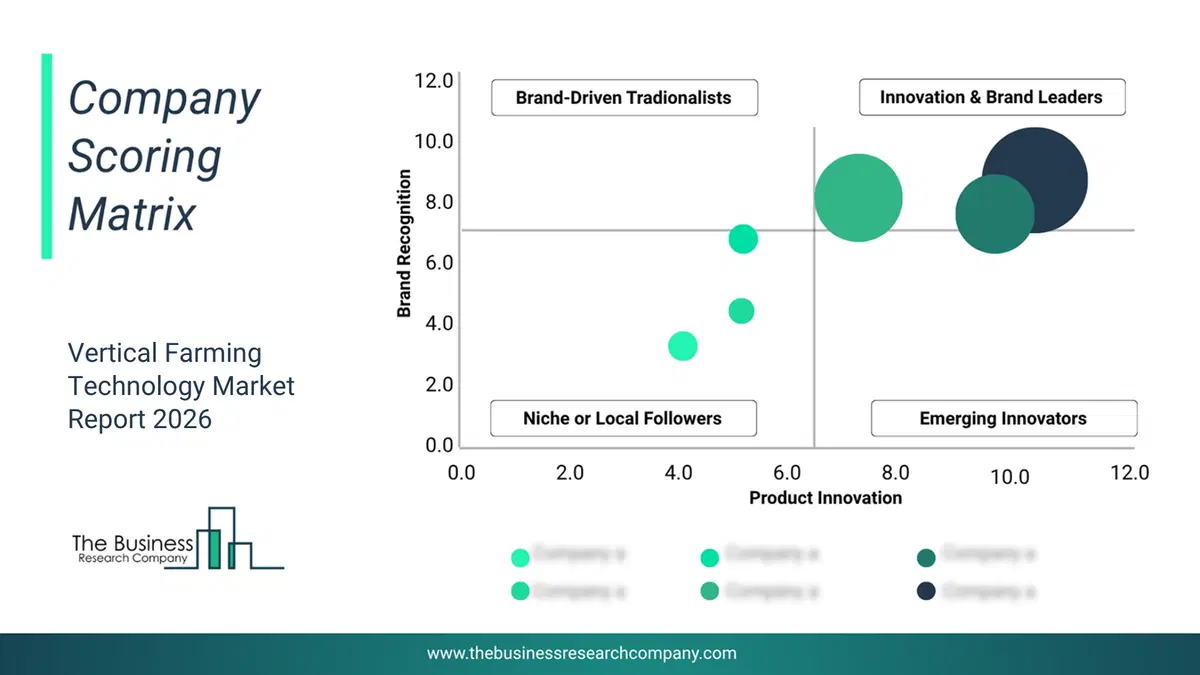
This chart maps companies by product innovation and brand strength, with bubble size indicating relative revenue, helping identify market leaders, challengers, and niche players. This is an illustrative chart; the full report provides a complete and accurate competitive analysis.
Global Vertical Farming Technology Market Trends and Insights
Major companies operating in the vertical farming technology market are focusing on developing innovative advancements such as inflatable aeroponic farming systems to enhance sustainable food production in resource-constrained and urban environments. An inflatable aeroponic farming system is a modular, lightweight indoor cultivation unit that uses a fine nutrient mist to nourish plant roots within a controlled environment, enabling efficient water use, rapid crop growth, and adaptability to diverse locations. For instance, in January 2025, AirFarm, a Jordan-based agricultural technology company, launched FOOD ARK, an inflatable aeroponic farming solution. The system integrates patented water vapor conversion and recirculation technology with smart monitoring capabilities to achieve exceptional water efficiency and automation in crop cultivation. Its compact, flat-packable design allows rapid deployment and scalability, making it suitable for both urban and arid regions where traditional farming is limited.What Are Latest Mergers And Acquisitions In The Vertical Farming Technology Market? Kalera Acquired By Lactuca Holdings To Accelerate Growth And Expansion In Vertical Farming
In October 2023, Lactuca Holdings, a US-based agricultural technology company, acquired Kalera for an undisclosed amount. The acquisition, backed by Sandton Capital Partners, will support Kalera's growth, strengthen customer relationships, and help scale operations with new partners. Kalera plans to increase production, expand its micro-green portfolio, and license its technology to other vertical growers. The company will continue operating under its premium brand with its current leadership in place. Kalera is a US-based vertical farming company.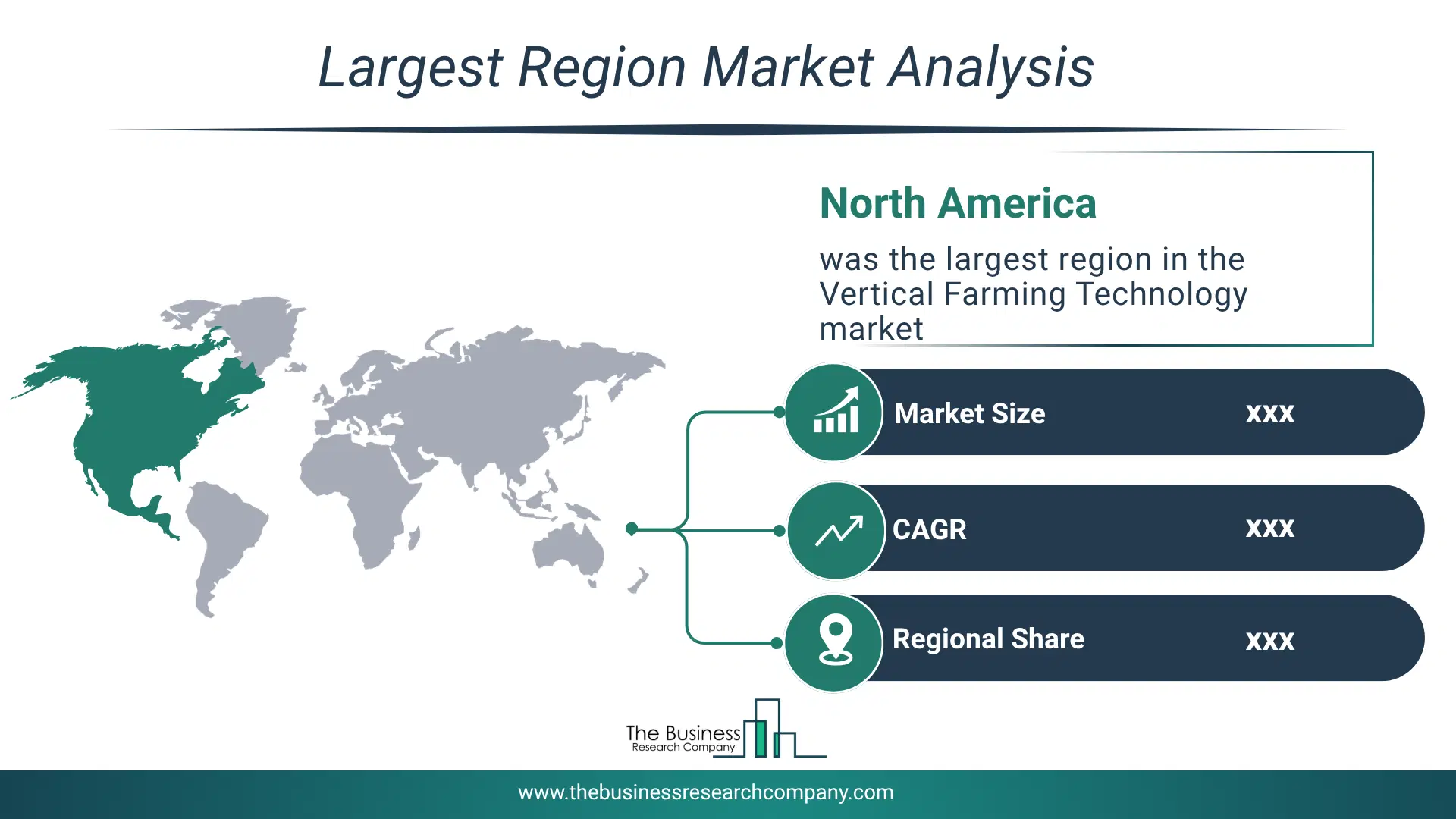
Regional Outlook
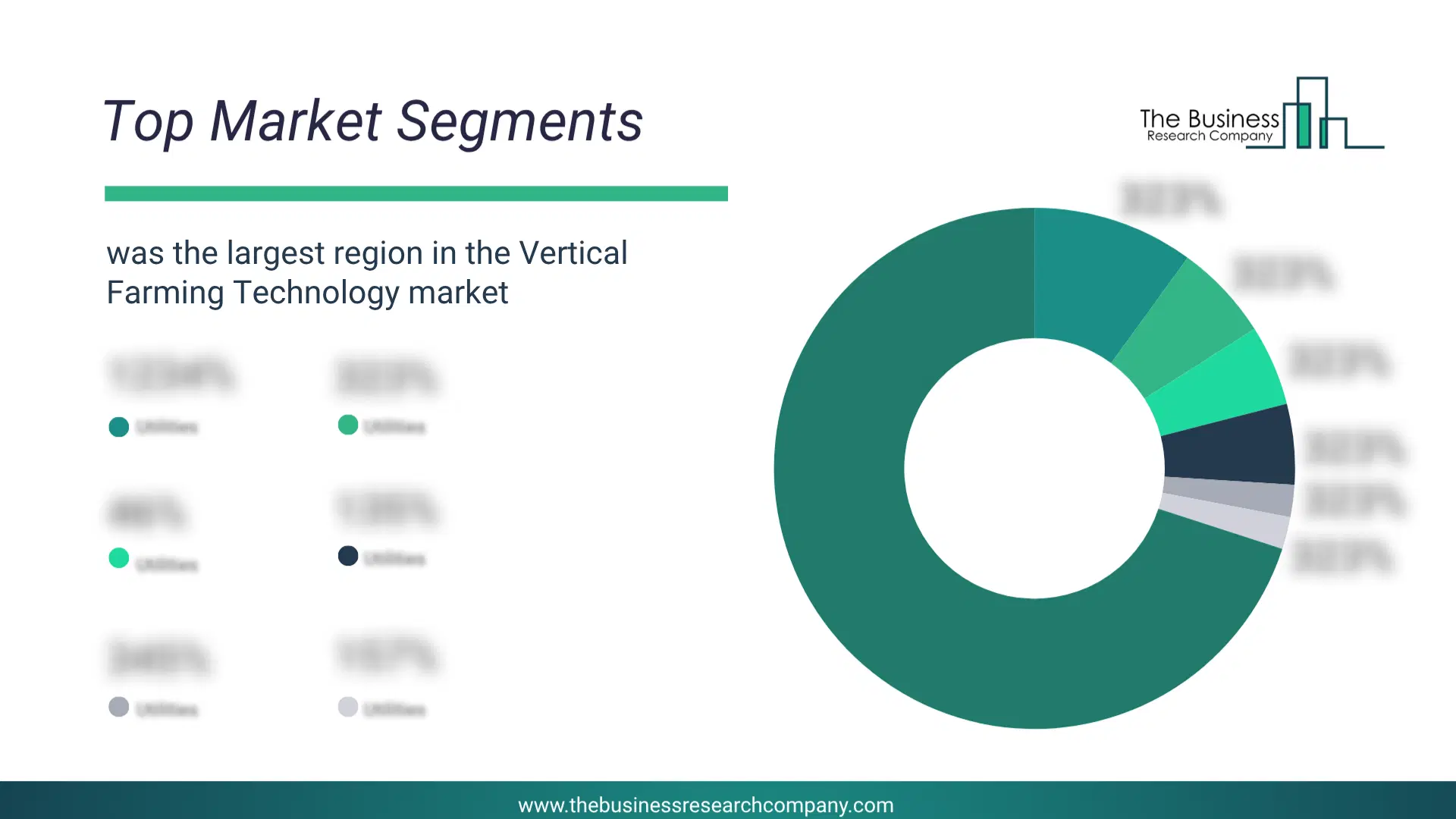
North America was the largest region in the vertical farming technology market in 2025. Asia-Pacific is expected to be the fastest-growing region in the forecast period. The regions covered in this market report are Asia-Pacific, South East Asia, Western Europe, Eastern Europe, North America, South America, Middle East, Africa. The countries covered in this market report are Australia, Brazil, China, France, Germany, India, Indonesia, Japan, Taiwan, Russia, South Korea, UK, USA, Canada, Italy, SpainWhat Defines the Vertical Farming Technology Market?
The vertical farming technology market consists of revenues earned by entities by providing services such as managed services, assisted professional services, automation services, and system integration and consulting. The market value includes the value of related goods sold by the service provider or included within the service offering. The vertical farming technology market also includes sales of lighting systems, hydroponic components, sensors, and climate control systems. Values in this market are ‘factory gate’ values, that is, the value of goods sold by the manufacturers or creators of the goods, whether to other entities (including downstream manufacturers, wholesalers, distributors, and retailers) or directly to end customers. The value of goods in this market includes related services sold by the creators of the goods.How is Market Value Defined and Measured?
The market value is defined as the revenues that enterprises gain from the sale of goods and/or services within the specified market and geography through sales, grants, or donations in terms of the currency (in USD unless otherwise specified). The revenues for a specified geography are consumption values that are revenues generated by organizations in the specified geography within the market, irrespective of where they are produced. It does not include revenues from resales along the supply chain, either further along the supply chain or as part of other products.
This chart presents market attractiveness based on a quantitative evaluation of growth, competition, strategic alignment, and risk, offering a clear view of opportunity areas for decision-making. This chart is for illustrative purposes; the full report contains the complete analysis.

This chart highlights the Total Addressable Market (TAM) by estimating the maximum revenue opportunity using an assumption-driven approach, supporting strategic planning and opportunity sizing across markets. The chart is illustrative; the full report provides a more comprehensive analysis.
What Key Data and Analysis Are Included in the Vertical Farming Technology Market Report 2026?
The vertical farming technology market research report is one of a series of new reports from The Business Research Company that provides market statistics, including industry global market size, regional shares, competitors with the market share, detailed market segments, market trends and opportunities, and any further data you may need to thrive in the vertical farming technology industry. The market research report delivers a complete perspective of everything you need, with an in-depth analysis of the current and future state of the industry.Vertical Farming Technology Market Report Forecast Analysis
| Report Attribute | Details |
|---|---|
| Market Size Value In 2026 | $9.84 billion |
| Revenue Forecast In 2030 | $24.03 billion |
| Growth Rate | CAGR of 25% from 2026 to 2030 |
| Base Year For Estimation | 2025 |
| Actual Estimates/Historical Data | 2020-2025 |
| Forecast Period | 2026 - 2030 |
| Market Representation | Revenue in USD Billion and CAGR from 2026 to 2030 |
| Segments Covered | Type, Installation Type, Growing Technology, Application, End User |
| Regional Scope | Asia-Pacific, Western Europe, Eastern Europe, North America, South America, Middle East, Africa |
| Country Scope | The countries covered in the report are Australia, Brazil, China, France, Germany, India, Indonesia, Japan, Taiwan, Russia, South Korea, UK, USA, Canada, Italy, Spain |
| Key Companies Profiled | Signify Holding, Swegreen, Bowery Farming Inc., SPREAD Co. Ltd., Plenty Unlimited Inc., Lufa Farms, IGS Ltd., AeroFarms LLC, Freight Farms Inc., MIRAI Official HP, SANANBIO, Vertical Future Ltd., Grow Pod Solutions, Sky Greens, Vertical Farm Systems Pty Ltd, Eden Green Technology, Urban Crop Solutions, Hort Americas LLC, TruLeaf, Gronska Stadsodling, iFarm |
| Customization Scope | Request for Customization |
| Pricing And Purchase Options | Explore Purchase Options |