

Vertical - Specific Software Market Report 2026
Global Outlook – By Type (Commerce Applications, Customer Relationship Management Applications, Supply Chain Management Applications, Enterprise Resource Planning Applications, Financial Applications, HR And Payroll Applications, Office Productivity Applications, Product Lifecycle Management Applications), By Deployment (On-Premise, Cloud), By Organization Size (Small And Medium-Sized Enterprises (SMEs), Large Enterprises), By End-User (Manufacturing, Banking, Financial Services And Insurance (BFSI), Healthcare And Pharmaceuticals, Telecom And Information Technology (IT), Government, Retail, Other End-Users) – Market Size, Trends, Strategies, and Forecast to 2030
Vertical - Specific Software Market Overview
• Vertical - Specific Software market size has reached to $313.67 billion in 2025 • Expected to grow to $519.27 billion in 2030 at a compound annual growth rate (CAGR) of 10.8% • Growth Driver: 5G Technology Adoption Fuels Growth In Vertical-Specific Software Market • Market Trend: AI-Enhanced Contract Management Solutions Strengthen Compliance And Efficiency In Legal-Heavy Industries • North America was the largest region in 2025 and Asia-Pacific is the fastest growing region.What Is Covered Under Vertical - Specific Software Market?
Vertical-specific software, also known as vertical market software, is software that is tailored to the demands of a single industry, market, or firm. It assists organizations in streamlining their processes, improving productivity, and lowering costs by delivering personalized solutions to match their specific requirements. The main types of vertical-specific software are commerce applications, customer relationship management applications, supply chain management applications, enterprise resource planning applications, financial applications, hr and payroll applications, office productivity applications, product lifecycle management applications, and others. Commercial applications software is the use of goods, tools, or intellectual property for commercial gain. The organization sizes involved are small and medium-sized enterprises (SMEs) and large enterprises which deploy software on premise and cloud for manufacturing, banking, financial services and insurance (BFSI), healthcare and pharmaceuticals, telecom and IT, government, retail, and other end-users.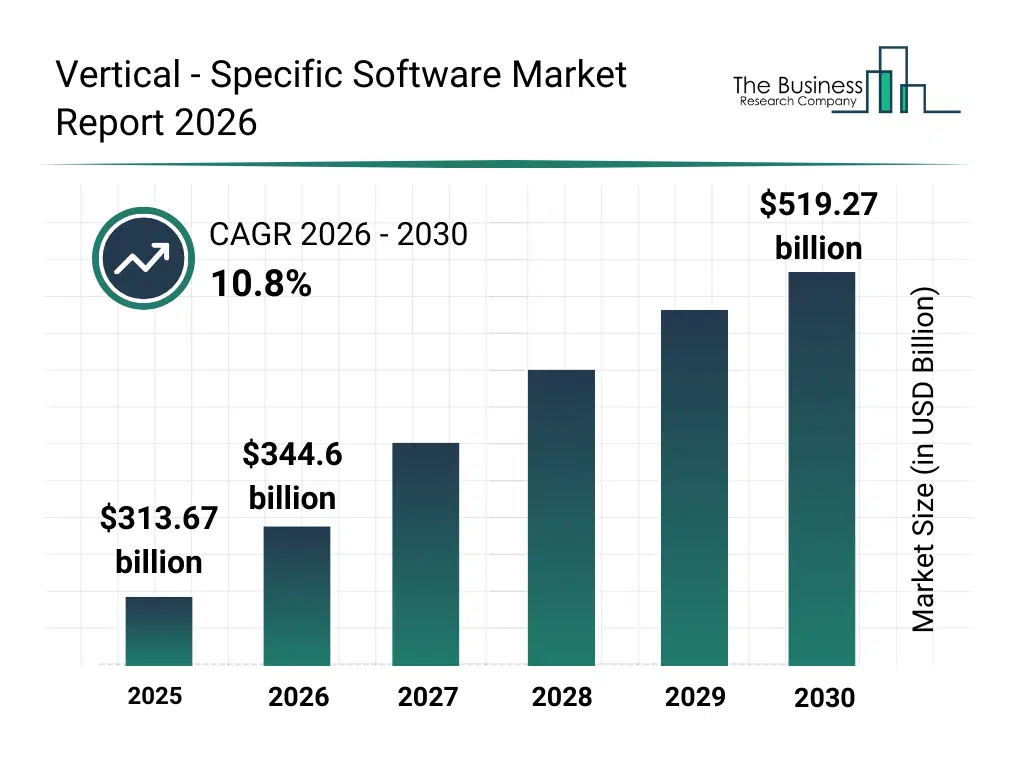
What Is The Vertical - Specific Software Market Size and Share 2026?
The vertical - specific software market size has grown strongly in recent years. It will grow from $313.67 billion in 2025 to $344.6 billion in 2026 at a compound annual growth rate (CAGR) of 9.9%. The growth in the historic period can be attributed to need for industry specific workflows, limitations of generic software, demand for operational efficiency, adoption of enterprise software solutions, growth of sector specific regulations.What Is The Vertical - Specific Software Market Growth Forecast?
The vertical - specific software market size is expected to see rapid growth in the next few years. It will grow to $519.27 billion in 2030 at a compound annual growth rate (CAGR) of 10.8%. The growth in the forecast period can be attributed to increasing digital transformation across industries, rising demand for cloud based solutions, adoption of AI driven business insights, focus on data driven decision making, expansion of smes using specialized software. Major trends in the forecast period include industry tailored software platforms, integration of analytics and reporting tools, customization for regulatory compliance, workflow automation for specific industries, subscription based software models.
Global Vertical - Specific Software Market Segmentation
1) By Type: Commerce Applications, Customer Relationship Management Applications, Supply Chain Management Applications, Enterprise Resource Planning Applications, Financial Applications, HR And Payroll Applications, Office Productivity Applications, Product Lifecycle Management Applications 2) By Deployment: On-Premise, Cloud 3) By Organization Size: Small And Medium-Sized Enterprises (SMEs), Large Enterprises 4) By End-User: Manufacturing, Banking, Financial Services And Insurance (BFSI), Healthcare And Pharmaceuticals, Telecom And Information Technology (IT), Government, Retail, Other End-Users Subsegments: 1) By Commerce Applications: E-Commerce Platforms, Point Of Sale (POS) Systems, Shopping Cart Solutions, Payment Processing Solutions 2) By Customer Relationship Management (CRM) Applications: Sales Force Automation, Customer Service And Support, Marketing Automation, Contact Management 3) By Supply Chain Management (SCM) Applications: Inventory Management, Demand Planning, Logistics Management, Supplier Relationship Management 4) By Enterprise Resource Planning (ERP) Applications: Financial Management, Manufacturing Management, Project Management, Compliance Management 5) By Financial Applications: Accounting Software, Budgeting And Forecasting Tools, Financial Reporting Solutions, Expense Management Software 6) By HR And Payroll Applications: Recruitment Software, Employee Management Systems, Payroll Processing Software, Performance Management Tools 7) By Office Productivity Applications: Word Processing Software, Spreadsheet Applications, Presentation Software, Collaboration Tools 8) By Product Lifecycle Management (PLM) Applications: Design And Development Tools, Quality Management Solutions, Regulatory Compliance Tools, Change Management SoftwareWhat Is The Driver Of The Vertical - Specific Software Market?
The adoption of 5G technology is expected to propel the growth of the vertical-specific software market going forward. 5G is the fifth generation of mobile networks that enables a new type of network that is meant to link almost everyone and everything, including machines, objects, and devices. The deployment of 5G is likely to boost the vertical-specific software industry by allowing the integration of various technologies such as IoT, AI, robots, cloud computing, and edge computing in a mobile context, resulting in the creation of new goods and services. Additionally, the growing popularity of cloud computing is boosting demand for 5G. For instance, in June 2025, according to Ericsson, a Sweden-based telecommunications company, by the end of 2024, 5G accounted for 35 percent of mobile data traffic, up from 26 percent in 2023, and is projected to rise to 80 percent by 2030. Therefore, the adoption of 5G technology will drive the vertical-specific software market.Key Players In The Global Vertical - Specific Software Market
Major companies operating in the vertical - specific software market are Microsoft Corporation; IBM Corporation; SAP SE; Oracle Corporation; Salesforce.com Inc.; Infor Inc.; Epicor Software Corporation; SYSPRO Corp.; Zoho Corporation Pvt. Ltd.; DocuSign Inc.; Granular Inc.; Naviance; ROLLER Software; Browzwear Solutions Pte Ltd.; FeedZAI Inc.; Kyndi Inc.; Act-On Software Inc.; MATRIXSPACE Inc.; Jobandtalent UK Ltd.; PayEngine Co.; SugarCRM Inc.; Pegasystems Inc.; ServiceNow Inc.; Workday Inc.; The Ultimate Kronos Group; Ceridian HCM Inc.; Paycom Software Inc.; Paylocity Holding Corporation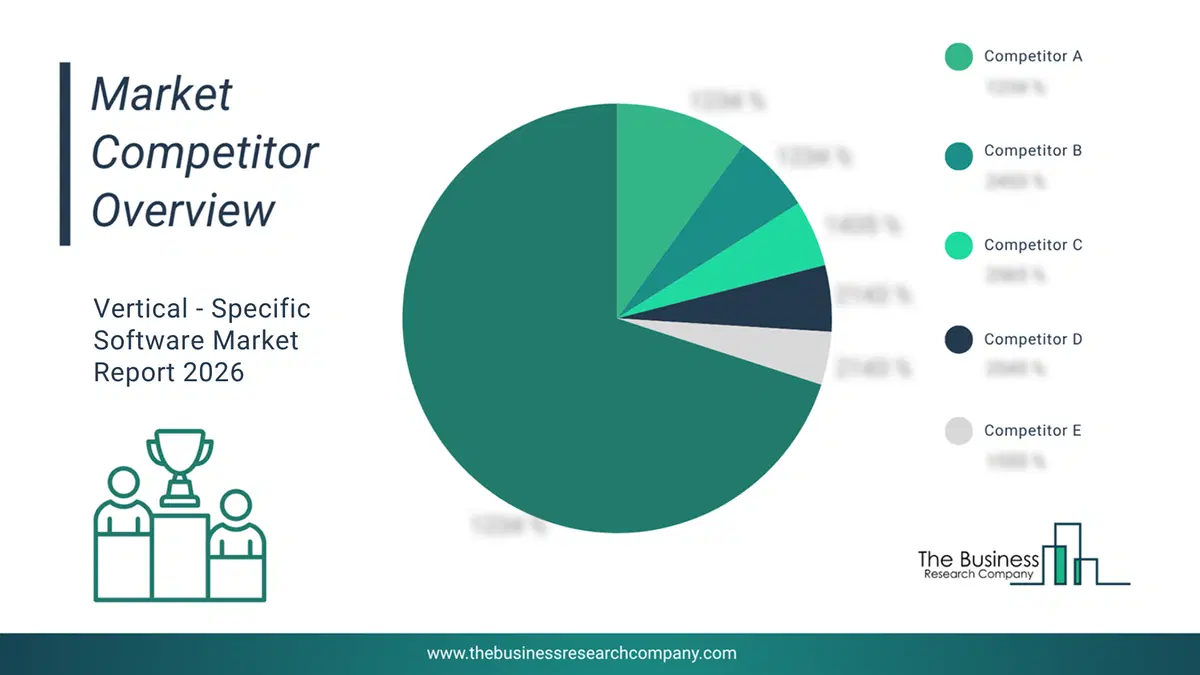
This chart is for illustrative purposes; the full report includes a detailed competitor analysis and comprehensive overview of the top 10 companies in the market.
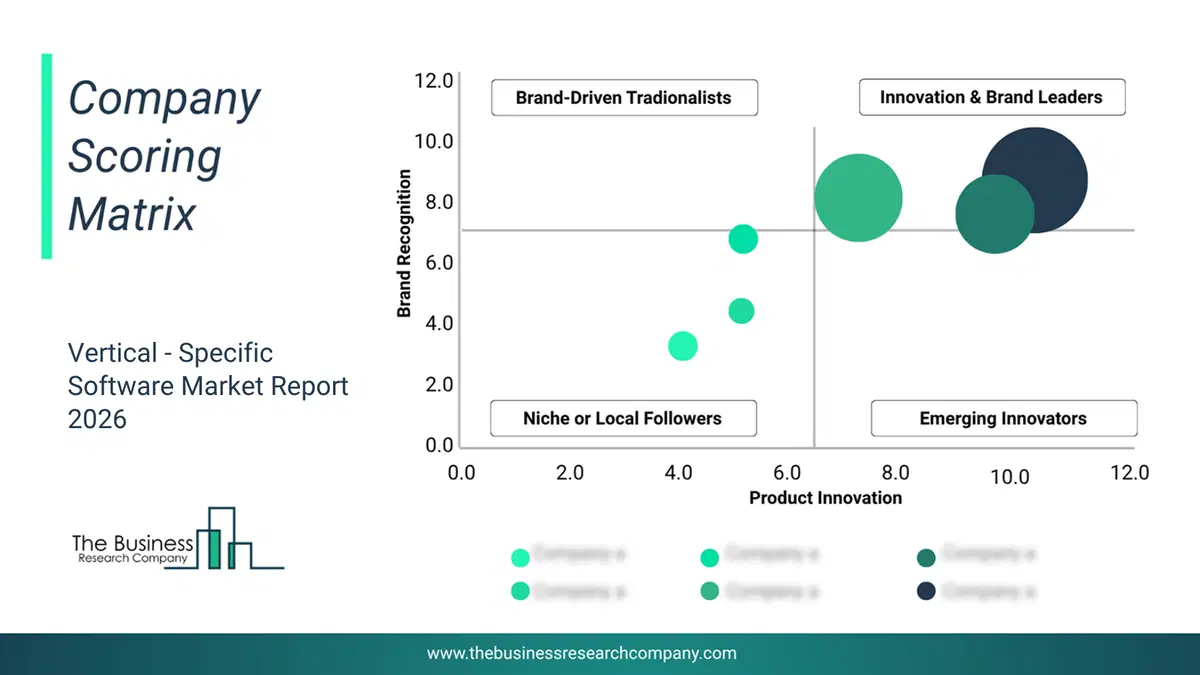
This chart maps companies by product innovation and brand strength, with bubble size indicating relative revenue, helping identify market leaders, challengers, and niche players. This is an illustrative chart; the full report provides a complete and accurate competitive analysis.
Global Vertical - Specific Software Market Trends and Insights
Major companies operating in the vertical-specific software market are focusing on developing advanced solutions, such as AI-enabled contract-management tools, to improve operational visibility, streamline workflows, and enhance regulatory compliance across legal-intensive sectors. AI-enhanced contract-management solutions utilize natural language processing (NLP) and automation to help organizations analyze, query, and manage contractual data more efficiently, thereby reducing manual review efforts, accelerating approval cycles, and minimizing risk exposure. For instance, in March 2024, Wolters Kluwer, a Netherlands-based legal and regulatory software company, launched new AI-enhanced contract-management functionality for its Legisway SaaS platform. Designed to support corporate legal departments, the solution enables users to query contracts using advanced NLP, improves visibility and control across contract portfolios, accelerates review and approval processes, reduces legal and compliance risks, and strengthens regulatory adherence within legal-heavy verticals.What Are Latest Mergers And Acquisitions In The Vertical - Specific Software Market?
In June 2024, Persistent Systems Limited, an India-based technology services company, entered into a strategic partnership with Google Cloud to accelerate enterprise digital transformation with AI-driven, industry-specific cloud solutions. The partnership aims to leverage Google Cloud’s advanced technologies, especially Gemini AI and cloud platforms, to co-develop innovative, industry-tailored solutions, expand global market reach, and drive broad adoption of generative AI while maximizing cloud ROI for enterprises. Google Cloud is a US-based cloud computing company that provides platforms, AI tools, and infrastructure enabling the development and deployment of vertical-specific software solutions.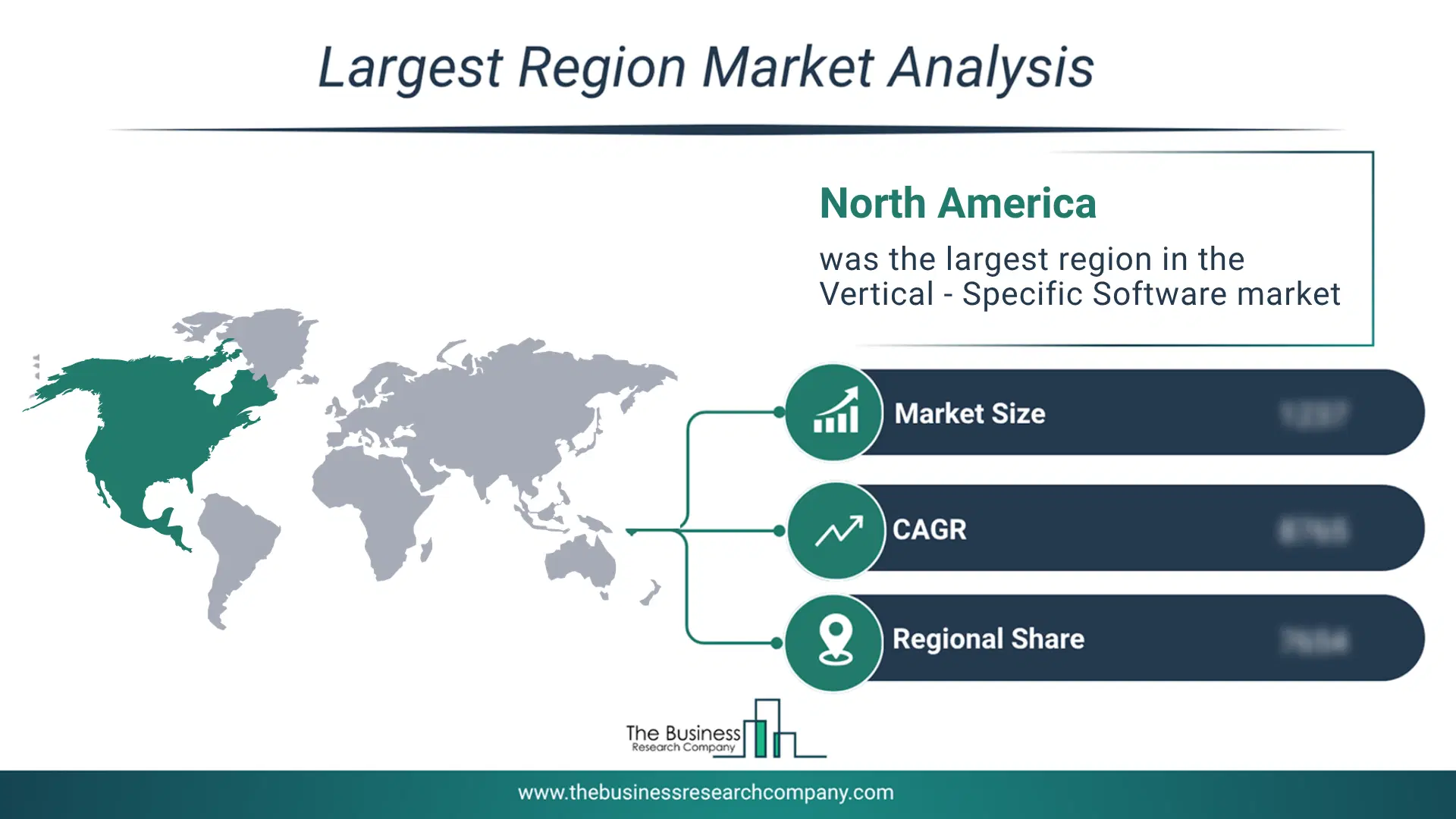
Regional Insights
North America was the largest region in the vertical-specific software market in 2025. Asia-Pacific is expected to be the fastest-growing region in the vertical-specific software market report during the forecast period. The regions covered in this market report are Asia-Pacific, South East Asia, Western Europe, Eastern Europe, North America, South America, Middle East, Africa. The countries covered in this market report are Australia, Brazil, China, France, Germany, India, Indonesia, Japan, Taiwan, Russia, South Korea, UK, USA, Canada, Italy, SpainWhat Defines the Vertical - Specific Software Market?
The vertical-specific software consists of revenues earned by entities by providing 3D modelling software, animation software, oil and gas software, military and defense software, financial services CRM systems, tax practice management software and clinical data management systems. The market value includes the value of related goods sold by the service provider or included within the service offering. Only goods and services traded between entities or sold to end consumers are included.How is Market Value Defined and Measured?
The market value is defined as the revenues that enterprises gain from the sale of goods and/or services within the specified market and geography through sales, grants, or donations in terms of the currency (in USD unless otherwise specified). The revenues for a specified geography are consumption values that are revenues generated by organizations in the specified geography within the market, irrespective of where they are produced. It does not include revenues from resales along the supply chain, either further along the supply chain or as part of other products.
This chart presents market attractiveness based on a quantitative evaluation of growth, competition, strategic alignment, and risk, offering a clear view of opportunity areas for decision-making. This chart is for illustrative purposes; the full report contains the complete analysis.

This chart highlights the Total Addressable Market (TAM) by estimating the maximum revenue opportunity using an assumption-driven approach, supporting strategic planning and opportunity sizing across markets. The chart is illustrative; the full report provides a more comprehensive analysis.
What Key Data and Analysis Are Included in the Vertical - Specific Software Market Report 2026?
The vertical - specific software market research report is one of a series of new reports from The Business Research Company that provides market statistics, including industry global market size, regional shares, competitors with the market share, detailed market segments, market trends and opportunities, and any further data you may need to thrive in the vertical - specific software industry. The market research report delivers a complete perspective of everything you need, with an in-depth analysis of the current and future state of the industry.Vertical - Specific Software Market Report Forecast Analysis
| Report Attribute | Details |
|---|---|
| Market Size Value In 2026 | $344.6 billion |
| Revenue Forecast In 2030 | $519.27 billion |
| Growth Rate | CAGR of 10.8% from 2026 to 2030 |
| Base Year For Estimation | 2025 |
| Actual Estimates/Historical Data | 2020-2025 |
| Forecast Period | 2026 - 2030 |
| Market Representation | Revenue in USD Billion and CAGR from 2026 to 2030 |
| Segments Covered | Type, Deployment, Organization Size, End-User |
| Regional Scope | Asia-Pacific, Western Europe, Eastern Europe, North America, South America, Middle East, Africa |
| Country Scope | The Countries Covered In This Market Report Are Australia, Brazil, China, France, Germany, India, Indonesia, Japan, Taiwan, Russia, South Korea, Uk, Usa, Canada, Italy, Spain. |
| Key Companies Profiled | Microsoft Corporation, IBM Corporation, SAP SE, Oracle Corporation, Salesforce.com Inc., Infor Inc., Epicor Software Corporation, SYSPRO Corp., Zoho Corporation Pvt. Ltd., DocuSign Inc., Granular Inc., Naviance, ROLLER Software, Browzwear Solutions Pte Ltd., FeedZAI Inc., Kyndi Inc., Act-On Software Inc., MATRIXSPACE Inc., Jobandtalent UK Ltd., PayEngine Co., SugarCRM Inc., Pegasystems Inc., ServiceNow Inc., Workday Inc., The Ultimate Kronos Group, Ceridian HCM Inc., Paycom Software Inc., Paylocity Holding Corporation |
| Customization Scope | Request for Customization |
| Pricing And Purchase Options | Explore Purchase Options |