
Very Low Sulphur Fuel Oil Market Report 2026
Global Outlook – By Fuel Type (Residual Based Very Low Sulphur Fuel Oil, Distillate Blend Very Low Sulphur Fuel Oil, Hybrid Blend Very Low Sulphur Fuel Oil, Other Fuel Types), By Source (Refinery, Hydrocracker), By Distribution Channel (Bunker Supply Ports, Barge To Ship Delivery, Direct Terminal Pipeline, Other Distribution Channels), By Application (Maritime Transport, Offshore Energy, Military Operations, Other Applications), By End User (Shipping Companies, Marine Operators, Oil And Gas Companies, Other End Users) – Market Size, Trends, Strategies, and Forecast to 2035
Very Low Sulphur Fuel Oil Market Overview
• Very Low Sulphur Fuel Oil market size has reached to $100.32 billion in 2025 • Expected to grow to $140.14 billion in 2030 at a compound annual growth rate (CAGR) of 7% • Growth Driver: Surge In Maritime Trade Volumes Driving The Market Growth Due To Expanding Seaborne Trade • Market Trend: Adoption Of Cleaner Marine Fuel Solutions Accelerates Amid Stricter Emission Regulations • Asia-Pacific was the largest region in 2025 and Middle East is the fastest growing region.What Is Covered Under Very Low Sulphur Fuel Oil Market?
Very low sulphur fuel oil (VLSFO) is a type of marine fuel oil that contains no more than 0.50% sulphur by mass. It is used primarily by ships to reduce emissions of harmful sulphur oxides (SOₓ) produced during fuel combustion. It serves as a cleaner alternative to traditional high-sulphur fuels, helping the shipping industry comply with environmental standards while minimizing air pollution and its impacts on human health and the environment. The main fuel types of very low sulphur fuel oil include residual based very low sulphur fuel oil, distillate blend very low sulphur fuel oil, hybrid blend very low sulphur fuel oil, and other fuel types. Residual based very low sulphur fuel oil refers to marine fuel produced from residual refinery streams with reduced sulphur content to meet emission regulations. These fuels are sourced from refinery and hydrocracker and are distributed through bunker supply ports, barge to ship delivery, direct terminal pipeline, and other distribution channels. The key applications of maritime transport, offshore energy, military operations, and others, while the end-use includes shipping companies, marine operators, oil and gas companies, and others.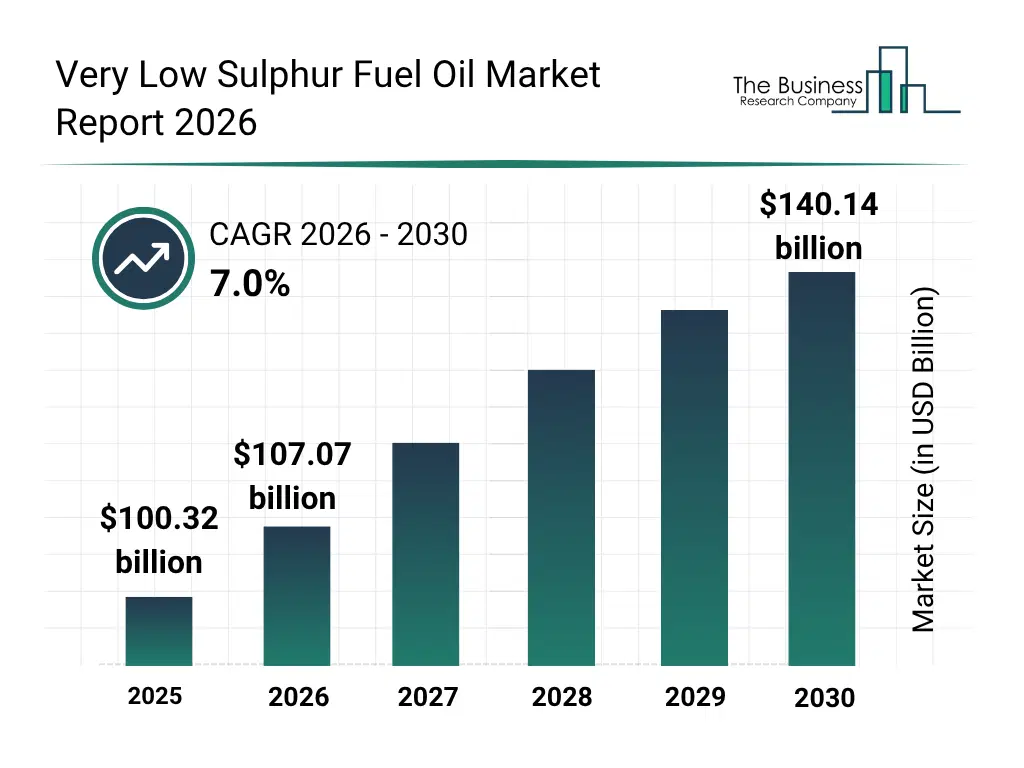
What Is The Very Low Sulphur Fuel Oil Market Size and Share 2026?
The very low sulphur fuel oil market size has grown strongly in recent years. It will grow from $100.32 billion in 2025 to $107.07 billion in 2026 at a compound annual growth rate (CAGR) of 6.7%. The growth in the historic period can be attributed to international maritime organization sulphur cap implementation, rising marine pollution concerns, increasing use of high sulphur fuel oil restrictions, growth in global shipping trade volumes, early adoption of emission control areas (ecas).What Is The Very Low Sulphur Fuel Oil Market Growth Forecast?
The very low sulphur fuel oil market size is expected to see strong growth in the next few years. It will grow to $140.14 billion in 2030 at a compound annual growth rate (CAGR) of 7.0%. The growth in the forecast period can be attributed to tightening global decarbonization regulations, expansion of green shipping corridors, rising adoption of alternative marine fuels, increasing demand for fuel efficiency optimization, growth in global seaborne trade and logistics. Major trends in the forecast period include increasing adoption of low sulphur marine fuels to comply with global emissions regulations, growing demand for blended vlsfo formulations with improved combustion efficiency and stability, rising use of refinery hydrocracking processes to produce cleaner marine fuel alternatives, expansion of bunker fuel supply chain optimization at major ports, increasing integration of digital fuel monitoring and emissions tracking systems in maritime operations.
Global Very Low Sulphur Fuel Oil Market Segmentation
1) By Fuel Type: Residual Based Very Low Sulphur Fuel Oil, Distillate Blend Very Low Sulphur Fuel Oil, Hybrid Blend Very Low Sulphur Fuel Oil, Other Fuel Types 2) By Source: Refinery, Hydrocracker 3) By Distribution Channel: Bunker Supply Ports, Barge To Ship Delivery, Direct Terminal Pipeline, Other Distribution Channels 4) By Application: Maritime Transport, Offshore Energy, Military Operations, Other Applications 5) By End User: Shipping Companies, Marine Operators, Oil And Gas Companies, Other End Users Subsegments: 1) By Residual Based Very Low Sulphur Fuel Oil: Low Viscosity Residual Based Very Low Sulphur Fuel Oil, High Stability Residual Based Very Low Sulphur Fuel Oil, Marine Grade Residual Based Very Low Sulphur Fuel Oil, Blended Residual Based Very Low Sulphur Fuel Oil 2) By Distillate Blend Very Low Sulphur Fuel Oil: Marine Distillate Blend Very Low Sulphur Fuel Oil, Low Aromatic Distillate Blend Very Low Sulphur Fuel Oil, High Purity Distillate Blend Very Low Sulphur Fuel Oil, Ultra Clean Distillate Blend Very Low Sulphur Fuel Oil 3) By Hybrid Blend Very Low Sulphur Fuel Oil: Balanced Composition Hybrid Blend Very Low Sulphur Fuel Oil, High Efficiency Hybrid Blend Very Low Sulphur Fuel Oil, Performance Optimized Hybrid Blend Very Low Sulphur Fuel Oil, Multi Component Hybrid Blend Very Low Sulphur Fuel Oil 4) By Other Fuel Types: Experimental Fuel Blends, Biofuel Mixed Very Low Sulphur Fuel Oil, Synthetic Fuel Variants, Custom Formulated Fuel TypesWhat Is The Driver Of The Very Low Sulphur Fuel Oil Market?
The surge in maritime trade volumes is expected to contribute to the growth of the very low sulphur fuel oil market going forward. Maritime trade volumes refer to the total quantity of goods transported by sea across international and domestic shipping routes. Maritime trade volumes are rising due to growing demand for goods, as globalization and expanding markets push more products to be transported internationally by sea. As shipping activity increases, the overall demand for marine fuels also rises, in the context of environmental regulations set by the International Maritime Organization, particularly limits on sulfur emissions, ship operators are required to use compliant fuels such as very low sulphur fuel oil or adopt alternative solutions. Very low sulphur fuel oil supports maritime trade activities by enabling compliance with these regulations, helping ships avoid penalties and port restrictions while maintaining uninterrupted international shipping operations. For instance, in October 2024, according to UN Trade and Development, a Switzerland-based intergovernmental organization, global maritime trade rose by 2.4% to 12.3 billion tons in 2023, recovering from the contraction in 2022, and is projected to grow by same rate through 2029. Therefore, the surge in maritime trade volumes is driving the growth of the very low sulphur fuel oil industry.Key Players In The Global Very Low Sulphur Fuel Oil Market
Major companies operating in the very low sulphur fuel oil market are Saudi Arabian Oil Company, Sinopec Group, Exxon Mobil Corporation, Shell plc, TotalEnergies SE, BP p.l.c., Chevron Corporation, Phillips 66, Valero Energy Corporation, Indian Oil Corporation Limited, Petróleo Brasileiro S.A., Bharat Petroleum Corporation Limited, Hindustan Petroleum Corporation Limited, OMV Aktiengesellschaft, PJSC LUKOIL, Adani Bunkering Private Limited, Neste Oyj, Mangalore Refinery and Petrochemicals Limited, Trafigura Group Pte. Ltd., Monjasa Holding A/S, Peninsula Petroleum Limited, Vitol Holding B.V.Global Very Low Sulphur Fuel Oil Market Trends and Insights
Major companies operating in the very low sulphur fuel oil market are focusing on developing advanced low-sulfur fuel bunkering to ensure compliance with stringent emission regulations and reduce maritime pollution. Advanced low-sulfur fuel bunkering refers to the efficient and safe supply of marine fuels with reduced sulfur content to ships using modern fueling systems, and it helps by lowering harmful emissions, ensuring compliance with environmental regulations, and improving overall fuel efficiency in maritime operations. For instance, in July 2025, Shanghai’s Yangshan Port, a China-based deep-water port and major maritime logistics hub, launched an advanced bunkering service for domestically produced ultra-low sulfur fuel oil, marking a significant step in sustainable marine fuel supply. The service involved ship-to-ship bunkering operations, during which 875 tons of ultra-low sulfur fuel oil were supplied to an internationally navigating vessel, demonstrating its operational efficiency and scalability. The fuel features a sulfur content as low as 0.1%, aligning with stringent international emission regulations and significantly reducing sulfur oxide emissions compared to conventional marine fuels. It is designed to ensure compatibility with existing marine engines while improving combustion performance and lowering environmental impact. Additionally, the bunkering system is integrated with infrastructure supporting multiple alternative fuels, enhancing flexibility and future-readiness for evolving maritime energy needs.What Are Latest Mergers And Acquisitions In The Very Low Sulphur Fuel Oil Market?
In May 2025, FincoEnergies B.V., a Netherlands-based energy company, acquired Oliehandel Klaas de Boer B.V. for an undisclosed amount. With this acquisition, FincoEnergies B.V. aimed to strengthen its position in the Dutch marine fuel supply sector by expanding its storage capacity, bunker fleet, and product portfolio while enhancing logistical capabilities and supporting sustainable fuel adoption. Oliehandel Klaas de Boer B.V. is a Netherlands-based energy company that specializes in providing very low sulphur fuel oil (VLSFO).Regional Outlook/Insights
Asia-Pacific was the largest region in the very low sulphur fuel oil market in 2025. Middle East is expected to be the fastest-growing region in the forecast period. The regions covered in this market report are Asia-Pacific, South East Asia, Western Europe, Eastern Europe, North America, South America, Middle East, Africa. The countries covered in this market report are Australia, Brazil, China, France, Germany, India, Indonesia, Japan, Taiwan, Russia, South Korea, UK, USA, Canada, Italy, Spain.What Defines the Very Low Sulphur Fuel Oil Market?
The very low sulphur fuel oil market consists of sales of residual fuel blends, hybrid marine fuel formulations, low sulphur bunker fuels, and marine distillate blends. Values in this market are ‘factory gate’ values, that is, the value of goods sold by the manufacturers or refiners of the goods, whether to other entities (including distributors, bunker suppliers, and wholesalers) or directly to end customers. The value of goods in this market includes related services sold by the creators of the goods.How is Market Value Defined and Measured?
The market value is defined as the revenues that enterprises gain from the sale of goods and/or services within the specified market and geography through sales, grants, or donations in terms of the currency (in USD unless otherwise specified). The revenues for a specified geography are consumption values that are revenues generated by organizations in the specified geography within the market, irrespective of where they are produced. It does not include revenues from resales along the supply chain, either further along the supply chain or as part of other products.What Key Data and Analysis Are Included in the Very Low Sulphur Fuel Oil Market Report 2026?
The very low sulphur fuel oil market research report is one of a series of new reports from The Business Research Company that provides market statistics, including industry global market size, regional shares, competitors with the market share, detailed market segments, market trends and opportunities, and any further data you may need to thrive in the very low sulphur fuel oil industry. The market research report delivers a complete perspective of everything you need, with an in-depth analysis of the current and future state of the industry.Very Low Sulphur Fuel Oil Market Report Forecast Analysis
| Report Attribute | Details |
|---|---|
| Market Size Value In 2026 | $107.07 billion |
| Revenue Forecast In 2035 | $140.14 billion |
| Growth Rate | CAGR of 7.0% from 2026 to 2035 |
| Base Year For Estimation | 2025 |
| Actual Estimates/Historical Data | 2020-2025 |
| Forecast Period | 2026 - 2030 - 2035 |
| Market Representation | Revenue in USD Billion and CAGR from 2026 to 2035 |
| Segments Covered | Fuel Type, Source, Distribution Channel, Application, End User |
| Regional Scope | Asia-Pacific, Western Europe, Eastern Europe, North America, South America, Middle East, Africa |
| Country Scope | The countries covered in the report are Australia, Brazil, China, France, Germany, India, Indonesia, Japan, Taiwan, Russia, South Korea, UK, USA, Canada, Italy, Spain. |
| Key Companies Profiled | Saudi Arabian Oil Company, Sinopec Group, Exxon Mobil Corporation, Shell plc, TotalEnergies SE, BP p.l.c., Chevron Corporation, Phillips 66, Valero Energy Corporation, Indian Oil Corporation Limited, Petróleo Brasileiro S.A., Bharat Petroleum Corporation Limited, Hindustan Petroleum Corporation Limited, OMV Aktiengesellschaft, PJSC LUKOIL, Adani Bunkering Private Limited, Neste Oyj, Mangalore Refinery and Petrochemicals Limited, Trafigura Group Pte. Ltd., Monjasa Holding A/S, Peninsula Petroleum Limited, Vitol Holding B.V. |
| Customization Scope | Request for Customization |
| Pricing And Purchase Options | Explore Purchase Options |