
Veterinary Assistive Reproduction Technology Market Report 2026
Global Outlook – By Type (Services, Semen, Instruments, Kit And Consumables), By Animal Type (Bovine, Swine, Ovine, Caprine, Equine, Other Animal Types), By Distribution Channel (Private, Public), By Technology (Artificial Insemination (AI), In Vitro Fertilization (IVF), Embryo Transfer (MOET), Other Technologies), By End-Use (Veterinary Clinics And Hospitals, Animal Breeding Centers, Research Institutes And Universities, Other End-Uses) – Market Size, Trends, Strategies, and Forecast to 2030
Veterinary Assistive Reproduction Technology Market Overview
• Veterinary Assistive Reproduction Technology market size has reached to $3.63 billion in 2025 • Expected to grow to $5.24 billion in 2030 at a compound annual growth rate (CAGR) of 7.6% • Growth Driver: Rising Demand For Livestock Fuels Growth In Veterinary Assistive Reproduction Technology • Market Trend: Transforming Dairy Farming With Advanced Reproductive Technologies • North America was the largest region in 2025.What Is Covered Under Veterinary Assistive Reproduction Technology Market?
Veterinary assistive reproduction technology refers to a set of advanced techniques and tools used to improve reproductive success in animals, including methods such as artificial insemination, embryo transfer, and in vitro fertilization. These technologies are employed to improve breeding efficiency, manage genetics, and increase the success rates of reproduction in various animal species. The main types of veterinary assistive reproduction technology are services, semen, instruments, and kits and consumables. The services in veterinary assistive reproduction technology include various veterinary procedures that support animal reproduction, such as artificial insemination, embryo transfer, and in vitro fertilization. These services apply to a range of animals, including bovine, swine, ovine, caprine, equine, and others, and are distributed through both private and public channels. The technology includes artificial insemination (AI), in vitro fertilization (IVF), embryo transfer (MOET), and others, and supports various end users, including veterinary clinics and hospitals, animal breeding centers, research institutes and universities, and others.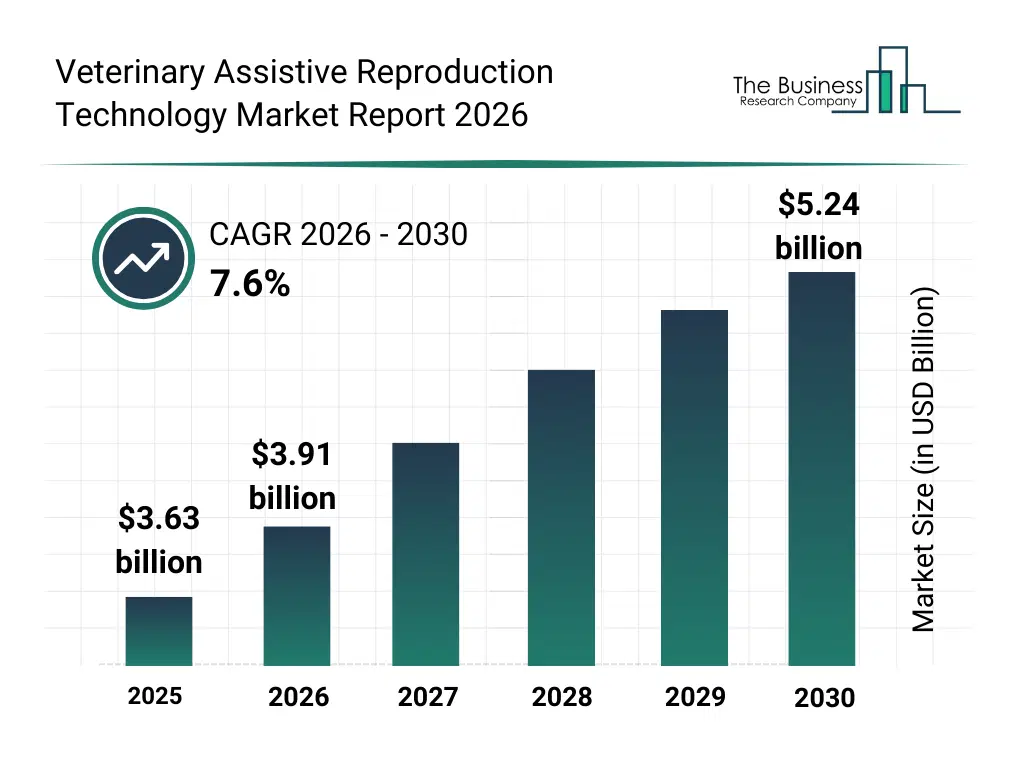
What Is The Veterinary Assistive Reproduction Technology Market Size and Share 2026?
The veterinary assistive reproduction technology market size has grown strongly in recent years. It will grow from $3.63 billion in 2025 to $3.91 billion in 2026 at a compound annual growth rate (CAGR) of 7.9%. The growth in the historic period can be attributed to reliance on natural breeding, limited access to reproductive technologies, growing demand for high-quality livestock, traditional veterinary services, low awareness of genetic improvement programs.What Is The Veterinary Assistive Reproduction Technology Market Growth Forecast?
The veterinary assistive reproduction technology market size is expected to see strong growth in the next few years. It will grow to $5.24 billion in 2030 at a compound annual growth rate (CAGR) of 7.6%. The growth in the forecast period can be attributed to adoption of ai, ivf, and embryo transfer technologies, expansion of animal breeding centers, increasing focus on genetic improvement, growth of veterinary clinics offering ART services, integration of digital reproductive management solutions. Major trends in the forecast period include expansion of embryo transfer and ivf services, increasing use of frozen and fresh semen across species, growth of genetic testing services in animal breeding, adoption of ultrasound and advanced reproductive instruments, rising demand for hormonal treatment and ai kits.
Global Veterinary Assistive Reproduction Technology Market Segmentation
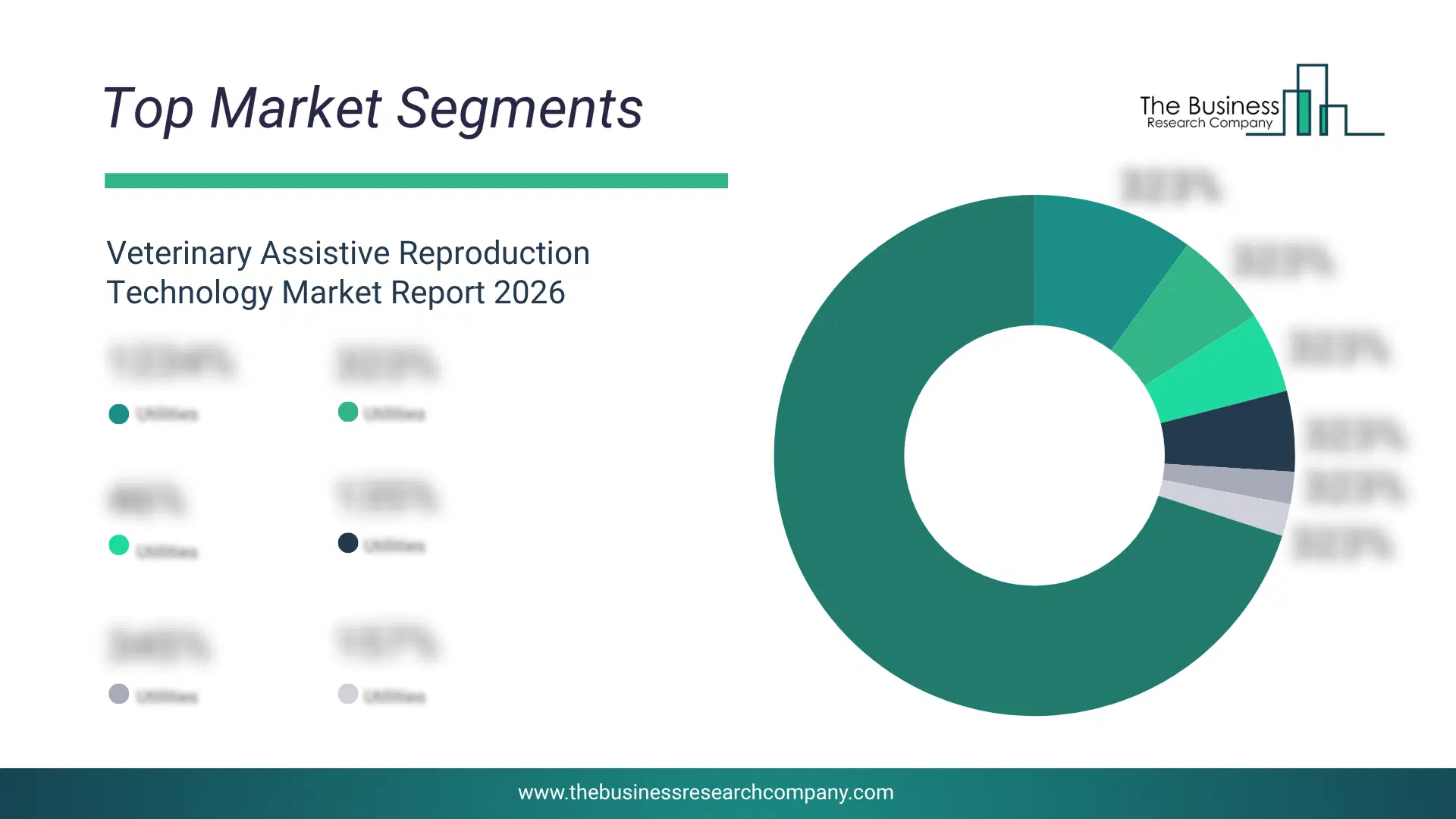
1) By Type: Services, Semen, Instruments, Kit And Consumables 2) By Animal Type: Bovine, Swine, Ovine, Caprine, Equine, Other Animal Types 3) By Distribution Channel: Private, Public 4) By Technology: Artificial Insemination (AI), In Vitro Fertilization (IVF), Embryo Transfer (MOET), Other Technologies 5) By End-Use: Veterinary Clinics And Hospitals, Animal Breeding Centers, Research Institutes And Universities, Other End-Uses Subsegments: 1) By Services: Artificial Insemination Services, In Vitro Fertilization (IVF) Services, Embryo Transfer Services, Genetic Testing Services 2) By Semen: Frozen Semen, Fresh Semen, Semen Collection Kits, Semen Processing Services 3) By Instruments: Insemination Cannulas, Embryo Transfer Instruments, Semen Storage Tanks, Ultrasound Machines 4) By Kits And Consumables: Artificial Insemination Kits, Embryo Transfer Kits, Collection And Storage Consumables, Hormonal Treatment KitsWhat Is The Driver Of The Veterinary Assistive Reproduction Technology Market?
The increasing demand for livestock is expected to propel the growth of the veterinary assistive reproduction technology market going forward. The demand for livestock is increasing due to rising consumer expectations for superior taste and nutritional value, as well as advancements in breeding technologies that produce animals with desirable traits. Veterinary assistive reproduction technology (VART) is used to improve livestock breeding efficiency by aiding in the fertilization and development of embryos, leading to increased genetic improvement and productivity. For instance, in August 2024, according to the Agriculture and Horticulture Development Board, a UK-based levy board that represents farmers, as of December 2023, the number of female cattle older than 24 months rose by 5,000 head from the previous year, reaching a total of 235,000. Therefore, the increasing demand for livestock is driving the growth of the veterinary assistive reproduction technology industry.Key Players In The Global Veterinary Assistive Reproduction Technology Market
Major companies operating in the veterinary assistive reproduction technology market are Zoetis Inc., Merck Animal Health, IDEXX Laboratories Inc., Neogen Corporation, Genus plc, ABS Global Inc., Cryoport Inc., Minitube International Inc., Semex Alliance, Select Sires Inc., Cogent Breeding Ltd., Trans Ova Genetics LLC, Viking Genetics, Vytelle Inc., Agtech Inc., IMV Technologies, MOFA Global Inc., Emlab Genetics, Avantea Srl, Alta Genetics Inc., Aberekin S.L.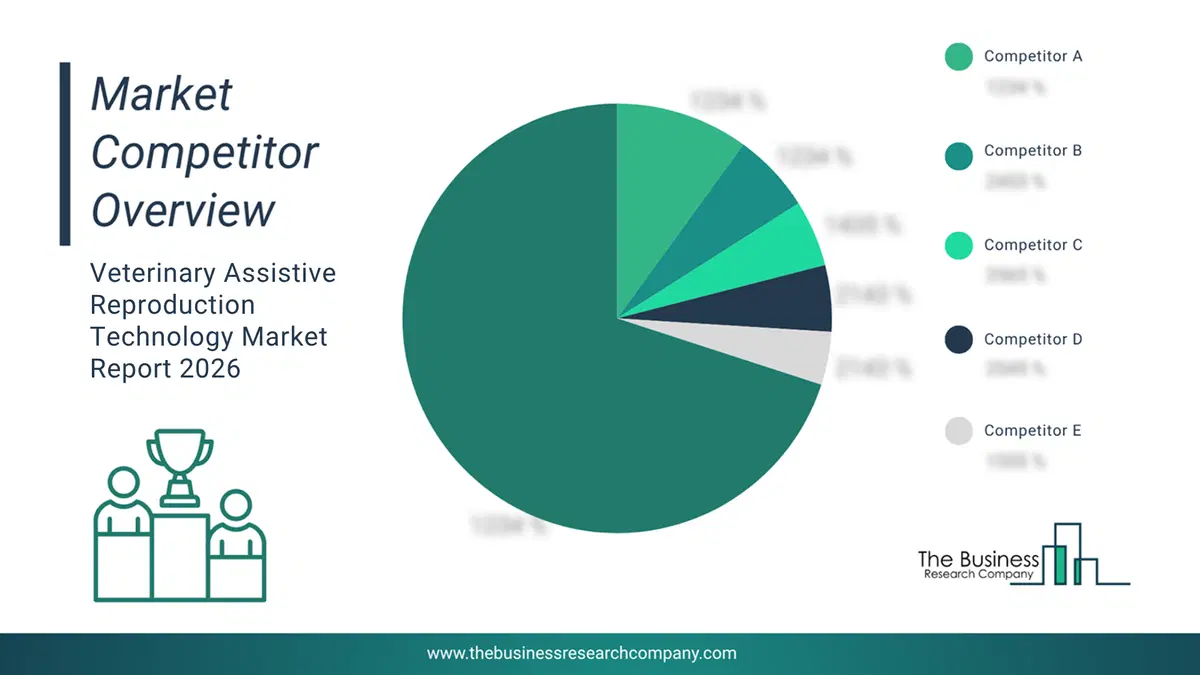
This chart is for illustrative purposes; the full report includes a detailed competitor analysis and comprehensive overview of the top 10 companies in the market.
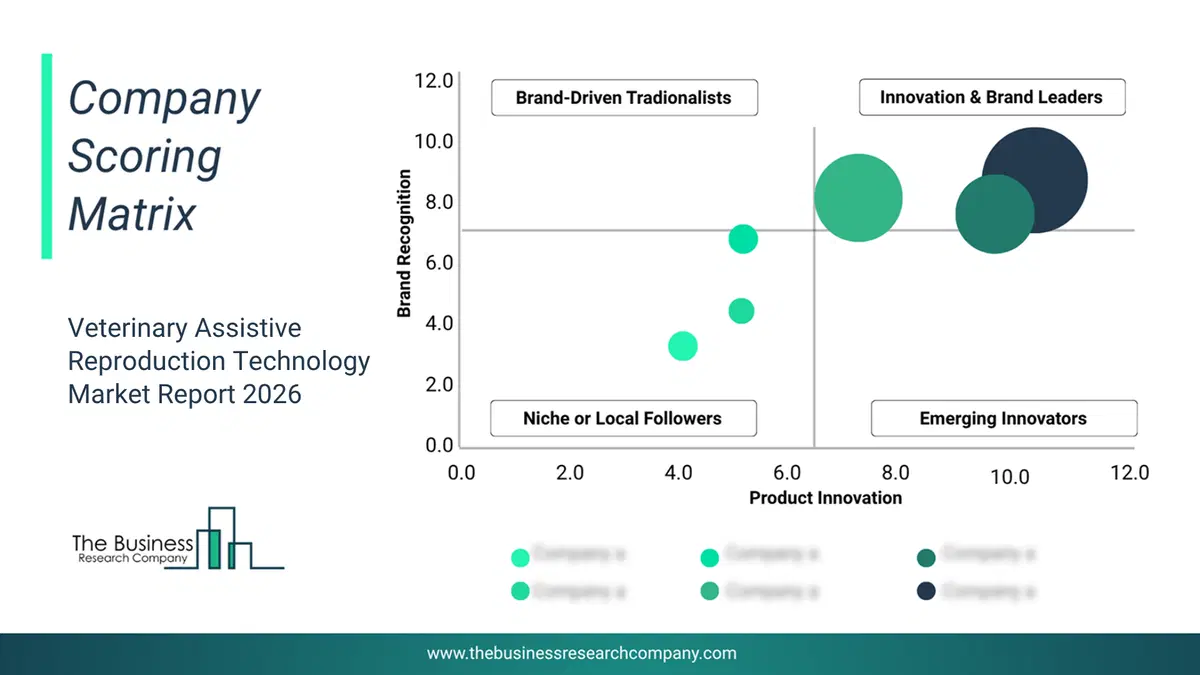
This chart maps companies by product innovation and brand strength, with bubble size indicating relative revenue, helping identify market leaders, challengers, and niche players. This is an illustrative chart; the full report provides a complete and accurate competitive analysis.
Global Veterinary Assistive Reproduction Technology Market Trends and Insights
Major companies operating in the veterinary assistive reproduction technology market are focusing on developing innovative products, such as advanced chelated minerals for the reproductive health of dairy animals, to improve reproductive efficiency and enhance the health and productivity of livestock. Advanced chelated minerals for the reproductive health of dairy animals refer to a specific form of dietary supplement designed to improve fertility and reproductive performance in dairy cattle. For instance, in July 2023, Rodec Pharma Limited, an India-based manufacturer of veterinary medicines, introduced the CMIN H8, an advanced chelated mineral feed specifically formulated to improve the reproductive health of dairy animals. This innovative product is designed to address common reproductive challenges faced by the dairy industry, such as infertility and other health-related issues that can hinder productivity. By providing essential minerals in a chelated form, CMIN H8 enhances the bioavailability of these nutrients, ensuring that dairy animals receive optimal support for their reproductive systems.What Are Latest Mergers And Acquisitions In The Veterinary Assistive Reproduction Technology Market?
In March 2024, Calibre Scientific, a US-based life sciences company, acquired Microm UK for an undisclosed amount. Through this acquisition, Calibre Scientific aims to expand its portfolio in assisted reproductive technologies, enhance its commitment to reproductive health, grow its customer base in key markets, and introduce complementary consumable products to its existing assisted reproductive technology (ART) instruments. Microm UK is a UK-based provider of assisted reproductive technology.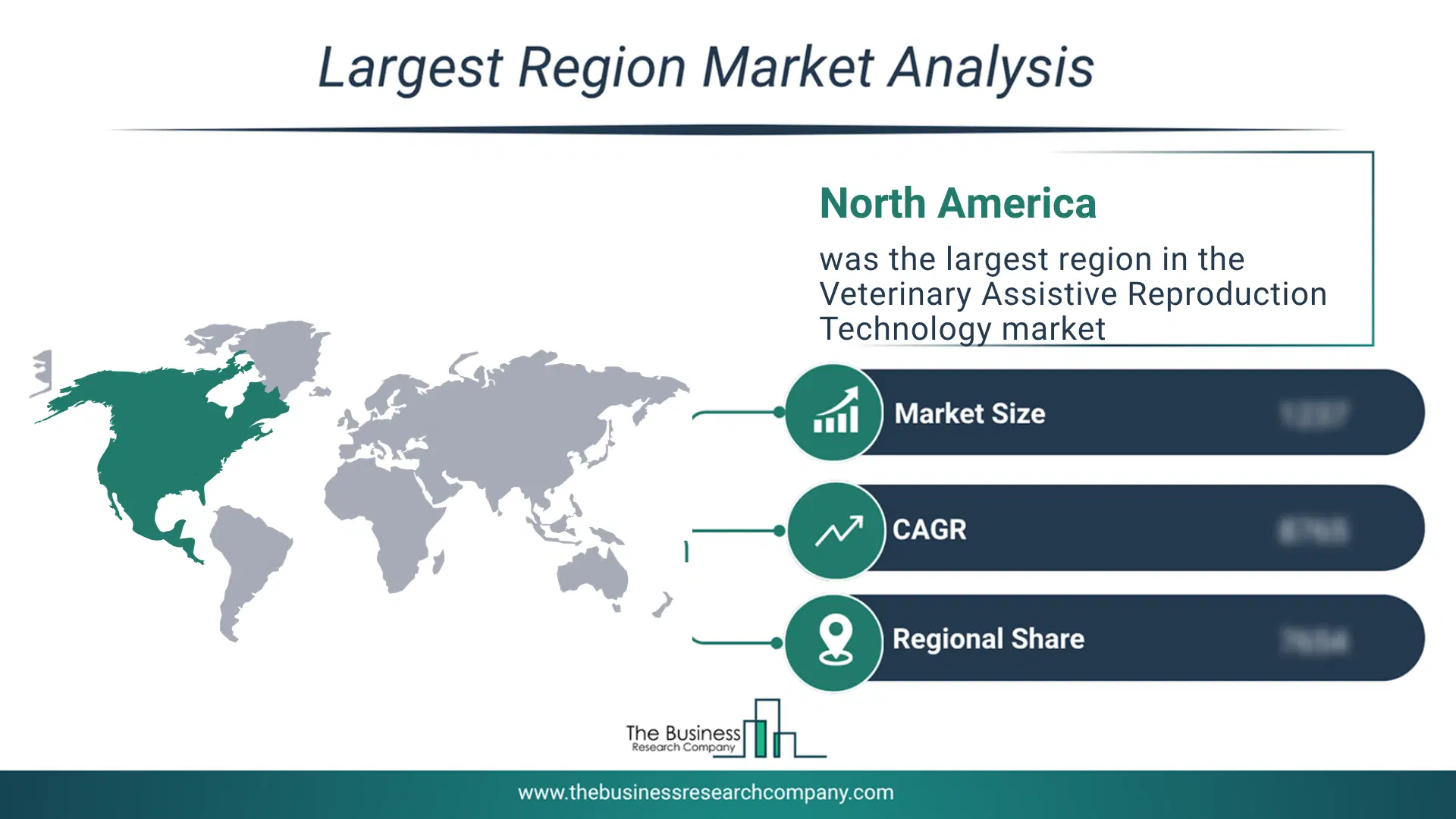
Regional Outlook
North America was the largest region in the veterinary assistive reproduction technology market in 2025. The regions covered in this market report are Asia-Pacific, South East Asia, Western Europe, Eastern Europe, North America, South America, Middle East, Africa. The countries covered in this market report are Australia, Brazil, China, France, Germany, India, Indonesia, Japan, Taiwan, Russia, South Korea, UK, USA, Canada, Italy, SpainWhat Defines the Veterinary Assistive Reproduction Technology Market?
The veterinary assistive reproduction technology market includes revenues earned by entities by providing services such as semen cryopreservation, estrus synchronization, ovum pick-up (OPU), cloning, genetic preservation, and animal breeding. The market value includes the value of related goods sold by the service provider or included within the service offering. The veterinary assistive reproduction technology market also consists of sales of embryo transfer kits, semen collection systems, cryopreservation equipment, and diagnostic tools. Values in this market are ‘factory gate’ values, that is, the value of goods sold by the manufacturers or creators of the goods, whether to other entities (including downstream manufacturers, wholesalers, distributors, and retailers) or directly to end customers. The value of goods in this market includes related services sold by the creators of the goods.How is Market Value Defined and Measured?
The market value is defined as the revenues that enterprises gain from the sale of goods and/or services within the specified market and geography through sales, grants, or donations in terms of the currency (in USD unless otherwise specified). The revenues for a specified geography are consumption values that are revenues generated by organizations in the specified geography within the market, irrespective of where they are produced. It does not include revenues from resales along the supply chain, either further along the supply chain or as part of other products.
This chart presents market attractiveness based on a quantitative evaluation of growth, competition, strategic alignment, and risk, offering a clear view of opportunity areas for decision-making. This chart is for illustrative purposes; the full report contains the complete analysis.

This chart highlights the Total Addressable Market (TAM) by estimating the maximum revenue opportunity using an assumption-driven approach, supporting strategic planning and opportunity sizing across markets. The chart is illustrative; the full report provides a more comprehensive analysis.
What Key Data and Analysis Are Included in the Veterinary Assistive Reproduction Technology Market Report 2026?
The veterinary assistive reproduction technology market research report is one of a series of new reports from The Business Research Company that provides market statistics, including industry global market size, regional shares, competitors with the market share, detailed market segments, market trends and opportunities, and any further data you may need to thrive in the veterinary assistive reproduction technology industry. The market research report delivers a complete perspective of everything you need, with an in-depth analysis of the current and future state of the industry.Veterinary Assistive Reproduction Technology Market Report Forecast Analysis
| Report Attribute | Details |
|---|---|
| Market Size Value In 2026 | $3.91 billion |
| Revenue Forecast In 2030 | $5.24 billion |
| Growth Rate | CAGR of 7.9% from 2026 to 2030 |
| Base Year For Estimation | 2025 |
| Actual Estimates/Historical Data | 2020-2025 |
| Forecast Period | 2026 - 2030 - 2030 |
| Market Representation | Revenue in USD Billion and CAGR from 2026 to 2030 |
| Segments Covered | Type, Animal Type, Distribution Channel, Technology, End-Use |
| Regional Scope | Asia-Pacific, Western Europe, Eastern Europe, North America, South America, Middle East, Africa |
| Country Scope | The countries covered in the report are Australia, Brazil, China, France, Germany, India, Indonesia, Japan, Taiwan, Russia, South Korea, UK, USA, Canada, Italy, Spain. |
| Key Companies Profiled | Zoetis Inc., Merck Animal Health, IDEXX Laboratories Inc., Neogen Corporation, Genus plc, ABS Global Inc., Cryoport Inc., Minitube International Inc., Semex Alliance, Select Sires Inc., Cogent Breeding Ltd., Trans Ova Genetics LLC, Viking Genetics, Vytelle Inc., Agtech Inc., IMV Technologies, MOFA Global Inc., Emlab Genetics, Avantea Srl, Alta Genetics Inc., Aberekin S.L. |
| Customization Scope | Request for Customization |
| Pricing And Purchase Options | Explore Purchase Options |