
Veterinary Parasiticides Market Report 2026
Global Outlook – By Type (Endoparasiticides, Ectoparasiticides, Endectocides ), By Formulation (Oral Liquids, Tablets, Injectables, Sprays, Other Formulations), By Application (Farm Animals, Companion Animals), By End Users (R&D Facilities, Farms, Veterinary Clinics ) – Market Size, Trends, Strategies, and Forecast to 2030
Veterinary Parasiticides Market Overview
• Veterinary Parasiticides market size has reached to $15.53 billion in 2025 • Expected to grow to $20.22 billion in 2030 at a compound annual growth rate (CAGR) of 5.4% • Growth Driver: Growing Adoption Of Pet To Drive Market Growth • Market Trend: Growth Of Long-Acting Injectable And Broad-Spectrum Formulations • North America was the largest region in 2025 and Asia-Pacific is the fastest growing region.What Is Covered Under Veterinary Parasiticides Market?
Veterinary parasiticides refer to the class of animal medications that eliminate parasites by inhibiting the activity of acetylcholinesterase to treat pets, livestock, and other animals from diseases caused by helminths, amoeba, ectoparasites, parasitic fungi, protozoa, and other parasites to improve the animals’ health. The main types of veterinary parasiticides are endoparasiticides, ectoparasiticides, and endectocides. Endectocides are medications that are administered directly to hosts to kill endoparasites and ectoparasites, primarily blood-feeding arthropods. The product types include oral liquids, tablets, injectables, sprays, and other products applied on farm animals, and companion animals that are used by R&D facilities, farms, and veterinary clinics.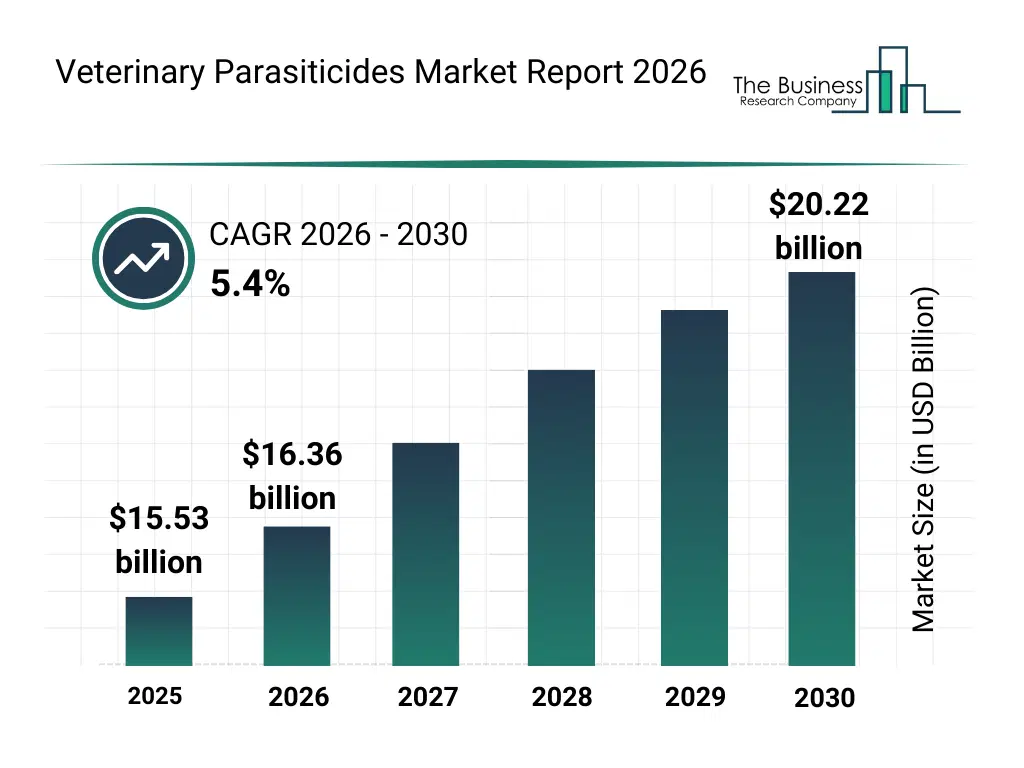
What Is The Veterinary Parasiticides Market Size and Share 2026?
The veterinary parasiticides market size has grown strongly in recent years. It will grow from $15.53 billion in 2025 to $16.36 billion in 2026 at a compound annual growth rate (CAGR) of 5.4%. The growth in the historic period can be attributed to high prevalence of parasitic infections in livestock, widespread use of conventional dewormers, expansion of commercial animal farming, increasing veterinary prescriptions for parasite control, availability of basic oral and injectable parasiticides.What Is The Veterinary Parasiticides Market Growth Forecast?
The veterinary parasiticides market size is expected to see strong growth in the next few years. It will grow to $20.22 billion in 2030 at a compound annual growth rate (CAGR) of 5.4%. The growth in the forecast period can be attributed to rising pet ownership and companion animal care, increasing awareness of zoonotic parasite risks, growth in preventive veterinary healthcare, development of novel parasiticide formulations, expansion of veterinary clinic networks. Major trends in the forecast period include rising demand for broad-spectrum parasiticides, increasing adoption of combination and endectocide products, growth in preventive parasite control programs, higher focus on companion animal parasite management, expanding use of long-acting and sustained-release formulations.
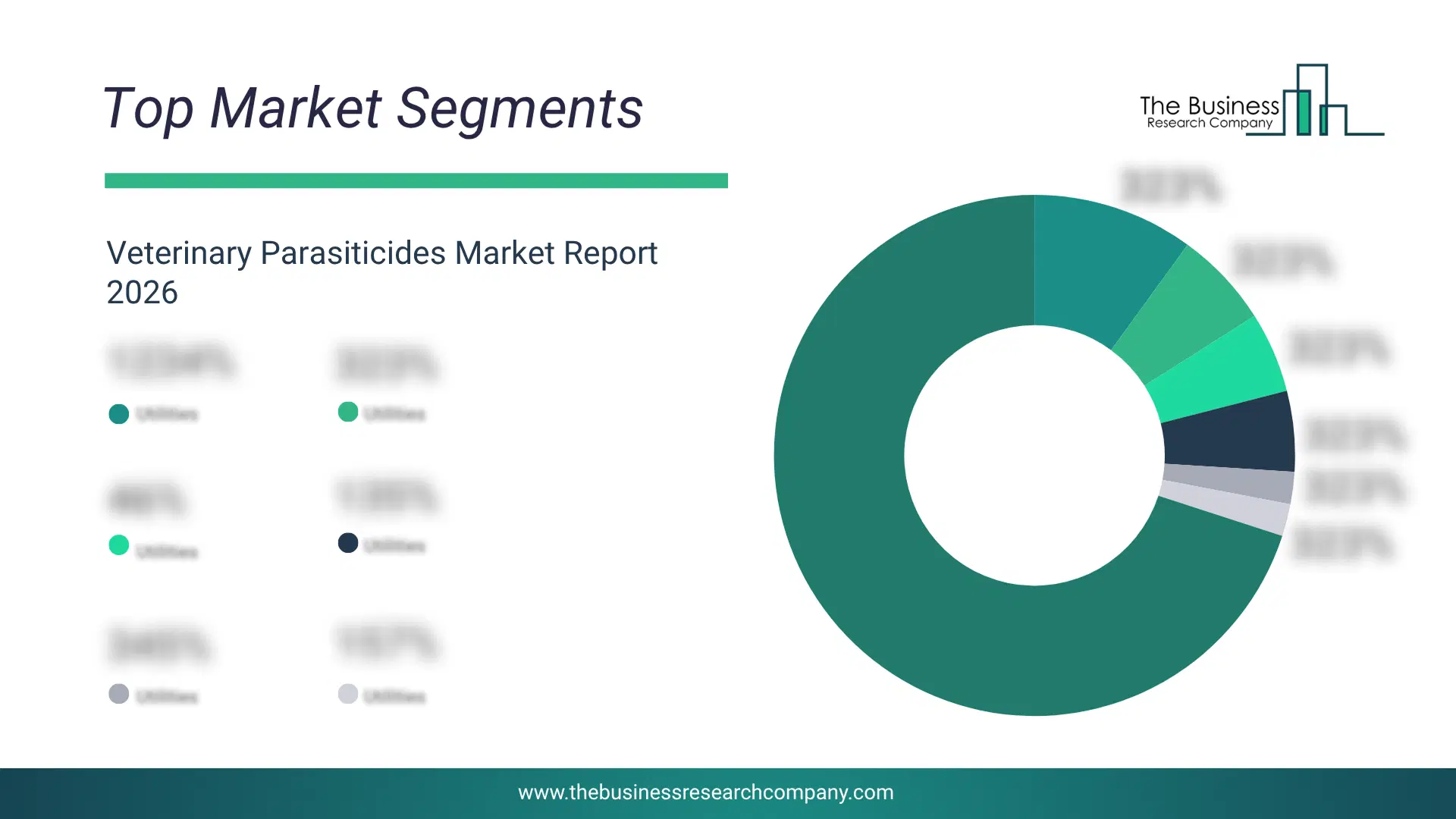
Global Veterinary Parasiticides Market Segmentation
1) By Type: Endoparasiticides, Ectoparasiticides, Endectocides 2) By Formulation: Oral Liquids, Tablets, Injectables, Sprays, Other Formulations 3) By Application: Farm Animals, Companion Animals 4) By End Users: R&D Facilities, Farms, Veterinary Clinics Subsegments: 1) By Endoparasiticides: Anthelmintics (Dewormers), Antiprotozoals, Anticestodals, Antitrematodals 2) By Ectoparasiticides: Insecticides, Acaricides, Repellents 3) By Endectocides: Ivermectin-based ProductsWhat Is The Driver Of The Veterinary Parasiticides Market?
The rising adoption of pets across the world is expected to propel the growth veterinary parasiticides market going forward. Pet adoption is the act of taking in and providing a permanent and caring home to a domesticated animal, typically from an animal shelter, rescue organization, or previous owner. Pet owners who adopt animals are more likely to be responsible and health-conscious, leading to a higher demand for parasiticides to protect their pets from common parasites and maintain their well-being. Shelter and rescue organizations often provide initial parasite prevention, further promoting the use of these products. For instance, in April 2025, according to the Canadian Animal Health Institute, a Canada-based trade association, in 2024, Canada was home to an estimated 7.2 million dogs and 8.2 million cats, making pets an integral part of more than half of Canadian households. Therefore, the growing adoption of pets is driving the growth of veterinary parasiticides industry.Key Players In The Global Veterinary Parasiticides Market
Major companies operating in the veterinary parasiticides market are Bayer AG, Zoetis Inc., Boehringer Ingelheim, Merck & Co. Inc., Ceva Animal Health, Dechra Pharmaceuticals plc, Phibro Animal Health Corporation, Bovian Health Care Pvt Ltd, Norbrook Laboratories Limited, Bimeda Holdings PLC, PetIQ Inc., ECO Animal Health Group plc, Bioniche Animal Health Canada Inc., Laboratorios Hipra SA, Elanco Animal Health Incorporated, Virbac, Huvepharma, Chanelle Pharma, Zydus Animal Health, KRKA d d
This chart is for illustrative purposes; the full report includes a detailed competitor analysis and comprehensive overview of the top 10 companies in the market.
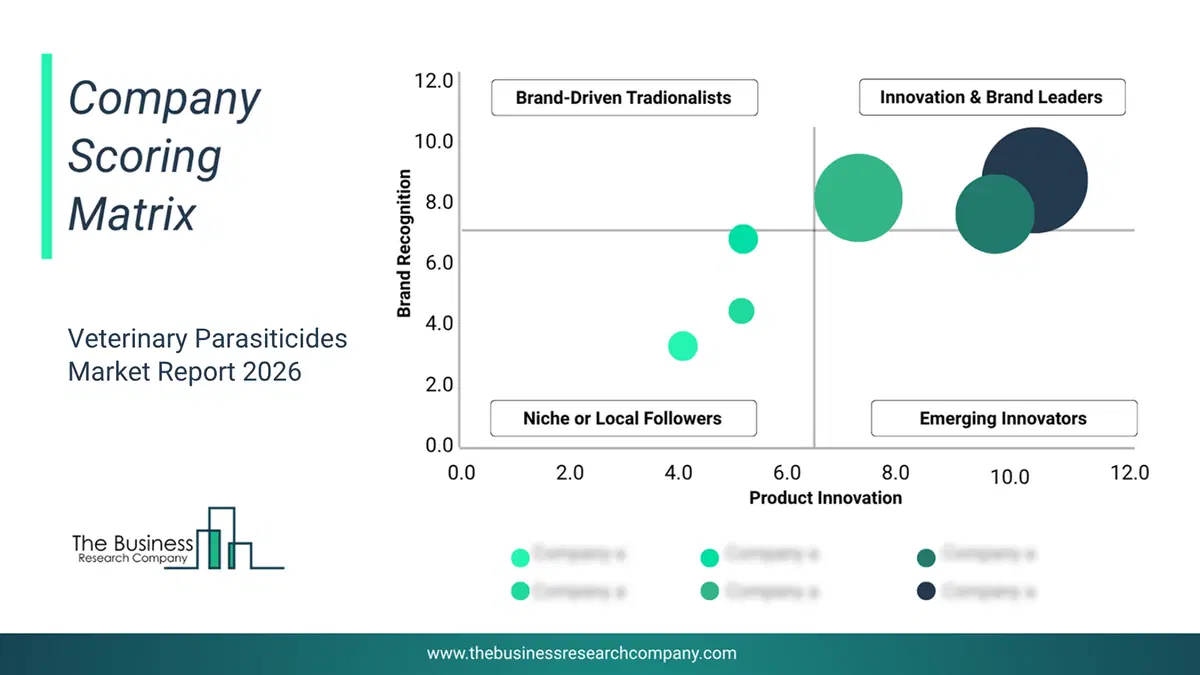
This chart maps companies by product innovation and brand strength, with bubble size indicating relative revenue, helping identify market leaders, challengers, and niche players. This is an illustrative chart; the full report provides a complete and accurate competitive analysis.
Global Veterinary Parasiticides Market Trends and Insights
Major companies operating in the veterinary parasiticides market are focusing on developing innovative solutions, such as long‑acting injectable and broad‑spectrum parasiticide formulations, to meet the rising demand for extended protection against multiple parasite species, improved compliance in pet owners, reduced treatment frequency, and comprehensive parasite control in companion animals and livestock amid rising awareness of zoonotic diseases and animal health needs. Long‑acting injectable and broad‑spectrum parasiticide formulations are designed to maintain therapeutic levels of active ingredients over extended periods, providing protection against fleas, ticks, and internal parasites in a single administration, which enhances convenience compared to traditional monthly oral or spot‑on products that require more frequent dosing and can suffer from compliance issues. For instance, in February 2025, Merck Animal Health, a US‑based animal health company, highlighted the injectable formulation of BRAVECTO (fluralaner) a parasiticide that delivers up to 12 months of continuous flea and tick protection with a single dose, granting veterinarians and pet owners a highly convenient and effective preventive option; this formulation sustains effective concentrations of fluralaner throughout the year, reduces missed doses, simplifies parasite management, and supports animal welfare by minimizing the need for repetitive treatments. The product’s extended‑release mechanism and year‑long duration represent a significant advancement over traditional parasiticides, which often require monthly or quarterly applications, thereby improving long‑term parasite control and adherence to treatment protocols.What Are Latest Mergers And Acquisitions In The Veterinary Parasiticides Market?
In July 2023, Freya Bidco Limited, a UK-based company, acquired Dechra Pharmaceuticals plc for approximately $5.47 billion (GBP 4.459 billion). With this acquisition, EQT aims to support Dechra’s next phase of growth by accelerating its global expansion and investing in its innovative animal health product pipeline. Dechra Pharmaceuticals plc is a UK-based healthcare company that specializes in developing, manufacturing, and supplying products for companion animals, equine, food-producing animals, and animal nutrition.
Regional Outlook
North America was the largest region in the veterinary parasiticides market in 2025. Asia-Pacific was the second-largest region in the veterinary parasiticides market. The regions covered in this market report are Asia-Pacific, South East Asia, Western Europe, Eastern Europe, North America, South America, Middle East, Africa. The countries covered in this market report are Australia, Brazil, China, France, Germany, India, Indonesia, Japan, Taiwan, Russia, South Korea, UK, USA, Canada, Italy, SpainWhat Defines the Veterinary Parasiticides Market?
The veterinary parasiticides market consists of sales of macrocyclic lactones, benzimidazoles, imidazothiazoles, piperazines, and salicylanilides. Values in this market are factory gate values, that is the value of goods sold by the manufacturers or creators of the goods, whether to other entities (including downstream manufacturers, wholesalers, distributors and retailers) or directly to end customers. The value of goods in this market includes related services sold by the creators of the goods.How is Market Value Defined and Measured?
The market value is defined as the revenues that enterprises gain from the sale of goods and/or services within the specified market and geography through sales, grants, or donations in terms of the currency (in USD unless otherwise specified). The revenues for a specified geography are consumption values that are revenues generated by organizations in the specified geography within the market, irrespective of where they are produced. It does not include revenues from resales along the supply chain, either further along the supply chain or as part of other products.
This chart presents market attractiveness based on a quantitative evaluation of growth, competition, strategic alignment, and risk, offering a clear view of opportunity areas for decision-making. This chart is for illustrative purposes; the full report contains the complete analysis.

This chart highlights the Total Addressable Market (TAM) by estimating the maximum revenue opportunity using an assumption-driven approach, supporting strategic planning and opportunity sizing across markets. The chart is illustrative; the full report provides a more comprehensive analysis.
What Key Data and Analysis Are Included in the Veterinary Parasiticides Market Report 2026?
The veterinary parasiticides market research report is one of a series of new reports from The Business Research Company that provides market statistics, including industry global market size, regional shares, competitors with the market share, detailed market segments, market trends and opportunities, and any further data you may need to thrive in the veterinary parasiticides industry. The market research report delivers a complete perspective of everything you need, with an in-depth analysis of the current and future state of the industry.Veterinary Parasiticides Market Report Forecast Analysis
| Report Attribute | Details |
|---|---|
| Market Size Value In 2026 | $16.36 billion |
| Revenue Forecast In 2030 | $20.22 billion |
| Growth Rate | CAGR of 5.4% from 2026 to 2030 |
| Base Year For Estimation | 2025 |
| Actual Estimates/Historical Data | 2020-2025 |
| Forecast Period | 2026 - 2030 - 2030 |
| Market Representation | Revenue in USD Billion and CAGR from 2026 to 2030 |
| Segments Covered | Type, Formulation, Application, End Users |
| Regional Scope | Asia-Pacific, Western Europe, Eastern Europe, North America, South America, Middle East, Africa |
| Country Scope | The countries covered in the report are Australia, Brazil, China, France, Germany, India, Indonesia, Japan, Taiwan, Russia, South Korea, UK, USA, Canada, Italy, Spain. |
| Key Companies Profiled | Bayer AG, Zoetis Inc., Boehringer Ingelheim, Merck & Co. Inc., Ceva Animal Health, Dechra Pharmaceuticals plc, Phibro Animal Health Corporation, Bovian Health Care Pvt Ltd, Norbrook Laboratories Limited, Bimeda Holdings PLC, PetIQ Inc., ECO Animal Health Group plc, Bioniche Animal Health Canada Inc., Laboratorios Hipra SA, Elanco Animal Health Incorporated, Virbac, Huvepharma, Chanelle Pharma, Zydus Animal Health, KRKA d d |
| Customization Scope | Request for Customization |
| Pricing And Purchase Options | Explore Purchase Options |