

Vibration Control Systems Market Report 2026
Global Outlook – By Component (Hardware, Software), By System Type (Passive Vibration Control Systems, Active Vibration Control Systems, Semi-Active Vibration Control Systems, Hybrid Vibration Control Systems), By Application (Automotive, Manufacturing, Aerospace And Defense, Electrical And Electronics, Oil And Gas, Healthcare, Other Applications) – Market Size, Trends, Strategies, and Forecast to 2030
Vibration Control Systems Market Overview
• Vibration Control Systems market size has reached to $5.8 billion in 2025 • Expected to grow to $8.1 billion in 2030 at a compound annual growth rate (CAGR) of 6.8% • Growth Driver: Growth In Automotive Industry To Accelerate Vibration Control Systems Market • Market Trend: Enhancing Vibration Management With Active Control Device Software • Asia-Pacific was the largest region in 2025 and Europe is the fastest growing region.What Is Covered Under Vibration Control Systems Market?
A vibration control system refers to a set of methods and technologies used to reduce or eliminate unwanted vibrations in structures, machines, or devices. These systems are designed to improve performance, increase the lifespan of components, and enhance safety by controlling the amplitude and frequency of vibrations. The main types of vibration control systems include motion control and vibration control. Motion control systems manage the movement of machinery and equipment to ensure precise and smooth operation and are essential for applications requiring high precision and stability to minimize vibration-related issues. The components include hardware and software for applications such as automotive, manufacturing, aerospace and defense, electrical and electronics, oil and gas, healthcare, and others.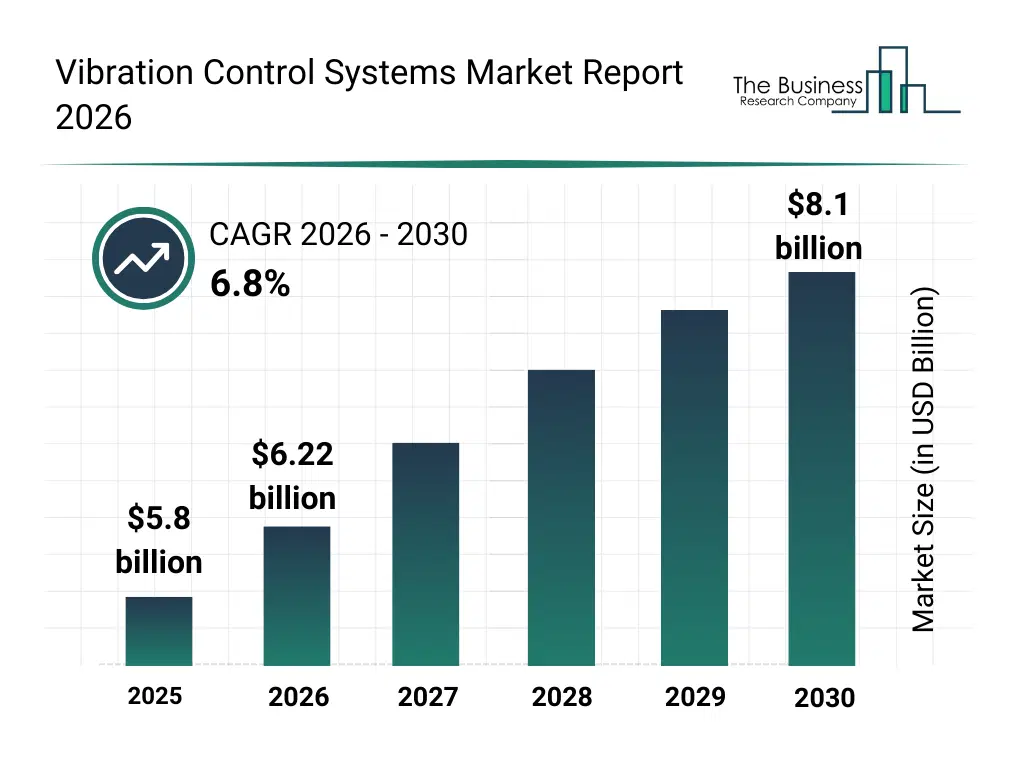
What Is The Vibration Control Systems Market Size and Share 2026?
The vibration control systems market size has grown strongly in recent years. It will grow from $5.8 billion in 2025 to $6.22 billion in 2026 at a compound annual growth rate (CAGR) of 7.2%. The growth in the historic period can be attributed to industrial automation growth, machinery reliability requirements, aerospace engineering needs, automotive comfort standards, manufacturing precision demand.What Is The Vibration Control Systems Market Growth Forecast?
The vibration control systems market size is expected to see strong growth in the next few years. It will grow to $8.1 billion in 2030 at a compound annual growth rate (CAGR) of 6.8%. The growth in the forecast period can be attributed to smart manufacturing adoption, growth in electric vehicles, predictive maintenance integration, infrastructure modernization, demand for noise and vibration reduction. Major trends in the forecast period include increasing use of active vibration control, integration of smart sensors and analytics, demand for high precision motion control, expansion of hybrid control systems, focus on equipment longevity and safety.Tariff Impact On Vibration Control Systems Market
Tariffs have impacted vibration control systems by increasing costs of sensors, actuators, and control electronics. North America and Europe are most affected. Higher prices slow system upgrades. Conversely, tariffs support domestic component manufacturing and system integration capabilities.
Global Vibration Control Systems Market Segmentation
1) By Component: Hardware, Software 2) By System Type: Passive Vibration Control Systems, Active Vibration Control Systems, Semi-Active Vibration Control Systems, Hybrid Vibration Control Systems 3) By Application: Automotive, Manufacturing, Aerospace And Defense, Electrical And Electronics, Oil And Gas, Healthcare, Other Applications Subsegments: 1) By Hardware: Vibration Isolators, Dampers and Shock Absorbers, Mounts and Bushings, Actuators and Sensors, Tuned Mass Dampers 2) By Software: Vibration Monitoring Software, Control and Feedback Algorithms, Predictive Maintenance and Analytics SoftwareWhat Is The Driver Of The Vibration Control Systems Market?
The expansion of the automotive industry is expected to propel the growth of the vibration control systems market going forward. The automotive industry focuses on designing, manufacturing, and selling motor vehicles such as cars, trucks, and motorcycles, along with their components and supporting infrastructure. The automotive industry is expanding due to rising global vehicle demand, advancements in electric and autonomous vehicle technologies, and the increasing need for efficient transportation solutions. Vibration control systems are used in the automotive industry to reduce noise and improve ride comfort by damping engine, road, and structural vibrations. For instance, in March 2024, according to the European Automobile Manufacturers Association, a Belgium-based automobile industry association, the European Union car industry grew by 13.9% in 2023 compared to 2022, reaching a production volume of 0.0105 billion units. Therefore, the expansion of the automotive industry will drive the growth of the vibration control systems industry.Key Players In The Global Vibration Control Systems Market
Major companies operating in the vibration control systems market are Continental AG, Hutchinson S.A., Parker Hannifin Corporation, Trelleborg Aktiebolag, Cooper Standard Holdings Inc., LORD Corporation, Mason Industries Inc., Kinetics Noise Control Inc., ACE Controls Inc., Kurashiki Kako Co. Ltd, GERB Vibration Control Systems Inc., Sentek Dynamics Incorporated, Crystal Instruments Corporation, LISEGA SE, Isolation Technology Inc., Fabreeka International Inc., VICODA GmbH, Enidine Inc., Getzner Werkstoffe GmbH, ITT Inc., Bridgestone Corporation, Sumitomo Rubber Industries Ltd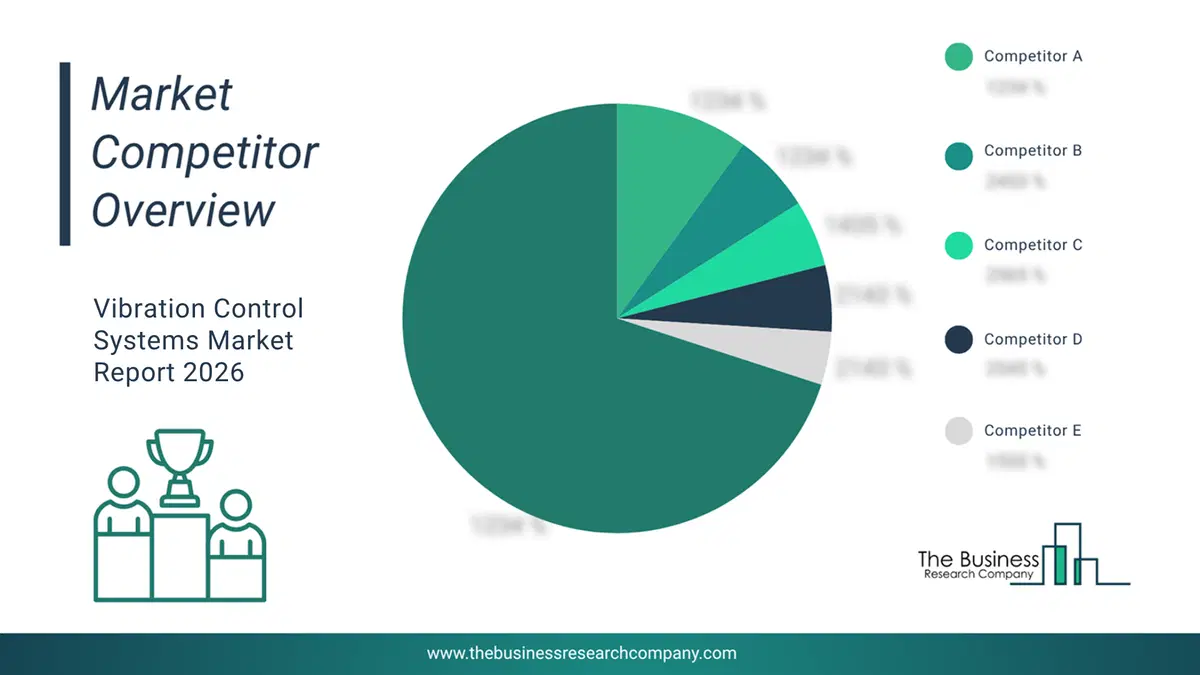
This chart is for illustrative purposes; the full report includes a detailed competitor analysis and comprehensive overview of the top 10 companies in the market.
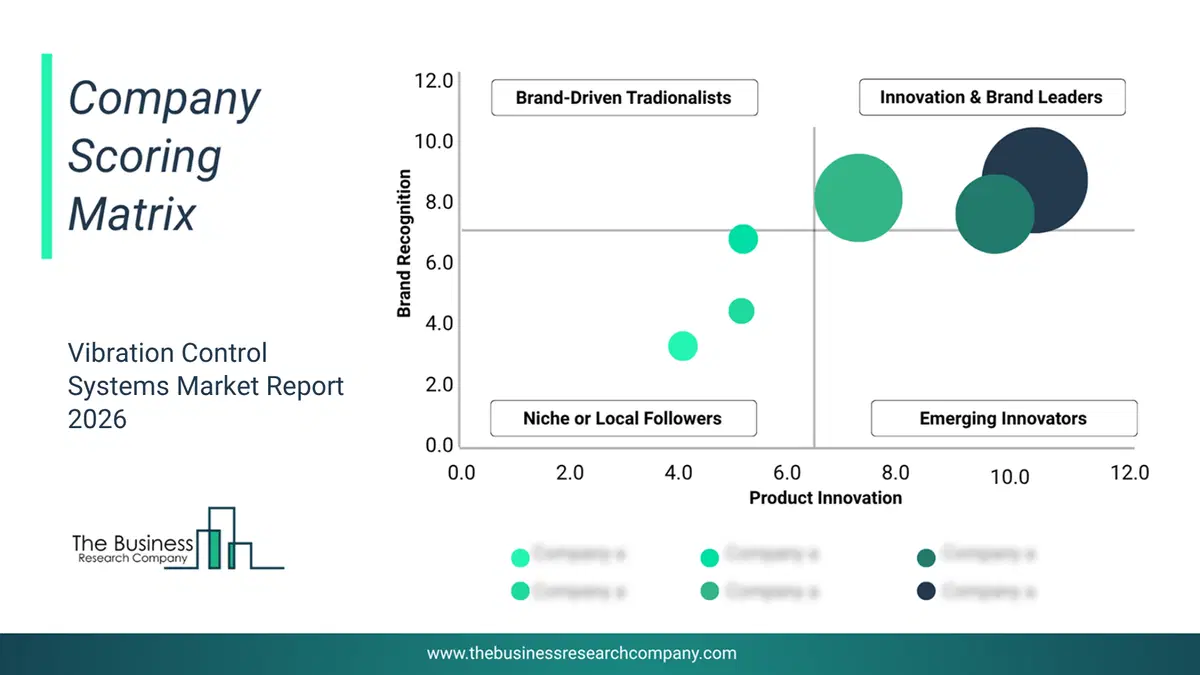
This chart maps companies by product innovation and brand strength, with bubble size indicating relative revenue, helping identify market leaders, challengers, and niche players. This is an illustrative chart; the full report provides a complete and accurate competitive analysis.
Global Vibration Control Systems Market Trends and Insights
Major companies operating in the vibration control systems market are focused on developing advanced technology such as wireless sensors to enhance real-time monitoring, improve system efficiency, and enable remote control and diagnostics for better performance and reliability in vibration management. A wireless sensor is a device that detects and measures physical properties such as temperature, pressure, motion, or vibration and transmits the data wirelessly to a central system or network without the need for physical cabling. Wireless sensors typically use technologies like Wi-Fi, Bluetooth, or Zigbee to communicate. In vibration control systems, wireless sensors are employed to monitor and measure vibrations in real-time. For instance, in November 2023, Worldsensing, a Spain-based software company, launched a new wireless sensor, the Vibration Meter. It is aimed at optimizing vibration monitoring in civil engineering. This innovative device is designed for long-term, continuous monitoring and utilizes a tri-axial MEMS accelerometer to enhance performance. Key features include battery life with robotic design.What Are Latest Mergers And Acquisitions In The Vibration Control Systems Market?
In September 2025, Prior Scientific Instruments Ltd., a UK-based automation solution company, acquired Kinetic Systems, Inc. for an undisclosed amount. With this acquisition, Prior Scientific aims to broaden its precision instrumentation capabilities and strengthen its presence across research, semiconductor, biomedical, and aerospace markets. Kinetic Systems is a US-based manufacturer of advanced vibration isolation systems designed to enhance performance and stability in high-precision scientific and industrial applications.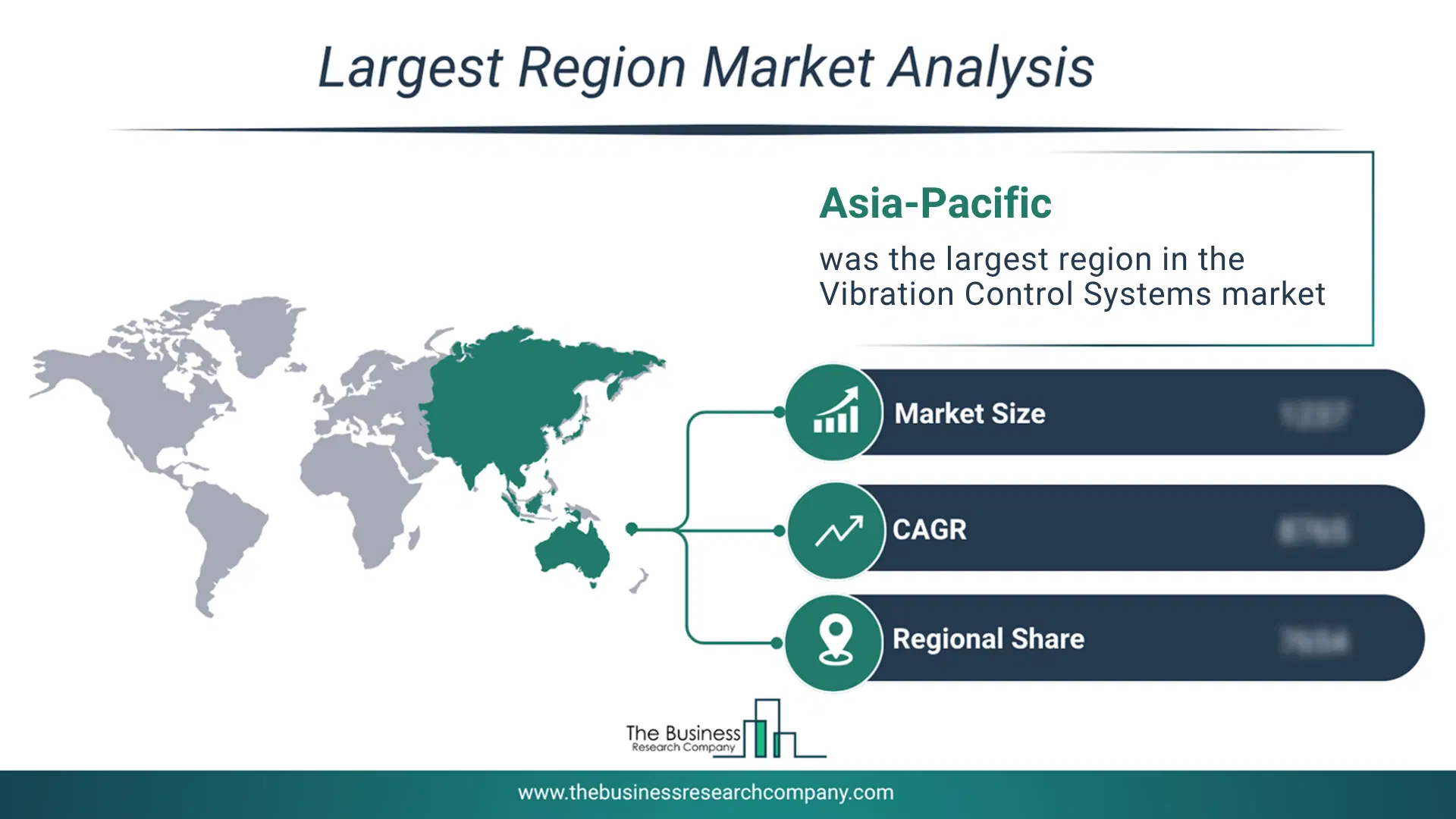
Regional Outlook
Asia-Pacific was the largest region in the vibration control systems market in 2025. Europe is expected to be the fastest-growing region in the forecast period. The regions covered in this market report are Asia-Pacific, South East Asia, Western Europe, Eastern Europe, North America, South America, Middle East, Africa The countries covered in this market report are Australia, Brazil, China, France, Germany, India, Indonesia, Japan, Taiwan, Russia, South Korea, UK, USA, Canada, Italy, Spain.What Defines the Vibration Control Systems Market?
The vibration control systems market consists of revenues earned by entities by providing services such as installation services, calibration services, maintenance, and repair. The market value includes the value of related goods sold by the service provider or included within the service offering. The vibration control systems market also includes sales of vibration isolators, vibration dampers, vibration sensors, and fibroelastic materials. Values in this market are ‘factory gate’ values, that is, the value of goods sold by the manufacturers or creators of the goods, whether to other entities (including downstream manufacturers, wholesalers, distributors, and retailers) or directly to end customers. The value of goods in this market includes related services sold by the creators of the goods.How is Market Value Defined and Measured?
The market value is defined as the revenues that enterprises gain from the sale of goods and/or services within the specified market and geography through sales, grants, or donations in terms of the currency (in USD unless otherwise specified). The revenues for a specified geography are consumption values that are revenues generated by organizations in the specified geography within the market, irrespective of where they are produced. It does not include revenues from resales along the supply chain, either further along the supply chain or as part of other products.
This chart presents market attractiveness based on a quantitative evaluation of growth, competition, strategic alignment, and risk, offering a clear view of opportunity areas for decision-making. This chart is for illustrative purposes; the full report contains the complete analysis.

This chart highlights the Total Addressable Market (TAM) by estimating the maximum revenue opportunity using an assumption-driven approach, supporting strategic planning and opportunity sizing across markets. The chart is illustrative; the full report provides a more comprehensive analysis.
What Key Data and Analysis Are Included in the Vibration Control Systems Market Report 2026?
The vibration control systems market research report is one of a series of new reports from The Business Research Company that provides market statistics, including industry global market size, regional shares, competitors with the market share, detailed market segments, market trends and opportunities, and any further data you may need to thrive in the vibration control systems industry. The market research report delivers a complete perspective of everything you need, with an in-depth analysis of the current and future state of the industry.Vibration Control Systems Market Report Forecast Analysis
| Report Attribute | Details |
|---|---|
| Market Size Value In 2026 | $6.22 billion |
| Revenue Forecast In 2030 | $8.1 billion |
| Growth Rate | CAGR of 6.8% from 2026 to 2030 |
| Base Year For Estimation | 2025 |
| Actual Estimates/Historical Data | 2020-2025 |
| Forecast Period | 2026 - 2030 |
| Market Representation | Revenue in USD Billion and CAGR from 2026 to 2030 |
| Segments Covered | Component, System Type, Application |
| Regional Scope | Asia-Pacific, Western Europe, Eastern Europe, North America, South America, Middle East, Africa |
| Key Companies Profiled | Continental AG, Hutchinson S.A., Parker Hannifin Corporation, Trelleborg Aktiebolag, Cooper Standard Holdings Inc., LORD Corporation, Mason Industries Inc., Kinetics Noise Control Inc., ACE Controls Inc., Kurashiki Kako Co. Ltd, GERB Vibration Control Systems Inc., Sentek Dynamics Incorporated, Crystal Instruments Corporation, LISEGA SE, Isolation Technology Inc., Fabreeka International Inc., VICODA GmbH, Enidine Inc., Getzner Werkstoffe GmbH, ITT Inc., Bridgestone Corporation, Sumitomo Rubber Industries Ltd |
| Customization Scope | Request for Customization |
| Pricing And Purchase Options | Explore Purchase Options |