

Video On Demand Global Market Opportunities And Strategies To 2035
By Component (Solutions, Services), By Platform Type (Smartphones, Tablets/Laptops, Smart TVs, Other Platform Types), By Business Model (Subscription Video On Demand (SVOD), Advertisement Video On Demand (AVOD), Hybrid (SVOD+AVOD), Pay-Per-View (PPV), Other Transactional Video On Demand (TVOD), Other Business Models), By End User (Media, Entertainment And Gaming, Travel And Hospitality, Education, Other End-Users), And By Region, Opportunities And Strategies – Global Forecast To 2035
Video On Demand Market Definition
Video on Demand (VoD) refers to a digital media distribution model that enables users to access and watch video content at their convenience, without being constrained by traditional broadcast schedules. It involves delivering pre-recorded video content over the internet or digital networks to compatible devices, allowing users to start, pause, rewind, or stop the content as desired. The video on demand market consists of sales of video on demand by entities (organizations, sole traders and partnerships) that is widely used by individual consumers for entertainment, educational, and informational purposes, as well as by institutions and enterprises for training, communication, and engagement. Content is accessed on-demand through various interfaces such as mobile applications, smart TVs, web browsers, and dedicated platforms, offering a personalized viewing experience.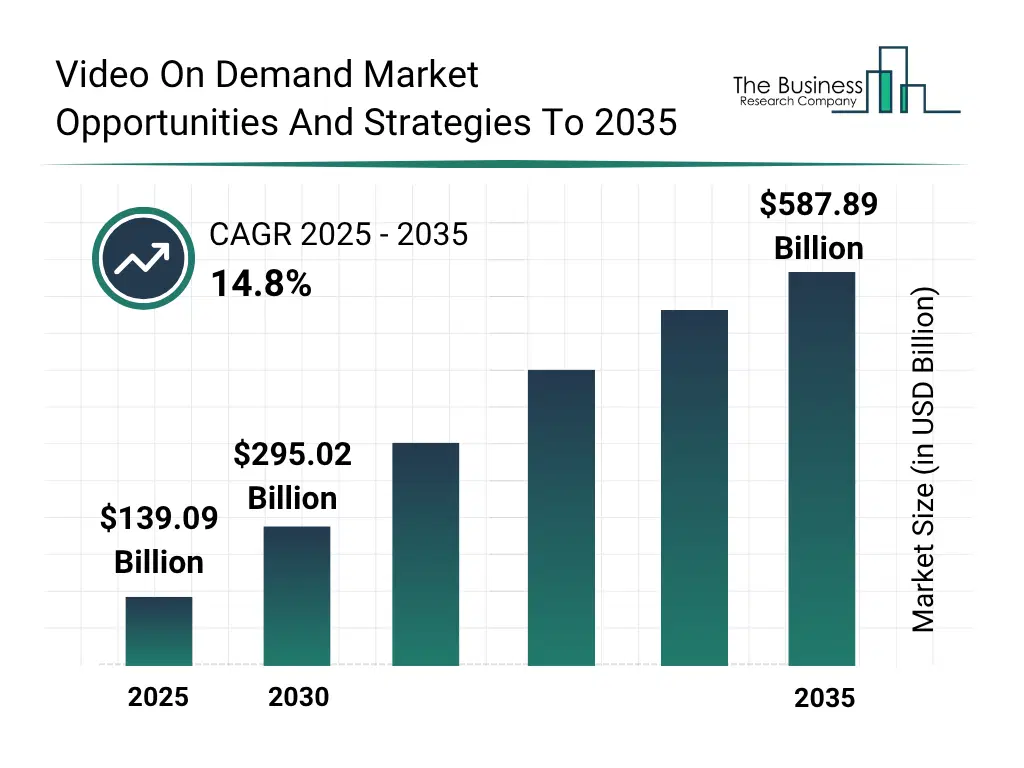
Video On Demand Market Size
The global video on demand market reached a value of nearly $139,087.7 million in 2025, having grown at a compound annual growth rate (CAGR) of 20.2% since 2020. The market is expected to grow from $139,087.7 million in 2025 to $295,022.5 million in 2030 at a rate of 16.2%. The market is then expected to grow at a CAGR of 14.8% from 2030 and reach $587,886.3 million in 2035. Growth in the historic period resulted from rising internet and smartphones penetration, shift in consumer entertainment consumption toward digital and on-demand formats, surge in on-demand content penetration, growth of subscription-based (SVOD) and hybrid monetization models. Factors that negatively affected growth in the historic period were piracy and illegal streaming and competition from free content platforms. Going forward, expansion of OTT platforms, rising penetration of smart TVs, connected TVs, and streaming devices, expansion of streaming platforms and subscription-based models and rapid expansion of high-speed broadband networks will drive the growth. Factors that could hinder the growth of the video on demand market in the future include government regulations and content censorship rules, high churn rates due to low switching costs, regulatory and censorship constraints on content distribution.
Video On Demand Market Segmentation
The video on demand market is segmented by component, by platform type, by business model and by end-users.By Component –
The video on demand market is segmented by component into:
- a) Solution
- b) Services
By Platform Type –
The video on demand market is segmented by platform type into:
- a) Smartphones
- b) Tablets/Laptops
- c) Smart TVs
- d) Other Platform Types
By Business Model –
The video on demand market is segmented by business model into:
- a) Subscription Video On Demand (SVOD)
- b) Advertisement Video On Demand (AVOD)
- c) Hybrid (SVOD+AVOD)
- d) Pay-Per-View (PPV)
- e) Other Transactional Video On Demand (TVOD)
- f) Other Business Models
By End Users –
The video on demand market is segmented by end users into:
- a) Media, Entertainment, And Gaming
- b) Travel And Hospitality
- c) Education
- d) Other End-Users
By Geography - The video on demand market is segmented by geography into:
- China
- India
- Japan
- Australia
- Taiwan
- South Korea
- Indonesia
- USA
- Canada
- Brazil
- France
- Germany
- UK
- Italy
- Spain
- Russia
-
o Asia Pacific
o Africa