
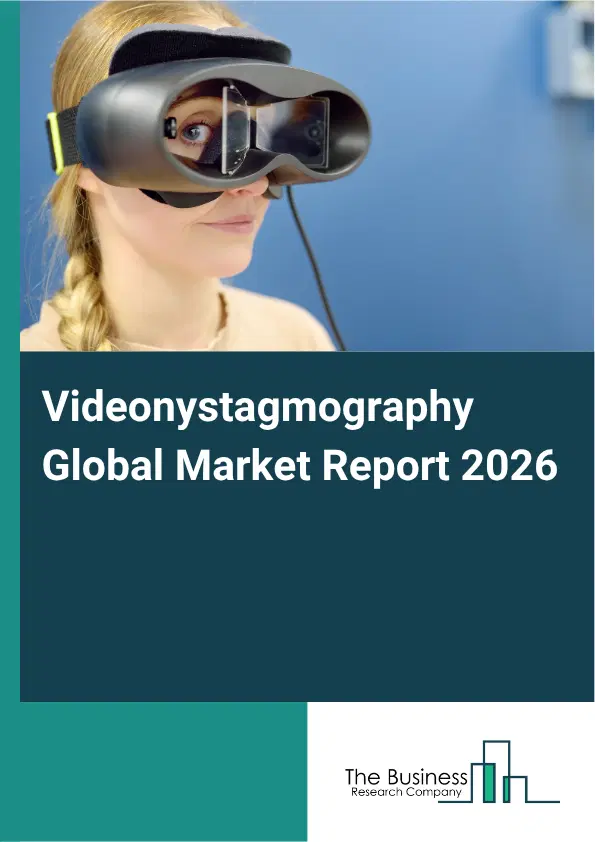
Videonystagmography Market Report 2026
Global Outlook – By Component (Hardware, Software, Services), By Test Type (Ocular Motor Testing, Positional Testing, Positioning Testing, Caloric Testing), By Technology (Wired Video Nystagmography Systems, Wireless Video Nystagmography Systems), By Application (Vertigo Diagnosis, Balance Disorder Assessment, Vestibular Function Evaluation, Neurological Disorder Diagnosis, Hearing And Ear Nose And Throat Disorder Assessment), By End User (Hospitals, Ear Nose And Throat Clinics, Audiology Clinics, Diagnostic Centers, Ambulatory Surgical Centers) – Market Size, Trends, Strategies, and Forecast to 2030
Videonystagmography Market Report 2026 Market Overview
• Videonystagmography Market Report 2026 market size has reached to $1 billion in 2025 • Expected to grow to $1.58 billion in 2030 at a compound annual growth rate (CAGR) of 9.6% • Growth Driver: Surge In The Preference For Non-Invasive Diagnostics Fueling The Growth Of The Market Due To Increasing Demand For Painless And Patient-Friendly Diagnostic Procedures • Market Trend: Wireless Infrared Eye Tracking Architecture Enhancing Clinical Workflow Efficiency • North America was the largest region in 2025 and Asia-Pacific is the fastest growing region.What Is Covered Under Videonystagmography Market?
Videonystagmography refers to a specialized diagnostic test platform that utilizes infrared cameras mounted inside a set of goggles to track and measure involuntary eye movements (nystagmus) in response to visual, positional, and thermal stimuli. This non-invasive test evaluates the function of the vestibular system and acoustic nerves, helping clinicians diagnose the underlying causes of vertigo, dizziness, and balance disorders. The main components of videonystagmography include hardware, software, and services. Hardware refers to specialized diagnostic equipment, including infrared video goggles, cameras, and recording devices, used to monitor and analyze eye movements for the assessment of vestibular and balance disorders. These systems support ocular motor testing, positional testing, positioning testing, and caloric testing and are available as wired video nystagmography systems and wireless video nystagmography systems. The various applications involved are vertigo diagnosis, balance disorder assessment, vestibular function evaluation, neurological disorder diagnosis, and hearing and ear nose and throat disorder assessment and they are utilized by end users including hospitals, ear nose and throat clinics, audiology clinics, diagnostic centers, and ambulatory surgical centers.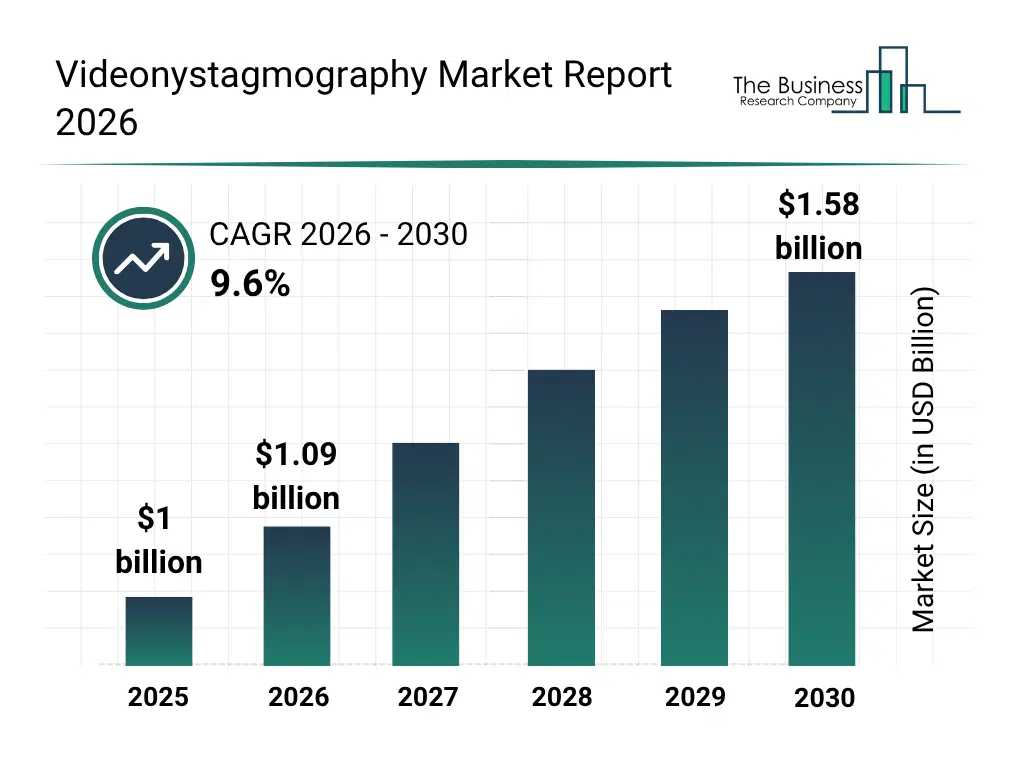
What Is The Videonystagmography Market Size and Share 2026?
The videonystagmography market size has grown strongly in recent years. It will grow from $1 billion in 2025 to $1.09 billion in 2026 at a compound annual growth rate (CAGR) of 9.4%. The growth in the historic period can be attributed to rising prevalence of vestibular disorders, increasing incidence of dizziness and vertigo cases, growing awareness of balance disorder diagnosis, expanding availability of ENT diagnostic services, increasing adoption of non-invasive diagnostic procedures.What Is The Videonystagmography Market Growth Forecast?
The videonystagmography market size is expected to see strong growth in the next few years. It will grow to $1.58 billion in 2030 at a compound annual growth rate (CAGR) of 9.6%. The growth in the forecast period can be attributed to growing demand for advanced vestibular assessment technologies, increasing investments in diagnostic infrastructure, rising adoption of wireless diagnostic systems, expanding geriatric population with balance disorders, increasing establishment of specialized vestibular care centers. Major trends in the forecast period include increasing adoption of non-invasive vestibular diagnostic testing, growing demand for comprehensive balance disorder assessment, rising utilization of infrared eye movement tracking systems, expanding use of videonystagmography in vertigo diagnosis, increasing focus on early detection of vestibular disorders.
Global Videonystagmography Market Segmentation
1) By Component: Hardware, Software, Services 2) By Test Type: Ocular Motor Testing, Positional Testing, Positioning Testing, Caloric Testing 3) By Technology: Wired Video Nystagmography Systems, Wireless Video Nystagmography Systems 4) By Application: Vertigo Diagnosis, Balance Disorder Assessment, Vestibular Function Evaluation, Neurological Disorder Diagnosis, Hearing And Ear Nose And Throat Disorder Assessment 5) By End User: Hospitals, Ear Nose And Throat Clinics, Audiology Clinics, Diagnostic Centers, Ambulatory Surgical Centers Subsegments: 1) By Hardware: Video Nystagmography Systems, Infrared Video Nystagmography Goggles, Eye Tracking Cameras, Caloric Irrigation Devices, Computer Workstations, Mounting And Positioning Accessories 2) By Software: Eye Movement Analysis Software, Vestibular Diagnostic Software, Report Generation Software, Data Management Software, Electronic Health Record Integration Software, Artificial Intelligence Based Analysis Software 3) By Services: Video Nystagmography Diagnostic Testing Services, Vestibular Function Assessment Services, Balance Disorder Evaluation Services, Installation And System Integration Services, Training And Technical Support Services, Maintenance And Calibration ServicesWhat Are The Drivers Of The Videonystagmography Market?
The growing preference for non-invasive diagnostics is expected to propel the growth of the videonystagmography market going forward. Non-invasive diagnostics are medical diagnostic methods that evaluate, monitor, or detect health conditions without penetrating the skin, entering the body, or requiring surgical procedures. Non-invasive diagnostics are increasing as patients and healthcare providers increasingly prefer painless, low-risk, and comfortable diagnostic procedures. Videonystagmography supports non-invasive diagnostics by accurately evaluating vestibular and balance disorders through infrared eye movement tracking without requiring surgical or invasive procedures. For instance, in November 2024, according to NHS England, a UK healthcare authority, diagnostic imaging tests in England increased to 47.2 million in 2023/24 from 45.0 million in 2022/23, representing a 4.8% increase, while MRI scans rose to 4.4 million from the previous year, an 8.1% increase. Therefore, the growing preference for non-invasive diagnostics is driving the growth of the videonystagmography industry. The increasing incidence of neurological disorders is expected to propel the growth of the videonystagmography market going forward. Neurological disorders are conditions that affect the brain, spinal cord, and nerves, causing disruptions in movement, sensation, cognition, communication, or other nervous system functions. The rising global elderly population is increasing the prevalence of neurological disorders, as age-related changes in the brain and nervous system elevate the risk of conditions such as stroke, dementia, and Parkinson’s disease. The rising incidence of neurological conditions that affect the brain’s control of balance and eye movements increases the need for videonystagmography (VNG) to accurately assess vestibular function, identify abnormalities in eye movements, and support diagnosis and treatment planning. For instance, in October 2023, according to the National Library of Medicine, a US-based biomedical library, global stroke mortality is projected to reach 9.7 million deaths annually by 2050 if current trends continue. Therefore, the increasing incidence of neurological disorders is driving the growth of the videonystagmography industry.Key Players In The Global Videonystagmography Market
Major companies operating in the videonystagmography market report are Interacoustics A/S, Natus Sensory, e3 Diagnostics, Difra S.A., BioMed Jena GmbH, Homoth Medizinelektronik GmbH & Co. KG, Neurosoft, American Institute of Balance (AIB), Inventis S.r.l., Secure Health Inc., Mayo Clinic, Johns Hopkins Medicine, Balanceback AB, Vestibular First, House Institute Foundation, FYZICAL Therapy & Balance Centers, Cleveland Clinic, ZEHNIT Medical Technology, Happersberger Otopront GmbH
This chart is for illustrative purposes; the full report includes a detailed competitor analysis and comprehensive overview of the top 10 companies in the market.
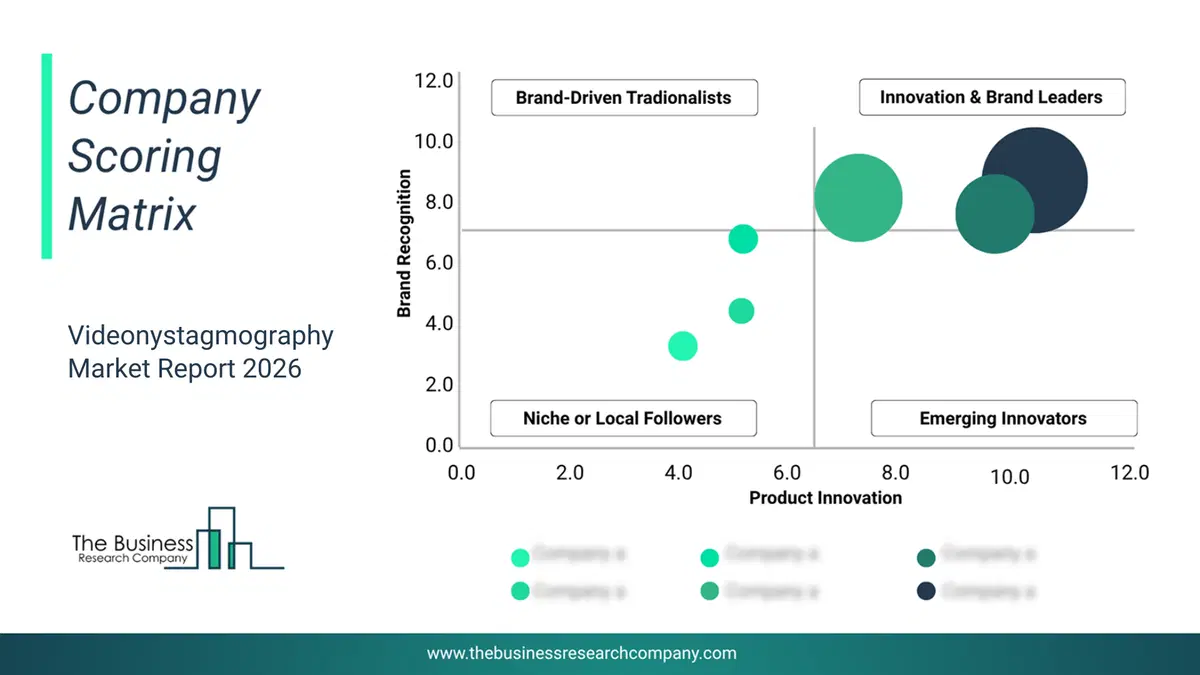
This chart maps companies by product innovation and brand strength, with bubble size indicating relative revenue, helping identify market leaders, challengers, and niche players. This is an illustrative chart; the full report provides a complete and accurate competitive analysis.
Global Videonystagmography Market Trends and Insights
Major companies operating in the videonystagmography market are focusing on developing advanced solutions, such as wireless infrared eye-tracking architecture, to simplify device setup and enhance clinical workflow. Wireless infrared eye tracking architecture is a system design that uses infrared imaging sensors and wireless communication technologies to capture, process, and transmit eye movement data in real time without requiring physical cable connections between the tracking device and connected systems. For instance, in May 2023, Inventis S.r.l., an Italy-based medical diagnostics company, launched the SYNAPSYS VideoScope. The system offers a wireless camera configuration with interchangeable Goggles Flex and Xpress Mask options, supports both wired and wireless operation for greater deployment flexibility, and provides high-resolution infrared eye-movement visualization with seamless integration into the Nystalyze platform for comprehensive vestibular assessment. These capabilities enhance clinician productivity, improve patient comfort, and support more efficient diagnosis of vestibular disorders across hospitals and specialty balance clinics.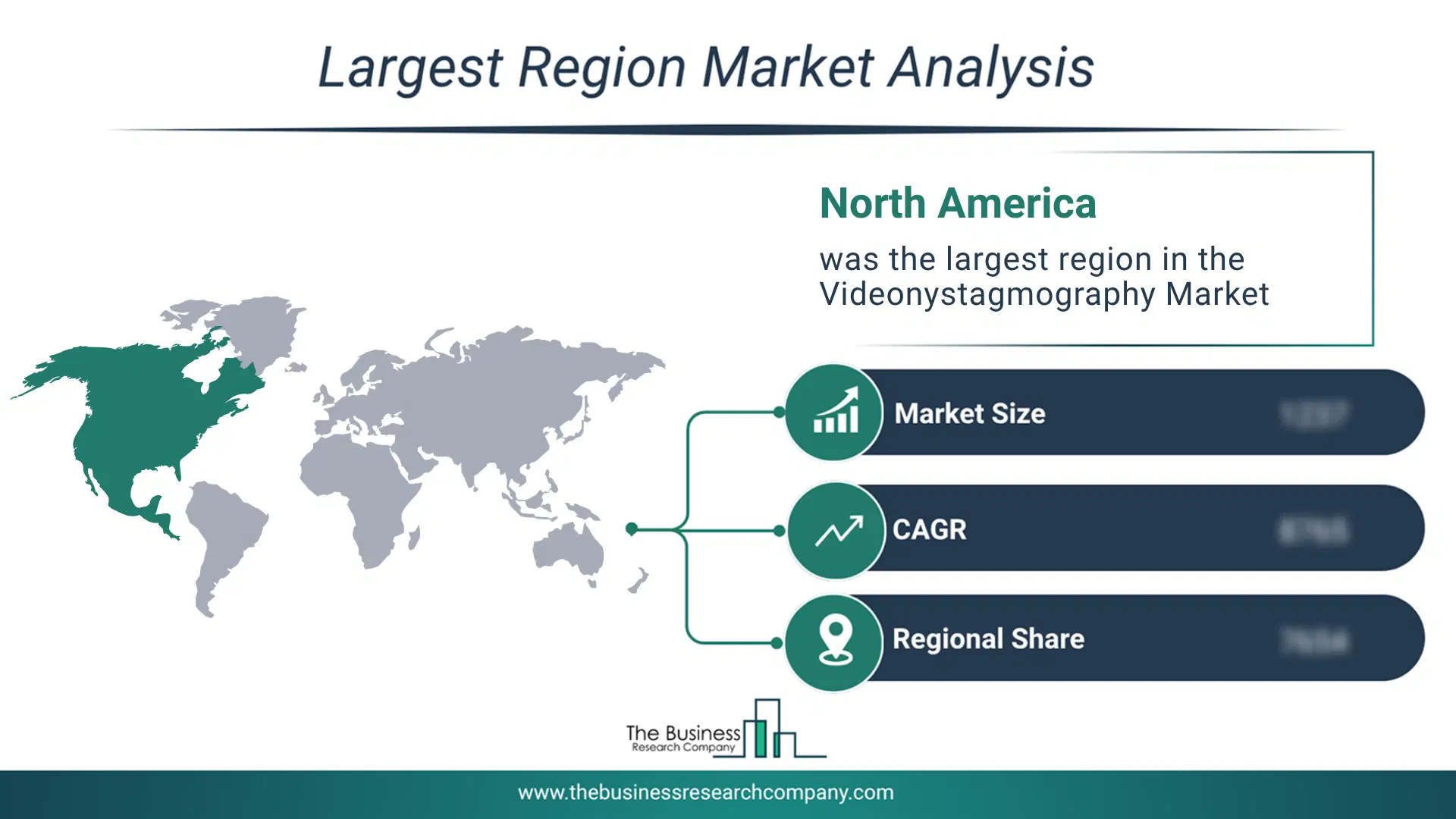
Regional Outlook
North America was the largest region in the videonystagmography market in 2025. Asia-Pacific is expected to be the fastest-growing region in the forecast period. The regions covered in this market report are Asia-Pacific, South East Asia, Western Europe, Eastern Europe, North America, South America, Middle East, Africa. The countries covered in this market report are Australia, Brazil, China, France, Germany, India, Indonesia, Japan, Taiwan, Russia, South Korea, UK, USA, Canada, Italy, Spain.What Defines the Videonystagmography Market?
The videonystagmography market consists of revenues earned by entities by providing services such as videonystagmography (vng) diagnostic testing, vestibular function assessment services, balance disorder evaluation services, dizziness and vertigo diagnostic services, vestibular rehabilitation and follow-up services. The market value includes the value of related goods sold by the service provider or included within the service offering. The videonystagmography market also includes sales of videonystagmography (vng) systems, infrared vng goggles, eye-tracking cameras, and caloric irrigation devices. Values in this market are ‘factory gate’ values, that is the value of goods sold by the manufacturers or creators of the goods, whether to other entities (including downstream manufacturers, wholesalers, distributors and retailers) or directly to end customers. The value of goods in this market includes related services sold by the creators of the goods.How is Market Value Defined and Measured?
The market value is defined as the revenues that enterprises gain from the sale of goods and/or services within the specified market and geography through sales, grants, or donations in terms of the currency (in USD unless otherwise specified). The revenues for a specified geography are consumption values that are revenues generated by organizations in the specified geography within the market, irrespective of where they are produced. It does not include revenues from resales along the supply chain, either further along the supply chain or as part of other products.
This chart presents market attractiveness based on a quantitative evaluation of growth, competition, strategic alignment, and risk, offering a clear view of opportunity areas for decision-making. This chart is for illustrative purposes; the full report contains the complete analysis.

This chart highlights the Total Addressable Market (TAM) by estimating the maximum revenue opportunity using an assumption-driven approach, supporting strategic planning and opportunity sizing across markets. The chart is illustrative; the full report provides a more comprehensive analysis.
What Key Data and Analysis Are Included in the Videonystagmography Market Report 2026?
The videonystagmography market research report is one of a series of new reports from The Business Research Company that provides market statistics, including industry global market size, regional shares, competitors with the market share, detailed market segments, market trends and opportunities, and any further data you may need to thrive in the videonystagmography industry. The market research report delivers a complete perspective of everything you need, with an in-depth analysis of the current and future state of the industry.Videonystagmography Market Report Forecast Analysis
| Report Attribute | Details |
|---|---|
| Market Size Value In 2026 | $1.09 billion |
| Revenue Forecast In 2030 | $1.58 billion |
| Growth Rate | CAGR of 9.6% from 2026 to 2030 |
| Base Year For Estimation | 2025 |
| Actual Estimates/Historical Data | 2020-2025 |
| Forecast Period | 2026 - 2030 |
| Market Representation | Revenue in USD Billion and CAGR from 2026 to 2030 |
| Segments Covered | Component, Test Type, Technology, Application, End User |
| Regional Scope | Asia-Pacific, Western Europe, Eastern Europe, North America, South America, Middle East, Africa |
| Country Scope | The countries covered in the report are Australia, Brazil, China, France, Germany, India, Indonesia, Japan, Taiwan, Russia, South Korea, UK, USA, Canada, Italy, Spain. |
| Key Companies Profiled | Interacoustics A/S, Natus Sensory, e3 Diagnostics, Difra S.A., BioMed Jena GmbH, Homoth Medizinelektronik GmbH & Co. KG, Neurosoft, American Institute of Balance (AIB), Inventis S.r.l., Secure Health Inc., Mayo Clinic, Johns Hopkins Medicine, Balanceback AB, Vestibular First, House Institute Foundation, FYZICAL Therapy & Balance Centers, Cleveland Clinic, ZEHNIT Medical Technology, Happersberger Otopront GmbH |
| Customization Scope | Request for Customization |
| Pricing And Purchase Options | Explore Purchase Options |