
Virtual Fitting Room Market Report 2026
Global Outlook – By Type (In-Store Virtual Mirrors, App-Based Body Scanners, Sizing Surveys Backed By 3d Body Data), By Component (Hardware, Software, Services), By Application (Apparel, Eyewear, Cosmetic And Beauty Products, Jewelry And Watches, Other Applications), By End User (Brick And Mortar Stores, Virtual Or E-Commerce Stores) – Market Size, Trends, Strategies, and Forecast to 2030
Virtual Fitting Room Market Overview
• Virtual Fitting Room market size has reached to $7.67 billion in 2025 • Expected to grow to $21.01 billion in 2030 at a compound annual growth rate (CAGR) of 22.3% • Growth Driver: The Impact of E-Commerce Growth On The Virtual Fitting Room Market • Market Trend: Innovative Solutions Drive Growth In The Mobile Virtual Fitting Market • North America was the largest region in 2025 and Asia-Pacific is the fastest growing region.What Is Covered Under Virtual Fitting Room Market?
A virtual fitting room refers to a digital platform or application that allows users to try on clothing and accessories virtually. It typically uses augmented reality (AR) or virtual reality (VR) technology to superimpose digital representations of clothing items onto the user's body in real-time, often using a webcam or smartphone camera. The main types of virtual fitting rooms are in-store virtual mirrors, app-based body scanners, and sizing surveys backed by 3D body data. In-store virtual mirrors are interactive screens that allow customers to virtually try on clothing items without physically putting them on. It includes various components, such as hardware, software, and services, and these are used for various applications, including apparel, eyewear, cosmetic and beauty products, jewelry and watches, and others, and end-users are brick-and-mortar stores and virtual/e-commerce stores.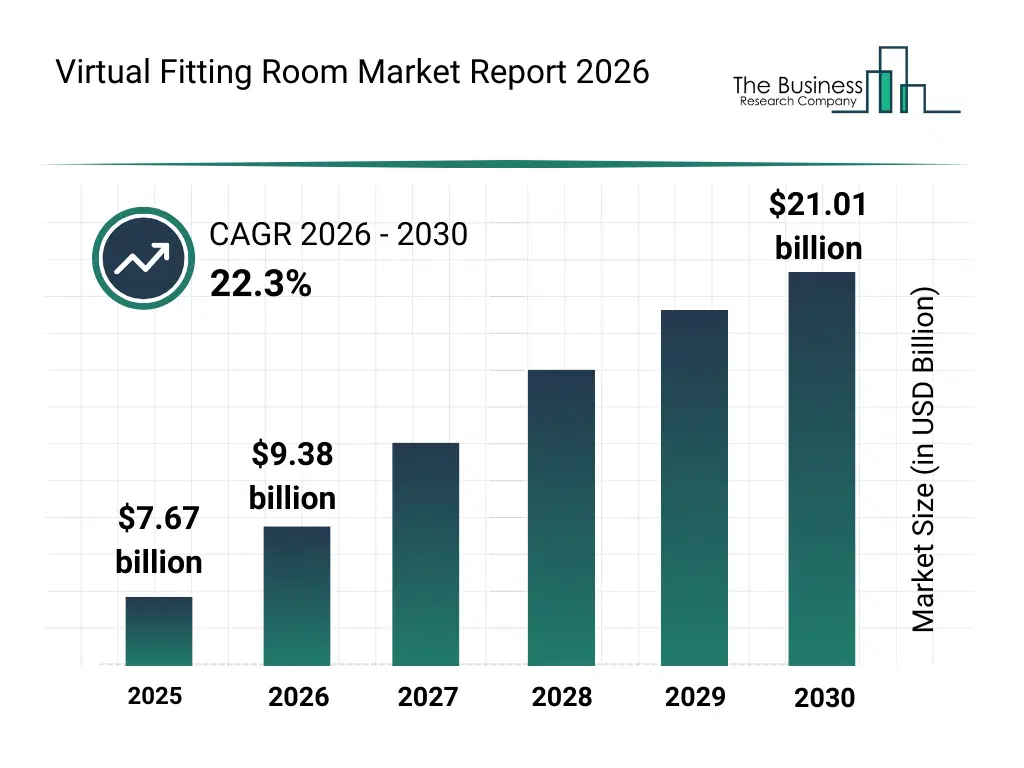
What Is The Virtual Fitting Room Market Size and Share 2026?
The virtual fitting room market size has grown exponentially in recent years. It will grow from $7.67 billion in 2025 to $9.38 billion in 2026 at a compound annual growth rate (CAGR) of 22.3%. The growth in the historic period can be attributed to early adoption of ar/vr technologies in retail, growing smartphone penetration, increasing online apparel sales, rising awareness of virtual fitting solutions, limited physical retail expansions.What Is The Virtual Fitting Room Market Growth Forecast?
The virtual fitting room market size is expected to see exponential growth in the next few years. It will grow to $21.01 billion in 2030 at a compound annual growth rate (CAGR) of 22.3%. The growth in the forecast period can be attributed to integration of ai and machine learning in fit prediction, expansion of omnichannel retail strategies, demand for sustainable and contactless shopping experiences, growth of fashion e-commerce in emerging markets, technological advancements in 3d body scanning and virtual mirrors. Major trends in the forecast period include personalized virtual try-on experience, 3d body scanning accuracy improvement, AI-driven size and fit recommendations, integration with e-commerce platforms, social media and influencer-focused virtual try-ons.
Global Virtual Fitting Room Market Segmentation
1) By Type: In-Store Virtual Mirrors, App-Based Body Scanners, Sizing Surveys Backed By 3d Body Data 2) By Component: Hardware, Software, Services 3) By Application: Apparel, Eyewear, Cosmetic And Beauty Products, Jewelry And Watches, Other Applications 4) By End User: Brick And Mortar Stores, Virtual Or E-Commerce Stores Subsegments: 1) By In-Store Virtual Mirrors: Interactive Virtual Try-On Mirrors, Augmented Reality (AR) Mirrors 2) By App-Based Body Scanners: Mobile Apps For Body Measurement, 3D Body Scanning Apps 3) By Sizing Surveys Backed By 3D Body Data: Online Sizing Surveys, AI-Driven Fit Recommendation ToolsWhat Is The Driver Of The Virtual Fitting Room Market?
The rapid expansion of e-commerce is expected to propel the growth of the virtual fitting room market going forward. E-commerce refers to the buying and selling of goods and services conducted over the internet or other electronic networks. The demand for e-commerce arises due to convenience, accessibility, changing consumer behavior, and evolving business strategies. E-commerce leverages virtual fitting rooms to reduce returns, enhance customer confidence, and improve conversion rates by enabling shoppers to try on clothing virtually before purchasing. For instance, in November 2023, according to the United States Census Bureau, a US-based government agency, e-commerce increased and reached the 3rd quarter of 2023 at 7.6%, compared to the 4th quarter of 2022 by 6.9%. 15.4% of all sales in the second quarter of 2023 were made through online stores. Therefore, the rapid expansion of e-commerce is driving the growth of the virtual fitting room industry.Key Players In The Global Virtual Fitting Room Market
Major companies operating in the virtual fitting room market are Zoovu GmbH, Total Immersion S.A., Fashion Fusion AG, Vue.ai Technologies Inc., WearWell Technologies Inc., True Fit Corporation, Visenze Pte. Ltd., Swivel Technologies Inc., 3DLook LLC, Fit Analytics GmbH, NexTech AR Solutions Corp., Tailor Store Sweden AB, My Size Inc., Reactive Reality AG, Virtusize AB, Fision Technologies Inc., Size Stream LLC, Zugara Inc., Trimirror Inc., StyleSpot Inc., Omnify Inc., StyleSage Inc., Coitor IT Tech Pvt. Ltd., Perfitly Inc., Metail
This chart is for illustrative purposes; the full report includes a detailed competitor analysis and comprehensive overview of the top 10 companies in the market.
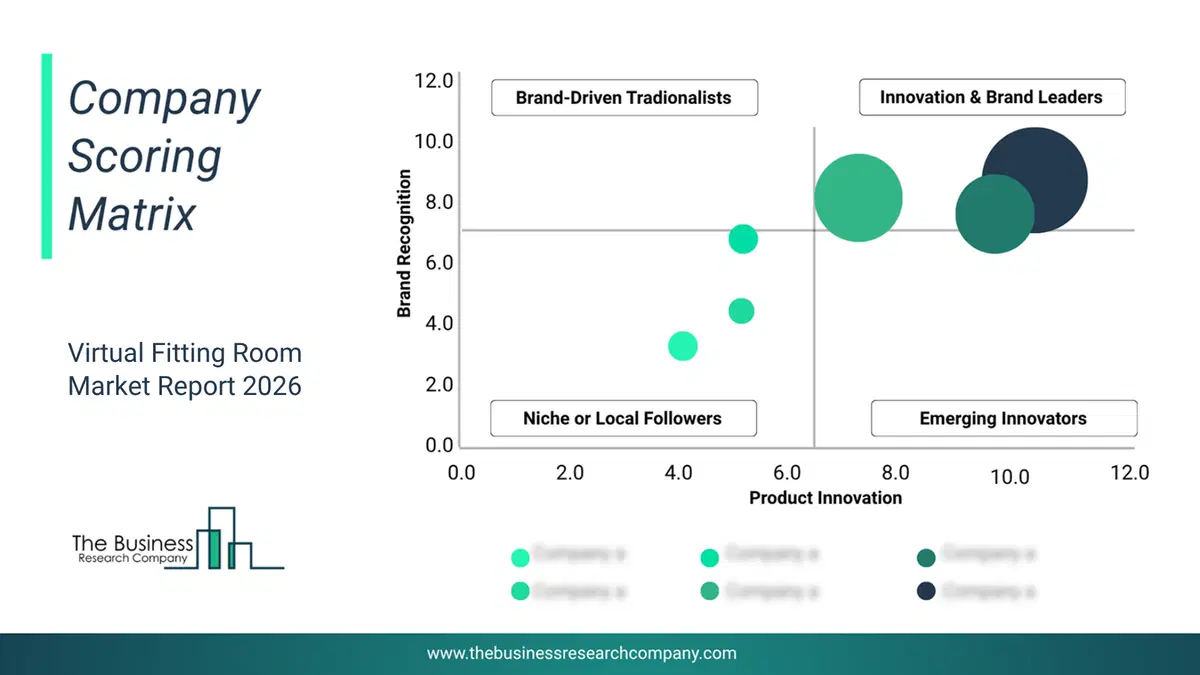
This chart maps companies by product innovation and brand strength, with bubble size indicating relative revenue, helping identify market leaders, challengers, and niche players. This is an illustrative chart; the full report provides a complete and accurate competitive analysis.
Global Virtual Fitting Room Market Trends and Insights
Major companies operating in the mobile virtual fitting market are concentrating on innovative advancements such as virtual fitting room pilot to provide an immersive shopping experience and the increasing demand for accurate size and fit recommendations. This is a technology that allows customers to try on clothes virtually without physically touching or buying them. It leverages the power of technology to enable shoppers to see the size, style, and fit of items. For instance, in April 2023, Zalando SE, a Germany-based online retail company, introduced a virtual fitting room pilot to reduce return rates, provide intelligent data management, and offer a more personalized and convenient shopping experience. allowing customers to create a 3D avatar and virtually try on clothing items, particularly jeans, which are often challenging to find the right size for due to the lack of sizing standards. It offers several key features, including the ability for customers to create a 3D avatar by entering their height, weight, and gender. This avatar can then be used to try on different sizes of jeans from various brands, with a heatmap indicating whether the item sits tight or loose. Additionally, it enhances the shopping experience, particularly for challenging items such as jeans, reduces returns, and also provides valuable data for retailers to improve their product offerings and inventory management.What Are Latest Mergers And Acquisitions In The Virtual Fitting Room Market?
In October 2023, Fittingbox S.A., a France‑based provider of digital eyewear solutions and virtual try‑on technologies, acquired Ditto Technologies Inc. for an undisclosed amount. With this acquisition, Fittingbox aimed to strengthen its leadership in the virtual fitting room and virtual try‑on market by combining its existing AR‑based eyewear try‑on capabilities with Ditto’s advanced 3D facial mapping and virtual try‑on technology, enhancing personalized customer experiences across optical retail channels. Ditto Technologies Inc. is a US‑based provider of virtual eyewear try‑on software and 3D facial scanning solutions, enabling consumers to digitally try on glasses and eyewear products before purchase.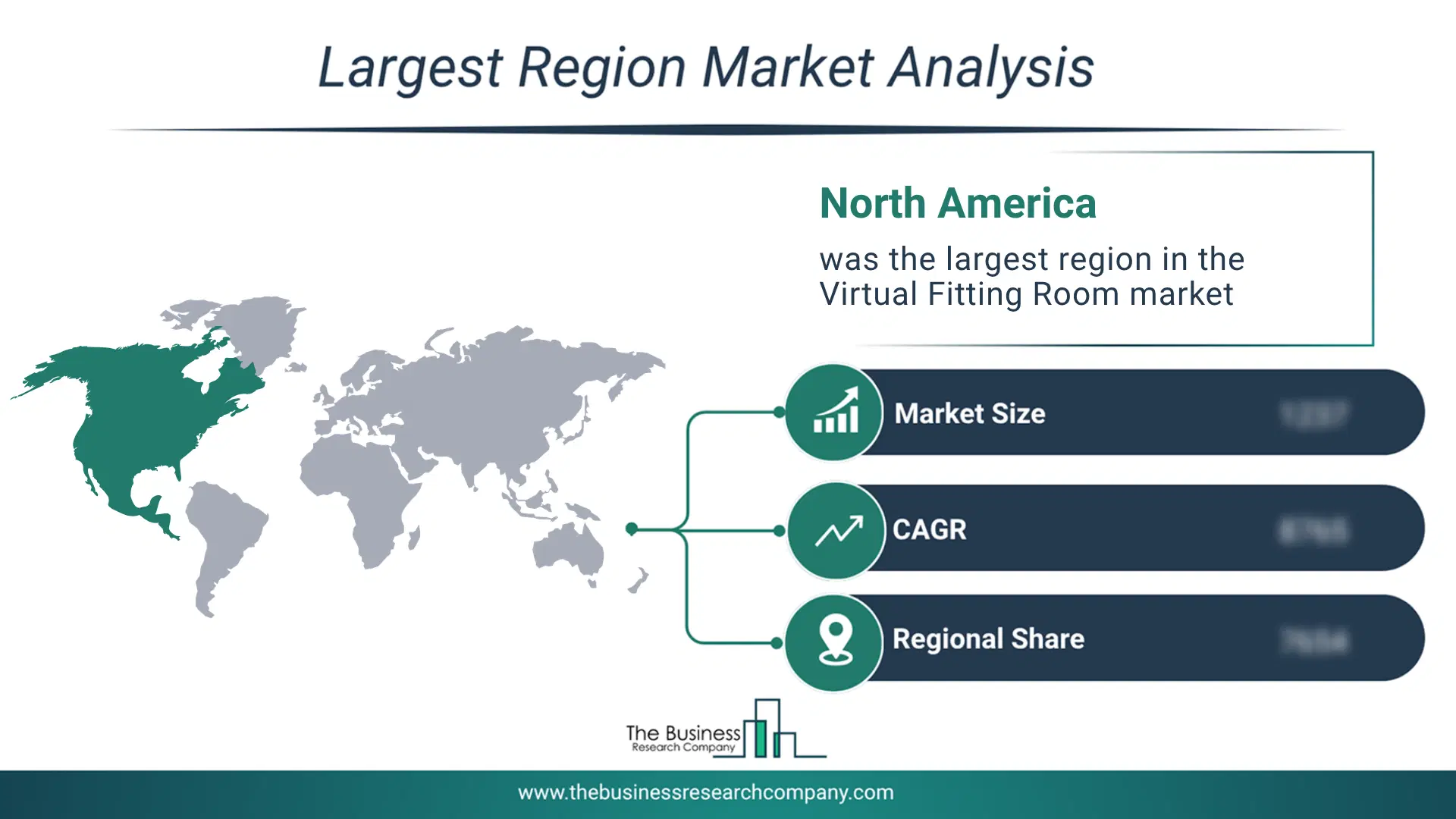
Regional Outlook
North America was the largest region in the virtual fitting room Market in 2025. Asia-Pacific is expected to be the fastest-growing region in the forecast period. The regions covered in this market report are Asia-Pacific, South East Asia, Western Europe, Eastern Europe, North America, South America, Middle East and Africa. The countries covered in this market report are Australia; Brazil; China; France; Germany; India; Indonesia; Japan; Taiwan; Russia; South Korea; UK; USA; Canada; Italy; Spain.What Defines the Virtual Fitting Room Market?
The virtual fitting room market consists of revenues earned by entities by providing services such as catalogue integration, customer support, and assistance, body measurement, scanning, visualization and rendering, and data privacy and security. The market value includes the value of related goods sold by the service provider or included within the service offering. The virtual fitting room market also includes sales of products such as integration plugins, AR/VR headsets, mobile applications, and virtual wardrobe management tools. Values in this market are ‘factory gate’ values, that is, the value of goods sold by the manufacturers or creators of the goods, whether to other entities (including downstream manufacturers, wholesalers, distributors, and retailers) or directly to end customers. The value of goods in this market includes related services sold by the creators of the goods.How is Market Value Defined and Measured?
The market value is defined as the revenues that enterprises gain from the sale of goods and/or services within the specified market and geography through sales, grants, or donations in terms of the currency (in USD unless otherwise specified). The revenues for a specified geography are consumption values that are revenues generated by organizations in the specified geography within the market, irrespective of where they are produced. It does not include revenues from resales along the supply chain, either further along the supply chain or as part of other products.
This chart presents market attractiveness based on a quantitative evaluation of growth, competition, strategic alignment, and risk, offering a clear view of opportunity areas for decision-making. This chart is for illustrative purposes; the full report contains the complete analysis.

This chart highlights the Total Addressable Market (TAM) by estimating the maximum revenue opportunity using an assumption-driven approach, supporting strategic planning and opportunity sizing across markets. The chart is illustrative; the full report provides a more comprehensive analysis.
What Key Data and Analysis Are Included in the Virtual Fitting Room Market Report 2026?
The virtual fitting room market research report is one of a series of new reports from The Business Research Company that provides market statistics, including industry global market size, regional shares, competitors with the market share, detailed market segments, market trends and opportunities, and any further data you may need to thrive in the virtual fitting room industry. The market research report delivers a complete perspective of everything you need, with an in-depth analysis of the current and future state of the industry.Virtual Fitting Room Market Report Forecast Analysis
| Report Attribute | Details |
|---|---|
| Market Size Value In 2026 | $9.38 billion |
| Revenue Forecast In 2030 | $21.01 billion |
| Growth Rate | CAGR of 22.3% from 2026 to 2030 |
| Base Year For Estimation | 2025 |
| Actual Estimates/Historical Data | 2020-2025 |
| Forecast Period | 2026 - 2030 |
| Market Representation | Revenue in USD Billion and CAGR from 2026 to 2030 |
| Segments Covered | Type, Component, Application, End User |
| Regional Scope | Asia-Pacific, Western Europe, Eastern Europe, North America, South America, Middle East, Africa |
| Country Scope | The countries covered in the report are Australia, Brazil, China, France, Germany, India, Indonesia, Japan, Taiwan, Russia, South Korea, UK, USA, Canada, Italy, Spain. |
| Key Companies Profiled | Zoovu GmbH, Total Immersion S.A., Fashion Fusion AG, Vue.ai Technologies Inc., WearWell Technologies Inc., True Fit Corporation, Visenze Pte. Ltd., Swivel Technologies Inc., 3DLook LLC, Fit Analytics GmbH, NexTech AR Solutions Corp., Tailor Store Sweden AB, My Size Inc., Reactive Reality AG, Virtusize AB, Fision Technologies Inc., Size Stream LLC, Zugara Inc., Trimirror Inc., StyleSpot Inc., Omnify Inc., StyleSage Inc., Coitor IT Tech Pvt. Ltd., Perfitly Inc., Metail |
| Customization Scope | Request for Customization |
| Pricing And Purchase Options | Explore Purchase Options |