
Virtual Goods Market Report 2026
Global Outlook – By Type (In-Game Items, Digital Collectibles, Virtual Currency, Other Types), By Platform (Gaming Consoles, Personal Computers, Mobile Devices, Other Platforms), By Payment Mode (Credit or Debit Cards, Digital Wallets, Other Payment Modes), By Distribution Channel (Direct Purchase, Subscription Based Services, In App Purchases, Online Marketplaces), By End-User (Gamers, Social Media Users, Other End-Users) – Market Size, Trends, Strategies, and Forecast to 2030
Virtual Goods Market Overview
• Virtual Goods market size has reached to $101.36 billion in 2025 • Expected to grow to $195.64 billion in 2030 at a compound annual growth rate (CAGR) of 14.1% • Growth Driver: Increasing Digital Gaming Adoption Is Fueling The Growth Of The Market Due To Rising Global Gamer Participation And Digital-first Game Consumption • Market Trend: Major Companies Drive Innovation In Digital Asset Marketplaces And Virtual Fashion Ecosystems To Enhance User Engagement And Monetization • Asia-Pacific was the largest region and fastest growing region.What Is Covered Under Virtual Goods Market?
Virtual goods are digital products or assets that exist only in a virtual environment and have no physical form. They help to enhance user experience, enable personalization, and create monetization opportunities for platforms through purchases, trades, or rewards. They also support engagement, social interaction, and the development of digital economies. The main types of virtual goods are in-game items, digital collectibles, Virtual Currency, and other types. In-Game items refer to digital assets that can be purchased or earned within a game to enhance gameplay, customize characters, or unlock special features. These goods are available across multiple platforms, including gaming consoles, personal computers, mobile devices, and other platforms, and can be purchased using various payment modes, such as credit or debit cards, digital wallets, and other payment modes. They are distributed through different channels, including direct purchase, subscription-based services, in-app purchases, and online marketplaces, and are primarily used by gamers, social media users, and other end-users.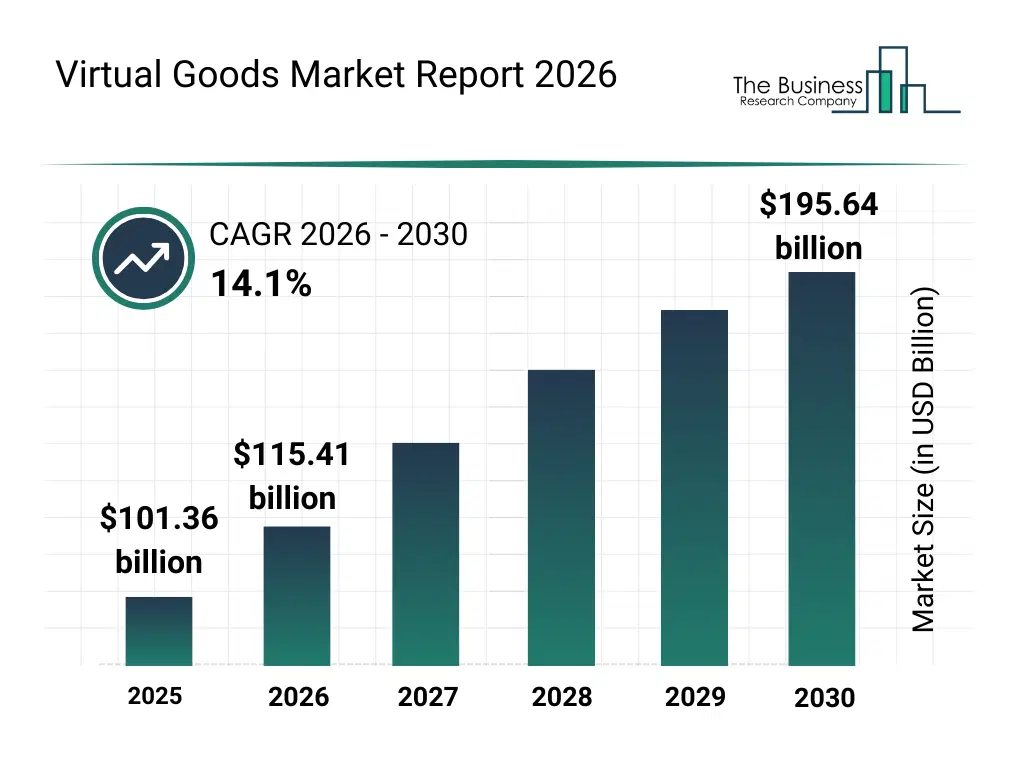
What Is The Virtual Goods Market Size and Share 2026?
The virtual goods market size has grown rapidly in recent years. It will grow from $101.36 billion in 2025 to $115.41 billion in 2026 at a compound annual growth rate (CAGR) of 13.9%. The growth in the historic period can be attributed to growth in online gaming, rise in social platforms, expansion of app stores, increase in digital payments, early microtransaction models.What Is The Virtual Goods Market Growth Forecast?
The virtual goods market size is expected to see rapid growth in the next few years. It will grow to $195.64 billion in 2030 at a compound annual growth rate (CAGR) of 14.1%. The growth in the forecast period can be attributed to increasing metaverse adoption, rising creator economy growth, expansion of Virtual Events, higher youth digital spending, growing cross platform virtual assets. Major trends in the forecast period include growing demand for avatar customization items, rising adoption of digital collectibles, expansion of in app virtual purchases, increasing use of platform based virtual currencies, higher monetization through virtual event assets.
Global Virtual Goods Market Segmentation
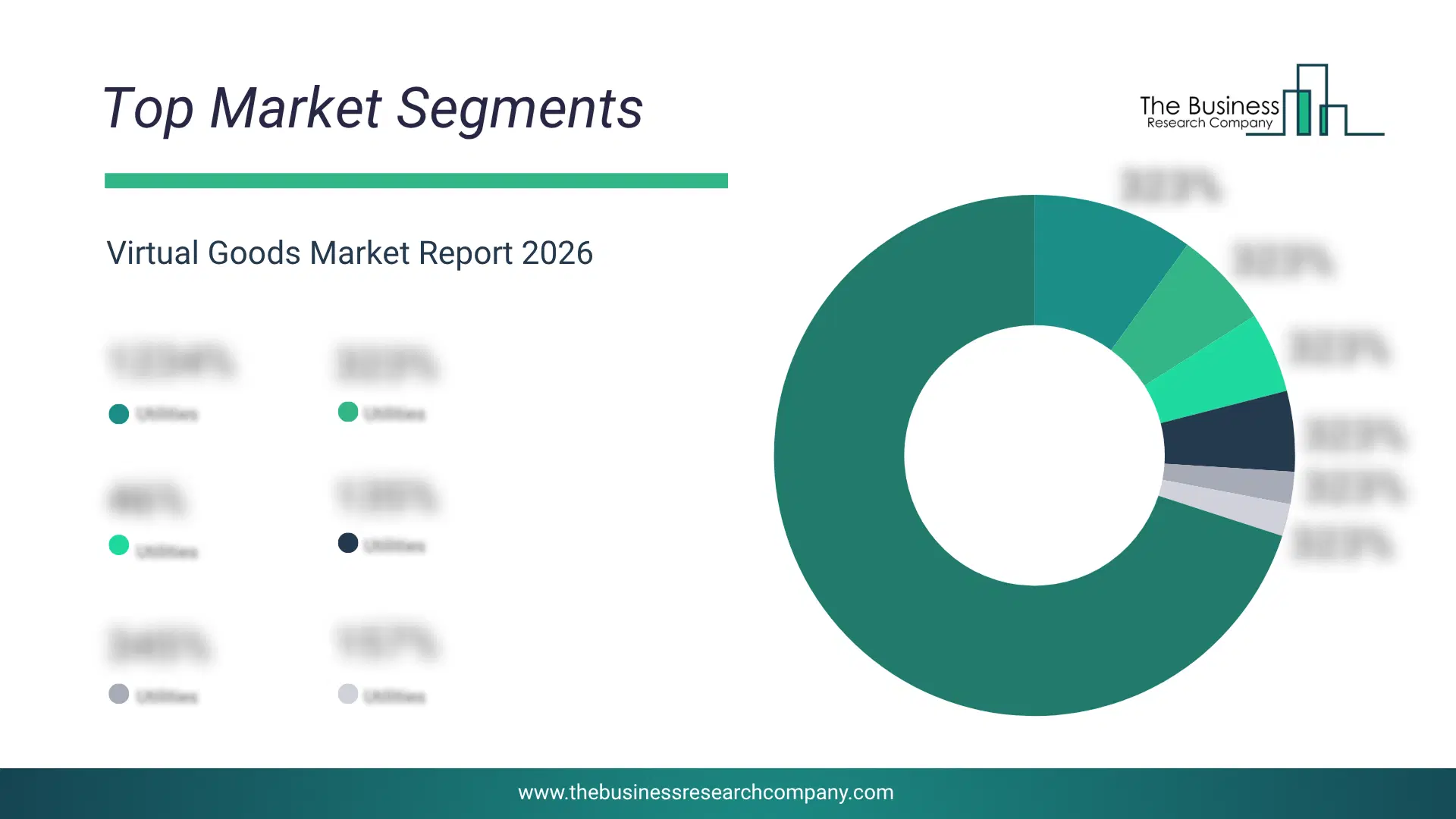
1) By Type: In-Game Items; Digital Collectibles; Virtual Currency; Other Types 2) By Platform: Gaming Consoles; Personal Computers; Mobile Devices; Other Platforms 3) By Payment Mode: Credit or Debit Cards; Digital Wallets; Other Payment Modes 4) By Distribution Channel: Direct Purchase; Subscription Based Services; In App Purchases; Online Marketplaces 5) By End-User: Gamers; Social Media Users; Other End-Users Subsegments: 1) By In-Game Items: Weapon Skins; Character Skins; Power-Ups; Virtual Pets; Accessories 2) By Digital Collectibles: Non-Fungible Tokens; Trading Cards; Digital Art; Virtual Memorabilia 3) By Virtual Currency: Game Coins; Premium Tokens; Reward Points; Cryptocurrency 4) By Other Types: Virtual Fashion; Digital Assets for Content Creation; Virtual Real Estate; Phygital GoodsWhat Is The Driver Of The Virtual Goods Market?
The increasing digital gaming adoption is expected to propel the growth of the virtual goods market going forward. Digital gaming is the playing of video games delivered and experienced through electronic devices and software platforms using digital content rather than physical media. The adoption of digital gaming is increasing due to expanding access to internet connectivity and affordable smart devices that enable wider participation in digital entertainment. The virtual goods supports digital gaming adoption by offering in-game items, digital currencies, and customization features that enhance user engagement and monetization within gaming ecosystems. For instance, in August 2024, according to International Trade Administration (ITA), a US-based government agency, the global gaming population exceeded 3.2 billion players, with digital game purchases accounting for approximately 95% of total game sales compared to physical formats, showing a sustained rise from 2023 levels. Therefore, the increasing digital gaming adoption is driving the growth in the virtual goods industry.Key Players In The Global Virtual Goods Market
Major companies operating in the virtual goods market are G2A.COM S.A., OpenSea Inc., SuperRare Labs Inc., Magic Eden Inc., Decentraland Marketplace, PlayerAuctions Inc., Zepeto Marketplace, Axie Marketplace, Solanart Inc., Exclusible Inc., Enjin Marketplace, Rarible Ltd., Mintable Inc., Foundation Inc., LooksRare Inc., AtomicHub Inc., DRESSX Inc., The Sandbox Marketplace, Larva Labs Marketplace, and SuperWorld Marketplace.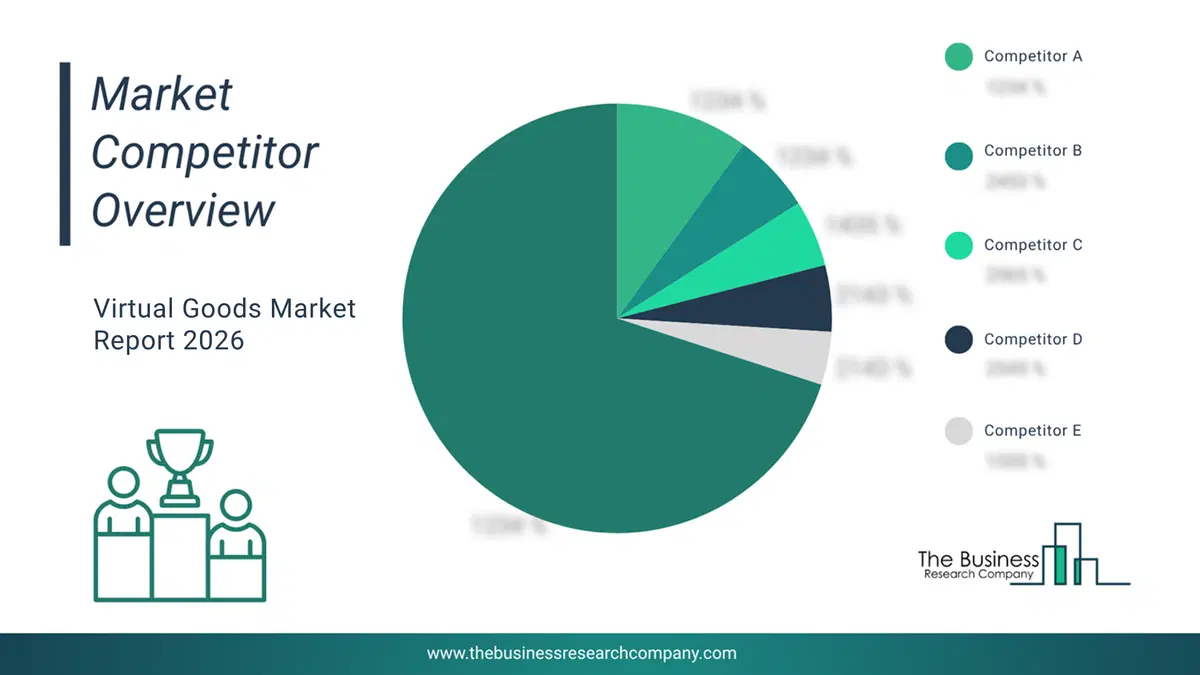
This chart is for illustrative purposes; the full report includes a detailed competitor analysis and comprehensive overview of the top 10 companies in the market.
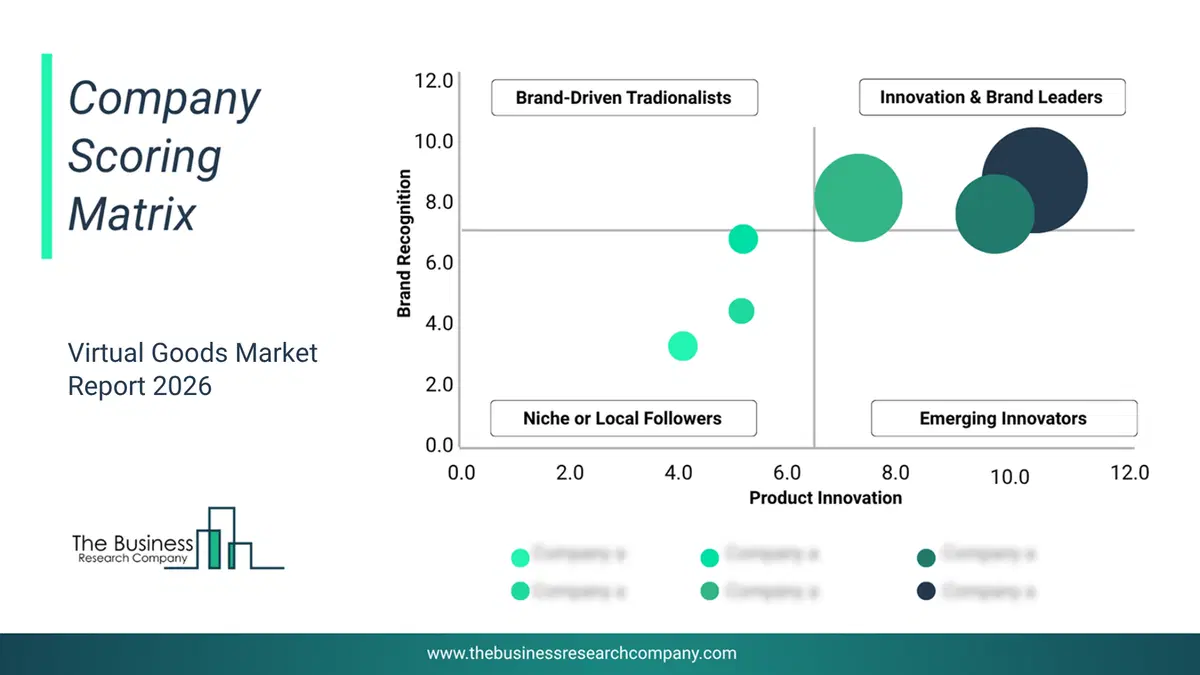
This chart maps companies by product innovation and brand strength, with bubble size indicating relative revenue, helping identify market leaders, challengers, and niche players. This is an illustrative chart; the full report provides a complete and accurate competitive analysis.
Global Virtual Goods Market Trends and Insights
Major companies operating in the virtual goods market are focusing on developing innovative solutions, such as unified digital asset marketplaces and advancements in digital fashion ecosystems, to meet the rising demand for enhanced user engagement, improved monetization opportunities, and seamless cross-platform interoperability. Unified digital asset marketplaces are platforms that consolidate digital assets from multiple sources into a single ecosystem, enabling creators and users to buy, sell, trade, and manage virtual items efficiently while reducing supply fragmentation and distribution complexity compared to traditional standalone marketplaces. For instance, in July 2025, DRESSX, a US-based digital fashion and artificial intelligence (AI) styling company, launched DRESSGO, a fashion-centric game on Roblox that transforms avatar styling into an interactive gameplay experience. This is designed to engage Gen Z and Gen Alpha users, the game allows players to collect rare virtual fashion items through Boutique Boxes, complete Daily Quests to earn in-game currency, and participate in brand collaborations with companies such as PUMA, supporting deeper community interaction and sustained virtual goods consumption.What Are Latest Mergers And Acquisitions In The Virtual Goods Market?
In November 2024, Metaverse Group Ltd., a Canada-based technology company, acquired Pavia Metaverse for an undisclosed amount. Through this acquisition, Metaverse Group aims to expand its virtual goods and digital asset portfolio by enhancing its presence in decentralized metaverse ecosystems, diversifying its virtual land and non-fungible token offerings, and enabling greater opportunities for users and enterprises to create, buy, sell, and interact with immersive digital assets. Pavia.io is a US-based metaverse platform and virtual world developer that acts as an non-fungible token (NFT)-based marketplace for digital goods.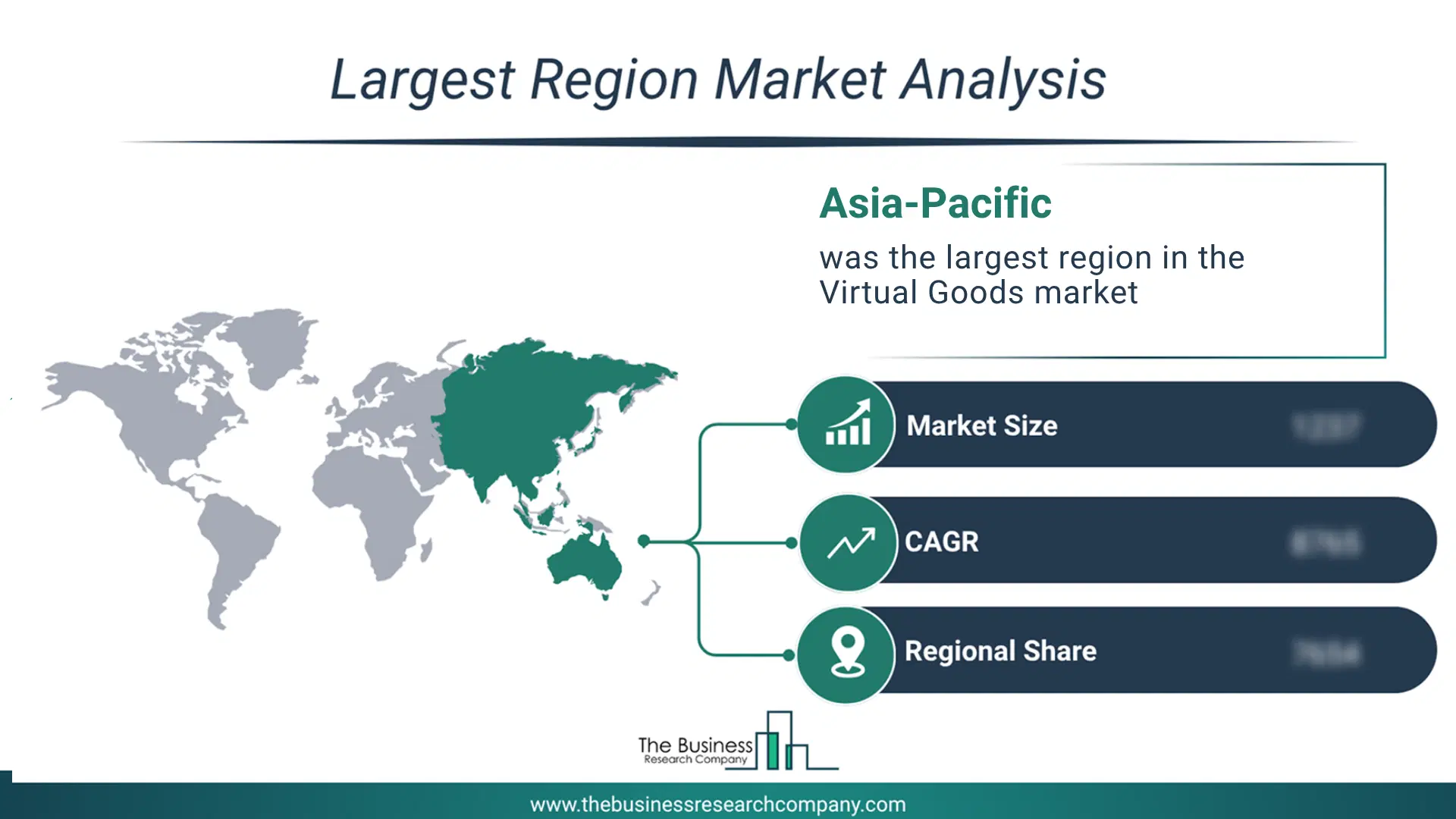
Regional Insights
Asia-Pacific was the largest region in the virtual goods market in 2025. North America is expected to be the fastest-growing region in the forecast period. The regions covered in this market report are Asia-Pacific, South East Asia, Western Europe, Eastern Europe, North America, South America, Middle East, Africa. The countries covered in this market report are Australia, Brazil, China, France, Germany, India, Indonesia, Japan, Taiwan, Russia, South Korea, UK, USA, Canada, Italy, Spain.What Defines the Virtual Goods Market?
The virtual goods market consists of revenues earned by entities by providing services such as virtual currency management, in-game asset trading platforms, avatar customization and cosmetic item services, virtual event access and ticketing, and subscription-based access to virtual environments. The market value includes the value of related goods sold by the service provider or included within the service offering. The virtual goods market also includes sales of avatars and avatar accessories, skins and cosmetic items, virtual real estate, virtual event tickets, digital content packs, and other software-based products. Values in this market are ‘factory gate’ values, that is the value of goods sold by the manufacturers or creators of the goods, whether to other entities (including downstream manufacturers, wholesalers, distributors and retailers) or directly to end customers. The value of goods in this market includes related services sold by the creators of the goods.How is Market Value Defined and Measured?
The market value is defined as the revenues that enterprises gain from the sale of goods and/or services within the specified market and geography through sales, grants, or donations in terms of the currency (in USD unless otherwise specified). The revenues for a specified geography are consumption values that are revenues generated by organizations in the specified geography within the market, irrespective of where they are produced. It does not include revenues from resales along the supply chain, either further along the supply chain or as part of other products.
This chart presents market attractiveness based on a quantitative evaluation of growth, competition, strategic alignment, and risk, offering a clear view of opportunity areas for decision-making. This chart is for illustrative purposes; the full report contains the complete analysis.

This chart highlights the Total Addressable Market (TAM) by estimating the maximum revenue opportunity using an assumption-driven approach, supporting strategic planning and opportunity sizing across markets. The chart is illustrative; the full report provides a more comprehensive analysis.
What Key Data and Analysis Are Included in the Virtual Goods Market Report 2026?
The virtual goods market research report is one of a series of new reports from The Business Research Company that provides market statistics, including industry global market size, regional shares, competitors with the market share, detailed market segments, market trends and opportunities, and any further data you may need to thrive in the virtual goods industry. The market research report delivers a complete perspective of everything you need, with an in-depth analysis of the current and future state of the industry.Virtual Goods Market Report Forecast Analysis
| Report Attribute | Details |
|---|---|
| Market Size Value In 2026 | $115.41 billion |
| Revenue Forecast In 2030 | $195.64 billion |
| Growth Rate | CAGR of 14.1% from 2026 to 2030 |
| Base Year For Estimation | 2025 |
| Actual Estimates/Historical Data | 2020-2025 |
| Forecast Period | 2026 - 2030 |
| Market Representation | Revenue in USD Billion and CAGR from 2026 to 2030 |
| Segments Covered | Type, Platform, Payment Mode, Distribution Channel, End-User |
| Regional Scope | Asia-Pacific, Western Europe, Eastern Europe, North America, South America, Middle East, Africa |
| Country Scope | The Countries Covered In This Market Report Are Australia, Brazil, China, France, Germany, India, Indonesia, Japan, Taiwan, Russia, South Korea, Uk, Usa, Canada, Italy, Spain. |
| Key Companies Profiled | G2A.COM S.A., OpenSea Inc., SuperRare Labs Inc., Magic Eden Inc., Decentraland Marketplace, PlayerAuctions Inc., Zepeto Marketplace, Axie Marketplace, Solanart Inc., Exclusible Inc., Enjin Marketplace, Rarible Ltd., Mintable Inc., Foundation Inc., LooksRare Inc., AtomicHub Inc., DRESSX Inc., The Sandbox Marketplace, Larva Labs Marketplace, and SuperWorld Marketplace. |
| Customization Scope | Request for Customization |
| Pricing And Purchase Options | Explore Purchase Options |