

Virtual Human Anatomy Software Market Report 2026
Global Outlook – By Type (3D Anatomy Software, VR Anatomy Software), By Technology (Cloud-Based, On-Premise), By Application (Educational Institution, Hospitals And Clinics, Other Applications) - Market Size, Trends, Strategies, and Forecast to 2030
Virtual Human Anatomy Software Market Overview
• Virtual Human Anatomy Software market size has reached to $0.45 billion in 2025 • Expected to grow to $1.32 billion in 2030 at a compound annual growth rate (CAGR) of 23.1% • Growth Driver: Symbiotic Relationship Between Digital Learning Tools and Virtual Human Anatomy Software • Market Trend: Advances In Inclusive 3D Modeling Enhance Representation And Accuracy In Anatomy Education • North America was the largest region in 2025.What Is Covered Under Virtual Human Anatomy Software Market?
Virtual human anatomy software refers to computer programs or applications designed to provide users with digital representations of the human body's anatomical structures. These software applications utilize advanced graphics, 3D modeling techniques, and sometimes virtual reality (VR) or augmented reality (AR) technologies to create interactive and immersive experiences for users. The main types of virtual human anatomy software are 3D anatomy software and VR anatomy software. 3D Anatomy Software is a digital tool that provides interactive three-dimensional representations of human anatomy for educational, medical, and research purposes. The various technologies involved are cloud-based, and on-premise, which has application including educational institutions, hospitals and clinics, other applications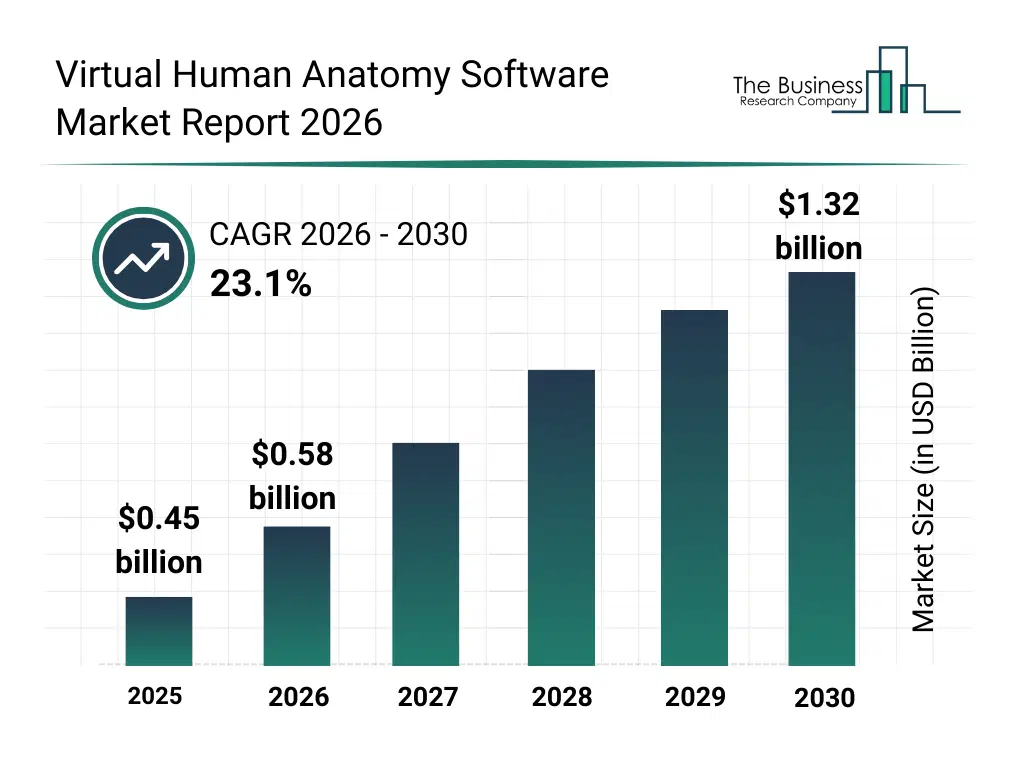
What Is The Virtual Human Anatomy Software Market Size and Share 2026?
The virtual human anatomy software market size has grown exponentially in recent years. It will grow from $0.45 billion in 2025 to $0.58 billion in 2026 at a compound annual growth rate (CAGR) of 27.5%. The growth in the historic period can be attributed to increasing digitization of medical education, growing use of 3d visualization in healthcare training, expansion of anatomy software adoption in institutions, rising investments in medical simulation tools, improved availability of high-performance computing systems.What Is The Virtual Human Anatomy Software Market Growth Forecast?
The virtual human anatomy software market size is expected to see exponential growth in the next few years. It will grow to $1.32 billion in 2030 at a compound annual growth rate (CAGR) of 23.1%. The growth in the forecast period can be attributed to increasing adoption of immersive learning technologies, rising demand for remote medical education solutions, expansion of vr and ar integration in healthcare training, growing focus on personalized learning platforms, increasing use of cloud-based medical software. Major trends in the forecast period include increasing adoption of interactive 3d anatomy visualization, rising use of vr-based anatomy learning platforms, growing integration of cloud-based anatomy software, expansion of simulation-driven medical education tools, enhanced focus on realistic anatomical modeling.
Global Virtual Human Anatomy Software Market Segmentation
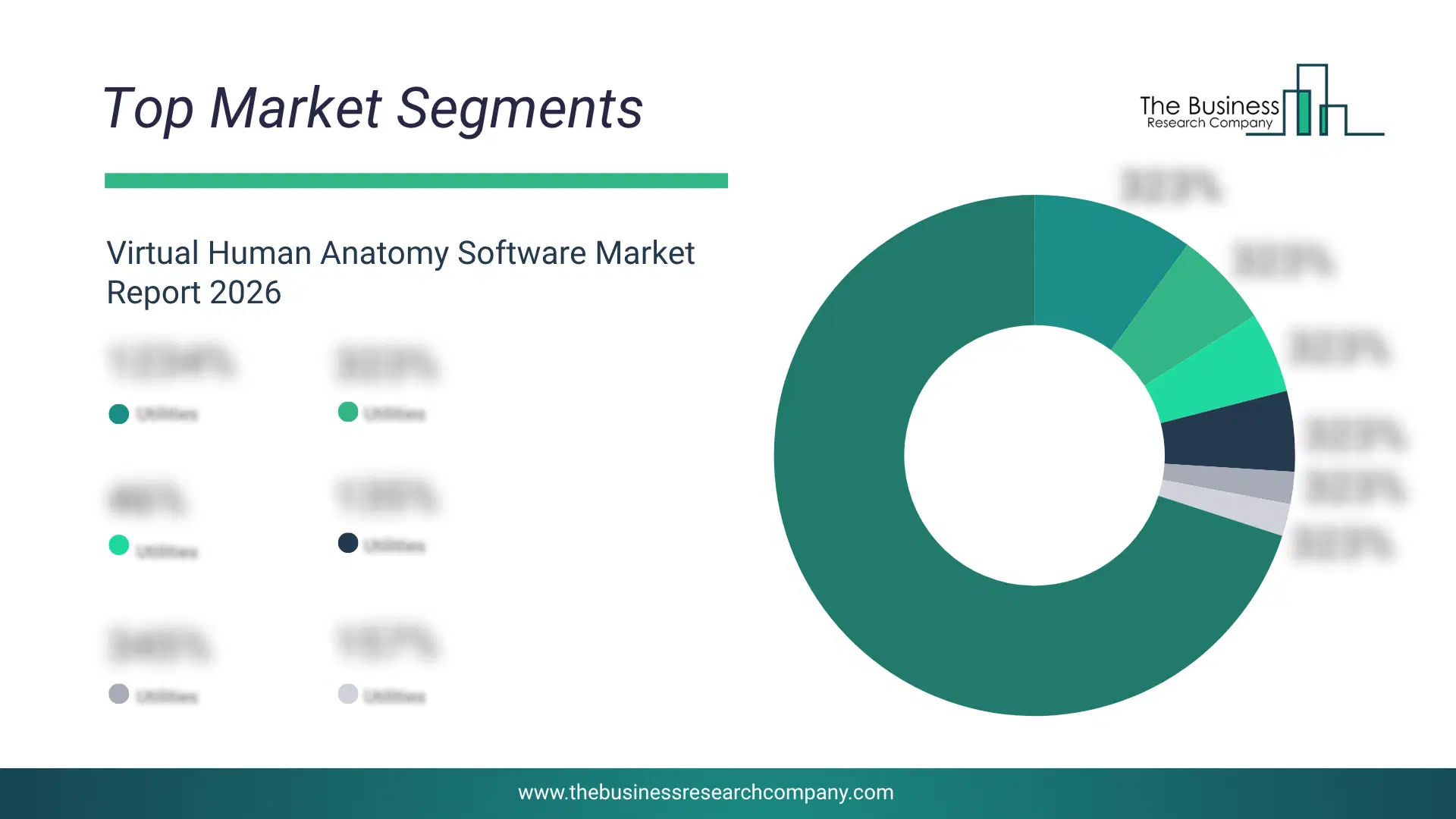
1) By Type: 3D Anatomy Software, VR Anatomy Software 2) By Technology: Cloud-Based, On-Premise 3) By Application: Educational Institution, Hospitals And Clinics, Other Applications Subsegments: 1) By 3D Anatomy Software: Interactive 3D Visualization, 3D Rendering And Simulation, Anatomical Modeling Tools 2) By VR Anatomy Software: Virtual Reality-Based Anatomy Exploration, VR Simulation For Medical Training, Immersive 3D Anatomy VisualizationWhat Is The Driver Of The Virtual Human Anatomy Software Market?
The increasing adoption in online education is expected to propel the growth of the virtual human anatomy software market going forward. Online education refers to a mode of learning that utilizes the internet and digital technologies to deliver educational content remotely. The increasing prevalence of online education is due to its accessibility, flexibility, affordability, technological advancements, and alignment with evolving societal and economic trends. Virtual human anatomy software greatly enriches online education by providing immersive, interactive, and accessible learning experiences that enhance students' understanding and appreciation of human anatomy. For instance, in January 2024, according to Eurostat, a Luxembourg-based statistical office of the European Union in 2023, 30% of EU internet users aged 16 to 74 reported participating in online courses or using online learning materials in the previous three months, marking a 2 %-point increase from 28% in 2022. Therefore, increasing adoption in online education will drive the growth of the virtual human anatomy software industryKey Players In The Global Virtual Human Anatomy Software Market
Major companies operating in the virtual human anatomy software market are VirtaMed AG, Wolters Kluwer Health, Inc., Anatomage Inc., Biomax Informatics AG, Visible Body, BioDigital Inc., 3D4Medical Ltd., Primal Pictures Ltd., BodyViz LLC, Kenhub GmbH, Zygote Media Group Inc., Medicalholodeck GmbH, Lifeliqe, s.r.o., 3D Organon Ltd., Vrtual Medicine, 4D Interactive Anatomy, Anatomy 3D Atlas, Elsevier B.V., Anatronica, Anomalous Medical, LLC, Cyber-Anatomy, Inc., Brain Science Tools B.V., BodyParts3D/Anatomography, BodyMaps, Digiscope Ltd., Human Anatomy VR
This chart is for illustrative purposes; the full report includes a detailed competitor analysis and comprehensive overview of the top 10 companies in the market.
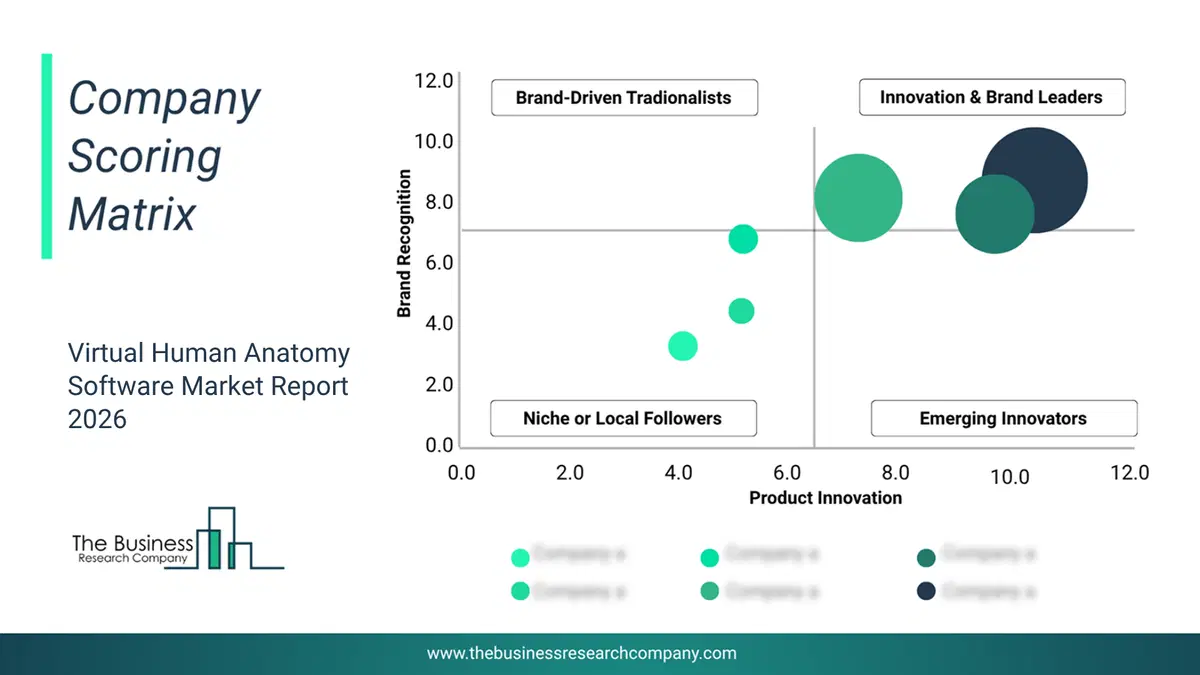
This chart maps companies by product innovation and brand strength, with bubble size indicating relative revenue, helping identify market leaders, challengers, and niche players. This is an illustrative chart; the full report provides a complete and accurate competitive analysis.
Global Virtual Human Anatomy Software Market Trends and Insights
Major companies operating in the virtual human anatomy software market are focusing on developing advanced solutions, such as diversity-enhanced 3D anatomical modeling, to address long-standing gaps in racial representation and improve the accuracy and inclusivity of medical education. Diversity-enhanced 3D modeling refers to the integration of multiple skin tones, facial characteristics, and anatomically precise variations into virtual anatomy platforms, enabling students to learn from representations that more closely mirror real patient populations. For instance, in January 2023, Elsevier, a Netherlands-based provider of clinical practice content and medical education technologies, launched Complete Anatomy 2023, an upgraded version of its flagship 3D anatomy teaching platform featuring the most expansive set of skin-tone options ever introduced in medical learning. The platform incorporates deeply researched anthropological data, customizable models reflecting diverse physical characteristics, and high-fidelity anatomical structures to reduce unconscious bias, improve diagnostic preparedness, and enhance the realism of virtual dissection. These upgrades help bridge the limitations of traditional anatomy education, which has historically relied on uniform, light-skinned models, by offering a more inclusive, accurate, and globally representative learning experience.What Are Latest Mergers And Acquisitions In The Virtual Human Anatomy Software Market?
In January 2025, Cengage Group, Inc., a US-based global edtech company, acquired Visible Body LLC for an undisclosed amount. Through this acquisition, Cengage Group, Inc. aims to expand its interactive science and anatomy education capabilities by integrating Visible Body LLC’s highly detailed 3D anatomical models, simulations, and immersive learning tools across its science portfolio. Visible Body LLC is a US-based developer of anatomically accurate, interactive 3D human body models used by more than 1,000 institutions worldwide, offering visual assets, augmented and mixed reality experiences, and assessment tools to support science and medical education.
Regional Outlook
North America was the largest region in the virtual human anatomy market in 2025. The regions covered in this market report are Asia-Pacific, South East Asia, Western Europe, Eastern Europe, North America, South America, Middle East, Africa. The countries covered in this market report are Australia, Brazil, China, France, Germany, India, Indonesia, Japan, Taiwan, Russia, South Korea, UK, USA, Canada, Italy, Spain.What Defines the Virtual Human Anatomy Software Market?
The virtual human anatomy software market consists of revenues earned by entities by providing services such as anatomical visualization, interactive learning tools, integration with learning management systems, and collaborative tools. The market value includes the value of related goods sold by the service provider or included within the service offering. The virtual human anatomy software market also includes sales of virtual anatomy atlas, interactive anatomy software, augmented reality (AR) apps, patient education tools, and virtual reality (VR) applications. Values in this market are ‘factory gate’ values, that is the value of goods sold by the manufacturers or creators of the goods, whether to other entities (including downstream manufacturers, wholesalers, distributors, and retailers) or directly to end customers. The value of goods in this market includes related services sold by the creators of the goods.How is Market Value Defined and Measured?
The market value is defined as the revenues that enterprises gain from the sale of goods and/or services within the specified market and geography through sales, grants, or donations in terms of the currency (in USD unless otherwise specified). The revenues for a specified geography are consumption values that are revenues generated by organizations in the specified geography within the market, irrespective of where they are produced. It does not include revenues from resales along the supply chain, either further along the supply chain or as part of other products.
This chart presents market attractiveness based on a quantitative evaluation of growth, competition, strategic alignment, and risk, offering a clear view of opportunity areas for decision-making. This chart is for illustrative purposes; the full report contains the complete analysis.

This chart highlights the Total Addressable Market (TAM) by estimating the maximum revenue opportunity using an assumption-driven approach, supporting strategic planning and opportunity sizing across markets. The chart is illustrative; the full report provides a more comprehensive analysis.
What Key Data and Analysis Are Included in the Virtual Human Anatomy Software Market Report 2026?
The virtual human anatomy software market research report is one of a series of new reports from The Business Research Company that provides market statistics, including industry global market size, regional shares, competitors with the market share, detailed market segments, market trends and opportunities, and any further data you may need to thrive in the virtual human anatomy software industry. The market research report delivers a complete perspective of everything you need, with an in-depth analysis of the current and future state of the industry.Virtual Human Anatomy Software Market Report Forecast Analysis
| Report Attribute | Details |
|---|---|
| Market Size Value In 2026 | $0.58 billion |
| Revenue Forecast In 2030 | $1.32 billion |
| Growth Rate | CAGR of 23.1% from 2026 to 2030 |
| Base Year For Estimation | 2025 |
| Actual Estimates/Historical Data | 2020-2025 |
| Forecast Period | 2026 - 2030 |
| Market Representation | Revenue in USD Billion and CAGR from 2026 to 2030 |
| Segments Covered | Type, Technology, Application |
| Regional Scope | Asia-Pacific, Western Europe, Eastern Europe, North America, South America, Middle East, Africa |
| Country Scope | The countries covered in the report are Australia, Brazil, China, France, Germany, India, Indonesia, Japan, Taiwan, Russia, South Korea, UK, USA, Canada, Italy, Spain |
| Key Companies Profiled | VirtaMed AG, Wolters Kluwer Health, Inc., Anatomage Inc., Biomax Informatics AG, Visible Body, BioDigital Inc., 3D4Medical Ltd., Primal Pictures Ltd., BodyViz LLC, Kenhub GmbH, Zygote Media Group Inc., Medicalholodeck GmbH, Lifeliqe, s.r.o., 3D Organon Ltd., Vrtual Medicine, 4D Interactive Anatomy, Anatomy 3D Atlas, Elsevier B.V., Anatronica, Anomalous Medical, LLC, Cyber-Anatomy, Inc., Brain Science Tools B.V., BodyParts3D/Anatomography, BodyMaps, Digiscope Ltd., Human Anatomy VR |
| Customization Scope | Request for Customization |
| Pricing And Purchase Options | Explore Purchase Options |