

Virtual Influencers Market Report 2026
Global Outlook – By Type (Virtual Humans, Animated Characters, Artificial Intelligence-Driven Avatars), By Deployment (Social Media Platforms, Brand Websites, E-Commerce Platforms), By Application (Product Marketing, Customer Service, Brand Storytelling, Entertainment), By End User (Consumer Goods And Retail, Fashion And Beauty, Technology And Software, Travel And Hospitality) – Market Size, Trends, Strategies, and Forecast to 2030
Virtual Influencers Market Overview
• Virtual Influencers market size has reached to $11.24 billion in 2025 • Expected to grow to $62.83 billion in 2030 at a compound annual growth rate (CAGR) of 40.9% • Growth Driver: The Rising Popularity Of Social Media And Influencer Marketing Fueling The Growth Of The Market Due To Increasing Trust And Engagement • Market Trend: AI-Driven Female Virtual Influencers Revolutionizing Digital Marketing • North America was the largest region in 2025 and Asia-Pacific is the fastest growing region.What Is Covered Under Virtual Influencers Market?
Virtual influencers are computer-generated characters or digital personas designed to resemble real people. They are created using 3D modeling, animation, and artificial intelligence, and are typically managed by brands, creators, or marketing agencies. These digital figures are active on social media platforms and engage audiences just like human influencers sharing content, promoting products, and building followings. The main types of virtual influencers are virtual humans, animated characters, and artificial intelligence-driven avatars. Virtual humans are AI-powered, computer-generated digital characters designed to simulate human-like appearance, behavior, and interaction in virtual environments. These are implemented across social media platforms, brand websites, and e-commerce platforms, serving a range of applications, including product marketing, customer service, brand storytelling, and entertainment. The primary end users include consumer goods and retail, fashion and beauty, technology and software, and travel and hospitality.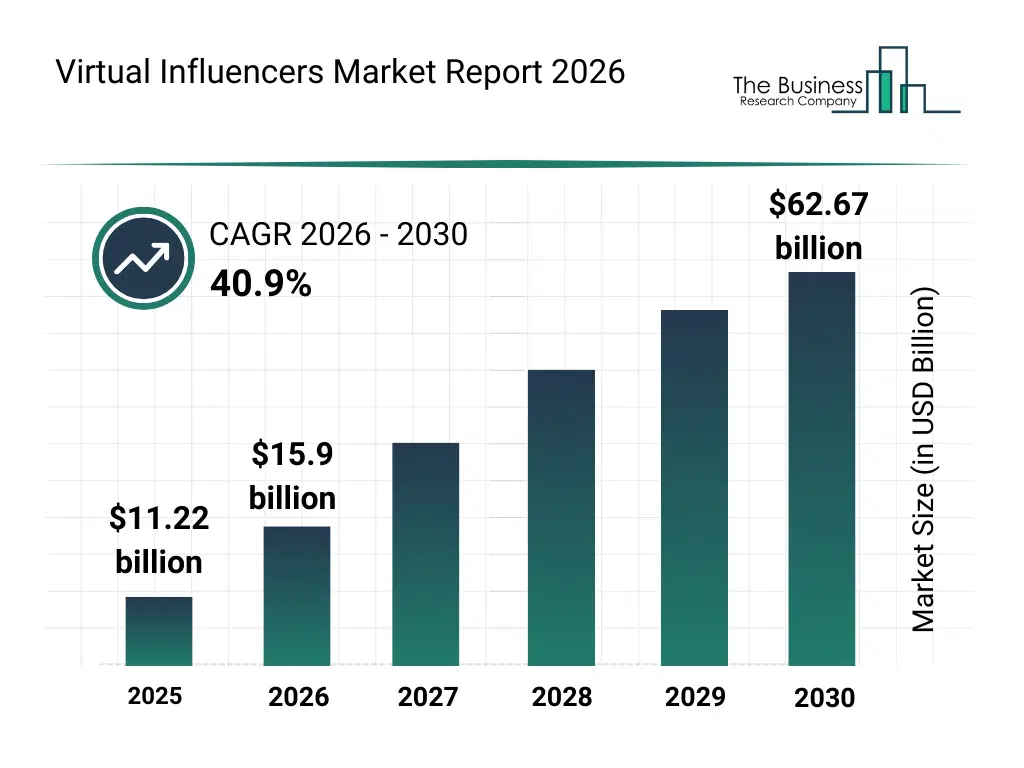
What Is The Virtual Influencers Market Size and Share 2026?
The virtual influencers market size has grown exponentially in recent years. It will grow from $11.24 billion in 2025 to $15.94 billion in 2026 at a compound annual growth rate (CAGR) of 41.8%. The growth in the historic period can be attributed to early adoption of digital marketing campaigns, rise of social media platforms, increased influencer marketing budgets, growth in consumer engagement metrics, development of 3d modeling and animation software.What Is The Virtual Influencers Market Growth Forecast?
The virtual influencers market size is expected to see exponential growth in the next few years. It will grow to $62.83 billion in 2030 at a compound annual growth rate (CAGR) of 40.9%. The growth in the forecast period can be attributed to expansion of ai-powered avatars, integration with immersive technologies, growth of e-commerce personalization, rising adoption of virtual customer service, increasing brand investments in digital experiences. Major trends in the forecast period include rise of social media engagement strategies, growth of brand-managed digital personas, expansion of virtual entertainment platforms, adoption of ai-generated content in marketing, increased consumer acceptance of non-human influencers.
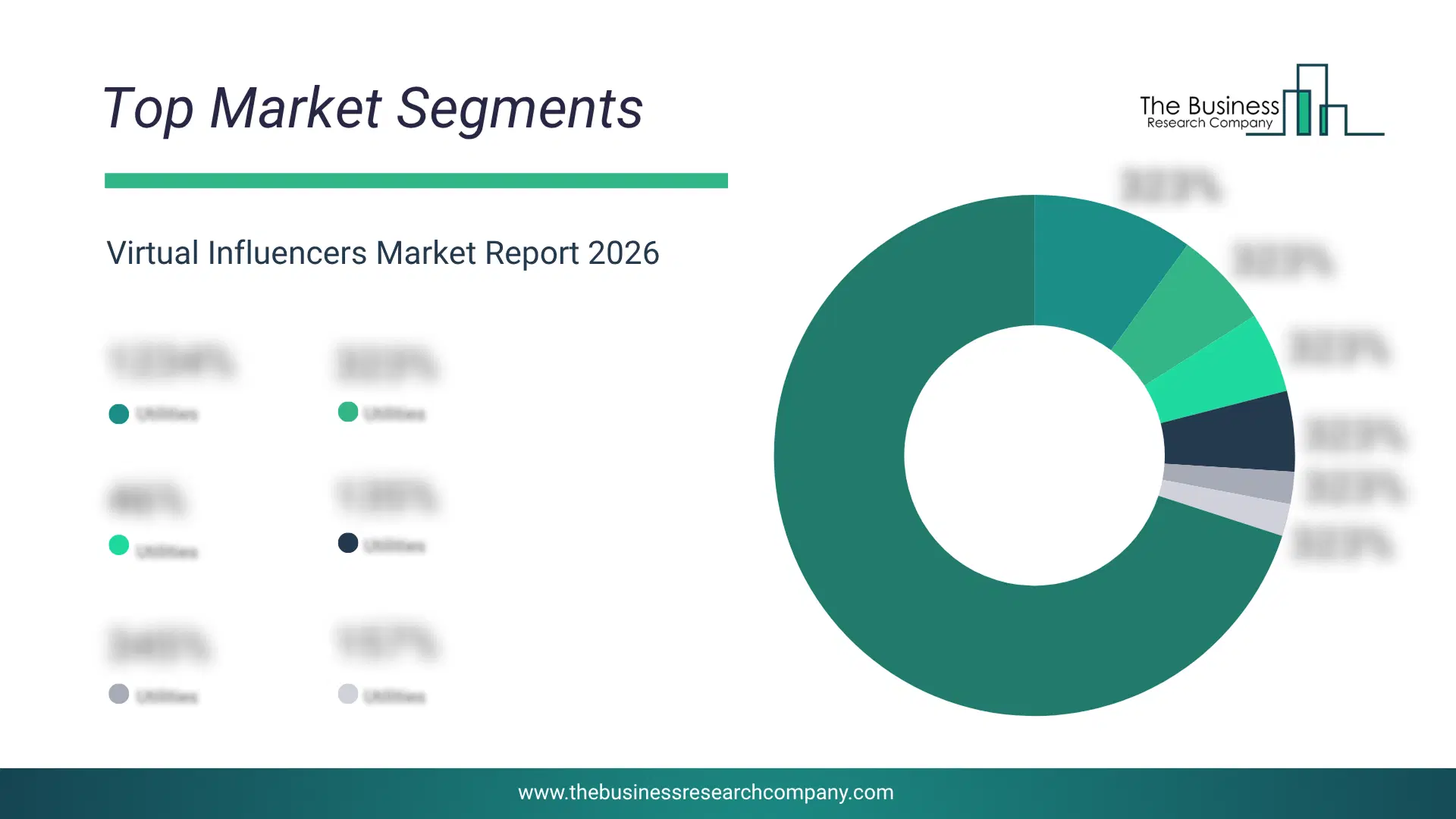
Global Virtual Influencers Market Segmentation
2) By Deployment: Social Media Platforms, Brand Websites, E-Commerce Platforms 3) By Application: Product Marketing, Customer Service, Brand Storytelling, Entertainment 4) By End User: Consumer Goods And Retail, Fashion And Beauty, Technology And Software, Travel And Hospitality Subsegments: 1) By Virtual Humans: AI-Powered Digital Models, Social Media Personalities, Brand Ambassadors, Digital Customer Service Representatives 2) By Animated Characters: 2D Animated Influencers, 3D CGI Characters, Cartoon-Style Avatars, Fantasy And Sci-Fi Characters 3) By Artificial Intelligence-Driven Avatars: Conversational AI Avatars, Virtual Brand Representatives, Interactive Gaming Avatars, Personalized AI AssistantsWhat Is The Driver Of The Virtual Influencers Market?
The rising popularity of social media and influencer marketing is expected to propel the growth of the virtual influencers market going forward. Social media and influencer marketing refers to the use of social media platforms and influential individuals to promote products, services, or brands. Social media and influencer marketing are growing as people trust influencers’ opinions more than regular ads, making them more likely to buy. Virtual influencers help social media and influencer marketing by offering brands full control over messaging, consistency in content, and the ability to engage audiences without the risks associated with human influencers. For instance, in January 2025, according to Made in CA, a Canada-based online platform that highlights and supports Canadian-made products, businesses, and innovations, Canada had 31.9 million social media users as of early 2023, reflecting a penetration rate of 91.3% suggesting that the vast majority of the population has at least one social media account. Therefore, the rising popularity of social media and influencer marketing is driving the virtual influencers industry.Key Players In The Global Virtual Influencers Market
Major companies operating in the virtual influencers market are Meta Platforms Inc., LG Uplus Corp., Magazine Luiza S.A., SM Entertainment Co. Ltd., Balmain S.A., The Diigitals, Hololive Production, Superplastic Inc., Aww Inc., UneeQ Limited, Brud Inc., FUTR Studios Ltd., InfluencerFarm, AvatarOS, SynthLife, Virtual Humans Inc., Genies Inc., Soul Machines Ltd., Pinscreen Inc., Wolf3D OÜ, Hour One AI Ltd., Ready Player Me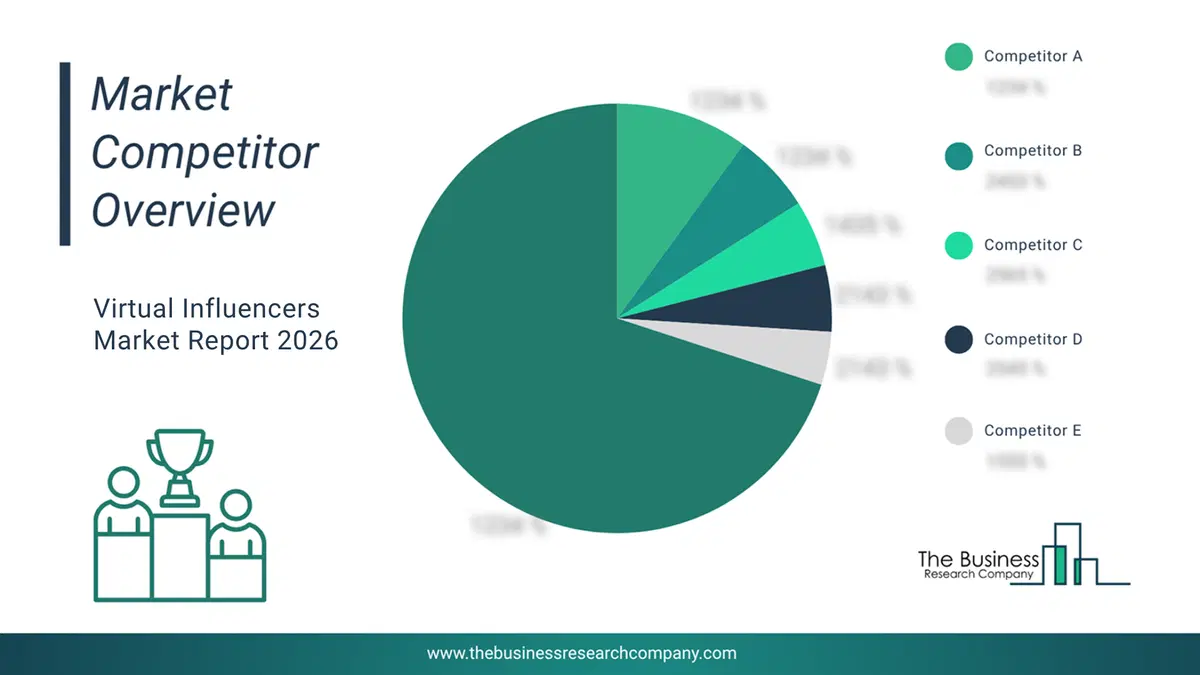
This chart is for illustrative purposes; the full report includes a detailed competitor analysis and comprehensive overview of the top 10 companies in the market.
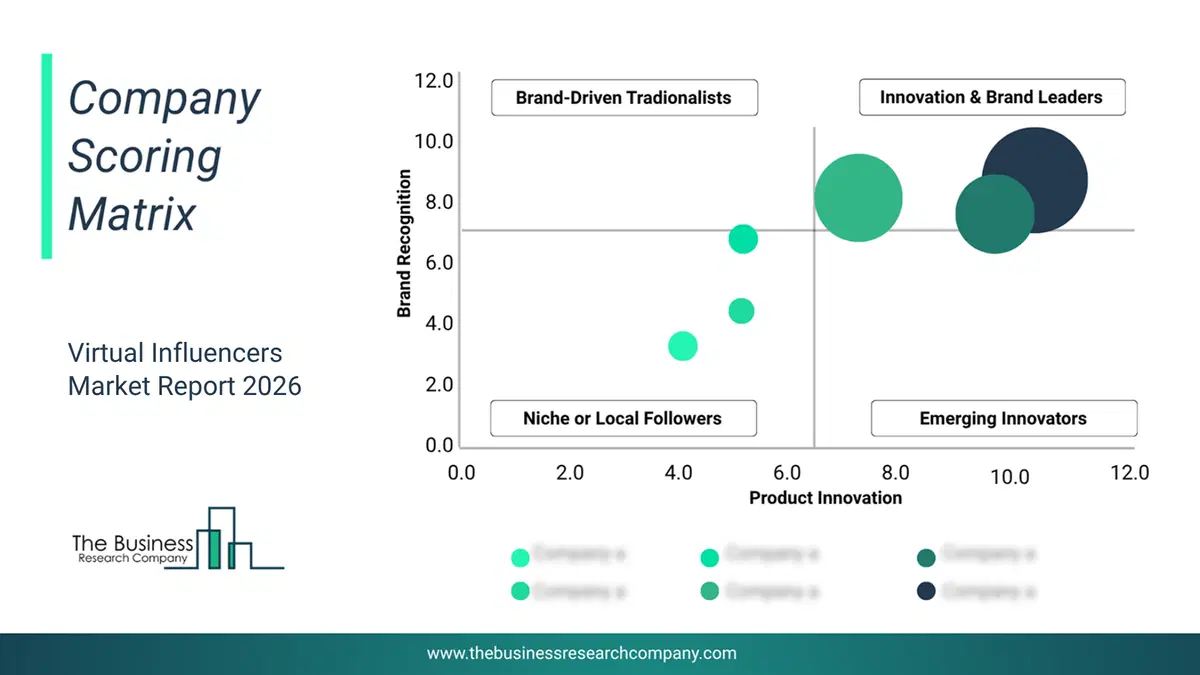
This chart maps companies by product innovation and brand strength, with bubble size indicating relative revenue, helping identify market leaders, challengers, and niche players. This is an illustrative chart; the full report provides a complete and accurate competitive analysis.
Global Virtual Influencers Market Trends and Insights
Major companies operating in the virtual influencers market are focusing on developing advancements in artificial intelligence and machine learning, such as a female virtual influencer to enhance realism, engagement, and interactivity, enabling more personalized and adaptive content creation for marketing and brand collaborations. A female virtual influencer refers to a computer-generated, AI-powered digital character designed to resemble a human female. For instance, in August 2023, Xhadow Media Pvt. Ltd., an India-based media and entertainment company, launched Sanvii, the first female virtual influencer on Instagram. It leverages AI and 3D visualization to engage audiences with relatable lifestyle content while offering brands consistency, cost-effectiveness, and enhanced reach. Her purpose is to redefine influencer marketing by merging technology and creativity for immersive digital experiences.What Are Latest Mergers And Acquisitions In The Virtual Influencers Market?
In November 2024, 17LIVE Group Limited, a Taiwan-based live-streaming company that offers interactive live broadcasts, acquired Mikai Inc. for an undisclosed amount. With this acquisition, 17LIVE Group Limited aims to expand its V-liver business, strengthen its virtual influencer portfolio, and capitalize on the global demand for virtual entertainment and Japanese animation. Mikai Inc. is a Japan-based entertainment startup specializing in virtual YouTuber (VTuber) management and VR and AR content development.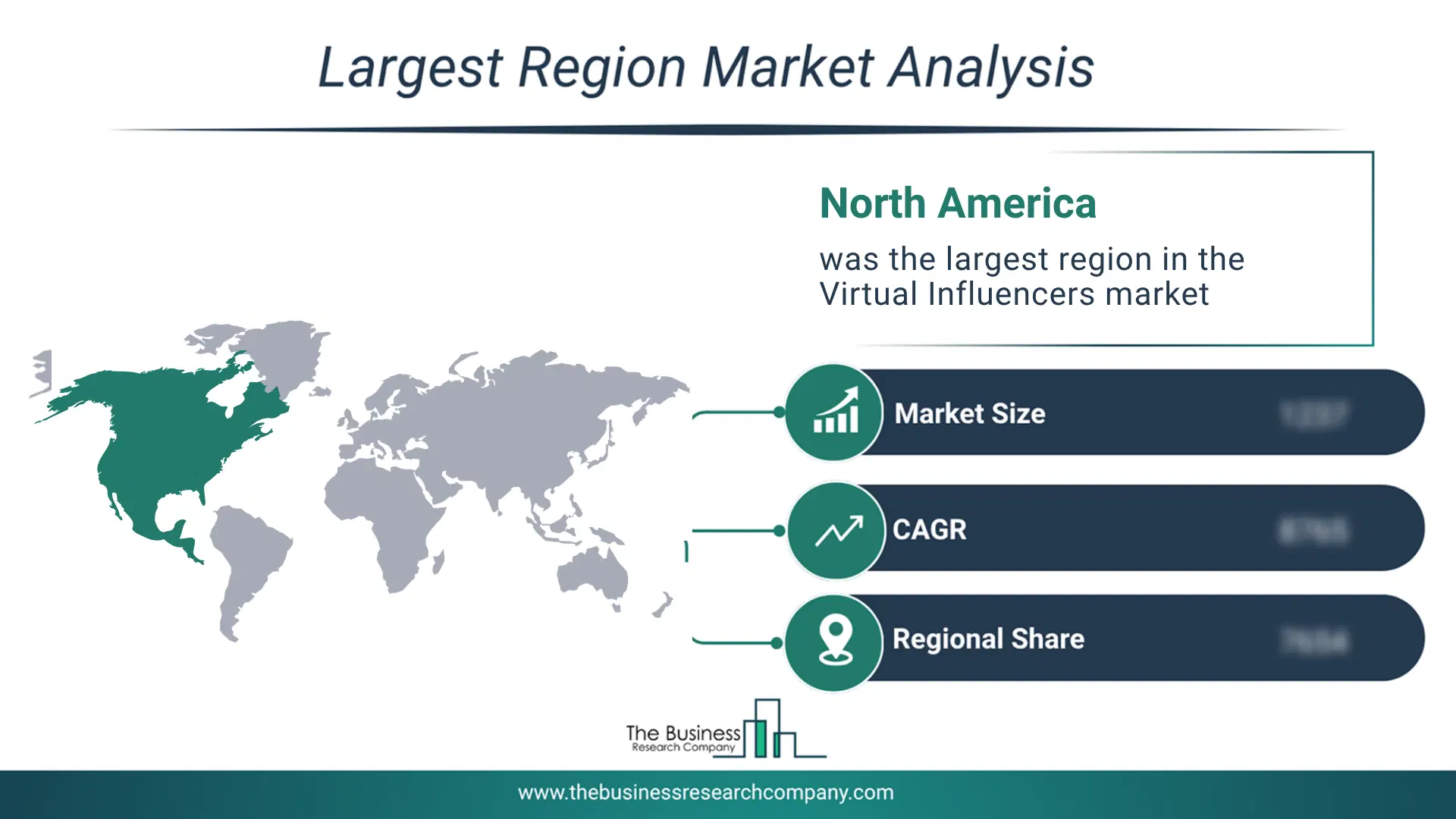
Regional Outlook
North America was the largest region in the virtual influencers market in 2025. Asia-Pacific is expected to be the fastest-growing region in the forecast period. The regions covered in this market report are Asia-Pacific, South East Asia, Western Europe, Eastern Europe, North America, South America, Middle East, Africa. The countries covered in this market report are Australia, Brazil, China, France, Germany, India, Indonesia, Japan, Taiwan, Russia, South Korea, UK, USA, Canada, Italy, Spain.What Defines the Virtual Influencers Market?
The virtual influencers market consists of revenues earned by entities by providing services such as brand promotion, content creation, and customer engagement. The market value includes the value of related goods sold by the service provider or included within the service offering. The virtual influencers market also includes sales of high-performance computers, motion capture equipment, headsets, camera rigs, and green screen setups. Values in this market are ‘factory gate’ values, that is, the value of goods sold by the manufacturers or creators of the goods, whether to other entities (including downstream manufacturers, wholesalers, distributors, and retailers) or directly to end customers. The value of goods in this market includes related services sold by the creators of the goods.How is Market Value Defined and Measured?
The market value is defined as the revenues that enterprises gain from the sale of goods and/or services within the specified market and geography through sales, grants, or donations in terms of the currency (in USD unless otherwise specified). The revenues for a specified geography are consumption values that are revenues generated by organizations in the specified geography within the market, irrespective of where they are produced. It does not include revenues from resales along the supply chain, either further along the supply chain or as part of other products.
This chart presents market attractiveness based on a quantitative evaluation of growth, competition, strategic alignment, and risk, offering a clear view of opportunity areas for decision-making. This chart is for illustrative purposes; the full report contains the complete analysis.

This chart highlights the Total Addressable Market (TAM) by estimating the maximum revenue opportunity using an assumption-driven approach, supporting strategic planning and opportunity sizing across markets. The chart is illustrative; the full report provides a more comprehensive analysis.
What Key Data and Analysis Are Included in the Virtual Influencers Market Report 2026?
The virtual influencers market research report is one of a series of new reports from The Business Research Company that provides market statistics, including industry global market size, regional shares, competitors with the market share, detailed market segments, market trends and opportunities, and any further data you may need to thrive in the virtual influencers industry. The market research report delivers a complete perspective of everything you need, with an in-depth analysis of the current and future state of the industry.Virtual Influencers Market Report Forecast Analysis
| Report Attribute | Details |
|---|---|
| Market Size Value In 2026 | $15.94 billion |
| Revenue Forecast In 2030 | $62.83 billion |
| Growth Rate | CAGR of 40.9% from 2026 to 2030 |
| Base Year For Estimation | 2025 |
| Actual Estimates/Historical Data | 2020-2025 |
| Forecast Period | 2026 - 2030 |
| Market Representation | Revenue in USD Billion and CAGR from 2026 to 2030 |
| Segments Covered | Type, Deployment, Application, End User |
| Regional Scope | Asia-Pacific, Western Europe, Eastern Europe, North America, South America, Middle East, Africa |
| Country Scope | The countries covered in the report are Australia, Brazil, China, France, Germany, India, Indonesia, Japan, Taiwan, Russia, South Korea, UK, USA, Canada, Italy, Spain. |
| Key Companies Profiled | Meta Platforms Inc., LG Uplus Corp., Magazine Luiza S.A., SM Entertainment Co. Ltd., Balmain S.A., The Diigitals, Hololive Production, Superplastic Inc., Aww Inc., UneeQ Limited, Brud Inc., FUTR Studios Ltd., InfluencerFarm, AvatarOS, SynthLife, Virtual Humans Inc., Genies Inc., Soul Machines Ltd., Pinscreen Inc., Wolf3D OÜ, Hour One AI Ltd., Ready Player Me |
| Customization Scope | Request for Customization |
| Pricing And Purchase Options | Explore Purchase Options |