
Virtual Kitchen Market Report 2026
Global Outlook – By Component (Software, Services, Hardware, Other Components), By Application (Workplaces, Schools, Other Applications), By End-User (Commercial Space, Hospitality, Other End Users) – Market Size, Trends, Strategies, and Forecast to 2030
Virtual Kitchen Market Overview
• Virtual Kitchen market size has reached to $76.72 billion in 2025 • Expected to grow to $134.9 billion in 2030 at a compound annual growth rate (CAGR) of 11.7% • Growth Driver: The Rising Importance Of Digital Presence Is Driving The Virtual Kitchen Market • Market Trend: Expanding Delivery-Only Operations With Branded Ghost Kitchens • North America was the largest region in 2025 and Asia-Pacific is the fastest growing region.What Is Covered Under Virtual Kitchen Market?
A virtual kitchen, also known as a ghost kitchen, is a professional food preparation and cooking facility set up to prepare delivery-only meals. It operates without a physical dine-in location and is designed to fulfill online orders through delivery services or directly via the restaurant's app or website. The main components of a virtual kitchen are software, services, hardware, and others. Software refers to the set of instructions and programs that enable a computer or other electronic device to perform specific tasks, such as running applications, managing data, and executing operations. These are used in various applications such as workplaces, households, schools, and others and also by various end-users such as commercial space, residential, hospitality, and others.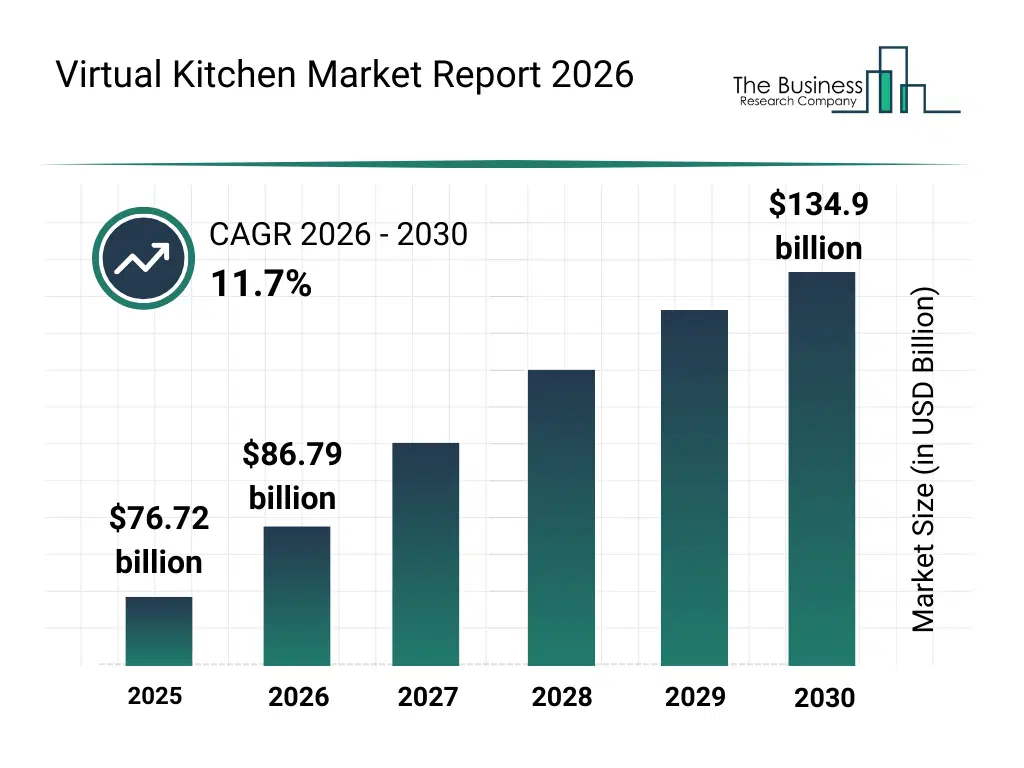
What Is The Virtual Kitchen Market Size and Share 2026?
The virtual kitchen market size has grown rapidly in recent years. It will grow from $76.72 billion in 2025 to $86.79 billion in 2026 at a compound annual growth rate (CAGR) of 13.1%. The growth in the historic period can be attributed to growth of online food delivery platforms, rising urbanization trends, increasing demand for convenience food options, lower entry barriers for food businesses, expansion of smartphone-based ordering.What Is The Virtual Kitchen Market Growth Forecast?
The virtual kitchen market size is expected to see rapid growth in the next few years. It will grow to $134.9 billion in 2030 at a compound annual growth rate (CAGR) of 11.7%. The growth in the forecast period can be attributed to increasing demand for cloud kitchens in tier-2 cities, rising adoption of AI-based demand forecasting, expansion of sustainable packaging usage, growing focus on operational scalability, increasing integration with third-party delivery platforms. Major trends in the forecast period include increasing adoption of delivery-only restaurant models, rising use of kitchen management software, growing focus on cost-efficient food operations, expansion of multi-brand virtual kitchens, enhanced integration of data-driven menu optimization.
Global Virtual Kitchen Market Segmentation
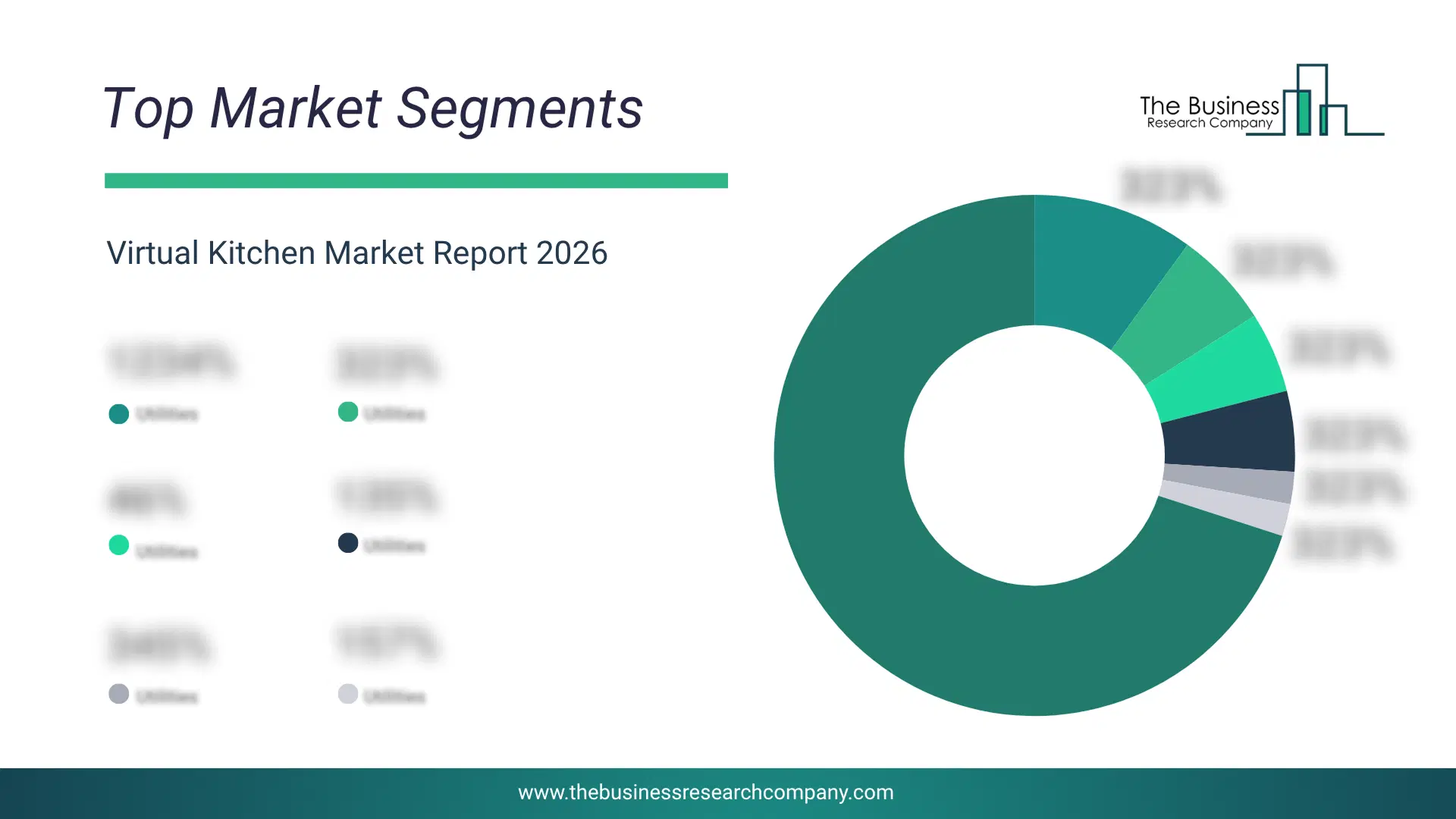
1) By Component: Software, Services, Hardware, Other Components 2) By Application: Workplaces, Schools, Other Applications 3) By End-User: Commercial Space, Hospitality, Other End Users Subsegments: 1) By Software: Kitchen Management Software, Order Management Software, Menu And Recipe Management Software, Delivery And Logistics Software, Pos (Point Of Sale) And Payment Solutions, Inventory And Supply Chain Management Software, Customer Relationship Management (Crm) Software, AI And Data Analytics Solutions For Virtual Kitchens 2) By Services: Cloud-Based Kitchen Solutions, Virtual Kitchen Setup And Integration Services, Maintenance And Support Services, Delivery And Logistics Services, Branding And Marketing Services, Consulting Services For Virtual Kitchen Operations, Packaging And Food Safety Compliance Services 3) By Hardware: Kitchen Equipment (Ovens, Fryers, Refrigerators), Pos Hardware (Tablets, Receipt Printers), Kitchen Automation Hardware (Robotic Food Prep Tools), Delivery Fleet Hardware (Vehicles, Delivery Bags), Iot Devices For Smart Kitchens, Voice-Activated Ordering Systems, Kitchen Display Systems (Kds) 4) By Other Components: Packaging Materials (Eco-Friendly Packaging, Food Containers), Cloud Infrastructure (Servers, Storage, Networking), Online Ordering And Delivery Platforms, Third-Party Integrations (Food Delivery Apps), Data Security And Compliance ToolsWhat Is The Driver Of The Virtual Kitchen Market?
The growing significance of digitalization is expected to propel the growth of the virtual kitchen market going forward. Digitalization is converting information, data, or physical objects into a digital format that computers can easily process, store, and transmit. The growing significance of digitalization can be attributed to increased brand awareness and visibility, enhanced customer engagement, improved customer support, and cost-effective marketing. Digitalization plays a crucial role in the success and efficiency of virtual kitchens by streamlining operations, improving customer experiences, and optimizing resource management. It enables virtual kitchens to operate more efficiently, reduce costs, and provide a better customer experience, ultimately driving growth and success in the competitive food delivery market. For instance, in August 2024, according to Eurostat, a Luxembourg-based government department, 59% of EU enterprises reached at least a basic level of digital intensity in 2023, with 58% of small and medium-sized enterprises achieving this threshold compared with 91% of large enterprises. Therefore, the growing significance of digitalization is driving the growth of the virtual kitchen industry.Key Players In The Global Virtual Kitchen Market
Major companies operating in the virtual kitchen market are Uber Eats, DoorDash Inc., Deliveroo, Foodpanda, CloudKitchens, GrubHub Holdings Inc., Kitopi, Postmates Inc., Rebel Foods, Kitchen United, Deliverect, Kitchen Connect, Zuul Kitchens Inc., Dahmakan, Taster Group Ltd., Franklin Junction, The Local Culinary, Smart City Kitchens, Ghost Kitchen Orlando, Kouzina FoodTech, Nextbite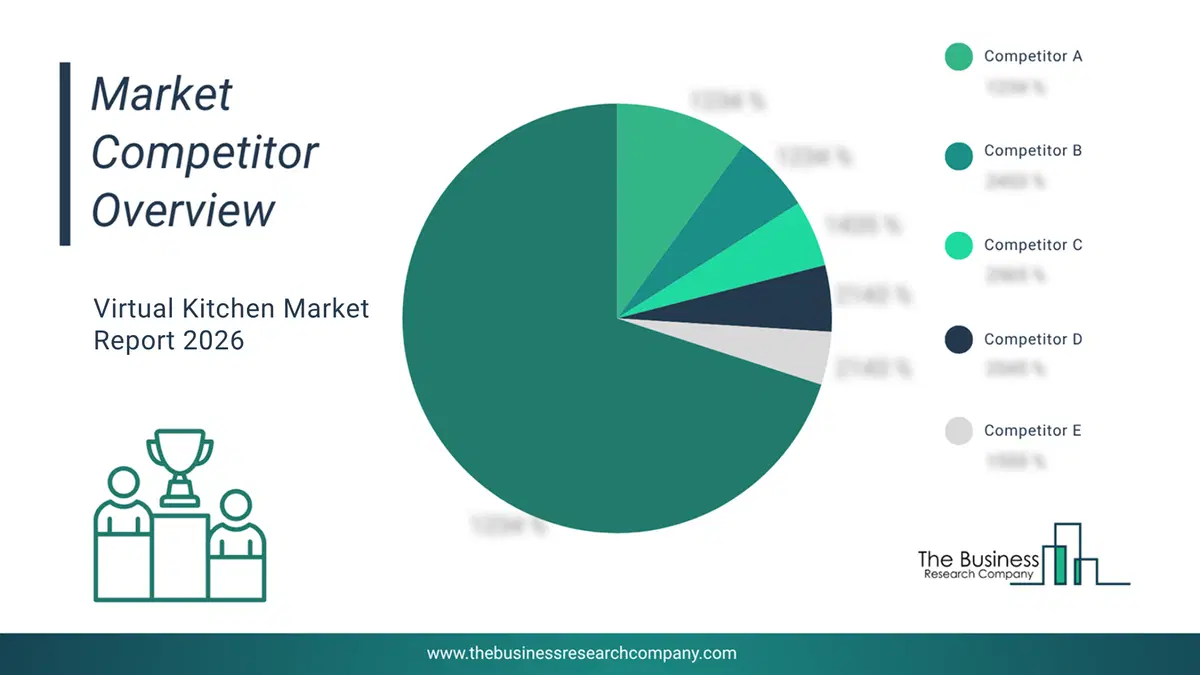
This chart is for illustrative purposes; the full report includes a detailed competitor analysis and comprehensive overview of the top 10 companies in the market.
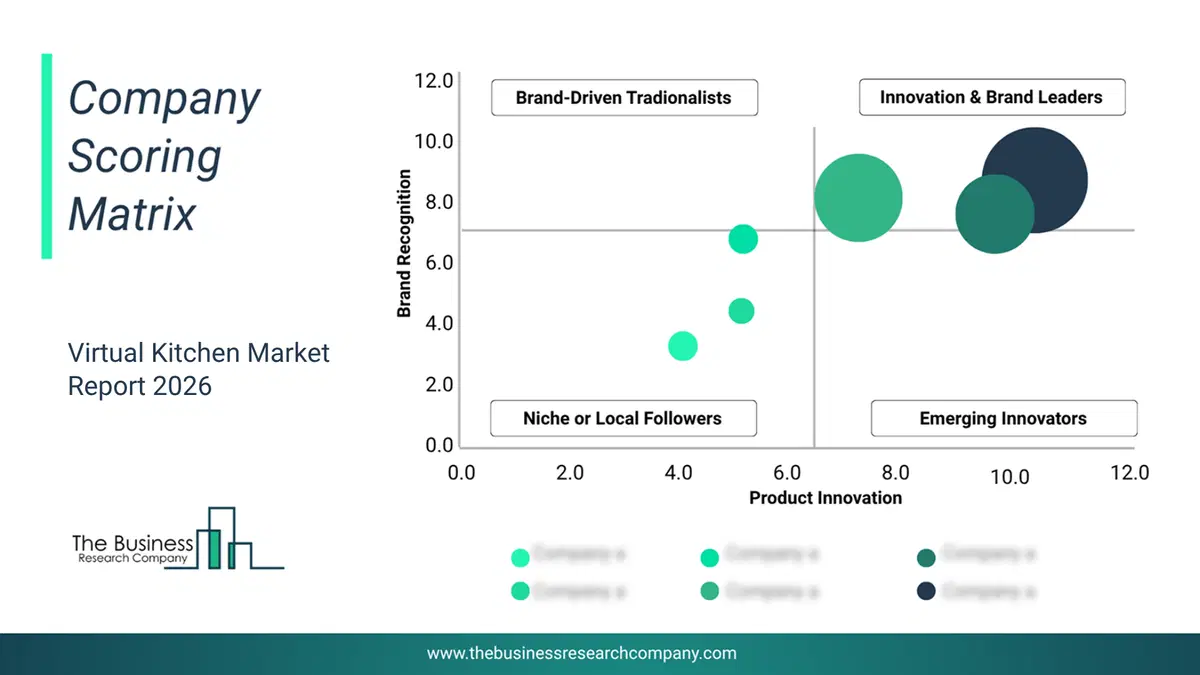
This chart maps companies by product innovation and brand strength, with bubble size indicating relative revenue, helping identify market leaders, challengers, and niche players. This is an illustrative chart; the full report provides a complete and accurate competitive analysis.
Global Virtual Kitchen Market Trends and Insights
Major companies operating in the virtual kitchen market are focusing on developing innovative solutions, such as multi-brand ghost kitchen platforms, to meet the rising demand for delivery-optimized food service models driven by convenience, low-overhead expansion, and the rapid growth of digital ordering. A multi-brand ghost kitchen platform is a delivery-first kitchen setup that brings multiple restaurant concepts under one shared back-of-house operation, enabling efficient ingredient use, centralized workflows, and lower real estate costs compared with traditional dine-in formats. For instance, in August 2023, WOWorks, a US-based restaurant group, launched WOW Kitchens, an innovative ghost kitchen prototype built to support multi-brand delivery and pickup. The concept streamlines cross-brand menu integration using overlapping ingredients, operates inside cloud-kitchen facilities without dine-in areas, leverages a digital ordering platform to manage several virtual brands, and offers franchisees a cost-effective channel to expand their presence and tap into delivery-driven demand.What Are Latest Mergers And Acquisitions In The Virtual Kitchen Market?
In March 2024, C3 and SBE, a US-based food and beverage company, acquired the Kitchen United for undisclosed amount. This acquisition of C3 and SBE’s aim is to establish Everybody Eats, a new holding company that combines these assets with his existing ventures, C3 and Nextbite. Kitchen United is a US-based ghost kitchen company that provides commercial kitchen space, automation, and software for restaurants to prepare delivery-only meals.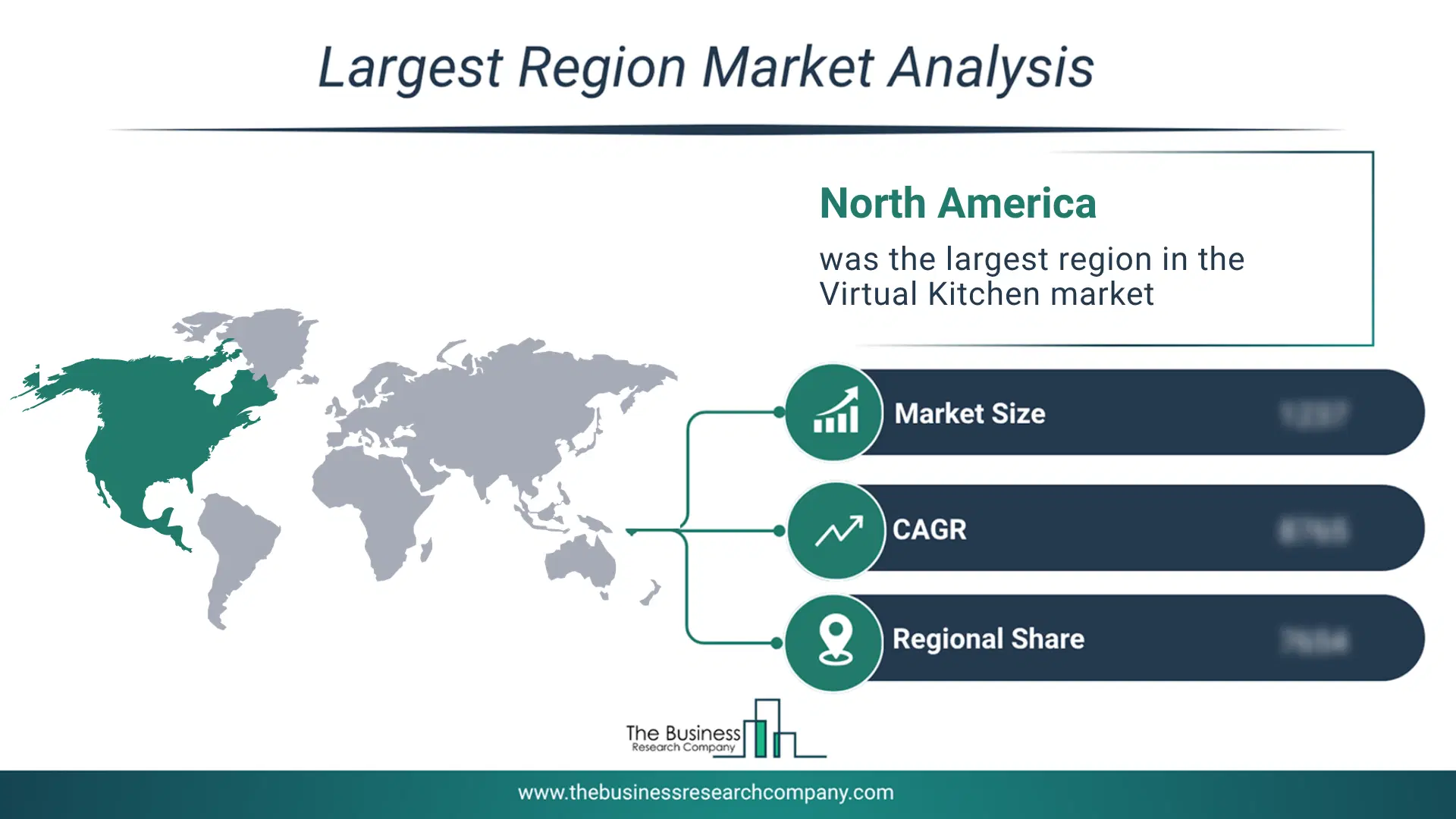
Regional Insights
North America was the largest region in the virtual kitchen market in 2025. Asia-Pacific is expected to be the fastest-growing region in the forecast period. The regions covered in this market report are Asia-Pacific, South East Asia, Western Europe, Eastern Europe, North America, South America, Middle East, Africa. The countries covered in this market report are Australia, Brazil, China, France, Germany, India, Indonesia, Japan, Taiwan, Russia, South Korea, UK, USA, Canada, Italy, Spain.What Defines the Virtual Kitchen Market?
The virtual kitchen market consists of revenues earned by entities by providing commissary kitchens, pop-up kitchens, managed kitchens, delivery-optimized kitchens, and hybrid kitchens. The market value includes the value of related goods sold by the service provider or included within the service offering. The virtual kitchen market also includes sales of cooking equipment, food preparation equipment, packaging equipment, and delivery drones. Values in this market are ‘factory gate’ values, that is the value of goods sold by the manufacturers or creators of the goods, whether to other entities (including downstream manufacturers, wholesalers, distributors, and retailers) or directly to end customers. The value of goods in this market includes related services sold by the creators of the goods.How is Market Value Defined and Measured?
The market value is defined as the revenues that enterprises gain from the sale of goods and/or services within the specified market and geography through sales, grants, or donations in terms of the currency (in USD unless otherwise specified). The revenues for a specified geography are consumption values that are revenues generated by organizations in the specified geography within the market, irrespective of where they are produced. It does not include revenues from resales along the supply chain, either further along the supply chain or as part of other products.
This chart presents market attractiveness based on a quantitative evaluation of growth, competition, strategic alignment, and risk, offering a clear view of opportunity areas for decision-making. This chart is for illustrative purposes; the full report contains the complete analysis.

This chart highlights the Total Addressable Market (TAM) by estimating the maximum revenue opportunity using an assumption-driven approach, supporting strategic planning and opportunity sizing across markets. The chart is illustrative; the full report provides a more comprehensive analysis.
What Key Data and Analysis Are Included in the Virtual Kitchen Market Report 2026?
The virtual kitchen market research report is one of a series of new reports from The Business Research Company that provides market statistics, including industry global market size, regional shares, competitors with the market share, detailed market segments, market trends and opportunities, and any further data you may need to thrive in the virtual kitchen industry. The market research report delivers a complete perspective of everything you need, with an in-depth analysis of the current and future state of the industry.Virtual Kitchen Market Report Forecast Analysis
| Report Attribute | Details |
|---|---|
| Market Size Value In 2026 | $86.79 billion |
| Revenue Forecast In 2030 | $134.9 billion |
| Growth Rate | CAGR of 11.7% from 2026 to 2030 |
| Base Year For Estimation | 2025 |
| Actual Estimates/Historical Data | 2020-2025 |
| Forecast Period | 2026 - 2030 |
| Market Representation | Revenue in USD Billion and CAGR from 2026 to 2030 |
| Segments Covered | Component, Application, End-User |
| Regional Scope | Asia-Pacific, Western Europe, Eastern Europe, North America, South America, Middle East, Africa |
| Country Scope | The Countries Covered In This Market Report Are Australia, Brazil, China, France, Germany, India, Indonesia, Japan, Taiwan, Russia, South Korea, Uk, Usa, Canada, Italy, Spain. |
| Key Companies Profiled | Uber Eats, DoorDash Inc., Deliveroo, Foodpanda, CloudKitchens, GrubHub Holdings Inc., Kitopi, Postmates Inc., Rebel Foods, Kitchen United, Deliverect, Kitchen Connect, Zuul Kitchens Inc., Dahmakan, Taster Group Ltd., Franklin Junction, The Local Culinary, Smart City Kitchens, Ghost Kitchen Orlando, Kouzina FoodTech, Nextbite |
| Customization Scope | Request for Customization |
| Pricing And Purchase Options | Explore Purchase Options |