
Contact Us
  Search
The Business Research Company Logo
Virtual Power Plant Global Market Opportunities And Strategies To 2035
Published :June 2026
Pages :218
Format :PDF
Delivery Time :2-3 Business Days
Why 2-3 days? We update the report with the latest data and news before delivery. Let us know if you need us to expedite.
Report Price :$4,490.00

Virtual Power Plant Global Market Opportunities And Strategies To 2035

By Technology (Distributed Generation, Demand Response, Mixed Asset), By Source (Renewable Energy, Cogeneration, Energy Storage), By End User (Industrial, Commercial, Residential), And By Region, Opportunities And Strategies – Global Forecast To 2035

Virtual Power Plant Market Definition

A virtual power plant (VPP) is a digitally integrated network of distributed energy resources (DERs) such as solar panels, wind turbines, battery storage systems, electric vehicles, and flexible loads, that are aggregated and coordinated through advanced software to operate as a single power plant. The primary purpose of a VPP is to enhance grid stability, improve energy efficiency, and support renewable energy integration. The virtual power plant market consists of sales by entities (organizations, sole traders and partnerships) of virtual power plant are used by utilities, grid operators, energy retailers, commercial facility managers, industrial operators, and residential prosumers who own distributed energy assets. They are used to balance supply and demand, provide grid stability services, reduce peak load, integrate renewable energy, and participate in electricity markets.
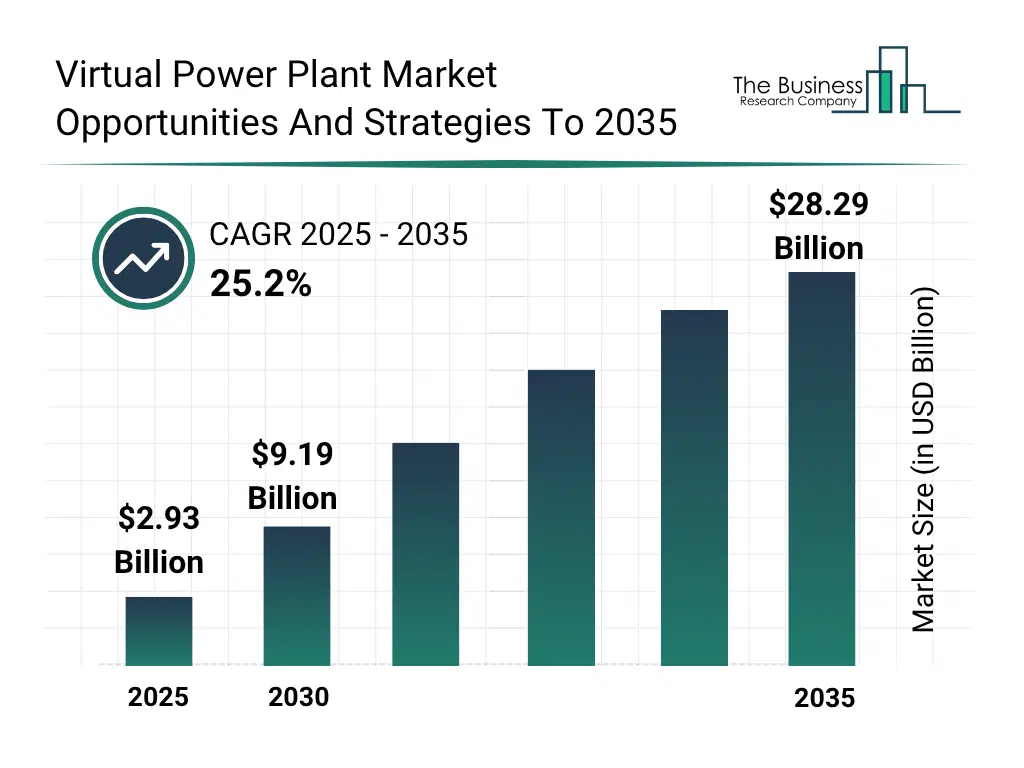
Virtual Power Plant Global Market Opportunities And Strategies To 2035 Market Size and growth rate 2026 to 2030: Graph

Virtual Power Plant Market Size

The global virtual power plant market reached a value of nearly $2,934.0 million in 2025, having grown at a compound annual growth rate (CAGR) of 26.1% since 2020. The market is expected to grow from $2,934.0 million in 2025 to $9,192.6 million in 2030 at a rate of 25.7%. The market is then expected to grow at a CAGR of 25.2% from 2030 and reach $28,287.0 million in 2035. Growth in the historic period resulted from integration of EVs charging station, increased demand for smart city infrastructure, increasing electricity consumption and rising focus on carbon emission reduction and energy efficiency. Factors that negatively affected growth in the historic period were high initial investment costs and complex regulatory and policy challenges. Going forward, integration of renewable energy sources, grid modernization and smart grid investments, supportive government regulations and incentives and rising demand for demand response and energy flexibility will drive the growth. Factors that could hinder the growth of the virtual power plant market in the future include technical complexity and interoperability issues, grid infrastructure limitations and impact of trade war and tariff.
Research Expert

Book your 30 minutes free consultation with our research experts

Virtual Power Plant Market Segmentation

The virtual power plant market is segmented by technology, by source and by end user.

By Technology –
The virtual power plant market is segmented by technology into:
    • a) Distributed Generation
    • b) Demand Response
    • c) Mixed Asset
The demand response market was the largest segment of the virtual power plant market segmented by technology, accounting for 43.7% or $1,281.6 million of the total in 2025. Going forward, the distributed generation segment is expected to be the fastest growing segment in the virtual power plant market segmented by technology, at a CAGR of 27.8% during 2025-2030.

By Source –
The virtual power plant market is segmented by source into:
    • a) Renewable Energy
    • b) Cogeneration
    • c) Energy Storage
The renewable energy was the largest segment of the virtual power plant market segmented by source, accounting for 51.0% or $1,496.4 million of the total in 2025. Going forward, the energy storage segment is expected to be the fastest growing segment in the virtual power plant market segmented by source, at a CAGR of 26.9% during 2025-2030.

By End User –
The virtual power plant market is segmented by end user into:
    • a) Industrial
    • b) Commercial
    • c) Residential
The industrial market was the largest segment of the virtual power plant market segmented by end user, accounting for 43.3% or $1,269.3 million of the total in 2025. Going forward, the industrial segment is expected to be the fastest growing segment in the virtual power plant market segmented by end user, at a CAGR of 27.7% during 2025-2030.

By Geography - The virtual power plant market is segmented by geography into:
      o Asia Pacific
      • China
      • India
      • Japan
      • Australia
      • Taiwan
      • South Korea
      o South East Asia
      • Indonesia
      o North America
      • USA
      • Canada
      o South America
      • Brazil
      o Western Europe
      • France
      • Germany
      • UK
      • Italy
      • Spain
      o Eastern Europe
      • Russia
      o Middle East
      o Africa
Western Europe was the largest region in the virtual power plant market, accounting for 52.0% or $1,526.8 million of the total in 2025. It was followed by North America, Asia Pacific and then the other regions. Going forward, the fastest-growing regions in the virtual power plant market will be Middle East and South America where growth will be at CAGRs of 76.9% and 59.8% respectively. These will be followed by Eastern Europe and Asia Pacific where the markets are expected to grow at CAGRs of 38.9% and 31.9% respectively.

Virtual Power Plant Market Competitive Landscape

Major Competitors are:

  • Next Kraftwerke GmbH
  • Enel X Ltd.
  • Tesla Inc.
  • Engie SA
  • Statkraft
  • Other Competitors Include:

  • Centrica plc
  • Stem Inc.
  • Sonnen GmbH
  • Generac Holdings Inc.
  • AGL Energy Ltd.
  • State Grid Corporation of China
  • CHN Energy Guangdong Integrated Energy Co. Ltd.
  • China General Nuclear Power Corp. (CGN)
  • Beijing Mingde Shengyuan Energy Storage Technology Co. Ltd. (Mingde Energy)
  • Huawei Digital Energy Technologies Co. Ltd.
  • Tokyo Electric Power Company Holdings Inc.
  • Kansai Electric Power Co., Inc.
  • NEC Corporation
  • Korea East-West Power
  • VGEN Co. Ltd.
  • SixtyHertz Inc.
  • VPPlab Co. Ltd.
  • LG Energy Solution, Ltd.
  • LS Electric Co. Ltd.
  • SolarEdge Technologies, Inc.
  • Robert Bosch GmbH
  • Siemens AG
  • Schneider Electric SE
  • Asea Brown Boveri Ltd. (ABB)
  • Limejump Limited
  • Flexitricity Limited
  • Iberdrola
  • Toshiba Energy Systems & Solutions Corporation
  • Hitachi Ltd.
  • General Electric Ltd. (GE)
  • Honeywell International Inc.
  • El Paso Electric
  • Base Power
  • sonnen GmbH
  • Lunar Energy
  • Wallbox
  • EnergyHub
  • Enphase Energy
  • BC Hydro
  • Solartility Inc.
  • Peak Power Inc.
  • Voltus Inc.
  • Virtual Power Plant Market Drivers

    The key drivers of the virtual power plant market include: Integration Of Renewable Energy Sources During the forecast period, the increasing integration of renewable energy sources is expected to be a key driver propelling growth in the virtual power plant market. As governments accelerate decarbonization strategies and expand national renewable capacity targets, utilities and grid operators continue to connect higher volumes of solar, wind and distributed clean energy assets to power systems across developed and emerging economies, leading to greater demand for advanced coordination and grid-balancing solutions. A growing renewable energy base increases the need for real-time aggregation, load optimization and distributed resource orchestration across geographically dispersed assets, driving sustained demand for cloud-based energy management platforms, battery storage integration systems, demand response technologies and smart grid control software. As a result, virtual power plant providers are expanding software capabilities, strengthening partnerships with distributed energy asset owners and enhancing grid service functionalities to support renewable integration and sustain long-term growth in the global virtual power plant market. The growth in increasing integration of renewable energy sources growth contribution during the forecast period in 2025 is 2.5%.

    Virtual Power Plant Market Restraints

    The key restraints on the virtual power plant market include: Technical Complexity And Interoperability Issues During the forecast period, technical complexity and interoperability issues are expected to restrain the growth of the virtual power plant market. Persistent challenges associated with integrating diverse distributed energy resources such as solar PV systems, wind turbines, battery storage units, electric vehicles and demand response assets into unified control platforms are placing operational and financial strain on utilities, aggregators and grid operators, which in turn discourages rapid large-scale VPP deployment and cross-platform coordination. From a commercial and system integration perspective, incompatibility between communication protocols, legacy grid infrastructure limitations, varying regional standards and fragmented software ecosystems increase pressure on stakeholders to invest in customized interfaces, middleware solutions and extended testing cycles, often at the expense of project timelines and scalability. These interoperability constraints, coupled with cybersecurity validation requirements, complex grid code compliance procedures and the need for continuous system synchronization across geographically dispersed assets, intensify operational burdens and heighten the risk of performance inconsistencies and delayed revenue realization from energy trading and ancillary services. As a result, VPP platform providers, utilities and distributed energy aggregators may face slower rollout strategies, higher integration costs and postponed investments in advanced orchestration and grid optimization solutions during the forecast period.

    Need data on a specific region in this market?

    Opportunities And Recommendations In The Virtual Power Plant Market

    Opportunities – The top opportunities in the virtual power plant market segmented by technology will arise in the distributed generation segment, which will gain $2,654.3 million of global annual sales by 2030. The top opportunities in the virtual power plant market segmented by source will arise in the renewable energy segment, which will gain $3,283.1 million of global annual sales by 2030. The top opportunities in the virtual power plant market segmented by end user will arise in the industrial segment, which will gain $3,044.9 million of global annual sales by 2030. The virtual power plant market size will gain the most in the USA at $1,729.9 million. Recommendations- To take advantage of the opportunities, The Business Research Company recommends the virtual power plant companies to focus on residential battery aggregation with advanced grid integration, focus on regulatory alignment and policy engagement to enable VPP scale, focus on distributed energy aggregation platforms for scalable revenue growth, focus on load orchestration and EV integration for flexible VPP scaling, focus on distributed generation segment for high-growth expansion, focus on energy storage segment for high-growth VPP optimization, expand in emerging markets, focus on multi-channel partner networks to scale VPP deployment, focus on value based pricing models to expand market participation, focus on data driven utility and regulator engagement to build market trust, focus on customer centric digital campaigns to accelerate adoption and focus on industrial segment to maximize scale and revenue growth.
    Chat with us