

Virtual Reality Headsets Market Report 2026
Global Outlook – By Product Type (Standalone Virtual Reality Headsets, Tethered Virtual Reality Headsets, Console-Connected Virtual Reality Headsets), By Technology (Inside-Out Tracking Technology, Outside-In Tracking Technology, Eye Tracking Technology, Haptic Feedback Technology), By End-Device (Low-End Device, Mid-Range Device, High-End Device), By Application (Gaming And Entertainment, Healthcare And Medical Training, Manufacturing And Industrial Design, Education And Workforce Training, Retail And Electronic Commerce), By End User (Consumer Users, Commercial And Enterprise Users, Government And Defense Organizations, Educational Institutions) – Market Size, Trends, Strategies, and Forecast to 2030
Virtual Reality Headsets Market Overview
• Virtual Reality Headsets market size has reached to $17.34 billion in 2025 • Expected to grow to $51.42 billion in 2030 at a compound annual growth rate (CAGR) of 24.3% • Growth Driver: The Increasing Adoption Of Immersive Gaming And Entertainment Fueling The Growth Of The Market Due To Expanding Economic Contributions And Demand For Realistic Experiences • Market Trend: Advancements In Mixed-Reality Standalone Virtual Reality Headsets Enhancing Immersive Experiences And Expanding Market Applications • North America was the largest region in 2025 and Asia-Pacific is the fastest growing region.What Is Covered Under Virtual Reality Headsets Market?
Virtual reality headsets are head-mounted devices that provide immersive, computer-generated environments through high-resolution displays, motion tracking, and spatial audio. They enable users to experience interactive digital worlds for various applications, offering a more realistic and engaging experience than traditional screens. The main product types of virtual reality headsets market include standalone virtual reality headsets, tethered virtual reality headsets, and console-connected virtual reality headsets. Standalone virtual reality headsets refer to self-contained devices that operate without requiring connection to external hardware such as PCs or gaming consoles. These are based on technologies including inside-out tracking technology, outside-in tracking technology, eye tracking technology, and haptic feedback technology and are categorized by end-device including low-end device, mid-range device, and high-end device. These are used for applications including gaming and entertainment, healthcare and medical training, manufacturing and industrial design, education and workforce training, retail and electronic commerce and are adopted by consumer users, commercial and enterprise users, government and defense organizations, and educational institutions.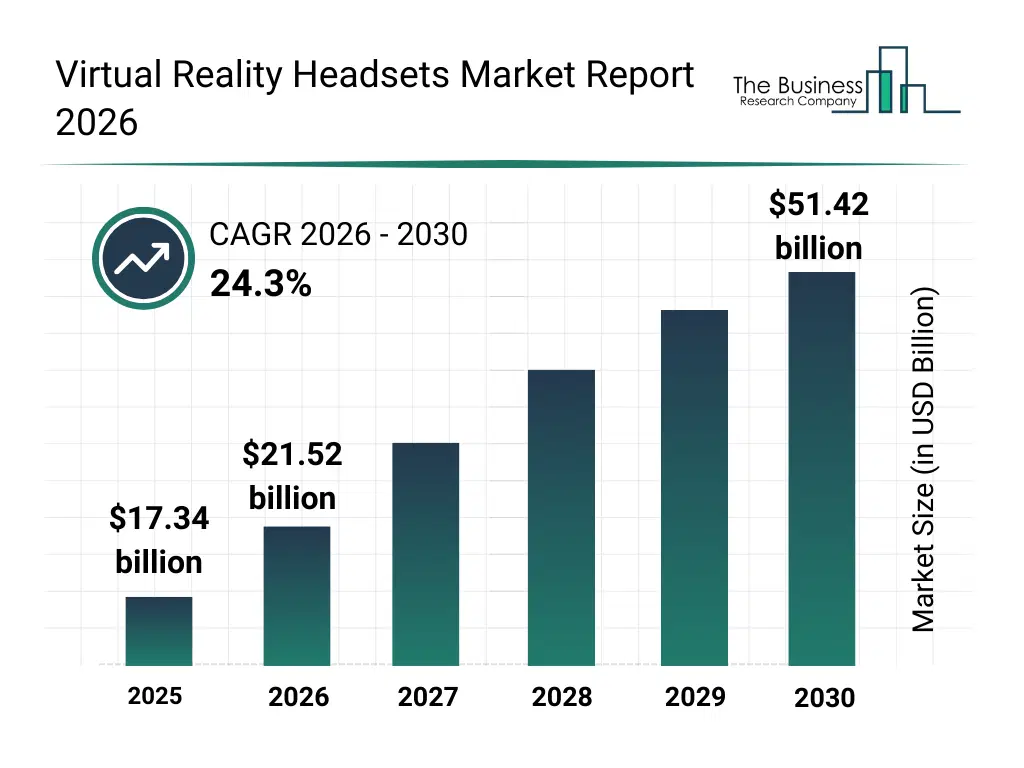
What Is The Virtual Reality Headsets Market Size and Share 2026?
The virtual reality headsets market size has grown exponentially in recent years. It will grow from $17.34 billion in 2025 to $21.52 billion in 2026 at a compound annual growth rate (CAGR) of 24.1%. The growth in the historic period can be attributed to increasing gaming and entertainment adoption, growth in consumer electronics penetration, rising industrial design and simulation needs, early adoption in healthcare training, expansion of educational VR programs.What Is The Virtual Reality Headsets Market Growth Forecast?
The virtual reality headsets market size is expected to see exponential growth in the next few years. It will grow to $51.42 billion in 2030 at a compound annual growth rate (CAGR) of 24.3%. The growth in the forecast period can be attributed to growing enterprise and commercial VR adoption, increasing integration with AI and motion tracking, rising investment in high-end immersive hardware, expansion of VR content development, increasing demand for remote training and virtual collaboration. Major trends in the forecast period include rising demand for standalone vr headsets, growing adoption of eye tracking and haptic feedback technologies, expansion of vr applications in healthcare and education, increasing focus on high-end device performance and resolution, rising integration with gaming and industrial simulation platforms.
Global Virtual Reality Headsets Market Segmentation
1) By Product Type: Standalone Virtual Reality Headsets, Tethered Virtual Reality Headsets, Console-Connected Virtual Reality Headsets 2) By Technology: Inside-Out Tracking Technology, Outside-In Tracking Technology, Eye Tracking Technology, Haptic Feedback Technology 3) By End-Device: Low-End Device, Mid-Range Device, High-End Device 4) By Application: Gaming And Entertainment, Healthcare And Medical Training, Manufacturing And Industrial Design, Education And Workforce Training, Retail And Electronic Commerce 5) By End User: Consumer Users, Commercial And Enterprise Users, Government And Defense Organizations, Educational Institutions Subsegments: 1) By Standalone Virtual Reality Headsets: Fully Integrated Standalone Headsets, Battery Powered Standalone Headsets, Wireless Standalone Headsets 2) By Tethered Virtual Reality Headsets: Personal Computer Connected Virtual Reality Headsets, Workstation Based Virtual Reality Headsets, High Performance Simulation Headsets 3) By Console-Connected Virtual Reality Headsets: Home Gaming Console Virtual Reality Headsets, Dedicated Entertainment Console Headsets, Living Room Gaming Virtual Reality HeadsetsWhat Is The Driver Of The Virtual Reality Headsets Market?
The increasing adoption of immersive gaming and entertainment is expected to propel the growth of the virtual reality headsets market going forward. Immersive gaming and entertainment refers to interactive digital environments that engage users through visual, audio, and motion-based feedback to create realistic and engaging experiences. The increasing adoption of immersive gaming and entertainment is driven by growing consumer demand for highly realistic gameplay, interactive storytelling, and next-generation digital experiences. Virtual reality headsets support immersive gaming and entertainment by providing head-mounted displays, spatial tracking, and motion-sensing capabilities that enable users to interact with fully simulated virtual environments in real time. For instance, in June 2024, according to the Interactive Games and Entertainment Association (IGEA), an Australia-based not-for-profit member organization, Australians spent $2.82 billion (AUD 4.4 billion) on video games and related hardware in 2023, marking a 5% increase from 2022, driven by an 11% rise in digital game sales. Therefore, the increasing adoption of immersive gaming and entertainment is driving the growth of the virtual reality headsets industry. Growing Adoption Of Hybrid Work Models Fueling The Growth Of The Market Due To Demand For Flexible Collaboration And Immersive Remote Experiences The growing adoption of hybrid work models is expected to propel the growth of the virtual reality headsets market going forward. Hybrid work models refer to a flexible approach where employees divide their time between remote work and on-site office work. Hybrid work models are increasing due to employee demand for flexibility, as workers seek better work-life balance and the ability to reduce commuting time while maintaining productivity. Virtual reality headsets support hybrid work models by enabling immersive collaboration, virtual meetings, and interactive training experiences, making them ideal for distributed teams and flexible workplaces. They reduce travel and communication barriers while improving engagement and productivity, enhancing overall remote and in-office work integration. For instance, in June 2025, according to the Office for National Statistics, a UK-based government department, more than a quarter (28%) of working adults in Great Britain worked in a hybrid model between January and March 2025, with the share of hybrid workers steadily increasing since March 2022. Therefore, the growing adoption of hybrid work models is driving the growth of the virtual reality headsets industry.Key Players In The Global Virtual Reality Headsets Market
Major companies operating in the virtual reality headsets market are Samsung Electronics Co. Ltd., Meta Platforms Inc., Sony Interactive Entertainment LLC, Lenovo Group Limited, HP Inc., GoerTek Inc., Vuzix Corporation, Seiko Epson Corporation, Valve Corporation, Magic Leap Inc., HTC Corporation, Pimax Technology (Shanghai) Co. Ltd., Varjo Technologies Oy, DPVR Technology Co. Ltd., NOLO VR Technology Co. Ltd., HOLOGATE GmbH, StarVR Corporation, Vrgineers B.V., Homido VR, and Arpara Technologies Co. Ltd.
This chart is for illustrative purposes; the full report includes a detailed competitor analysis and comprehensive overview of the top 10 companies in the market.
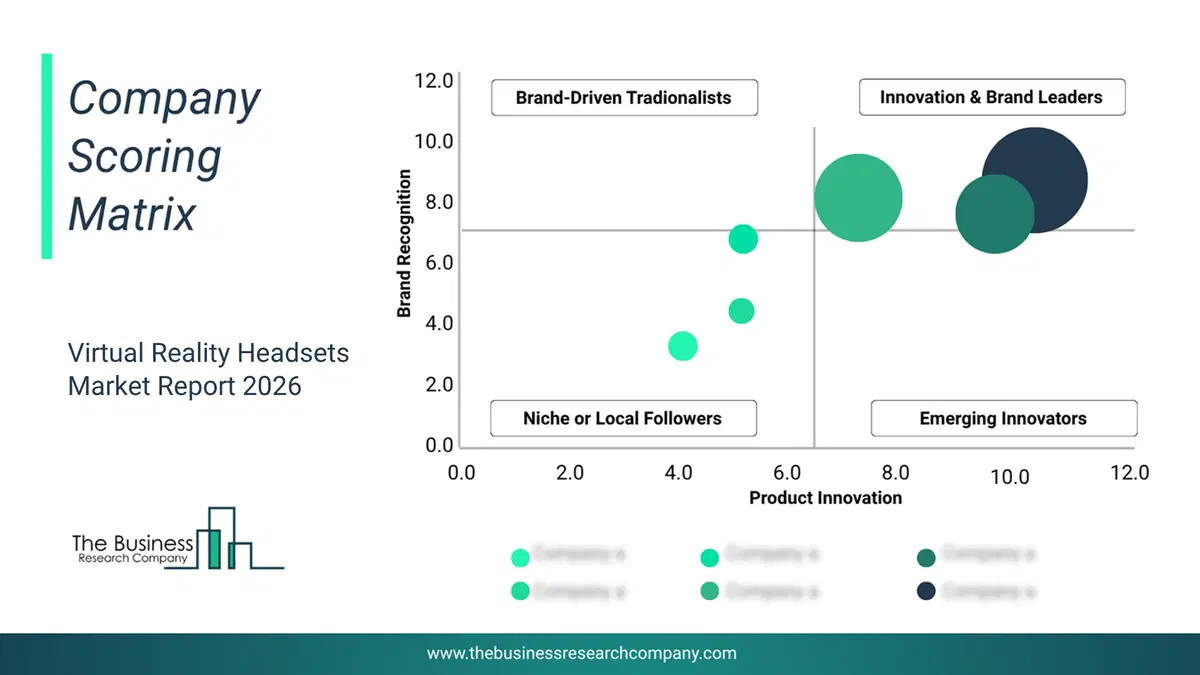
This chart maps companies by product innovation and brand strength, with bubble size indicating relative revenue, helping identify market leaders, challengers, and niche players. This is an illustrative chart; the full report provides a complete and accurate competitive analysis.
Global Virtual Reality Headsets Market Trends and Insights
Major companies operating in the virtual reality headsets market are focusing on developing technologically advanced products, such as high-resolution optical systems, to boost immersion, enhance user experience, and reduce physical strain. High-resolution optical systems refer to advanced display mechanisms in MR headsets that deliver ultra-sharp, life-like visuals for seamless blending of digital and real worlds. For instance, in August 2024, Vivo, a China-based consumer electronics manufacturer, launched the Vivo Vision Discovery Edition. It is a mixed reality headset, featuring dual Micro-OLED screens with 8K binocular resolution and co-engineered ZEISS optics for exceptional color accuracy and wide color coverage. It includes advanced eye-tracking and fingertip gesture recognition, enabling natural move-and-pinch interactions without traditional controllers. It also incorporates a lightweight design, being 26% smaller than the industry average and weighing just 398g, enhancing comfort for extended use in immersive entertainment, gaming, and productivity scenarios.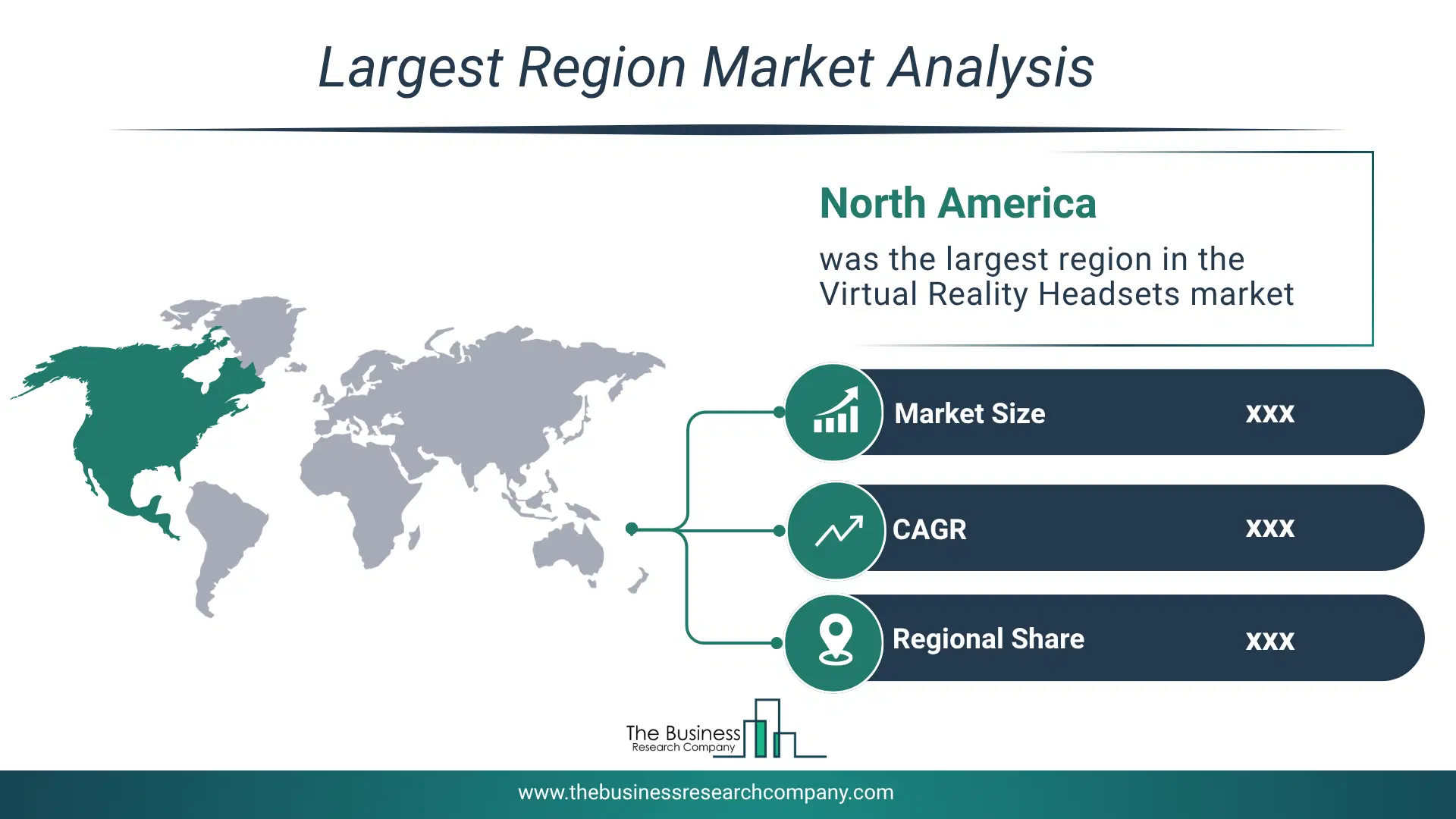
Regional Insights
North America was the largest region in the virtual reality headsets market in 2025. Asia-Pacific is expected to be the fastest-growing region in the forecast period. The regions covered in this market report are Asia-Pacific, South East Asia, Western Europe, Eastern Europe, North America, South America, Middle East, Africa. The countries covered in this market report are Australia, Brazil, China, France, Germany, India, Indonesia, Japan, Taiwan, Russia, South Korea, UK, USA, Canada, Italy, Spain.What Defines the Virtual Reality Headsets Market?
The virtual reality headsets market consists of revenues earned by entities by providing services such as software and content development, platform integration and compatibility support, training and consulting services, and after-sales support. The market value includes the price of hardware sold by manufacturers, standalone software or content packages, and integrated services offered with the devices. The virtual reality headsets market includes sales of motion sensors, VR-compatible audio devices, docking stations, tracking cameras, and bundled accessories. Values in this market are ‘factory gate’ values, that is, the value of goods sold by the manufacturers or creators of the goods, whether to other entities (including downstream manufacturers, wholesalers, distributors, and retailers) or directly to end customers. The value of goods in this market includes related services sold by the creators of the goods.How is Market Value Defined and Measured?
The market value is defined as the revenues that enterprises gain from the sale of goods and/or services within the specified market and geography through sales, grants, or donations in terms of the currency (in USD unless otherwise specified). The revenues for a specified geography are consumption values that are revenues generated by organizations in the specified geography within the market, irrespective of where they are produced. It does not include revenues from resales along the supply chain, either further along the supply chain or as part of other products.
This chart presents market attractiveness based on a quantitative evaluation of growth, competition, strategic alignment, and risk, offering a clear view of opportunity areas for decision-making. This chart is for illustrative purposes; the full report contains the complete analysis.

This chart highlights the Total Addressable Market (TAM) by estimating the maximum revenue opportunity using an assumption-driven approach, supporting strategic planning and opportunity sizing across markets. The chart is illustrative; the full report provides a more comprehensive analysis.
What Key Data and Analysis Are Included in the Virtual Reality Headsets Market Report 2026?
The virtual reality headsets market research report is one of a series of new reports from The Business Research Company that provides virtual reality headsets market statistics, including virtual reality headsets industry global market size, regional shares, competitors with a virtual reality headsets market share, detailed virtual reality headsets market segments, market trends and opportunities, and any further data you may need to thrive in the virtual reality headsets industry. This virtual reality headsets market research report delivers a complete perspective of everything you need, with an in-depth analysis of the current and future scenario of the industry.Virtual Reality Headsets Market Report Forecast Analysis
| Report Attribute | Details |
|---|---|
| Market Size Value In 2026 | $21.52 billion |
| Revenue Forecast In 2030 | $51.42 billion |
| Growth Rate | CAGR of 24.1% from 2026 to 2030 |
| Base Year For Estimation | 2025 |
| Actual Estimates/Historical Data | 2020-2025 |
| Forecast Period | 2026 - 2030 |
| Market Representation | Revenue in USD Billion and CAGR from 2026 to 2030 |
| Segments Covered | Product Type, Technology, End-Device, Application, End User |
| Regional Scope | Asia-Pacific, Western Europe, Eastern Europe, North America, South America, Middle East, Africa |
| Country Scope | The countries covered in the report are Australia, Brazil, China, France, Germany, India, Indonesia, Japan, Taiwan, Russia, South Korea, UK, USA, Canada, Italy, Spain. |
| Key Companies Profiled | Samsung Electronics Co. Ltd., Meta Platforms Inc., Sony Interactive Entertainment LLC, Lenovo Group Limited, HP Inc., GoerTek Inc., Vuzix Corporation, Seiko Epson Corporation, Valve Corporation, Magic Leap Inc., HTC Corporation, Pimax Technology (Shanghai) Co. Ltd., Varjo Technologies Oy, DPVR Technology Co. Ltd., NOLO VR Technology Co. Ltd., HOLOGATE GmbH, StarVR Corporation, Vrgineers B.V., Homido VR, and Arpara Technologies Co. Ltd. |
| Customization Scope | Request for Customization |
| Pricing And Purchase Options | Explore Purchase Options |