

Virtual Reality In Healthcare Market Report 2026
Global Outlook – By Component (Hardware, Software), By Technology (Full Immersive Virtual Reality, Non-Immersive Virtual Reality, Semi-Immersive Virtual Reality), By Device Type (Head-Mounted Display, Gesture-Tracking Device, Projectors And Display Units, Other Device Types), By Application (Patient Care Management, Education And Training, Fitness Management, Surgery, Other Applications), By End User (Research And Diagnostics, Laboratories, Hospitals And Clinics, Pharmaceutical Companies, Other End Users) – Market Size, Trends, Strategies, and Forecast to 2030
Virtual Reality In Healthcare Market Overview
• Virtual Reality In Healthcare market size has reached to $5.98 billion in 2025 • Expected to grow to $42.18 billion in 2030 at a compound annual growth rate (CAGR) of 47.8% • Growth Driver: Surging Incidences Of Neurological Disorders Drive Virtual Reality Innovations In Healthcare • Market Trend: Leading Virtual Reality Healthcare Companies Forge Strategic Partnerships For Enhanced Services • North America was the largest region in 2025.What Is Covered Under Virtual Reality In Healthcare Market?
Virtual reality (VR) is an artificial environment created with software that is presented to the user so that the user stops believing and accepts it as a real environment. It is used for medical education, surgical simulations, pain management, and rehabilitation, enhancing patient care and professional training. The main types of components in virtual reality in the healthcare market are hardware and software. The hardware virtual reality in healthcare includes headsets, goggles, and other accessories used in healthcare facilities for medical training, performing virtual surgeries, and other tasks to make the user feel immersed in the 3D environment. The main technologies used in VR in healthcare are full-immersive virtual reality, non-immersive virtual reality, and semi-immersive virtual reality, and it has various device types such as head-mounted displays, gesture-tracking devices, projectors and display units, among others. VR in healthcare is used in research and diagnostics, laboratories, hospitals and clinics, pharmaceutical companies, and others and is applied in patient care management, education and training, fitness management, pharmacy, surgery, and others.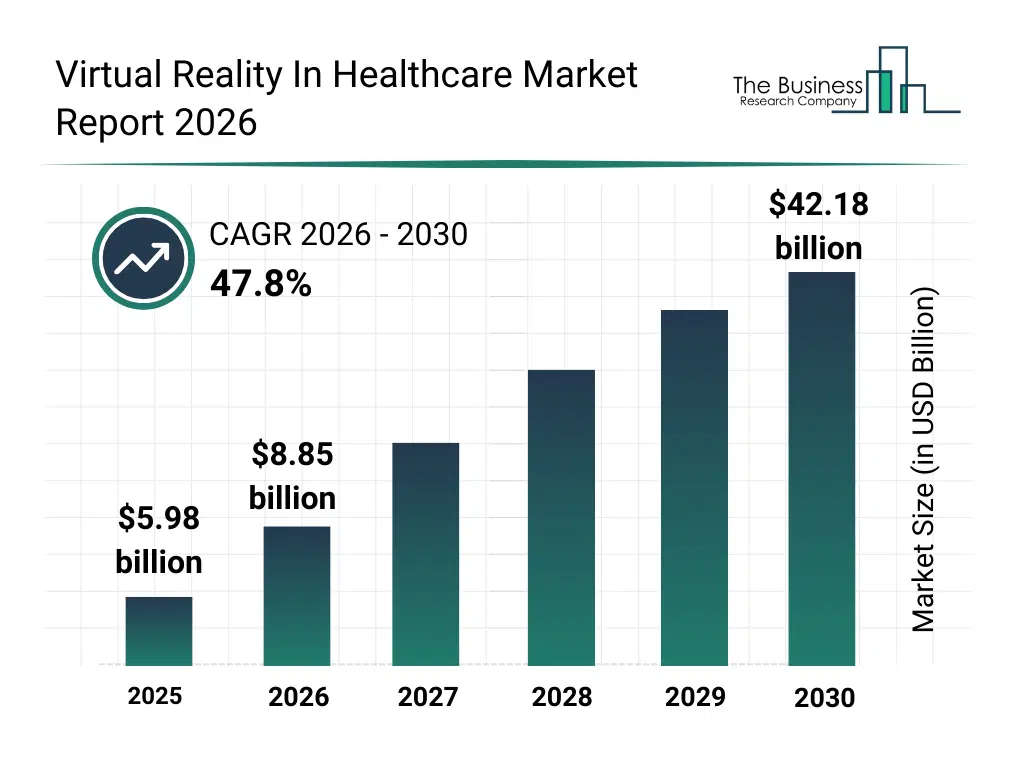
What Is The Virtual Reality In Healthcare Market Size and Share 2026?
The virtual reality in healthcare market size has grown exponentially in recent years. It will grow from $5.98 billion in 2025 to $8.85 billion in 2026 at a compound annual growth rate (CAGR) of 48.0%. The growth in the historic period can be attributed to increasing demand for advanced medical training tools, expansion of digital healthcare infrastructure, rising focus on minimally invasive procedures, growing acceptance of simulation-based learning, availability of vr-enabled medical devices.What Is The Virtual Reality In Healthcare Market Growth Forecast?
The virtual reality in healthcare market size is expected to see exponential growth in the next few years. It will grow to $42.18 billion in 2030 at a compound annual growth rate (CAGR) of 47.8%. The growth in the forecast period can be attributed to increasing adoption of vr-assisted clinical workflows, rising investments in digital therapeutics, expansion of vr applications in mental health treatment, growing demand for remote medical training, increasing integration of vr with healthcare analytics platforms. Major trends in the forecast period include increasing adoption of vr-based surgical simulations, rising use of vr for pain management and therapy, growing deployment of vr in medical training, expansion of rehabilitation-focused vr applications, enhanced integration of data-driven healthcare vr.
Global Virtual Reality In Healthcare Market Segmentation
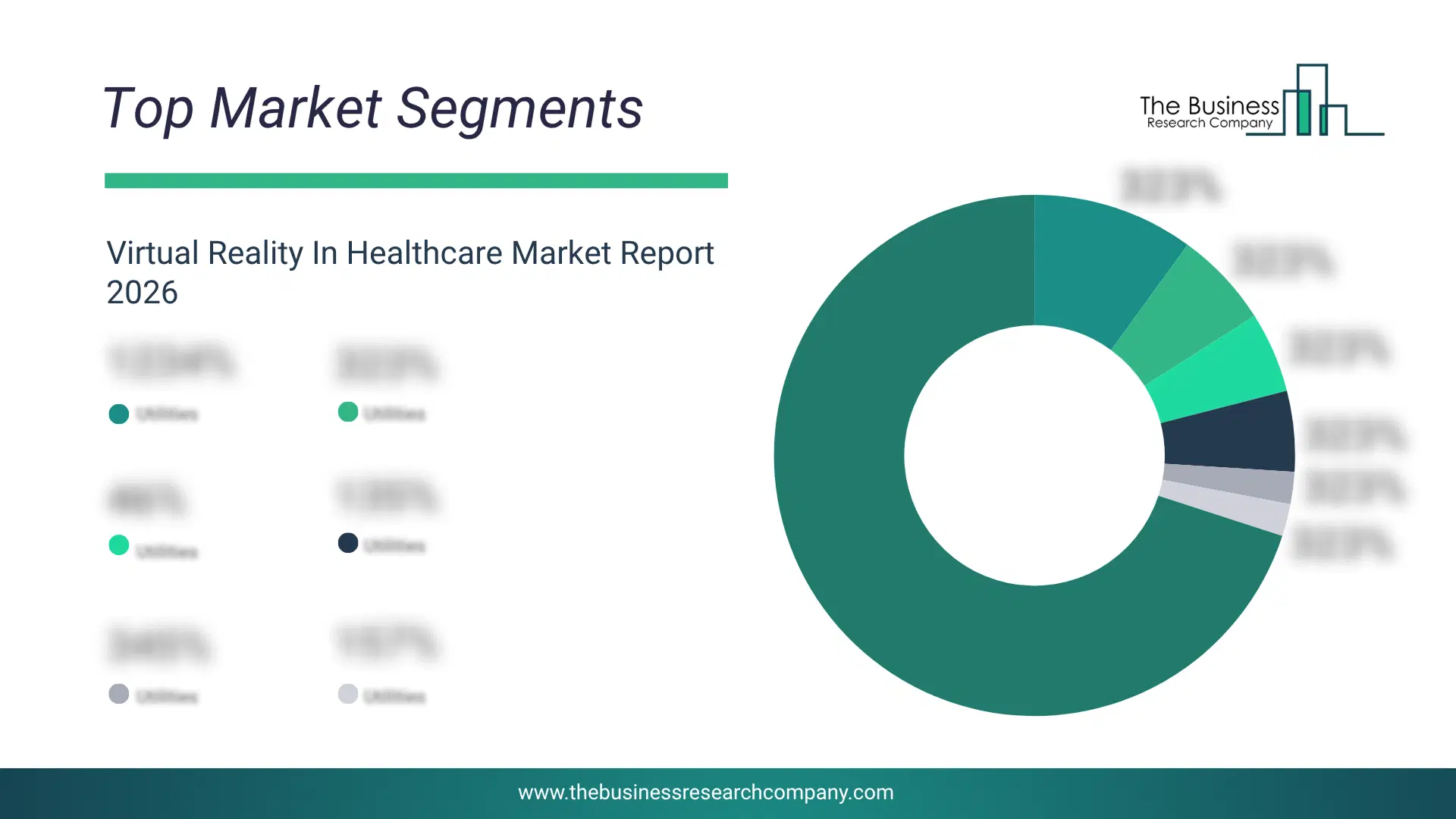
1) By Component: Hardware, Software 2) By Technology: Full Immersive Virtual Reality, Non-Immersive Virtual Reality, Semi-Immersive Virtual Reality 3) By Device Type: Head-Mounted Display, Gesture-Tracking Device, Projectors And Display Units, Other Device Types 4) By Application: Patient Care Management, Education And Training, Fitness Management, Surgery, Other Applications 5) By End User: Research And Diagnostics, Laboratories, Hospitals And Clinics, Pharmaceutical Companies, Other End Users Subsegments: 1) By Hardware: VR Headsets, Motion Sensors, Haptic Devices 2) By Software: VR Simulation Software, Training And Education Software, Therapy And Rehabilitation ApplicationsWhat Is The Driver Of The Virtual Reality In Healthcare Market?
The rise in incidences of neurological disorders is expected to propel the growth of virtual reality in healthcare market going forward. Neurological disorders are diseases such as Alzheimer’s disease, Parkinson’s disease, dementia, multiple sclerosis, migraines, and others that affect the body’s central nervous system. The rise in neurological disorders is due to aging population, as advancing age increases vulnerability to conditions such as Alzheimer’s disease, Parkinson’s disease, and stroke. Virtual reality in healthcare helps neurological disorders by providing immersive rehabilitation and cognitive training environments, enabling patients to improve motor skills, memory, and coordination through engaging, repeatable, and personalized therapy sessions. For instance, in March 2023, according to the Alzheimer's Association, a US-based nonprofit voluntary health organization, 6.7 million Americans aged 65 and older are living with Alzheimer's dementia, with projections indicating this could rise to 13.8 million by 2060 Therefore, the rise in incidences of neurological disorders is driving the growth of the virtual reality in the healthcare industry market.Key Players In The Global Virtual Reality In Healthcare Market
Major companies operating in the virtual reality in healthcare market are SAMSUNG Electronics Co. Ltd.; Atheer Inc.; Augmedix Inc.; Firsthand Technology Inc.; Microsoft Corporation; Medical Realities Ltd.; MindMaze; Medtronic Inc.; Siemens Healthineers AG; Oculus VR (Meta Platforms Inc.); Wipro GE Healthcare Pvt Ltd; Orca Health Inc.; Koninklijke Philips N. V.; HTC Corporation; EON Reality Inc.; XRHealth Inc.; Psious S. L.; Appello Software Inc.; HypnosVR Inc.; Fusion VR LLC; Sapizon Technologies Pvt. Ltd.; Lucid Reality Labs Inc.; VR Simulators Inc.; CAE Healthcare Inc.; Google LLC; Room 505 Inc.; DAQRI LLC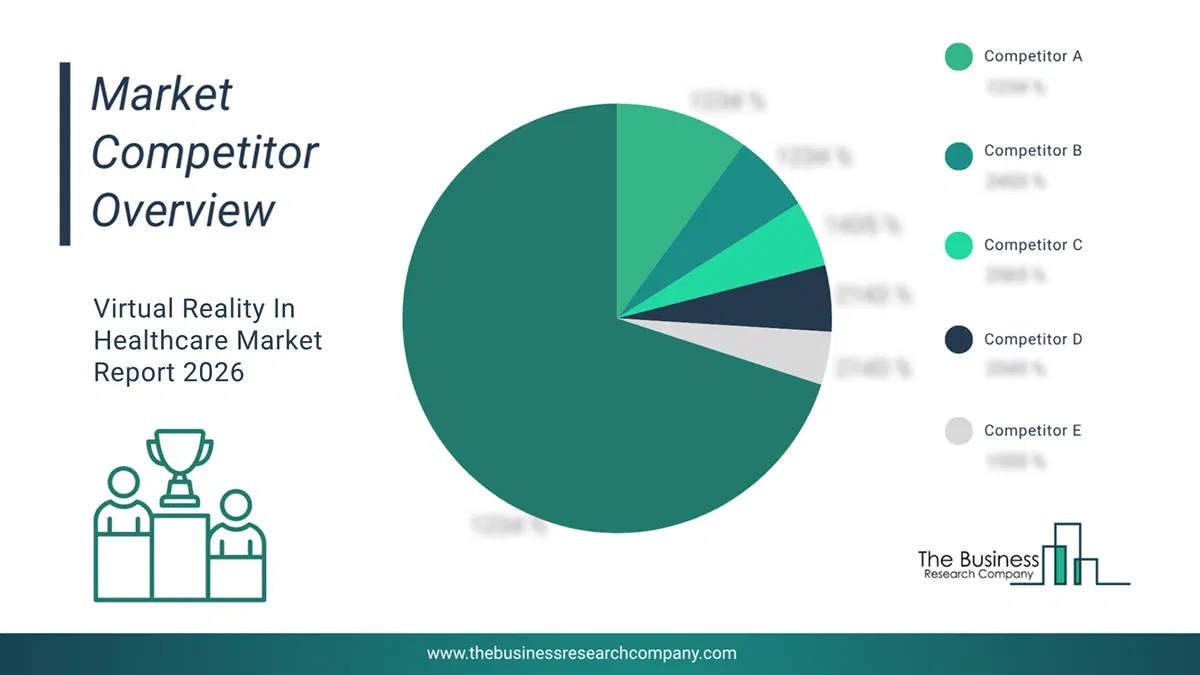
This chart is for illustrative purposes; the full report includes a detailed competitor analysis and comprehensive overview of the top 10 companies in the market.
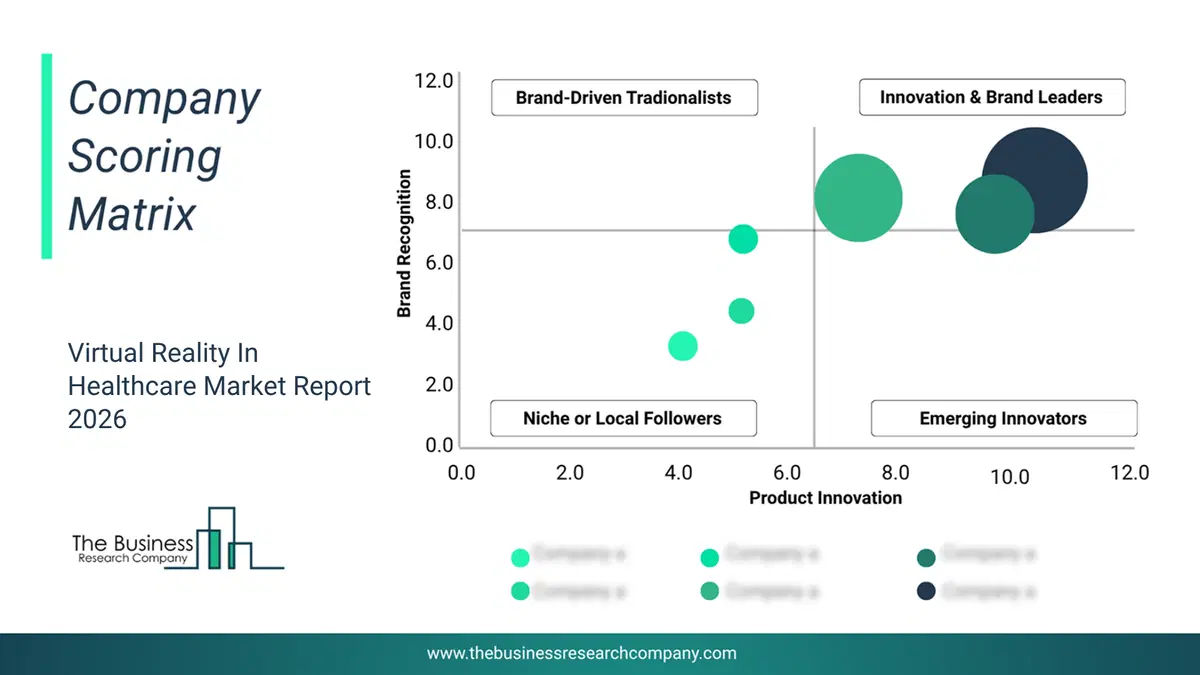
This chart maps companies by product innovation and brand strength, with bubble size indicating relative revenue, helping identify market leaders, challengers, and niche players. This is an illustrative chart; the full report provides a complete and accurate competitive analysis.
Global Virtual Reality In Healthcare Market Trends and Insights
Major companies operating in the virtual reality in the healthcare industry are adopting strategic partnerships approach to provide essential virtual reality in the healthcare services to individuals, businesses, and governments. Strategic partnerships refer to a process in which companies leverage each other’s strengths and resources to achieve mutual benefits and success. For instance, in April 2023 Vuzix, a US-based smart eyewear manufacturer partnered with VSee, a US-based software developer to develop smart glass for the telemedicine industry. The partnership between Vuzix and VSee aims to enable positive outcomes while saving time and money for medical practitioners, offering a higher level of precision, and sharing knowledge when it matters.What Are Latest Mergers And Acquisitions In The Virtual Reality In Healthcare Market?
In February 2024, the National Board of Medical Examiners (NBME), a US-based non-profit that develops and manages assessments for student physicians, acquired MedVR Education for an undisclosed amount. Through this acquisition, the National Board of Medical Examiners aims to enhance its capabilities in developing innovative tools and assessments for medical education. The acquisition of MedVR Education combines NBME's expertise in psychometrics and test development with MedVR’s simulation-based learning technology, creating opportunities for next-generation tools that support learners throughout their medical education journey. MedVR Education is a US-based company focused on leveraging virtual reality in the healthcare field to improve medical training and provide immersive educational tools for professionals.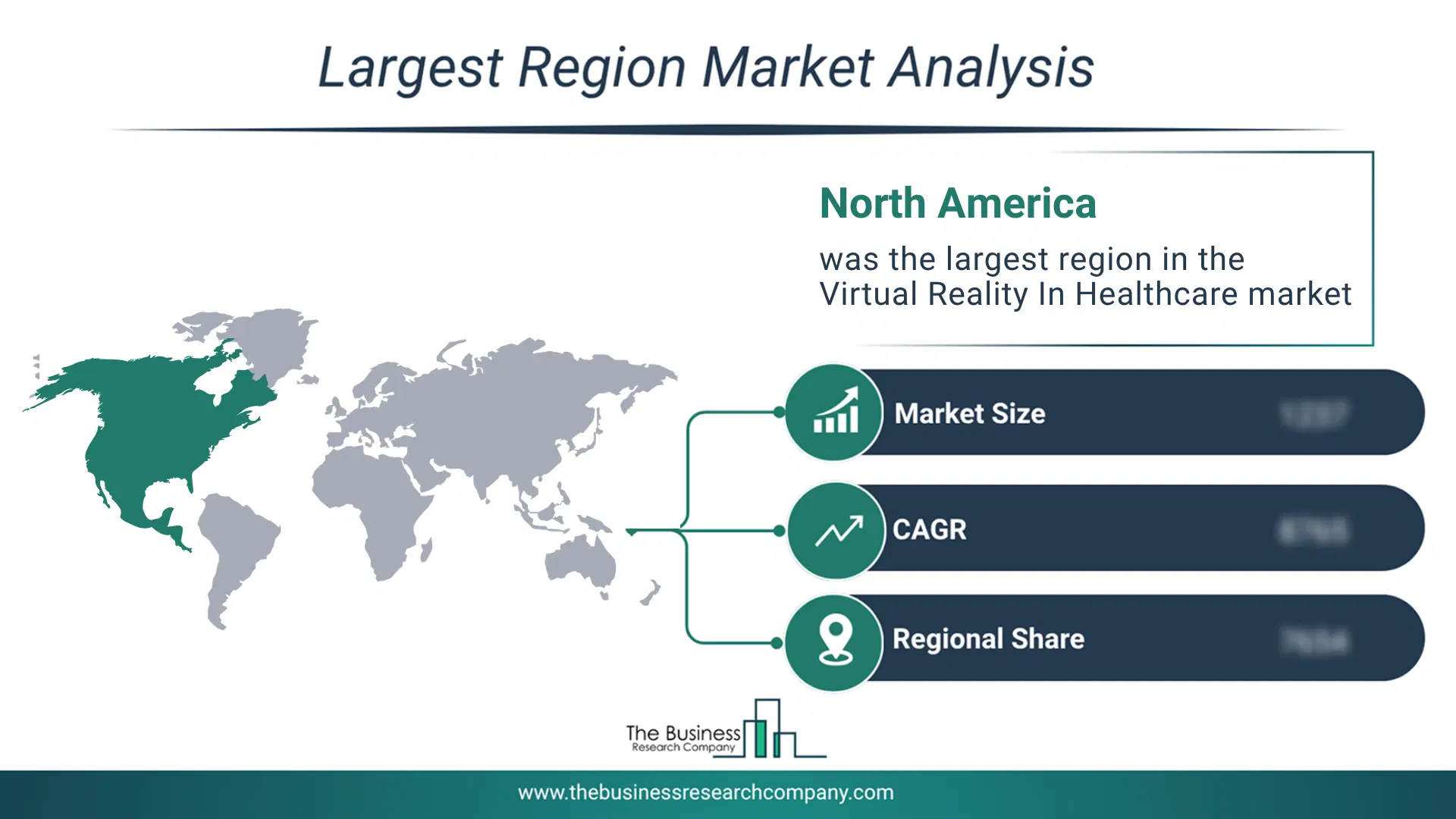
Regional Insights
North America was the largest region in the virtual reality healthcare market in 2025. The regions covered in this market report are Asia-Pacific, South East Asia, Western Europe, Eastern Europe, North America, South America, Middle East, Africa. The countries covered in this market report are Australia, Brazil, China, France, Germany, India, Indonesia, Japan, Taiwan, Russia, South Korea, UK, USA, Canada, Italy, SpainWhat Defines the Virtual Reality In Healthcare Market?
The virtual reality in the healthcare market includes revenues earned by entities by offering 3D environment to create more impactful visual experiences of space and human anatomy, lowering medical costs, decreasing traumatic events, and improving outcomes. The market value includes the value of related goods sold by the service provider or included within the service offering. Only goods and services traded between entities or sold to end consumers are included.How is Market Value Defined and Measured?
The market value is defined as the revenues that enterprises gain from the sale of goods and/or services within the specified market and geography through sales, grants, or donations in terms of the currency (in USD unless otherwise specified). The revenues for a specified geography are consumption values that are revenues generated by organizations in the specified geography within the market, irrespective of where they are produced. It does not include revenues from resales along the supply chain, either further along the supply chain or as part of other products.
This chart presents market attractiveness based on a quantitative evaluation of growth, competition, strategic alignment, and risk, offering a clear view of opportunity areas for decision-making. This chart is for illustrative purposes; the full report contains the complete analysis.

This chart highlights the Total Addressable Market (TAM) by estimating the maximum revenue opportunity using an assumption-driven approach, supporting strategic planning and opportunity sizing across markets. The chart is illustrative; the full report provides a more comprehensive analysis.
What Key Data and Analysis Are Included in the Virtual Reality In Healthcare Market Report 2026?
The virtual reality in healthcare market research report is one of a series of new reports from The Business Research Company that provides market statistics, including industry global market size, regional shares, competitors with the market share, detailed market segments, market trends and opportunities, and any further data you may need to thrive in the virtual reality in healthcare industry. The market research report delivers a complete perspective of everything you need, with an in-depth analysis of the current and future state of the industry.Virtual Reality In Healthcare Market Report Forecast Analysis
| Report Attribute | Details |
|---|---|
| Market Size Value In 2026 | $8.85 billion |
| Revenue Forecast In 2030 | $42.18 billion |
| Growth Rate | CAGR of 47.8% from 2026 to 2030 |
| Base Year For Estimation | 2025 |
| Actual Estimates/Historical Data | 2020-2025 |
| Forecast Period | 2026 - 2030 |
| Market Representation | Revenue in USD Billion and CAGR from 2026 to 2030 |
| Segments Covered | Component, Technology, Device Type, Application, End User |
| Regional Scope | Asia-Pacific, Western Europe, Eastern Europe, North America, South America, Middle East, Africa |
| Country Scope | The Countries Covered In This Market Report Are Australia, Brazil, China, France, Germany, India, Indonesia, Japan, Taiwan, Russia, South Korea, Uk, Usa, Canada, Italy, Spain. |
| Key Companies Profiled | SAMSUNG Electronics Co. Ltd., Atheer Inc., Augmedix Inc., Firsthand Technology Inc., Microsoft Corporation, Medical Realities Ltd., MindMaze, Medtronic Inc., Siemens Healthineers AG, Oculus VR (Meta Platforms Inc.), Wipro GE Healthcare Pvt Ltd, Orca Health Inc., Koninklijke Philips N. V., HTC Corporation, EON Reality Inc., XRHealth Inc., Psious S. L., Appello Software Inc., HypnosVR Inc., Fusion VR LLC, Sapizon Technologies Pvt. Ltd., Lucid Reality Labs Inc., VR Simulators Inc., CAE Healthcare Inc., Google LLC, Room 505 Inc., DAQRI LLC |
| Customization Scope | Request for Customization |
| Pricing And Purchase Options | Explore Purchase Options |