

Virtual Reality Market Report 2026
Global Outlook – By Component (Hardware, Software), By Deployment (On-Premises Virtual Reality (VR), Cloud-Based), By Device (Head-Mounted Display (HMD), Gesture-Tracking Device (GTD), Projectors And Display Wall (PDW)), By Technology (Semi And Fully Immersive, Non-Immersive), By Application (Aerospace And Defense, Consumer, Commercial, Enterprise, Healthcare, Other Applications) – Market Size, Trends, Strategies, and Forecast to 2030
Virtual Reality Market Overview
• Virtual Reality market size has reached to $33.52 billion in 2025 • Expected to grow to $116.22 billion in 2030 at a compound annual growth rate (CAGR) of 28.2% • Growth Driver: Increasing Demand For Immersive Gaming Experiences Fueling Market Growth Through Enhanced User Engagement And Realistic Digital Environments • Market Trend: Advancing AI?Native Immersive Headsets To Expand User Engagement And Platform Capabilities • North America was the largest region in 2025 and Asia-Pacific is the fastest growing region.What Is Covered Under Virtual Reality Market?
Virtual reality is a computer-generated simulation that creates an immersive, interactive environment, making users feel as if they are physically present within it. It uses specialized hardware and software to replicate sensory experiences such as sight, sound, and sometimes touch. This technology enables exploration and interaction with digital worlds in real time. The main components of the virtual reality include hardware and software. Hardware refers to the physical devices and equipment used to enable, support, and deliver virtual reality experiences. The deployment can be on-premises virtual reality systems and cloud-based. The devices such as head-mounted displays, gesture-tracking devices, projectors, and display walls. The technologies ranging from semi and fully immersive and non-immersive. The applications such as aerospace and defense, consumer entertainment, commercial and enterprise use cases, healthcare, and others.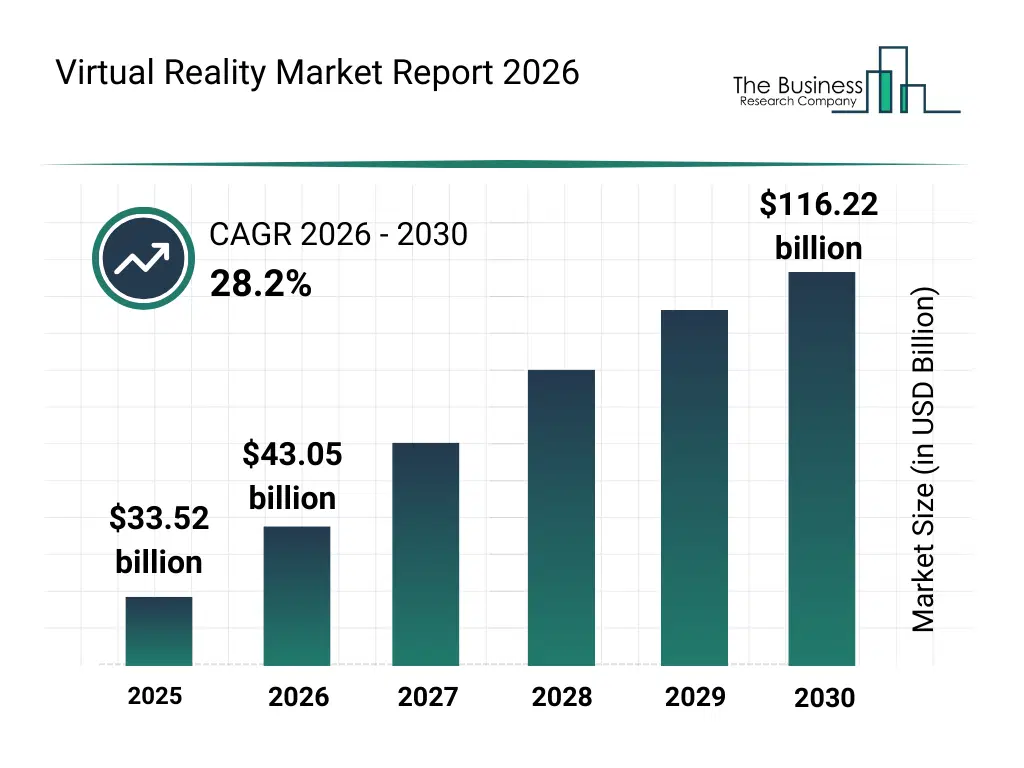
What Is The Virtual Reality Market Size and Share 2026?
The virtual reality market size has grown exponentially in recent years. It will grow from $33.52 billion in 2025 to $43.05 billion in 2026 at a compound annual growth rate (CAGR) of 28.5%. The growth in the historic period can be attributed to increasing demand for immersive gaming, growing enterprise adoption of virtual reality training, rising investment in virtual reality content creation, expansion of virtual reality hardware availability, and increasing use of virtual reality in education and healthcare.What Is The Virtual Reality Market Growth Forecast?
The virtual reality market size is expected to see exponential growth in the next few years. It will grow to $116.22 billion in 2030 at a compound annual growth rate (CAGR) of 28.2%. The growth in the forecast period can be attributed to growing integration of virtual reality with artificial intelligence and 5G, rising adoption of virtual reality for remote collaboration, increasing enterprise spending on virtual reality simulations, expansion of cloud-based virtual reality platforms, and growing deployment of virtual reality solutions in retail and e-commerce. Major trends in the forecast period include advancements in virtual reality hardware technology, innovations in haptic feedback systems, developments in eye-tracking and motion tracking, research and development in ultra-realistic virtual reality experiences, and technological advancements in standalone virtual reality devices.
Global Virtual Reality Market Segmentation
1) By Component: Hardware, Software 2) By Deployment: On-Premises Virtual Reality (VR), Cloud-Based 3) By Device: Head-Mounted Display (HMD), Gesture-Tracking Device (GTD), Projectors And Display Wall (PDW) 4) By Technology: Semi And Fully Immersive, Non-Immersive 5) By Application: Aerospace And Defense, Consumer, Commercial, Enterprise, Healthcare, Other Applications Subsegments: 1) By Hardware: Head Mounted Display, Motion Controllers, Haptic Devices, Tracking Cameras, Gesture Tracking Sensors 2) By Software: Rendering Engines, Simulation And Training Software, Content Management Systems, Interaction Middleware, Development Tools And LibrariesWhat Is The Driver Of The Virtual Reality Market?
The increasing demand for immersive gaming experiences is expected to propel the growth of the Virtual Reality (VR) market going forward. Immersive gaming refers to interactive digital entertainment in which players engage deeply with richly detailed, three?dimensional virtual worlds, often accessed via VR hardware that tracks user movement and provides responsive visual and audio feedback. The demand for immersive gaming experiences is rising as more players seek higher levels of realism and engagement than traditional gaming platforms can deliver. Virtual reality (VR) supports immersive gaming by enabling highly interactive, sensory?rich environments that meet rising player expectations for engagement and realism. For instance, in March 2025, according to Meta Platforms, a US-based social technology company, cumulative spending on Meta Quest titles surpassed $2 billion, with total developer payments increasing by about 12% in 2024, while user engagement strengthened as customers spent 30% more monthly time in virtual reality during 2024 compared with the previous year. Therefore, the increasing demand for immersive gaming experiences is driving the growth of the Virtual Reality (VR) market.Key Players In The Global Virtual Reality Market
Major companies operating in the virtual reality market are Meta Platforms Inc., Valve Corporation, Unity Software Inc., Epic Games Inc., Crytek GmbH, HTC Corporation, Pimax Technology Co. Ltd., Varjo Technologies Oy, nDreams Limited, EON Reality Inc., Shanghai Lexiang Technology Co. Ltd., Resolution Games AB, Survios Inc., Ultraleap Ltd., VRgineers Inc., Fast Travel Games AB, HaptX Inc., Virtuix Holdings Inc., Bigscreen Inc., Lynx Mixed Reality SAS, Manus VR B.V., InstaVR Inc., WorldViz LLC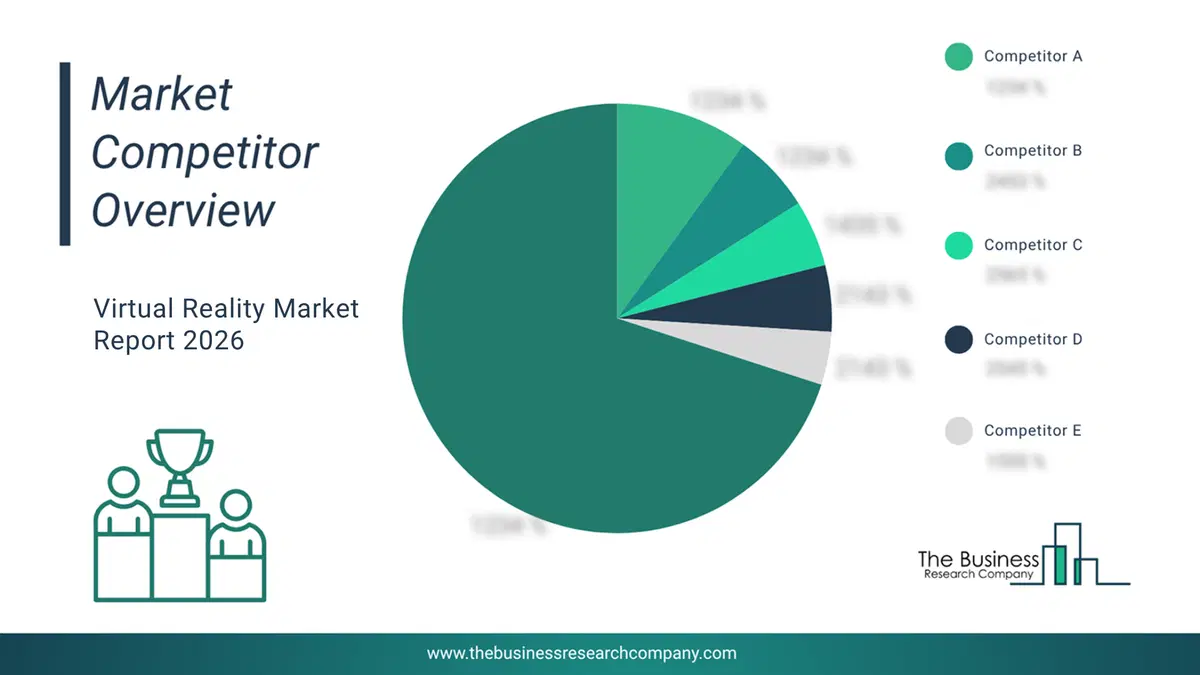
This chart is for illustrative purposes; the full report includes a detailed competitor analysis and comprehensive overview of the top 10 companies in the market.
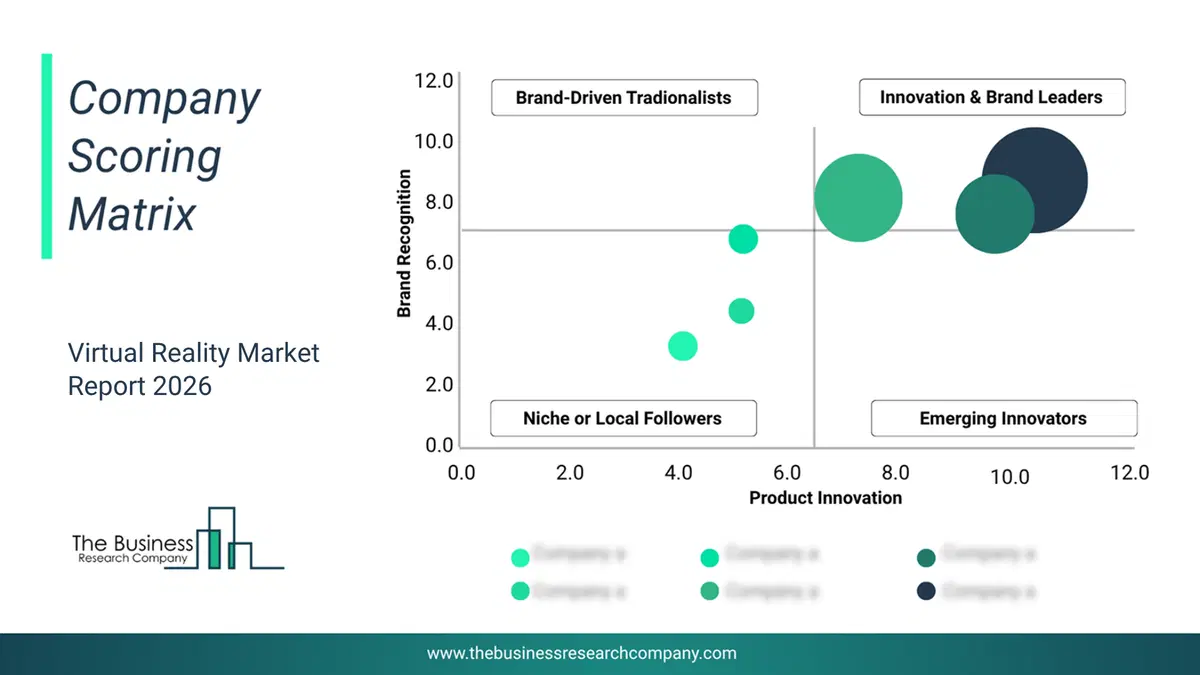
This chart maps companies by product innovation and brand strength, with bubble size indicating relative revenue, helping identify market leaders, challengers, and niche players. This is an illustrative chart; the full report provides a complete and accurate competitive analysis.
Global Virtual Reality Market Trends and Insights
Major companies operating in the virtual reality (VR) market are focusing on developing technologically advanced products, such as extended reality (XR) headset, to broaden VR experiences, enhance natural interaction, and integrate contextual artificial intelligence within virtual environments. An extended reality (XR) headset refers to a wearable device that places immersive digital content over or around the user’s real-world view, enabling virtual, augmented, or mixed reality experiences within a single hardware platform. For instance, in October 2025, Samsung Electronics Co. Ltd., a South Korea‑based consumer electronics company, launched the Galaxy XR, its Android XR‑powered extended reality headset, featuring dual 4K micro‑OLED displays with up to 27 million total pixels, a Qualcomm Snapdragon XR2+ Gen 2 processor, and multimodal interaction support including voice, hand and eye tracking powered by integrated AI. These capabilities deliver high visual fidelity, intuitive interaction, and broad app compatibility, allowing users to access Android apps such as Google Maps and YouTube in immersive environments, representing a strategic push to elevate immersive engagement and expand the practical utility of VR and extended reality platforms.What Are Latest Mergers And Acquisitions In The Virtual Reality Market?
In September 2025, One Door Inc., a US‑based provider of visual merchandising software, acquired ReadySet Technologies Inc. (ReadySet VR) for an undisclosed amount. With this acquisition, One Door aims to accelerate its innovation in immersive virtual reality technologies by integrating ReadySet VR’s advanced 3D visualization and virtual reality design capabilities, enabling retailers and brands to test and implement merchandising concepts in virtual environments more efficiently and cost‑effectively, thus enhancing strategic decision‑making across retail execution. ReadySet Technologies Inc. (ReadySet VR) is a US‑based provider of immersive virtual reality solutions.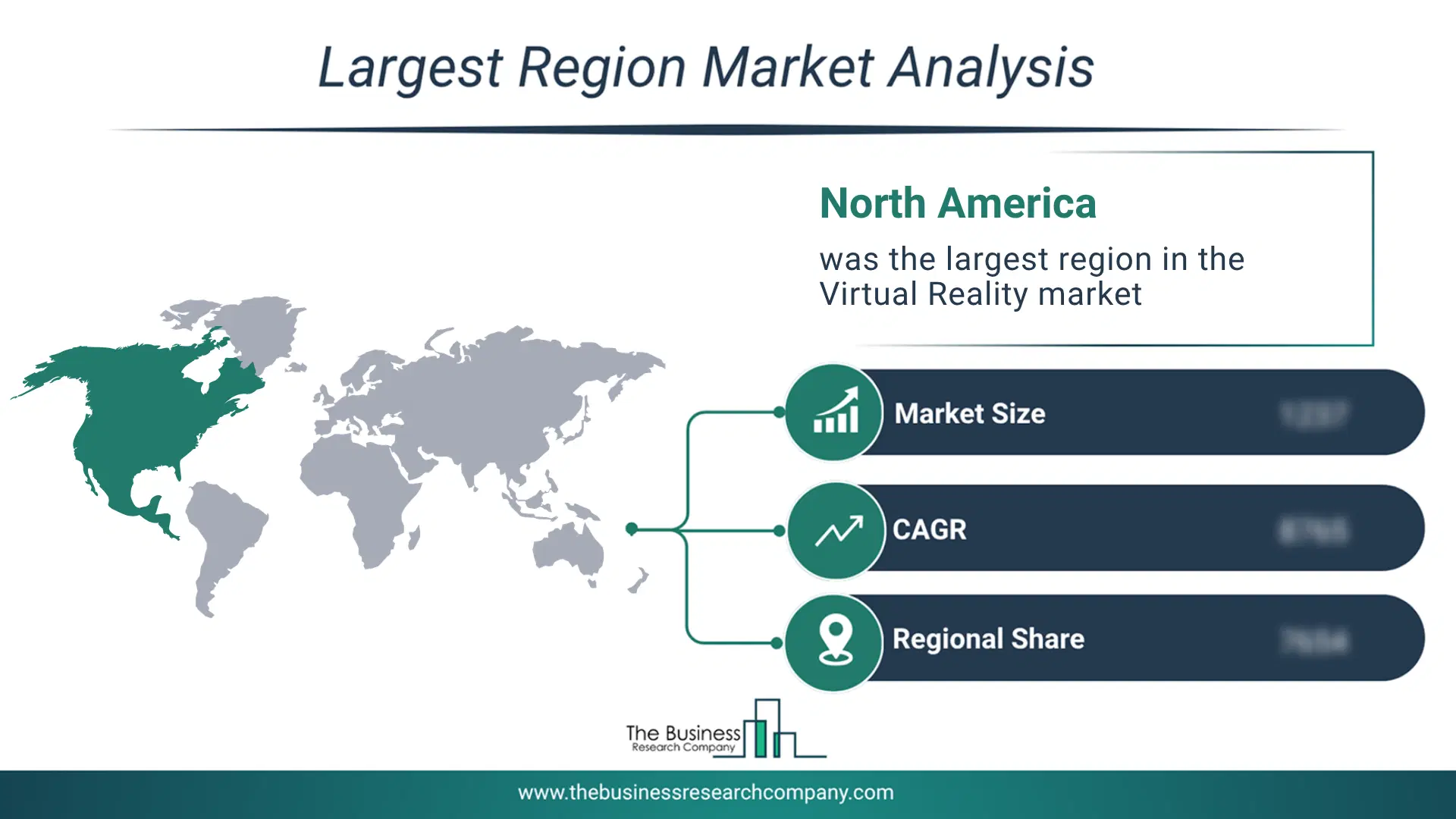
Regional Insights
North America was the largest region in the virtual reality market in 2025. Asia-Pacific is expected to be the fastest-growing region in the forecast period. The regions covered in this market report are Asia-Pacific, South East Asia, Western Europe, Eastern Europe, North America, South America, Middle East, Africa. The countries covered in this market report are Australia, Brazil, China, France, Germany, India, Indonesia, Japan, Taiwan, Russia, South Korea, UK, USA, Canada, Italy, Spain.What Defines the Virtual Reality Market?
The virtual reality market consists of revenues earned by entities by providing services such as virtual reality simulation services, virtual reality immersive training services, virtual reality content development services, virtual reality collaboration services, and virtual reality entertainment services. The market value includes the value of related goods sold by the service provider or included within the service offering. The virtual reality market also includes sales of virtual reality head-mounted displays, virtual reality motion controllers, virtual reality haptic feedback devices, virtual reality 360-degree cameras, and virtual reality immersive display systems. Values in this market are ‘factory gate’ values, that is, the value of goods sold by the manufacturers or creators of the goods, whether to other entities (including downstream manufacturers, wholesalers, distributors, and retailers) or directly to end customers. The value of goods in this market includes related services sold by the creators of the goods.How is Market Value Defined and Measured?
The market value is defined as the revenues that enterprises gain from the sale of goods and/or services within the specified market and geography through sales, grants, or donations in terms of the currency (in USD unless otherwise specified). The revenues for a specified geography are consumption values that are revenues generated by organizations in the specified geography within the market, irrespective of where they are produced. It does not include revenues from resales along the supply chain, either further along the supply chain or as part of other products.
This chart presents market attractiveness based on a quantitative evaluation of growth, competition, strategic alignment, and risk, offering a clear view of opportunity areas for decision-making. This chart is for illustrative purposes; the full report contains the complete analysis.

This chart highlights the Total Addressable Market (TAM) by estimating the maximum revenue opportunity using an assumption-driven approach, supporting strategic planning and opportunity sizing across markets. The chart is illustrative; the full report provides a more comprehensive analysis.
What Key Data and Analysis Are Included in the Virtual Reality Market Report 2026?
The virtual reality market research report is one of a series of new reports from The Business Research Company that provides market statistics, including industry global market size, regional shares, competitors with the market share, detailed market segments, market trends and opportunities, and any further data you may need to thrive in the virtual reality industry. The market research report delivers a complete perspective of everything you need, with an in-depth analysis of the current and future state of the industry.Virtual Reality Market Report Forecast Analysis
| Report Attribute | Details |
|---|---|
| Market Size Value In 2026 | $43.05 billion |
| Revenue Forecast In 2030 | $116.22 billion |
| Growth Rate | CAGR of 28.2% from 2026 to 2030 |
| Base Year For Estimation | 2025 |
| Actual Estimates/Historical Data | 2020-2025 |
| Forecast Period | 2026 - 2030 |
| Market Representation | Revenue in USD Billion and CAGR from 2026 to 2030 |
| Segments Covered | Component, Deployment, Device, Technology, Application |
| Regional Scope | Asia-Pacific, Western Europe, Eastern Europe, North America, South America, Middle East, Africa |
| Country Scope | The Countries Covered In This Market Report Are Australia, Brazil, China, France, Germany, India, Indonesia, Japan, Taiwan, Russia, South Korea, Uk, Usa, Canada, Italy, Spain. |
| Key Companies Profiled | Meta Platforms Inc., Valve Corporation, Unity Software Inc., Epic Games Inc., Crytek GmbH, HTC Corporation, Pimax Technology Co. Ltd., Varjo Technologies Oy, nDreams Limited, EON Reality Inc., Shanghai Lexiang Technology Co. Ltd., Resolution Games AB, Survios Inc., Ultraleap Ltd., VRgineers Inc., Fast Travel Games AB, HaptX Inc., Virtuix Holdings Inc., Bigscreen Inc., Lynx Mixed Reality SAS, Manus VR B.V., InstaVR Inc., WorldViz LLC |
| Customization Scope | Request for Customization |
| Pricing And Purchase Options | Explore Purchase Options |