
Virtual Reality Vision Therapy Market Report 2026
Global Outlook – By Product Type (Hardware, Software, Services), By Therapy Type (Amblyopia, Strabismus, Convergence Insufficiency, Binocular Vision Dysfunction, Other Therapy Types), By Distribution Channel (Direct Sales, Online Retail, Other Distribution Channels), By End-User (Hospitals And Clinics, Vision Therapy Centers, Homecare Settings, Other End-Users) - Market Size, Trends, Strategies, and Forecast to 2030
Virtual Reality Vision Therapy Market Overview
• Virtual Reality Vision Therapy market size has reached to $1.49 billion in 2025 • Expected to grow to $3.87 billion in 2030 at a compound annual growth rate (CAGR) of 20.9% • Growth Driver: The Rising Prevalence Of Vision Disorders Is Fueling The Growth Of The Market Due To Increasing Digital Eye Strain And Unmet Visual Health Needs • Market Trend: Advancements In Virtual Reality-Based Amblyopia Therapy To Enhance Treatment Outcomes • North America was the largest region in 2025 and Asia-pacific is the fastest growing region.What Is Covered Under Virtual Reality Vision Therapy Market?
Virtual reality vision therapy (VRVT) is a technology-driven approach that uses immersive virtual reality environments to improve visual function and eye coordination. It actively engages the visual system through controlled exercises, stimulating neural pathways to enhance visual processing. VRVT provides the advantage of delivering precise, repeatable, and adaptable visual training in a safe and interactive digital setting. The main product types of virtual reality vision therapy are hardware, software, and services. Hardware refers to physical devices that enable immersive therapeutic experiences. It is utilized in various therapy types, such as amblyopia, strabismus, convergence insufficiency, binocular vision dysfunction, and others, and is distributed through several distribution channels, including direct sales, online retail, and others, and is used by multiple end-users, such as hospitals and clinics, vision therapy centers, homecare settings, and others.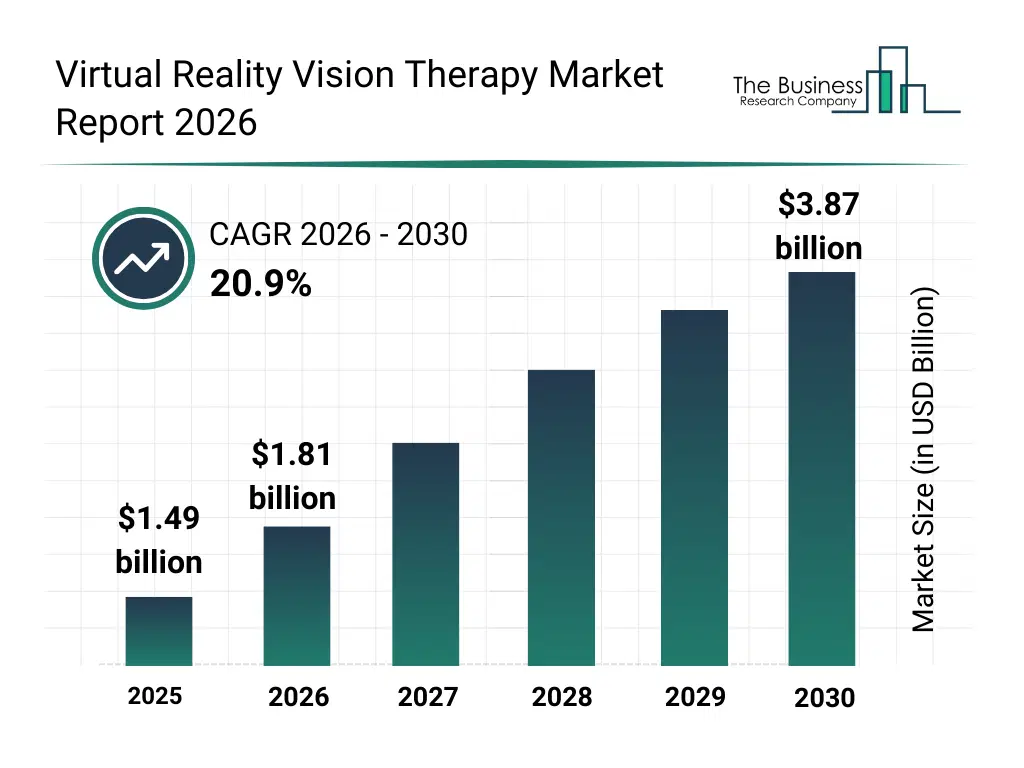
What Is The Virtual Reality Vision Therapy Market Size and Share 2026?
The virtual reality vision therapy market size has grown exponentially in recent years. It will grow from $1.49 billion in 2025 to $1.81 billion in 2026 at a compound annual growth rate (CAGR) of 21.2%. The growth in the historic period can be attributed to increasing prevalence of visual disorders, rising adoption of digital therapeutic tools, growing acceptance of non-invasive vision treatments, expansion of pediatric vision therapy practices, availability of consumer-grade VR hardware.What Is The Virtual Reality Vision Therapy Market Growth Forecast?
The virtual reality vision therapy market size is expected to see exponential growth in the next few years. It will grow to $3.87 billion in 2030 at a compound annual growth rate (CAGR) of 20.9%. The growth in the forecast period can be attributed to increasing demand for home-based vision therapy, rising integration of AI-driven visual assessments, expansion of tele-vision therapy services, growing investments in digital healthcare platforms, increasing adoption of immersive healthcare solutions. Major trends in the forecast period include increasing adoption of immersive vision training platforms, rising use of gamified therapy modules, growing integration of eye-tracking technologies, expansion of remote and home-based vision therapy, enhanced personalization of therapy programs.
Global Virtual Reality Vision Therapy Market Segmentation
1) By Product Type: Hardware, Software, Services 2) By Therapy Type: Amblyopia, Strabismus, Convergence Insufficiency, Binocular Vision Dysfunction, Other Therapy Types 3) By Distribution Channel: Direct Sales, Online Retail, Other Distribution Channels 4) By End-User: Hospitals And Clinics, Vision Therapy Centers, Homecare Settings, Other End-Users Subsegments: 1) By Hardware: Head-Mounted Displays (HMDs), Virtual Reality (VR) Glasses, Eye-Tracking Devices, Motion Sensors, Haptic Feedback Devices, Handheld Controllers 2) By Software: Vision Therapy Applications, Virtual Reality (VR) Simulation Software, Eye Exercise Software, Gamified Vision Therapy Programs, Augmented Reality (AR) Integration Software 3) By Services: Tele-Vision Therapy Services, Clinical Consultation Services, Rehabilitation Program Management, Training And Support Services, Software As A Service (SaaS) For Vision TherapyWhat Is The Driver Of The Virtual Reality Vision Therapy Market?
The rising prevalence of vision disorders is expected to propel the growth of the virtual reality vision therapy market going forward. Vision disorders are impairments that hinder clear sight, impacting sharpness, focus, or the range of vision. The rise in vision disorders is largely driven by extended screen use, which strains the eyes and contributes to digital eye fatigue, impairing overall visual health. Virtual reality vision therapy aids vision disorders by providing immersive exercises that improve eye coordination, focus, and depth perception while stimulating neural pathways to enhance visual processing and overall eye function. For instance, in August 2023, according to the World Health Organization, a Switzerland-based government organization, globally, over 2.2 billion people experience vision impairment, either for near or distance vision. In nearly 1 billion of these cases, which is almost half, the impairment could have been prevented or remains unaddressed. Therefore, the rising prevalence of vision disorders is driving the growth of the virtual reality vision therapy industry.Key Players In The Global Virtual Reality Vision Therapy Market
Major companies operating in the virtual reality vision therapy market are Meta Platforms Inc., Tobii AB, Varjo Technologies Inc., XRHealth Ltd., VR Vision Group, Floreo Inc., AmblyoPlay, Vivid Vision Inc., Luminopia Inc., NovaSight Inc., Virtualis VR Corp., Wow Vision Therapy, Cognihab Inc., Fusion VR, Computer Orthoptics Inc., SyncThink Inc., NeuraSim Private Limited, Neuro Rehab VR, MindMotion SA, AppliedVR Inc.
This chart is for illustrative purposes; the full report includes a detailed competitor analysis and comprehensive overview of the top 10 companies in the market.
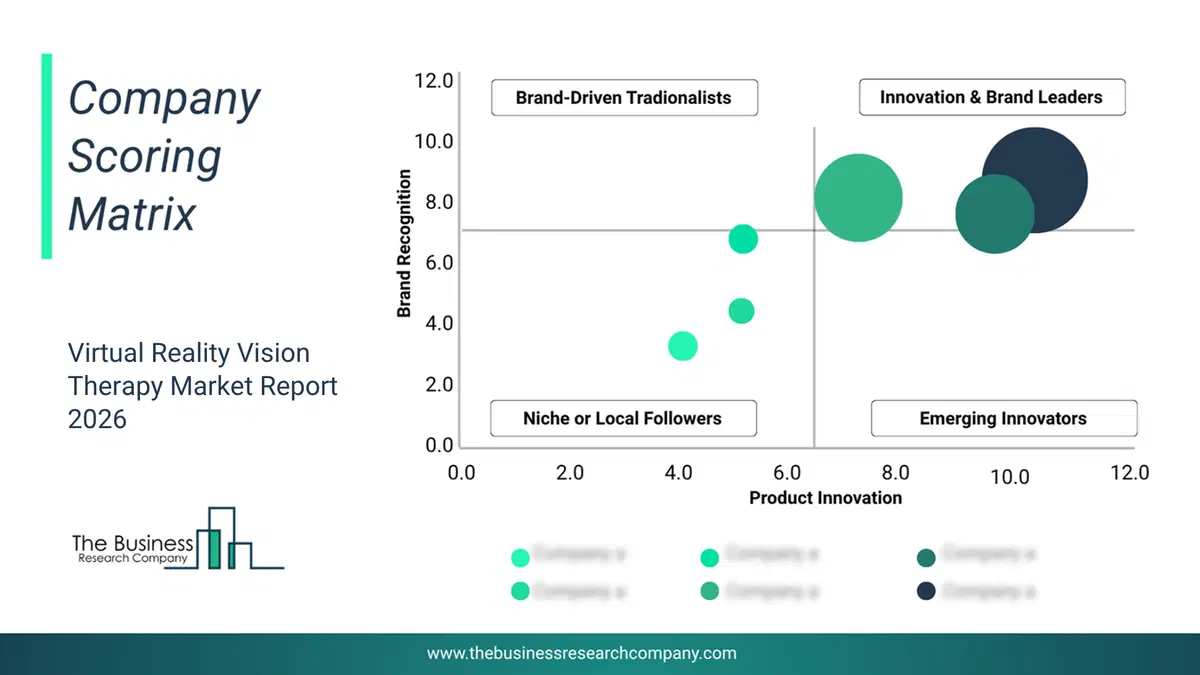
This chart maps companies by product innovation and brand strength, with bubble size indicating relative revenue, helping identify market leaders, challengers, and niche players. This is an illustrative chart; the full report provides a complete and accurate competitive analysis.
Global Virtual Reality Vision Therapy Market Trends and Insights
Major companies operating in the virtual reality vision therapy market are focusing on developing advanced solutions such as virtual reality-based amblyopia therapy to enhance treatment adherence and improve visual outcomes. Virtual reality-based amblyopia therapy engages the weaker eye through immersive visual exercises to enhance focus, coordination, and depth perception while stimulating neural pathways to improve visual processing and overall vision. For instance, in April 2025, Luminopia, Inc., a US-based digital therapeutics company, received approval from the Food and Drug Administration (FDA) for amblyopia treatment for children aged 8 to 12 years, expanding its previous clearance for ages 4 to 7. This clearance is based on robust real-world evidence from Luminopia's PUPiL Registry and clinical trials. Luminopia's digital therapy uses a VR headset, allowing patients to watch familiar TV shows while therapeutic algorithms engage both eyes to improve vision in children with amblyopia linked to anisometropia and mild strabismus.What Are Latest Mergers And Acquisitions In The Virtual Reality Vision Therapy Market?
In March 2025, Pentec Health, Inc., a US-based healthcare company specializing in clinical nutrition and specialty infusion therapies, partnered with Luminopia, Inc. to expand access to innovative digital vision care for children and families. The collaboration aims to broaden market access for Luminopia’s FDA-approved digital therapeutics by leveraging Pentec Health’s distribution, patient support, and provider services, ensuring therapy adherence and seamless insurance navigation. Luminopia, Inc. is a US-based provider of virtual reality therapy for amblyopia.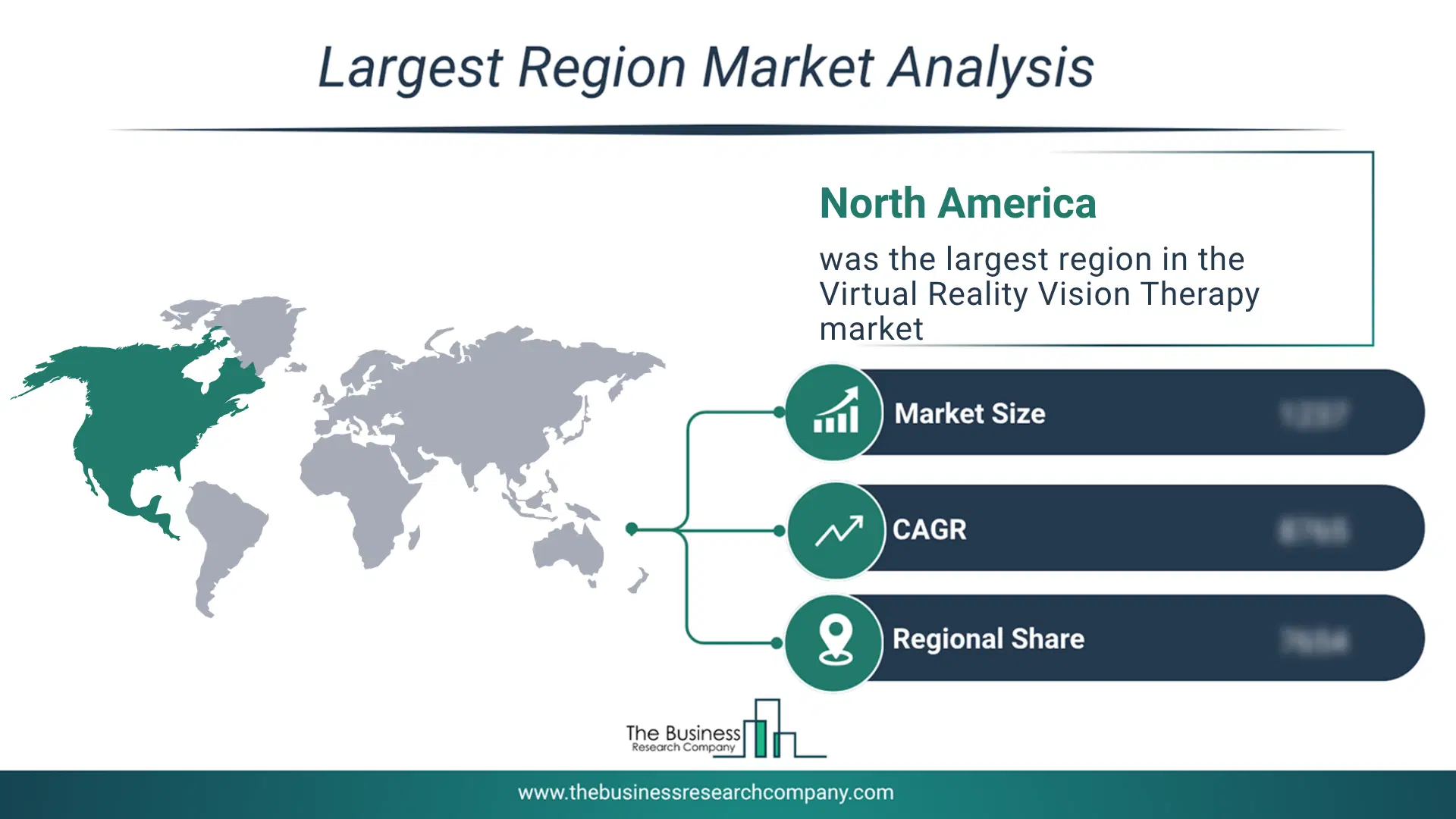
Regional Outlook
North America was the largest region in the virtual reality vision therapy market in 2025. Asia-Pacific is expected to be the fastest-growing region in the forecast period. The regions covered in this market report are Asia-Pacific, South East Asia, Western Europe, Eastern Europe, North America, South America, Middle East, Africa. The countries covered in this market report are Australia, Brazil, China, France, Germany, India, Indonesia, Japan, Taiwan, Russia, South Korea, UK, USA, Canada, Italy, Spain.What Defines the Virtual Reality Vision Therapy Market?
The virtual reality vision therapy market consists of revenues earned by entities by providing services such as vision assessment, personalized therapy programs, tele-rehabilitation support, patient monitoring, and clinical consultation services. The market value includes the value of related goods sold by the service provider or included within the service offering. The virtual reality vision therapy market value also includes sales of VR hardware devices, software applications, wearable devices, and therapy kits. Values in this market are ‘factory gate’ values, that is, the value of goods sold by the manufacturers or creators of the goods, whether to other entities (including downstream manufacturers, wholesalers, distributors, and retailers) or directly to end customers. The value of goods in this market includes related services sold by the creators of the goods.How is Market Value Defined and Measured?
The market value is defined as the revenues that enterprises gain from the sale of goods and/or services within the specified market and geography through sales, grants, or donations in terms of the currency (in USD unless otherwise specified). The revenues for a specified geography are consumption values that are revenues generated by organizations in the specified geography within the market, irrespective of where they are produced. It does not include revenues from resales along the supply chain, either further along the supply chain or as part of other products.
This chart presents market attractiveness based on a quantitative evaluation of growth, competition, strategic alignment, and risk, offering a clear view of opportunity areas for decision-making. This chart is for illustrative purposes; the full report contains the complete analysis.

This chart highlights the Total Addressable Market (TAM) by estimating the maximum revenue opportunity using an assumption-driven approach, supporting strategic planning and opportunity sizing across markets. The chart is illustrative; the full report provides a more comprehensive analysis.
What Key Data and Analysis Are Included in the Virtual Reality Vision Therapy Market Report 2026?
The virtual reality vision therapy market research report is one of a series of new reports from The Business Research Company that provides market statistics, including industry global market size, regional shares, competitors with the market share, detailed market segments, market trends and opportunities, and any further data you may need to thrive in the virtual reality vision therapy industry. The market research report delivers a complete perspective of everything you need, with an in-depth analysis of the current and future state of the industry.Virtual Reality Vision Therapy Market Report Forecast Analysis
| Report Attribute | Details |
|---|---|
| Market Size Value In 2026 | $1.81 billion |
| Revenue Forecast In 2030 | $3.87 billion |
| Growth Rate | CAGR of 20.9% from 2026 to 2030 |
| Base Year For Estimation | 2025 |
| Actual Estimates/Historical Data | 2020-2025 |
| Forecast Period | 2026 - 2030 |
| Market Representation | Revenue in USD Billion and CAGR from 2026 to 2030 |
| Segments Covered | Product Type, Therapy Type, Distribution Channel, End-User |
| Regional Scope | Asia-Pacific, Western Europe, Eastern Europe, North America, South America, Middle East, Africa |
| Country Scope | The countries covered in the report are Australia, Brazil, China, France, Germany, India, Indonesia, Japan, Taiwan, Russia, South Korea, UK, USA, Canada, Italy, Spain |
| Key Companies Profiled | Meta Platforms Inc., Tobii AB, Varjo Technologies Inc., XRHealth Ltd., VR Vision Group, Floreo Inc., AmblyoPlay, Vivid Vision Inc., Luminopia Inc., NovaSight Inc., Virtualis VR Corp., Wow Vision Therapy, Cognihab Inc., Fusion VR, Computer Orthoptics Inc., SyncThink Inc., NeuraSim Private Limited, Neuro Rehab VR, MindMotion SA, AppliedVR Inc. |
| Customization Scope | Request for Customization |
| Pricing And Purchase Options | Explore Purchase Options |