
Virtual Reality (VR) In Medical Simulation Market Report 2026
Global Outlook – By Age Group (Adult, Children, Infant), By Application (Medical Education, Virtual Reality In Diagnostics, Pain Management, Mental Illness Treatment, Physical Fitness And Therapy, Virtual Reality In Surgery, Human Simulation Techniques, Virtual Reality In Dentistry, Virtual Reality In Nursing, Other Applications), By End-User (Hospitals, Physician Clinics, Ambulatory Surgical Centers, Medical Institutes, Research Laboratory, Pharmaceutical Industry, Other End-Users) - Market Size, Trends, Strategies, and Forecast to 2030
Virtual Reality (VR) In Medical Simulation Market Overview
• Virtual Reality (VR) In Medical Simulation market size has reached to $6.28 billion in 2025 • Expected to grow to $24.18 billion in 2030 at a compound annual growth rate (CAGR) of 30.2% • Growth Driver: Increasing Number Of Surgeries Driving Growth Of The Market Due To Rising Surgical Demand And Advancements In Medical Procedures • Market Trend: Advanced VR-Based Orthopedic Training Enhances Surgical Skill Development In Medical Education • North America was the largest region in 2025 and Asia-Pacific is the fastest growing region.What Is Covered Under Virtual Reality (VR) In Medical Simulation Market?
Virtual reality (VR) in medical simulation refers to the use of computer-generated environments and immersive experiences to replicate real-life medical scenarios for training, education, and assessment purposes. VR technology allows healthcare professionals and students to interact with virtual patients, perform medical procedures, and experience clinical situations in a controlled, risk-free setting. The main age group for virtual reality (VR) in medical simulation are adult, children, and infant. The adult age group typically refers to individuals who have reached the age of 18 years or older. For applications such as medical education, virtual reality in diagnostics, pain management, mental illness treatment, physical fitness, and therapy, virtual reality in surgery, human simulation techniques, virtual reality in dentistry, virtual reality in nursing, and others utilized by end users such as hospitals, physician clinics, ambulatory surgical centers, medical institutes, research laboratory, pharmaceutical industry, and others.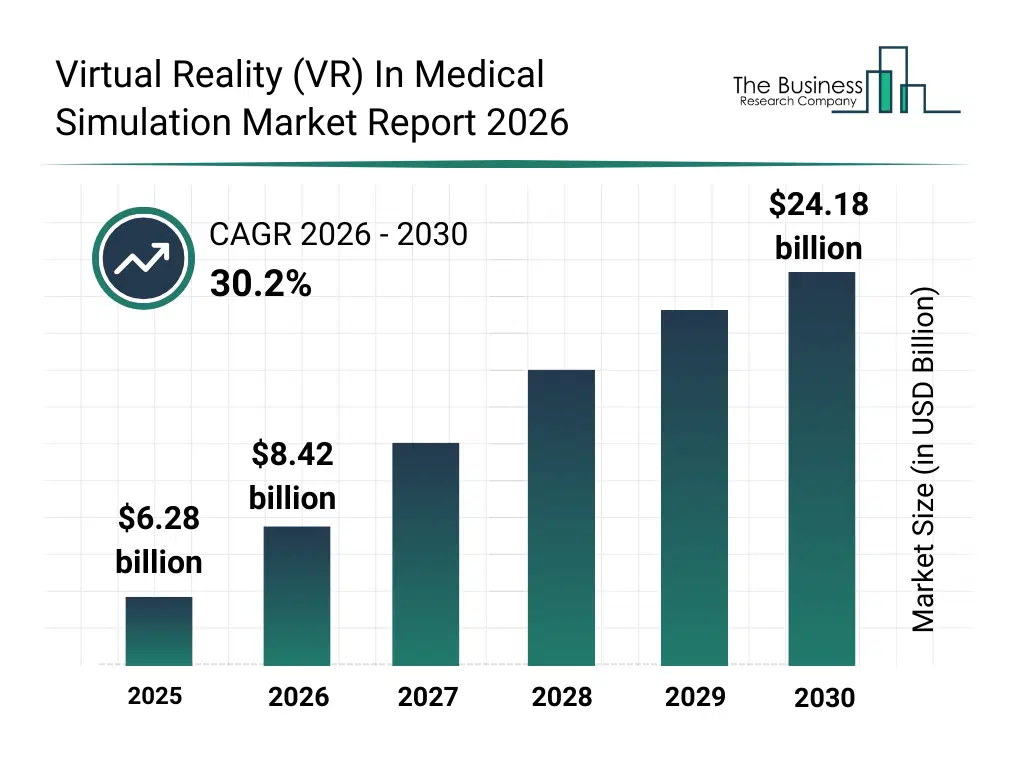
What Is The Virtual Reality (VR) In Medical Simulation Market Size and Share 2026?
The virtual reality (vr) in medical simulation market size has grown exponentially in recent years. It will grow from $6.28 billion in 2025 to $8.42 billion in 2026 at a compound annual growth rate (CAGR) of 34.2%. The growth in the historic period can be attributed to expansion of medical education infrastructure, increasing demand for standardized clinical training, growing adoption of simulation-based learning, rising investments in medical training technologies, improved accessibility of vr hardware.What Is The Virtual Reality (VR) In Medical Simulation Market Growth Forecast?
The virtual reality (vr) in medical simulation market size is expected to see exponential growth in the next few years. It will grow to $24.18 billion in 2030 at a compound annual growth rate (CAGR) of 30.2%. The growth in the forecast period can be attributed to increasing investments in immersive medical education, rising demand for remote and scalable training solutions, expansion of vr usage in clinical assessment, growing integration of ai-driven feedback systems, increasing adoption across healthcare institutions. Major trends in the forecast period include increasing adoption of vr-based medical training simulations, rising use of virtual surgical practice platforms, growing integration of AI-assisted clinical scenarios, expansion of remote medical education programs, enhanced focus on risk-free skill development.
Global Virtual Reality (VR) In Medical Simulation Market Segmentation
1) By Age Group: Adult, Children, Infant 2) By Application: Medical Education, Virtual Reality In Diagnostics, Pain Management, Mental Illness Treatment, Physical Fitness And Therapy, Virtual Reality In Surgery, Human Simulation Techniques, Virtual Reality In Dentistry, Virtual Reality In Nursing, Other Applications 3) By End-User: Hospitals, Physician Clinics, Ambulatory Surgical Centers, Medical Institutes, Research Laboratory, Pharmaceutical Industry, Other End-Users Subsegments: 1) By Adult: Vr Medical Simulations For Surgical Training, Vr Simulations For Clinical Diagnosis And Procedures, Vr For Pain Management And Physical Rehabilitation, Vr For Emergency And Trauma Care Training, Vr For Mental Health Therapy (Anxiety, Ptsd) 2) By Children: Pediatric Vr Simulations For Medical Procedures, Vr For Pediatric Pain Management And Relaxation, Vr For Children’s Health Education (Explaining Procedures), Vr For Pediatric Physical Therapy And Rehabilitation, Vr For Cognitive And Emotional Development 3) By Infant: Neonatal Vr Simulations For Caregivers And Healthcare Providers, Vr For Infant Care Training (Resuscitation Techniques), Vr For Monitoring Infant Vital Signs And Development, Vr For Early Developmental Therapy (Sensory Stimulation)What Is The Driver Of The Virtual Reality (VR) In Medical Simulation Market?
The increasing number of surgeries is expected to propel the growth of virtual reality (VR) in the medical simulation market going forward. Surgeries are medical procedures performed by surgeons to diagnose, treat, or prevent diseases or injuries, often involving incisions to access tissues or internal organs. The rise in surgical volumes is driven by advances in medical technologies, improved surgical techniques, and broader eligibility for surgical intervention across specialties. VR in medical simulation supports this shift by offering immersive, highly realistic training environments that accurately replicate complex anatomy and surgical scenarios, enabling surgeons to develop skills safely before entering the operating room. For instance, in June 2024, according to the International Society of Aesthetic Plastic Surgery (ISAPS), a US-based professional association, its Global Survey 2023 reported that total aesthetic procedures reached 34.9 million, including more than 15.8 million surgical procedures performed by plastic surgeons in 2023, a 5.5% year-over-year increase and a 40% rise over four years. Therefore, the increasing number of surgeries is driving the growth of virtual reality (VR) in the medical simulation market.Key Players In The Global Virtual Reality (VR) In Medical Simulation Market
Major companies operating in the virtual reality (vr) in medical simulation market are CAE Healthcare Inc, Brainlab AG, Surgical Science Sweden AB, Osso VR Inc, Mentice AB, Augmedics, Virtalis Holdings Ltd, VirtaMed AG, Oxford Medical Simulation Ltd, Health Scholars Inc, AppliedVR Inc, Medisim Ltd, Fundamental Surgery, ImmersiveTouch Inc, SimforHealth, SimX, PrecisionOS Technologies Inc, Body Interact, XRHealth, Oxford Medical Simulation Ltd, Psious, Surgical Theater, MedVR Education, Medical Realities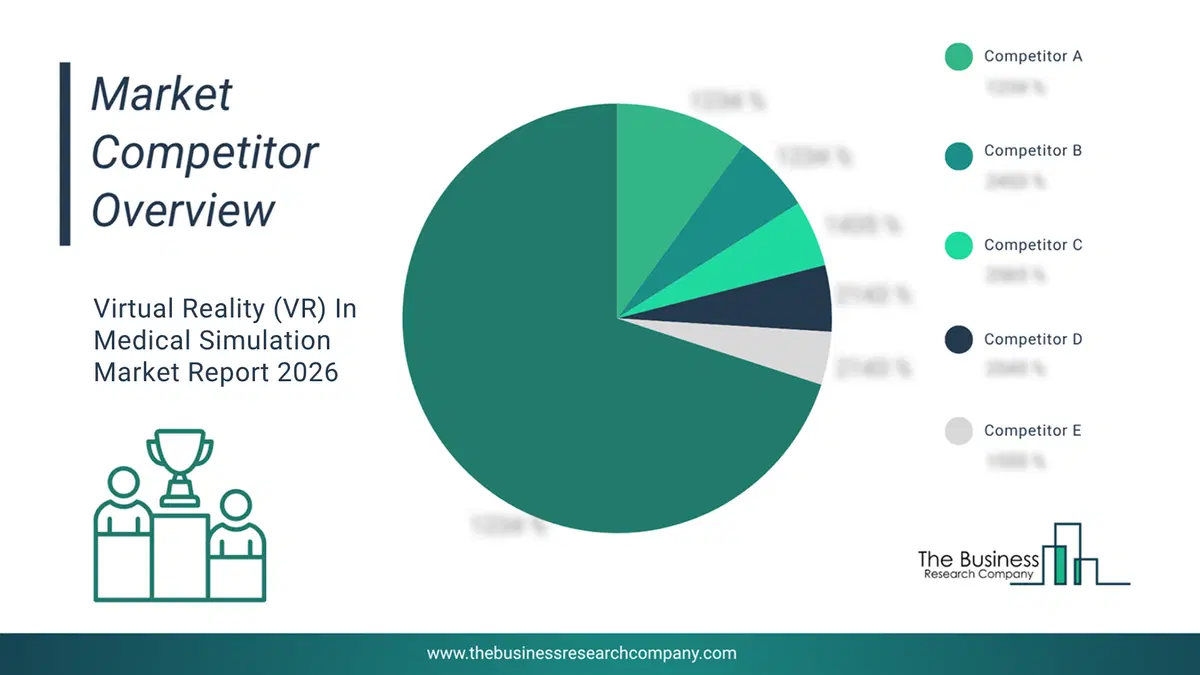
This chart is for illustrative purposes; the full report includes a detailed competitor analysis and comprehensive overview of the top 10 companies in the market.
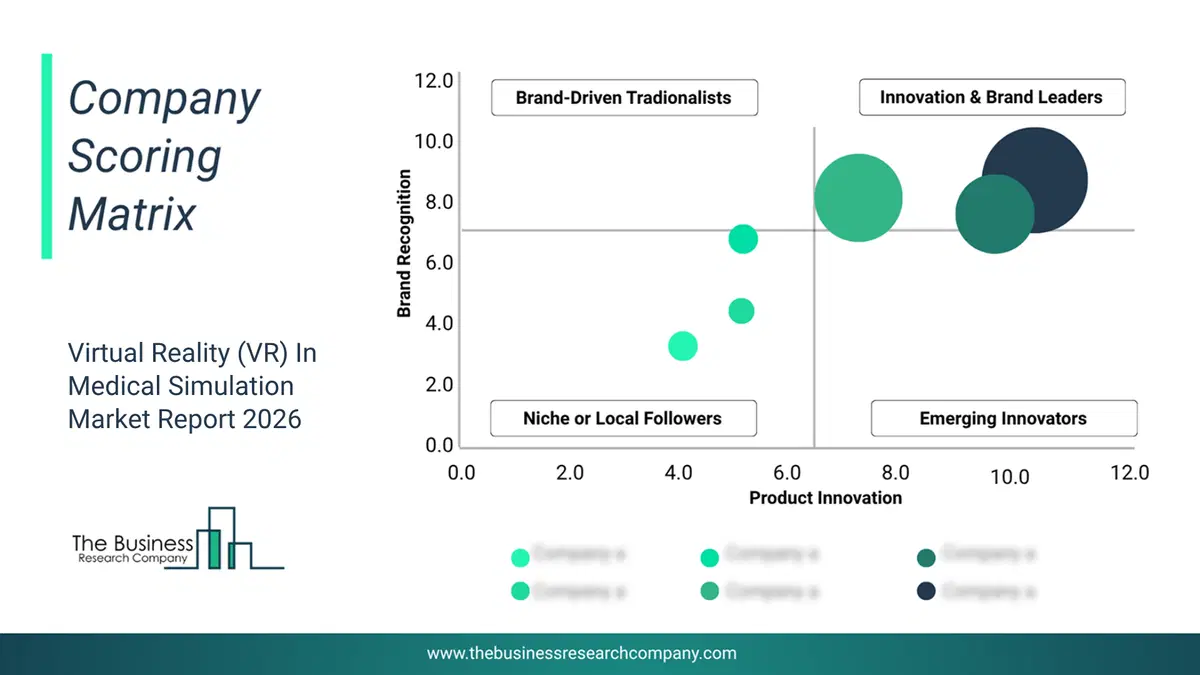
This chart maps companies by product innovation and brand strength, with bubble size indicating relative revenue, helping identify market leaders, challengers, and niche players. This is an illustrative chart; the full report provides a complete and accurate competitive analysis.
Global Virtual Reality (VR) In Medical Simulation Market Trends and Insights
Major companies operating in the virtual reality (VR) in the medical simulation market are focusing on developing advanced solutions, such as immersive arthroscopic training modules, to improve surgical competency, reduce training risks, and deliver anatomically accurate, repeatable practice environments for learners. Arthroscopic VR training modules are virtual reality–based instructional tools that replicate minimally invasive orthopedic procedures, allowing trainees to practice instrument handling, triangulation, arm positioning, and repair techniques in a controlled, lifelike setting far beyond the limitations of traditional cadaver labs or textbook learning. For instance, in May 2023, PrecisionOS, a Canada-based medical simulation technology company, launched its VR Shoulder Simulation Module, an innovative arthroscopic double-row rotator cuff repair training solution sponsored by CONMED. Designed to strengthen trainee proficiency, the module provides high-fidelity anatomical visualization, real-time feedback, procedural step guidance, rotator cuff tear pattern assessment, and the ability to practice independently or with remote mentorship, helping residents and fellows build the skill set required for safe and effective surgical performance.What Are Latest Mergers And Acquisitions In The Virtual Reality (VR) In Medical Simulation Market?
In February 2024, National Board of Medical Examiners (NBME), a US-based non-profit organization, acquired MedVR Education for undisclosed amount. This acquisition of National Board of Medical Examiners (NBME)’s aim is to enhance medical education and assessment through the integration of advanced technologies. MedVR Education is a US-based EdTech company that provides virtual reality (VR) simulations for healthcare education.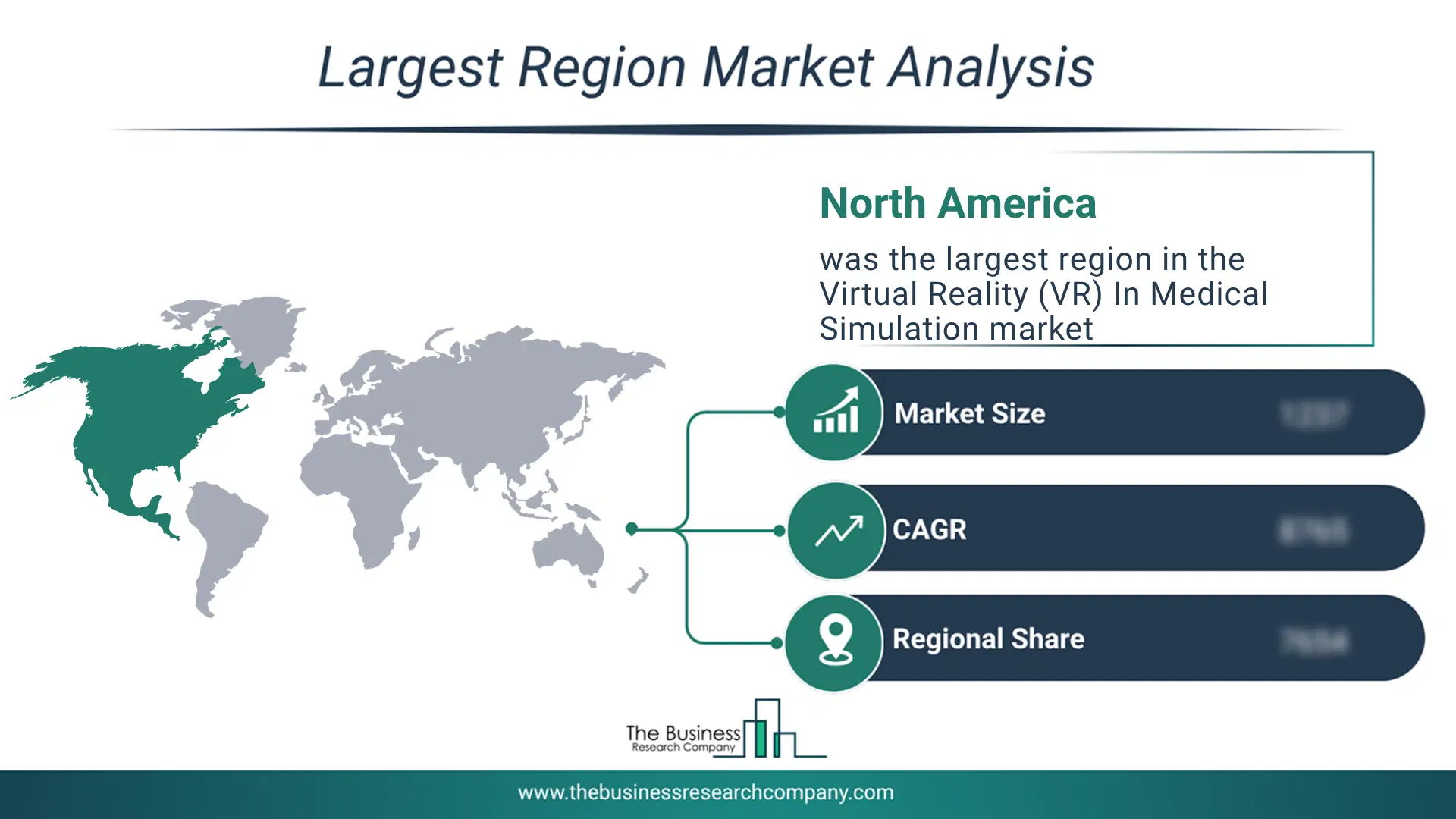
Regional Outlook
North America was the largest region in the virtual reality (VR) in medical simulation market in 2025. Asia-Pacific is expected to be the fastest-growing region in the forecast period. The regions covered in this market report are Asia-Pacific, South East Asia, Western Europe, Eastern Europe, North America, South America, Middle East, Africa. The countries covered in this market report are Australia, Brazil, China, France, Germany, India, Indonesia, Japan, Taiwan, Russia, South Korea, UK, USA, Canada, Italy, Spain.What Defines the Virtual Reality (VR) In Medical Simulation Market?
The virtual reality (VR) in medical simulation market consists of revenues earned by entities by providing services such as virtual reality rehabilitation and therapy, virtual reality anatomy and physiology training, and virtual reality diagnostic training. The market value includes the value of related goods sold by the service provider or included within the service offering. The virtual reality (VR) in medical simulation market also includes sales of virtual reality surgical simulators, and virtual reality emergency and trauma simulators. Values in this market are ‘factory gate’ values, that is the value of goods sold by the manufacturers or creators of the goods, whether to other entities (including downstream manufacturers, wholesalers, distributors and retailers) or directly to end customers. The value of goods in this market includes related services sold by the creators of the goods.How is Market Value Defined and Measured?
The market value is defined as the revenues that enterprises gain from the sale of goods and/or services within the specified market and geography through sales, grants, or donations in terms of the currency (in USD unless otherwise specified). The revenues for a specified geography are consumption values that are revenues generated by organizations in the specified geography within the market, irrespective of where they are produced. It does not include revenues from resales along the supply chain, either further along the supply chain or as part of other products.
This chart presents market attractiveness based on a quantitative evaluation of growth, competition, strategic alignment, and risk, offering a clear view of opportunity areas for decision-making. This chart is for illustrative purposes; the full report contains the complete analysis.

This chart highlights the Total Addressable Market (TAM) by estimating the maximum revenue opportunity using an assumption-driven approach, supporting strategic planning and opportunity sizing across markets. The chart is illustrative; the full report provides a more comprehensive analysis.
What Key Data and Analysis Are Included in the Virtual Reality (VR) In Medical Simulation Market Report 2026?
The virtual reality (vr) in medical simulation market research report is one of a series of new reports from The Business Research Company that provides market statistics, including industry global market size, regional shares, competitors with the market share, detailed market segments, market trends and opportunities, and any further data you may need to thrive in the virtual reality (vr) in medical simulation industry. The market research report delivers a complete perspective of everything you need, with an in-depth analysis of the current and future state of the industry.Virtual Reality (VR) In Medical Simulation Market Report Forecast Analysis
| Report Attribute | Details |
|---|---|
| Market Size Value In 2026 | $8.42 billion |
| Revenue Forecast In 2030 | $24.18 billion |
| Growth Rate | CAGR of 30.2% from 2026 to 2030 |
| Base Year For Estimation | 2025 |
| Actual Estimates/Historical Data | 2020-2025 |
| Forecast Period | 2026 - 2030 |
| Market Representation | Revenue in USD Billion and CAGR from 2026 to 2030 |
| Segments Covered | Age Group, Application, End-User |
| Regional Scope | Asia-Pacific, Western Europe, Eastern Europe, North America, South America, Middle East, Africa |
| Country Scope | The countries covered in the report are Australia, Brazil, China, France, Germany, India, Indonesia, Japan, Taiwan, Russia, South Korea, UK, USA, Canada, Italy, Spain |
| Key Companies Profiled | CAE Healthcare Inc, Brainlab AG, Surgical Science Sweden AB, Osso VR Inc, Mentice AB, Augmedics, Virtalis Holdings Ltd, VirtaMed AG, Oxford Medical Simulation Ltd, Health Scholars Inc, AppliedVR Inc, Medisim Ltd, Fundamental Surgery, ImmersiveTouch Inc, SimforHealth, SimX, PrecisionOS Technologies Inc, Body Interact, XRHealth, Oxford Medical Simulation Ltd, Psious, Surgical Theater, MedVR Education, Medical Realities |
| Customization Scope | Request for Customization |
| Pricing And Purchase Options | Explore Purchase Options |