
Visual Merchandising Artificial Intelligence (AI) Market Report 2026
Global Outlook – By Component (Software, Hardware, Services), By Deployment Mode (On-Premises, Cloud), By Enterprise Size (Small And Medium Enterprises, Large Enterprises), By Application (Retail Stores, Supermarkets And Hypermarkets, Shopping Malls, E-Commerce, Other Applications), By End-User (Apparel And Fashion, Electronics, Grocery, Home Décor, Other End-Users) – Market Size, Trends, Strategies, and Forecast to 2035
Visual Merchandising Artificial Intelligence (AI) Market Overview
• Visual Merchandising Artificial Intelligence (AI) market size has reached to $1.71 billion in 2025 • Expected to grow to $4.77 billion in 2030 at a compound annual growth rate (CAGR) of 22.7% • Growth Driver: Rise In Omnichannel Retail Strategies The Growth Of The Market Due To Seamless, Integrated Shopping Experiences Across Channels • Market Trend: AI-Powered Store-Specific Tool Optimizes Shelf Layouts And Boosts Sales • North America was the largest region in 2025 and Asia-Pacific is the fastest growing region.What Is Covered Under Visual Merchandising Artificial Intelligence (AI) Market?
Visual merchandising artificial intelligence (AI) refers to the use of AI technologies to optimize the presentation of products in retail spaces, both physical and online, by analyzing customer behavior, preferences, and trends. It enables retailers to create personalized, data-driven displays and layouts that enhance customer engagement, boost sales, and improve the overall shopping experience. The main components of visual merchandising artificial intelligence (AI) include software, hardware, and services. Software provides intelligent platforms that analyze consumer behavior, optimize product placement, and enhance in-store and online merchandising strategies. They are deployed through on-premises and cloud models and are implemented by enterprises of different sizes, including small and medium enterprises, and large enterprises. They find application in retail stores, supermarkets and hypermarkets, shopping malls, e-commerce, and other applications, serving end users including apparel and fashion, electronics, grocery, home décor, and other end-users.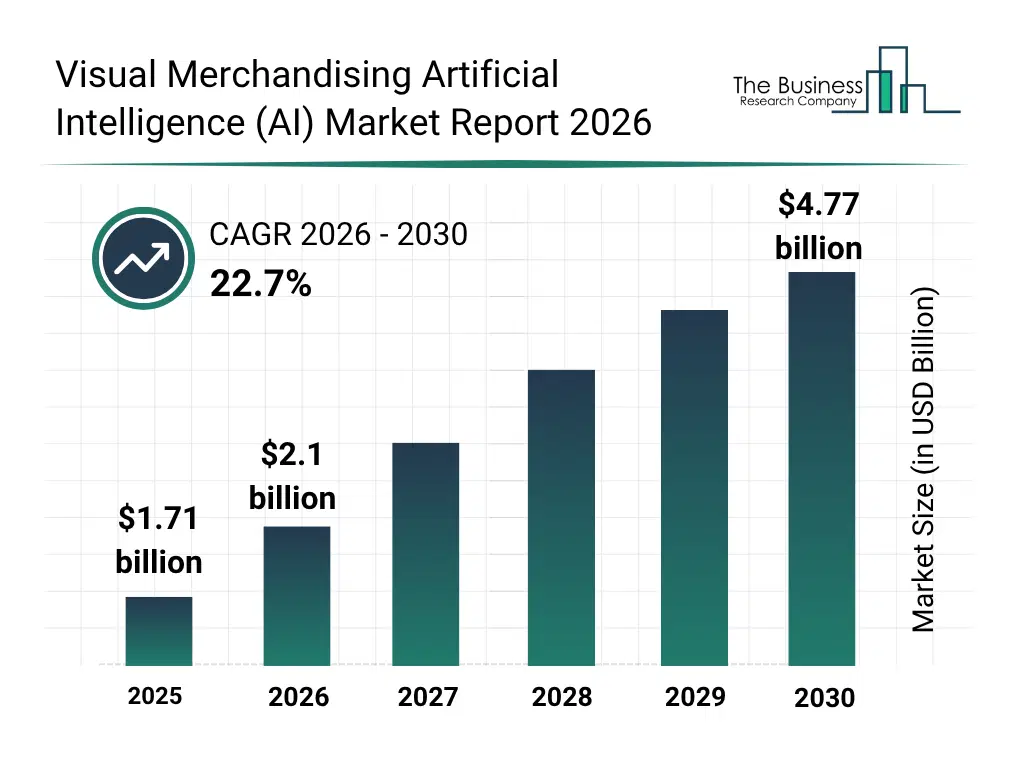
What Is The Visual Merchandising Artificial Intelligence (AI) Market Size and Share 2026?
The visual merchandising artificial intelligence (AI) market size has grown exponentially in recent years. It will grow from $1.71 billion in 2025 to $2.1 billion in 2026 at a compound annual growth rate (CAGR) of 22.5%. The growth in the historic period can be attributed to adoption of basic merchandising software, increasing e-commerce penetration, demand for enhanced in-store customer experience, integration of digital displays, rising retail competition.What Is The Visual Merchandising Artificial Intelligence (AI) Market Growth Forecast?
The visual merchandising artificial intelligence (AI) market size is expected to see exponential growth in the next few years. It will grow to $4.77 billion in 2030 at a compound annual growth rate (CAGR) of 22.7%. The growth in the forecast period can be attributed to ai-driven visual merchandising adoption, integration with immersive technologies, growth of omnichannel retailing, real-time analytics for product placement, expansion of smart retail infrastructure. Major trends in the forecast period include ai-powered customer behavior analysis, automated planogram optimization, personalized visual displays, real-time shelf monitoring, predictive sales and demand forecasting.
Global Visual Merchandising Artificial Intelligence (AI) Market Segmentation
1) By Component: Software, Hardware, Services 2) By Deployment Mode: On-Premises, Cloud 3) By Enterprise Size: Small And Medium Enterprises, Large Enterprises 4) By Application: Retail Stores, Supermarkets And Hypermarkets, Shopping Malls, E-Commerce, Other Applications 5) By End-User: Apparel And Fashion, Electronics, Grocery, Home Décor, Other End-Users Subsegments: 1) By Software: Planogram Optimization Software, Image Recognition Software, Shelf Monitoring Software, Analytics And Reporting Software 2) By Hardware: Smart Cameras, Digital Display Devices, Sensor Devices, Edge Computing Devices 3) By Services: Consulting Services, Implementation Services, Integration Services, Support And Maintenance ServicesWhat Is The Driver Of The Visual Merchandising Artificial Intelligence (AI) Market?
The growing adoption of omnichannel retail strategies is expected to propel the growth of the visual merchandising artificial intelligence (AI) market going forward. Omnichannel retail strategies refer to a coordinated approach where retailers integrate multiple shopping channels such as physical stores, online platforms, mobile apps, and social media to provide customers with a seamless and consistent shopping experience across all touchpoints. The growing adoption of omnichannel retail strategies is due to consumers increasingly expecting a seamless, convenient shopping experience across online and offline channels, prompting retailers to integrate multiple touchpoints to meet these demands. Omnichannel retail strategies enhance Visual Merchandising Artificial Intelligence (AI) by integrating data from online and offline channels, enabling AI-driven, personalized shelf layouts and optimized in-store experiences. For instance, in May 2025, according to Digital Commerce 360, operated by Vertical Web Media LLC, a US-based media and research organization, the percentage of the top 1000 retail chains offering shoppers in-store stock status as an omnichannel feature increased from 64.4% in 2023 to 65.5% in 2024. Therefore, growing adoption of omnichannel retail strategies is driving the growth of the visual merchandising artificial intelligence (AI) industry.Key Players In The Global Visual Merchandising Artificial Intelligence (AI) Market
Major companies operating in the visual merchandising artificial intelligence (AI) market are Google LLC, Microsoft Corporation, Amazon Web Services Inc., International Business Machines Corporation, Oracle Corporation, SAP SE, Zebra Technologies Corporation, Scandit AG, SpreeAI Corporation, Evatro Inc., Pensa Systems Inc., Focal Systems Inc., InContext Solutions Inc., StrataVision Inc., Constems-AI Systems, DRESSX Inc., Retail VR Inc., Shopic Technologies Ltd, Leafio Inc., VirtualRetail.io.Global Visual Merchandising Artificial Intelligence (AI) Market Trends and Insights
Major companies operating in the visual merchandising artificial intelligence (AI) market are focusing on developing advanced AI-powered tools, such as store-specific ai planogram tools, to enhance efficiency, accuracy, and sustainability in retail operations. Store-specific AI planogram tools refer to advanced software platforms that automatically create tailored visual display plans for individual retail locations using real-time inventory data and business objectives. For instance, in January 2025, Optimum Retailing, a brand of Unefi Inc., a Canada-based software company, launched Realgram AI. It is an AI-driven visual merchandising platform featuring a generative AI engine that auto-generates custom planograms for individual stores in one click, dramatically reducing the time and complexity of manual merchandising. It includes the ability to align planograms with business goals such as profit optimization and inventory levels, and incorporates a generative AI chatbot named ORKA (Optimum Retailing Knowledge Assistant) that enables teams to query and access on-demand sales and performance insights, extending operational intelligence and reducing waste for retailers managing hundreds or thousands of stores.What Are Latest Mergers And Acquisitions In The Visual Merchandising Artificial Intelligence (AI) Market?
In July 2023, Stylitics Inc., a US-based AI-powered technology company, acquired Wide Eyes Technologies S.L. for an undisclosed amount. With this acquisition, Stylitics aims to integrate Wide Eyes’ advanced visual AI, including image recognition, visual search, and automated product tagging technologies, into its platform to enhance product discovery, enable AI-driven outfit recommendations, and strengthen its leadership in visual merchandising solutions for fashion and retail e-commerce. Wide Eyes Technologies S.L. is a Spain-based company that offers visual AI solutions for the fashion and e-commerce sector, using image recognition to optimize visual merchandising.Regional Insights
North America was the largest region in the visual merchandising artificial intelligence (AI) market in 2025. Asia-Pacific is expected to be the fastest-growing region in the forecast period. The regions covered in this market report are Asia-Pacific, South East Asia, Western Europe, Eastern Europe, North America, South America, Middle East, Africa. The countries covered in this market report are Australia, Brazil, China, France, Germany, India, Indonesia, Japan, Taiwan, Russia, South Korea, UK, USA, Canada, Italy, Spain.What Defines the Visual Merchandising Artificial Intelligence (AI) Market?
The visual merchandising artificial intelligence market consists of revenues earned by entities by providing services such as automated shelf monitoring, planogram compliance verification, product placement optimization, customer engagement analysis, and foot traffic analytics. The market value includes the value of related goods sold by the service provider or included within the service offering. The visual merchandising artificial intelligence market also includes sales of computer vision merchandising systems, planogram optimization ai platforms, customer behavior analytics ai models, visual recognition ai systems,and predictive merchandising ai tools. Values in this market are ‘factory gate’ values, that is the value of goods sold by the manufacturers or creators of the goods, whether to other entities (including downstream manufacturers, wholesalers, distributors and retailers) or directly to end customers. The value of goods in this market includes related services sold by the creators of the goods.How is Market Value Defined and Measured?
The market value is defined as the revenues that enterprises gain from the sale of goods and/or services within the specified market and geography through sales, grants, or donations in terms of the currency (in USD unless otherwise specified). The revenues for a specified geography are consumption values that are revenues generated by organizations in the specified geography within the market, irrespective of where they are produced. It does not include revenues from resales along the supply chain, either further along the supply chain or as part of other products.What Key Data And Analysis Are Included In The Visual Merchandising Artificial Intelligence (AI) Market Report 2026?
The visual merchandising artificial intelligence (ai) market research report is one of a series of new reports from The Business Research Company that provides market statistics, including industry global market size, regional shares, competitors with the market share, detailed market segments, market trends and opportunities, and any further data you may need to thrive in the visual merchandising artificial intelligence (ai) industry. The market research report delivers a complete perspective of everything you need, with an in-depth analysis of the current and future state of the industry.Visual Merchandising Artificial Intelligence (AI) Market Report Forecast Analysis
| Report Attribute | Details |
|---|---|
| Market Size Value In 2026 | $2.1 billion |
| Revenue Forecast In 2035 | $4.77 billion |
| Growth Rate | CAGR of 22.5% from 2026 to 2035 |
| Base Year For Estimation | 2025 |
| Actual Estimates/Historical Data | 2020-2025 |
| Forecast Period | 2026 - 2030 - 2035 |
| Market Representation | Revenue in USD Billion and CAGR from 2026 to 2035 |
| Segments Covered | Component, Deployment Mode, Enterprise Size, Application, End-User |
| Regional Scope | Asia-Pacific, Western Europe, Eastern Europe, North America, South America, Middle East, Africa |
| Country Scope | The countries covered in the report are Australia, Brazil, China, France, Germany, India, Indonesia, Japan, Taiwan, Russia, South Korea, UK, USA, Canada, Italy, Spain. |
| Key Companies Profiled | Google LLC, Microsoft Corporation, Amazon Web Services Inc., International Business Machines Corporation, Oracle Corporation, SAP SE, Zebra Technologies Corporation, Scandit AG, SpreeAI Corporation, Evatro Inc., Pensa Systems Inc., Focal Systems Inc., InContext Solutions Inc., StrataVision Inc., Constems-AI Systems, DRESSX Inc., Retail VR Inc., Shopic Technologies Ltd, Leafio Inc., VirtualRetail.io. |
| Customization Scope | Request for Customization |
| Pricing And Purchase Options | Explore Purchase Options |