
Vitamin-Fortified Beverages Market Report 2026
Global Outlook – By Product Type ( Energy Drinks, Sports Drinks, Flavored Water, Juices, Ready-To-Drink Teas And Coffees, Other Product Types), By Ingredient ( Vitamin A, Vitamin B, Vitamin C, Vitamin D, Vitamin E, Other Ingredients), By Nature ( Organic, Conventional), By Distribution Channel ( Supermarkets Or Hypermarkets, Convenience Stores, Online Retail, Specialty Stores, Other Distribution Channels), By End-User ( Children, Adults, Geriatric) – Market Size, Trends, Strategies, and Forecast to 2030
Vitamin-Fortified Beverages Market Overview
• Vitamin-Fortified Beverages market size has reached to $15.72 billion in 2025 • Expected to grow to $26.19 billion in 2030 at a compound annual growth rate (CAGR) of 10.8% • Growth Driver: Rising Prevalence Of Vitamin Deficiencies Fueling The Growth Of The Market Due To Increasing Consumption Of Nutrient-Poor Diets • Market Trend: Innovative Products In Electrolyte Hydration Are Reshaping Functional Wellness • North America was the largest region in 2025 and Asia-Pacific is the fastest growing region.What Is Covered Under Vitamin-Fortified Beverages Market?
Vitamin-fortified beverages are drinks that are enhanced with added vitamins to improve their nutritional value and support overall health and wellness. These beverages are consumed for hydration as well as for their functional benefits, such as boosting immunity, improving energy levels, and supplementing dietary nutrient intake, making them popular among health-conscious consumers. The main product types of vitamin-fortified beverages include energy drinks, sports drinks, flavored water, juices, ready-to-drink teas and coffees, and other product types. Energy drinks refer to functional beverages enriched with vitamins and formulated to boost energy levels, alertness, and physical performance. They are formulated using ingredients such as vitamin A, vitamin B, vitamin C, vitamin D, vitamin E, and other ingredients and are available in both organic and conventional nature categories. They are distributed through supermarkets or hypermarkets, convenience stores, online retail, specialty stores, and other distribution channels and they are used by end users including children, adults, and geriatric populations.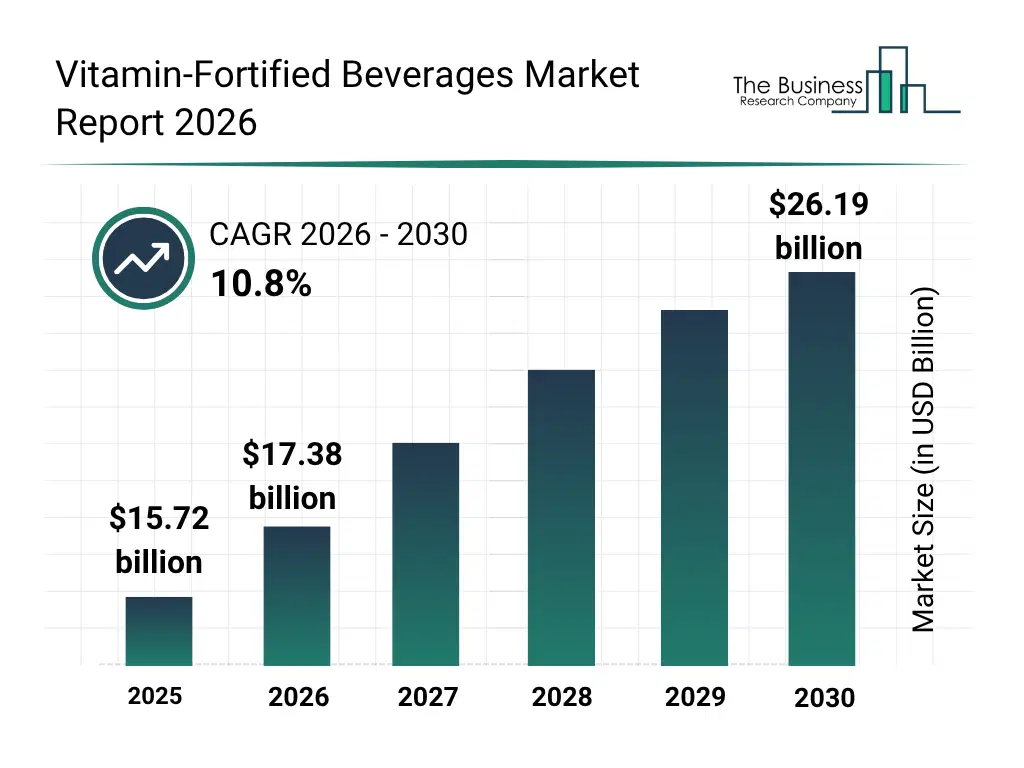
What Is The Vitamin-Fortified Beverages Market Size and Share 2026?
The vitamin-fortified beverages market size has grown rapidly in recent years. It will grow from $15.72 billion in 2025 to $17.38 billion in 2026 at a compound annual growth rate (CAGR) of 10.6%. The growth in the historic period can be attributed to rising awareness of nutritional deficiencies, growth of packaged beverage consumption, expansion of retail and supermarket distribution channels, increasing urbanization and busy lifestyles, early adoption of sports and energy drinks.What Is The Vitamin-Fortified Beverages Market Growth Forecast?
The vitamin-fortified beverages market size is expected to see rapid growth in the next few years. It will grow to $26.19 billion in 2030 at a compound annual growth rate (CAGR) of 10.8%. The growth in the forecast period can be attributed to growth in preventive healthcare and wellness trends, rising demand for personalized nutrition solutions, expansion of functional beverage innovation pipelines, increasing disposable income in emerging markets, advancement in vitamin encapsulation and beverage fortification technologies. Major trends in the forecast period include functional wellness beverage adoption driven by immunity and energy enhancement demand, rising consumer preference for clean-label and sugar-free fortified drinks, expansion of personalized nutrition and vitamin-enriched hydration products, growing integration of plant-based and natural vitamin infusion ingredients, increasing demand for ready-to-drink fortified beverages in urban lifestyles.
Global Vitamin-Fortified Beverages Market Segmentation
1) By Product Type: Energy Drinks, Sports Drinks, Flavored Water, Juices, Ready-To-Drink Teas And Coffees, Other Product Types 2) By Ingredient: Vitamin A, Vitamin B, Vitamin C, Vitamin D, Vitamin E, Other Ingredients 3) By Nature: Organic, Conventional 4) By Distribution Channel: Supermarkets Or Hypermarkets, Convenience Stores, Online Retail, Specialty Stores, Other Distribution Channels 5) By End-User: Children, Adults, Geriatric Subsegments: 1) By Energy Drinks: Vitamin Enriched Energy Drinks, Caffeinated Vitamin Energy Drinks, Sugar Free Vitamin Energy Drinks, Herbal Infused Vitamin Energy Drinks 2) By Sports Drinks: Electrolyte And Vitamin Sports Drinks, Isotonic Vitamin Sports Drinks, Hypotonic Vitamin Sports Drinks, Protein Enriched Vitamin Sports Drinks 3) By Flavored Water: Vitamin Infused Flavored Water, Zero Calorie Vitamin Flavored Water, Sparkling Vitamin Flavored Water, Natural Flavor Vitamin Water 4) By Juices: Fruit Based Vitamin Fortified Juices, Vegetable Based Vitamin Fortified Juices, Mixed Fruit And Vegetable Vitamin Juices, Cold Pressed Vitamin Fortified Juices 5) By Ready-To-Drink Teas And Coffees: Vitamin Fortified Ready-to-Drink (RTD) Teas, Vitamin Enriched Ready-to-Drink (RTD) Coffees, Herbal Vitamin Ready-to-Drink (RTD) Teas, Functional Vitamin Ready-to-Drink (RTD) Beverages 6) By Other Product Types: Dairy Based Vitamin Beverages, Plant-Based Vitamin Beverages, Probiotic Vitamin Drinks, Nutritional Supplement BeveragesWhat Is The Driver Of The Vitamin-Fortified Beverages Market?
The increasing prevalence of vitamin deficiencies is expected to propel the growth of the vitamin-fortified beverages market going forward. Vitamin deficiencies refer to a condition in which the body does not receive or absorb sufficient amounts of essential vitamins required for normal physiological functions, growth, and overall health. The prevalence of vitamin deficiencies is rising due to growing consumption of processed and nutrient-poor foods, which replace balanced diets and reduce the intake of essential vitamins. Vitamin-fortified beverages help address vitamin deficiencies by providing an easy, ready-to-consume source of essential nutrients that supports daily intake without requiring major dietary changes. For instance, in February 2025, according to Health Club Management, a UK-based company overseeing the operations, staff, and services of fitness facilities, in 2023–24, there were 191,927 hospital admissions primarily due to iron deficiency and 6,120 admissions where b vitamin deficiencies were identified as the main cause. Therefore, the increasing prevalence of vitamin deficiencies is driving the growth of the vitamin-fortified beverages industry.Key Players In The Global Vitamin-Fortified Beverages Market
Major companies operating in the vitamin-fortified beverages market are Nestlé S.A., PepsiCo Inc., The Coca-Cola Company, Danone S.A., Abbott Laboratories, The Kraft Heinz Company, General Mills Inc., Monster Beverage Corporation, Keurig Dr Pepper, Red Bull GmbH, Suntory Beverage & Food Limited, Asahi Group, Otsuka Holdings, Celsius Holdings, Britvic plc, Herbalife Ltd., Nongfu Spring Co. Ltd., Amway Corporation, Yakult Honsha Co. Ltd., Hindustan Unilever Limited, The Hain Celestial Group Inc., HiPP GmbH & Co. Vertrieb KG, Arizona Beverages USA LLC, Talking Rain Beverage Company, Hint Inc., Mengniu Dairy Company LimitedGlobal Vitamin-Fortified Beverages Market Trends and Insights
Major companies operating in the vitamin-fortified beverages market are focusing on developing innovative products, such as electrolyte-enhanced hydration drink mixes to meet the growing demand for functional, health-focused hydration solutions among consumers. Electrolyte-enhanced hydration drink mixes are powdered or liquid supplements added to water that contain essential minerals such as sodium, potassium, and magnesium, which help the body quickly restore fluid balance, prevent dehydration, and support muscle and nerve function, especially during exercise or illness. For instance, in September 2024, the Gatorade Company, a US-based sports beverage company, launched its Hydration Booster, a next-generation electrolyte powder designed for everyday hydration. The product contains an advanced blend of electrolytes along with 100% daily value of essential vitamins such as A, B3, B5, B6, and C, and is formulated without artificial flavors, sweeteners, or added colors. Developed with support from the Gatorade Sports Science Institute, the solution is designed to deliver all-day hydration and cater to evolving consumer demand for functional and vitamin-enriched beverage options. This advancement enables beverage manufacturers to develop more reliable and high-performance vitamin-fortified drinks, strengthening product differentiation in a competitive market.What Are Latest Mergers And Acquisitions In The Vitamin-Fortified Beverages Market?
In April 2025, Celsius Holdings Inc., a US-based functional beverages company, acquired Alani Nutrition LLC for $1.8 billion. Through this acquisition, Celsius aims to strengthen its position in the functional and vitamin-fortified beverage market by combining its CELSIUS brand with Alani Nu to create a leading portfolio, well positioned to capitalize on the growing consumer preference for healthier, zero-sugar beverage alternatives. Alani Nutrition LLC a US based functional beverage brand that specializes in providing vitamin-fortified beverages.Regional Outlook
North America was the largest region in the vitamin-fortified beverages market in 2025. Asia-Pacific is expected to be the fastest-growing region in the forecast period.The regions covered in this market report are Asia-Pacific, South East Asia, Western Europe, Eastern Europe, North America, South America, Middle East, Africa. The countries covered in this market report are Australia, Brazil, China, France, Germany, India, Indonesia, Japan, Taiwan, Russia, South Korea, UK, USA, Canada, Italy, Spain.What Defines the Vitamin-Fortified Beverages Market?
The vitamin-fortified beverages market consists of sales of fortified dairy beverages, fortified plant-based beverages, meal replacement beverages, and medical nutrition beverages. Values in this market are ‘factory gate’ values, that is the value of goods sold by the manufacturers or creators of the goods, whether to other entities (including downstream manufacturers, wholesalers, distributors and retailers) or directly to end customers. The value of goods in this market includes related services sold by the creators of the goods.How is Market Value Defined and Measured?
The market value is defined as the revenues that enterprises gain from the sale of goods and/or services within the specified market and geography through sales, grants, or donations in terms of the currency (in USD unless otherwise specified). The revenues for a specified geography are consumption values that are revenues generated by organizations in the specified geography within the market, irrespective of where they are produced. It does not include revenues from resales along the supply chain, either further along the supply chain or as part of other products.What Key Data and Analysis Are Included in the Vitamin-Fortified Beverages Market Report 2026?
The vitamin-fortified beverages market research report is one of a series of new reports from The Business Research Company that provides vitamin-fortified beverages market statistics, including vitamin-fortified beverages industry global market size, regional shares, competitors with a vitamin-fortified beverages market share, detailed vitamin-fortified beverages market segments, market trends and opportunities, and any further data you may need to thrive in the vitamin-fortified beverages industry. This vitamin-fortified beverages market research report delivers a complete perspective of everything you need, with an in-depth analysis of the current and future scenario of the industry.Vitamin-Fortified Beverages Market Report Forecast Analysis
| Report Attribute | Details |
|---|---|
| Market Size Value In 2026 | $17.38 billion |
| Revenue Forecast In 2030 | $26.19 billion |
| Growth Rate | CAGR of 10.8% from 2026 to 2030 |
| Base Year For Estimation | 2025 |
| Actual Estimates/Historical Data | 2020-2025 |
| Forecast Period | 2026 - 2030 |
| Market Representation | Revenue in USD Billion and CAGR from 2026 to 2030 |
| Segments Covered | Product Type, Ingredient, Nature, Distribution Channel, End-User |
| Regional Scope | Asia-Pacific, Western Europe, Eastern Europe, North America, South America, Middle East, Africa |
| Country Scope | The countries covered in the vitamin-fortified beverages market report are Australia, Brazil, China, France, Germany, India, Indonesia, Japan, Taiwan, Russia, South Korea, UK, USA, Canada, Italy, Spain. |
| Key Companies Profiled | Nestlé S.A., PepsiCo Inc., The Coca-Cola Company, Danone S.A., Abbott Laboratories, The Kraft Heinz Company, General Mills Inc., Monster Beverage Corporation, Keurig Dr Pepper, Red Bull GmbH, Suntory Beverage & Food Limited, Asahi Group, Otsuka Holdings, Celsius Holdings, Britvic plc, Herbalife Ltd., Nongfu Spring Co. Ltd., Amway Corporation, Yakult Honsha Co. Ltd., Hindustan Unilever Limited, The Hain Celestial Group Inc., HiPP GmbH & Co. Vertrieb KG, Arizona Beverages USA LLC, Talking Rain Beverage Company, Hint Inc., Mengniu Dairy Company Limited |
| Customization Scope | Request for Customization |
| Pricing And Purchase Options | Explore Purchase Options |