
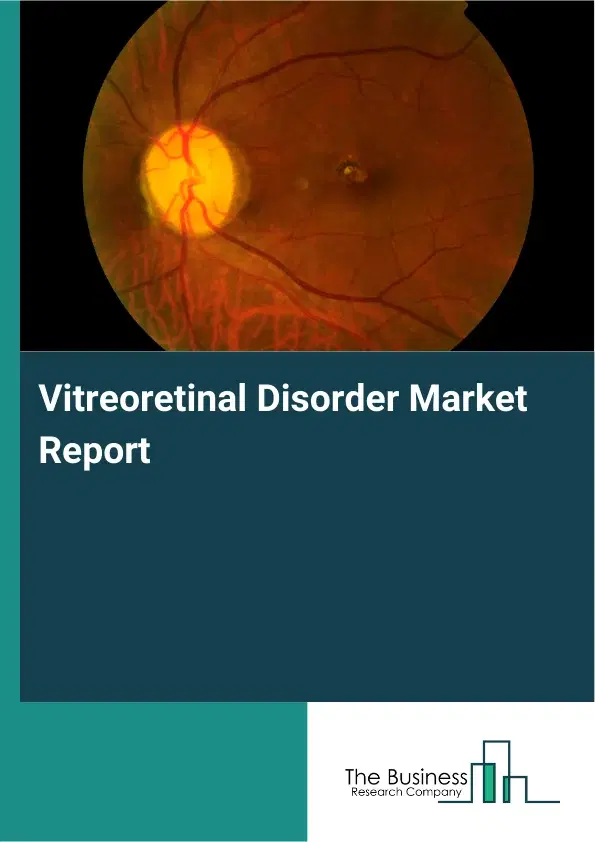
Vitreoretinal Disorder Market Report 2026
Global Outlook – By Type (Retinal Tear, Retinal Detachment, Diabetic Retinopathy, Macular Degeneration, Macular Hole, Other Types), By Diagnosis (Digital Fluorescein Angiography, Optical Coherence Tomography, Heidelberg Retinal Tomography, Indocyanine Green Angiography, Other Diagnosis), By Treatment (Surgery, Medication, Other Treatments), By Distribution Channel (Hospital Pharmacy, Online Pharmacy, Retail Pharmacy), By End User (Hospitals, Homecare, Specialty Clinics, Other End Users) - Market Size, Trends, Strategies, and Forecast to 2030
Vitreoretinal Disorder Market Overview
• Vitreoretinal Disorder market size has reached to $4.63 billion in 2025 • Expected to grow to $6.71 billion in 2030 at a compound annual growth rate (CAGR) of 7.7% • Growth Driver: Growing Incidence Of Diabetic Retinopathy Fueling The Growth Of The Market Due To Rising Retinal Complications • Market Trend: Innovations In Continuous Drug Delivery Transform Treatment Of Diabetic Macular Edema • North America was the largest region in 2025.What Is Covered Under Vitreoretinal Disorder Market?
Vitreoretinal disorder refers to a group of eye conditions that affect the retina and the vitreous humor, which plays a crucial role in maintaining the eye’s shape and visual clarity. These disorders can significantly impair vision over time and often require advanced diagnostic techniques and specialized medical or surgical interventions for effective management. The main types of vitreoretinal disorders are retinal tears, retinal detachment, diabetic retinopathy, macular degeneration, macular holes, and others. A retinal tear refers to a small break or rip in the retina, the light-sensitive tissue at the back of the eye. The different diagnostic methods include digital fluorescein angiography, optical coherence tomography, heidelberg retinal tomography, indocyanine green angiography, and others, for various treatment options such as surgery, medication, and others. It is distributed through hospital pharmacies, online pharmacies, and retail pharmacies, catering to various end users, including hospitals, home care, specialty clinics, and others.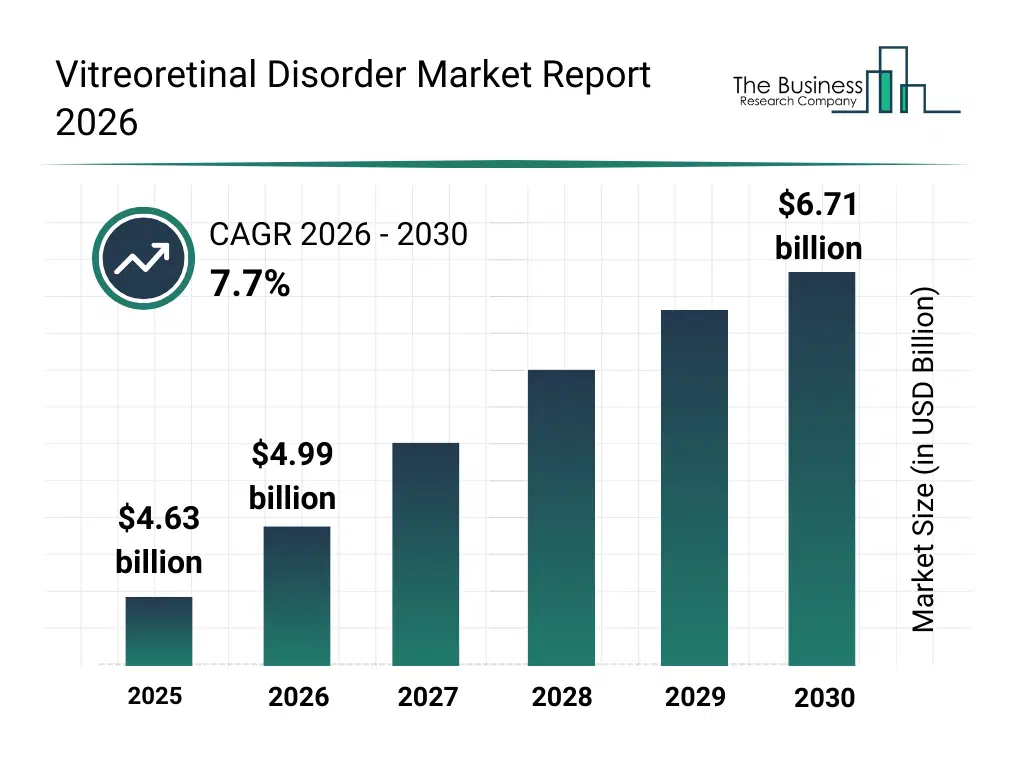
What Is The Vitreoretinal Disorder Market Size and Share 2026?
The vitreoretinal disorder market size has grown strongly in recent years. It will grow from $4.63 billion in 2025 to $4.99 billion in 2026 at a compound annual growth rate (CAGR) of 7.9%. The growth in the historic period can be attributed to increasing prevalence of diabetic eye diseases, wider availability of optical coherence tomography, growth in ophthalmic surgical procedures, expansion of specialty eye clinics, improved diagnostic accuracy.What Is The Vitreoretinal Disorder Market Growth Forecast?
The vitreoretinal disorder market size is expected to see strong growth in the next few years. It will grow to $6.71 billion in 2030 at a compound annual growth rate (CAGR) of 7.7%. The growth in the forecast period can be attributed to increasing demand for personalized retinal treatments, rising investments in ophthalmic innovation, expansion of minimally invasive surgical techniques, growing use of ai-driven diagnostics, increasing focus on vision preservation therapies. Major trends in the forecast period include increasing adoption of advanced retinal imaging techniques, rising use of minimally invasive vitreoretinal surgery, growing integration of AI-based diagnostic tools, expansion of targeted retinal therapies, enhanced focus on early disease detection.
Global Vitreoretinal Disorder Market Segmentation
1) By Type: Retinal Tear, Retinal Detachment, Diabetic Retinopathy, Macular Degeneration, Macular Hole, Other Types 2) By Diagnosis: Digital Fluorescein Angiography, Optical Coherence Tomography, Heidelberg Retinal Tomography, Indocyanine Green Angiography, Other Diagnosis 3) By Treatment: Surgery, Medication, Other Treatments 4) By Distribution Channel: Hospital Pharmacy, Online Pharmacy, Retail Pharmacy 5) By End User: Hospitals, Homecare, Specialty Clinics, Other End Users Subsegments: 1) By Retinal Tear: Atrophic Retinal Tear, Operculated Retinal Tear, Horseshoe Retinal Tear, Giant Retinal Tear 2) By Retinal Detachment: Rhegmatogenous Retinal Detachment, Tractional Retinal Detachment, Exudative Retinal Detachment 3) By Diabetic Retinopathy: Non-Proliferative Diabetic Retinopathy, Proliferative Diabetic Retinopathy, Diabetic Macular Edema 4) By Macular Degeneration: Dry Macular Degeneration, Wet Macular Degeneration 5) By Macular Hole: Full-Thickness Macular Hole, Lamellar Macular Hole, Tractional Macular Hole 6) By Other Types: Epiretinal Membrane, Retinal Vein Occlusion, Retinal Artery Occlusion, Retinitis Pigmentosa, Uveitis, Vitreous Hemorrhage, Macular Edema, Central Serous Retinopathy, Proliferative VitreoretinopathyWhat Is The Driver Of The Vitreoretinal Disorder Market?
The growing incidence of diabetic retinopathy is expected to propel the growth of the vitreoretinal disorder market going forward. Diabetic retinopathy is an eye condition that occurs due to damage to the blood vessels in the retina caused by high blood sugar levels in people with diabetes. The incidence of diabetic retinopathy is increasing due to the rising prevalence of diabetes, driven by sedentary lifestyles, and poor blood sugar control, causing damage to retinal blood vessels. Vitreoretinal disorder management plays a crucial role in treating diabetic retinopathy by addressing complications such as vitreous hemorrhage and tractional retinal detachment, thereby preserving vision and preventing further retinal damage. For instance, in October 2024, according to the Australian Institute of Health and Welfare, an Australia-based government agency, in 2022–23, 1.8% of screened First Nations people in Australia received treatment for diabetic retinopathy, with a lower age-standardized treatment rate (1.3%) than non-Indigenous Australians (1.5%). Therefore, the growing incidence of diabetic retinopathy is driving the growth of the vitreoretinal disorder industry.Key Players In The Global Vitreoretinal Disorder Market
Major companies operating in the vitreoretinal disorder market are F. Hoffmann-La Roche AG, Bayer AG, Novartis AG, Regeneron Pharmaceuticals Inc., Alcon Inc., Bausch Health Companies Inc., Santen Pharmaceutical Co. Ltd., Topcon Corporation, Carl Zeiss Meditec AG, Ocular Therapeutix Inc., EyePoint Pharmaceuticals Inc., Kodiak Sciences Inc., Clearside Biomedical, Apellis Pharmaceuticals Inc., Genentech Inc., Oxurion NV, Adverum Biotechnologies Inc., Opthea Limited, Graybug Vision Inc., Kiora Pharmaceuticals Inc., Allegro Ophthalmics Inc., Lineage Cell Therapeutics Inc., Ocugen Inc.
This chart is for illustrative purposes; the full report includes a detailed competitor analysis and comprehensive overview of the top 10 companies in the market.
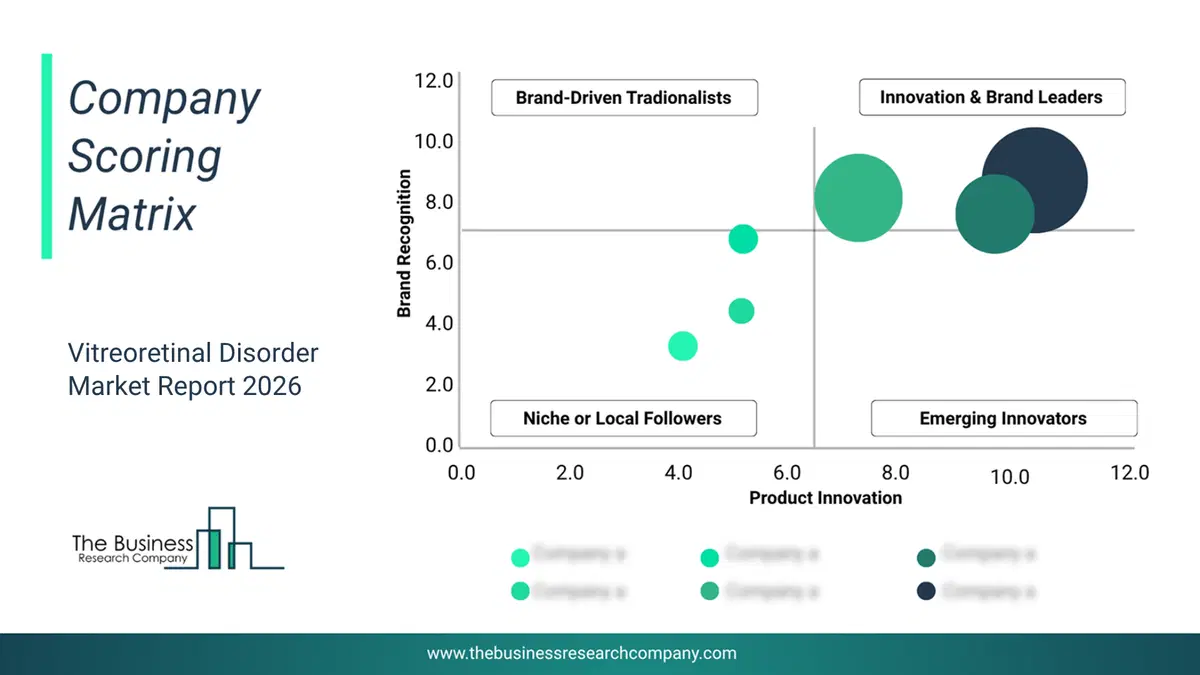
This chart maps companies by product innovation and brand strength, with bubble size indicating relative revenue, helping identify market leaders, challengers, and niche players. This is an illustrative chart; the full report provides a complete and accurate competitive analysis.
Global Vitreoretinal Disorder Market Trends and Insights
Major companies operating in the vitreoretinal disorder market are focusing on innovative products such as continuous delivery drug solutions to reduce injection frequency and improve patient outcomes. Continuous delivery drug solutions are medical systems that provide a sustained, controlled release of medication directly to the eye, helping reduce the need for frequent injections, maintain consistent therapeutic levels, and improve patient adherence and visual outcomes. For instance, in February 2025, Roche, a Switzerland-based global pharmaceutical company, received U.S. Food and Drug Administration (FDA) approval for Susvimo (ranibizumab injection) 100 mg/mL, a Port Delivery System for diabetic macular edema (DME). Susvimo provides continuous ranibizumab delivery via a refillable implant, allowing patients to maintain vision with as few as two treatments per year, compared with monthly eye injections. The system was evaluated in the Phase III Pagoda study, demonstrating sustained improvements in visual acuity and safety consistent with prior approvals for neovascular age-related macular degeneration (nAMD). Susvimo’s innovative platform reduces treatment burden, enhances patient convenience, and addresses the growing prevalence of DME globally.What Are Latest Mergers And Acquisitions In The Vitreoretinal Disorder Market?
In July 2024, Merck & Co. Inc., a US-based pharmaceutical company, acquired Eyebiotech Limited (EyeBio) for $3 billion. With this acquisition, Merck aims to strengthen its eye disease treatment portfolio, gaining Restoret (EYE103), a drug for diabetic macular edema (DME) and wet age-related macular degeneration (nAMD). Eyebiotech Limited is a UK-based clinical-stage ophthalmology biotechnology company focused on developing treatments for retinal diseases, including vitreoretinal conditions.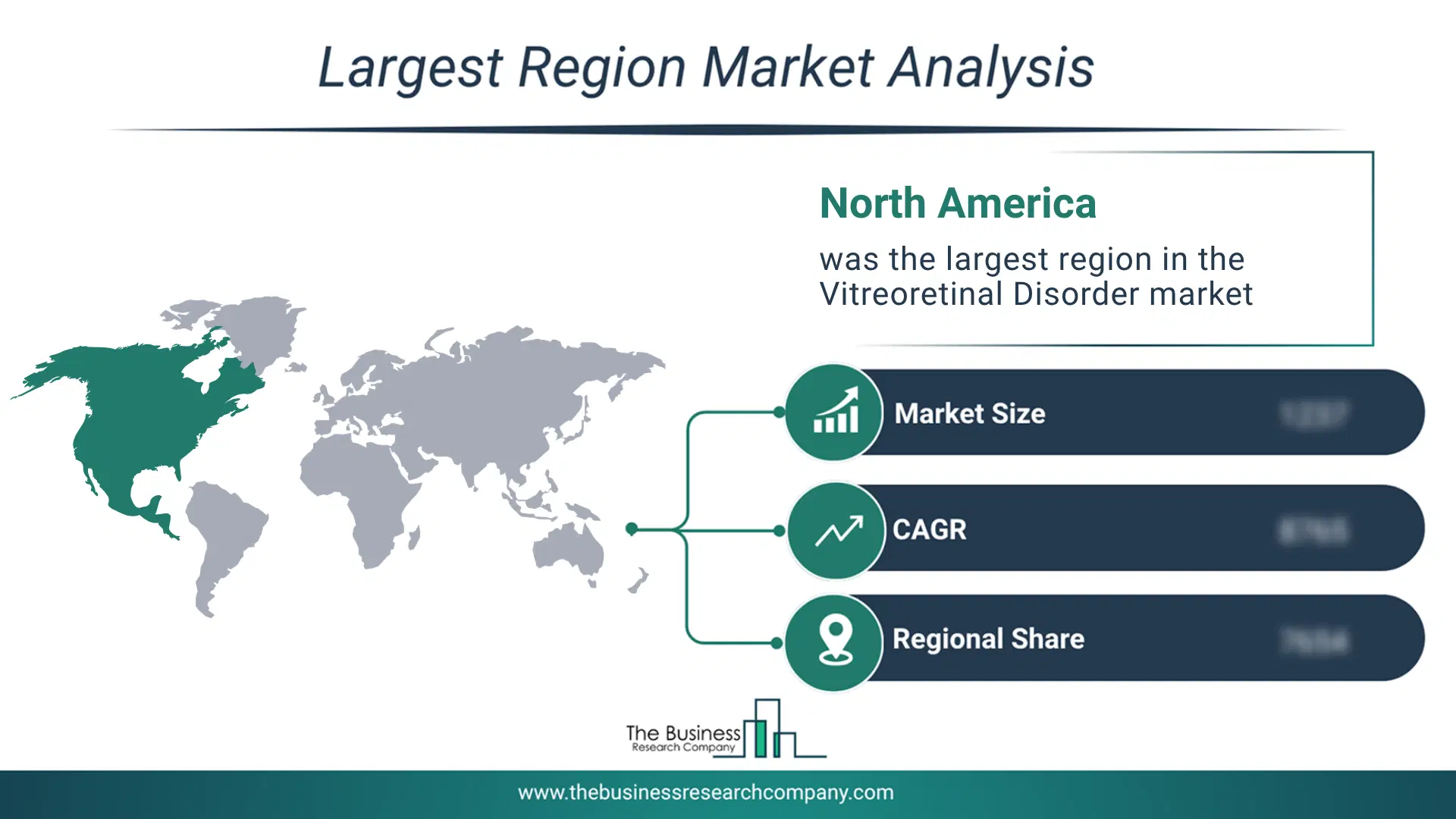
Regional Outlook
North America was the largest region in the vitreoretinal disorder market in 2025. The regions covered in this market report are Asia-Pacific, South East Asia, Western Europe, Eastern Europe, North America, South America, Middle East, Africa. The countries covered in this market report are Australia, Brazil, China, France, Germany, India, Indonesia, Japan, Taiwan, Russia, South Korea, UK, USA, Canada, Italy, Spain.What Defines the Vitreoretinal Disorder Market?
The vitreoretinal disorder market includes revenues earned by entities by providing services such as diagnostic services, intravitreal injection therapies, imaging services, teleophthalmology consultations, postoperative care, and retinal rehabilitation services. The vitreoretinal disorder market also includes sales of fundus cameras, injections, and steroid implants. Values in this market are ‘factory gate’ values, that is the value of goods sold by the manufacturers or creators of the goods, whether to other entities (including downstream manufacturers, wholesalers, distributors and retailers) or directly to end customers. The value of goods in this market includes related services sold by the creators of the goods.How is Market Value Defined and Measured?
The market value is defined as the revenues that enterprises gain from the sale of goods and/or services within the specified market and geography through sales, grants, or donations in terms of the currency (in USD unless otherwise specified). The revenues for a specified geography are consumption values that are revenues generated by organizations in the specified geography within the market, irrespective of where they are produced. It does not include revenues from resales along the supply chain, either further along the supply chain or as part of other products.
This chart presents market attractiveness based on a quantitative evaluation of growth, competition, strategic alignment, and risk, offering a clear view of opportunity areas for decision-making. This chart is for illustrative purposes; the full report contains the complete analysis.

This chart highlights the Total Addressable Market (TAM) by estimating the maximum revenue opportunity using an assumption-driven approach, supporting strategic planning and opportunity sizing across markets. The chart is illustrative; the full report provides a more comprehensive analysis.
What Key Data and Analysis Are Included in the Vitreoretinal Disorder Market Report 2026?
The vitreoretinal disorder market research report is one of a series of new reports from The Business Research Company that provides market statistics, including industry global market size, regional shares, competitors with the market share, detailed market segments, market trends and opportunities, and any further data you may need to thrive in the vitreoretinal disorder industry. The market research report delivers a complete perspective of everything you need, with an in-depth analysis of the current and future state of the industry.Vitreoretinal Disorder Market Report Forecast Analysis
| Report Attribute | Details |
|---|---|
| Market Size Value In 2026 | $4.99 billion |
| Revenue Forecast In 2030 | $6.71 billion |
| Growth Rate | CAGR of 7.7% from 2026 to 2030 |
| Base Year For Estimation | 2025 |
| Actual Estimates/Historical Data | 2020-2025 |
| Forecast Period | 2026 - 2030 |
| Market Representation | Revenue in USD Billion and CAGR from 2026 to 2030 |
| Segments Covered | Type, Diagnosis, Treatment, Distribution Channel, End User |
| Regional Scope | Asia-Pacific, Western Europe, Eastern Europe, North America, South America, Middle East, Africa |
| Country Scope | The countries covered in the report are Australia, Brazil, China, France, Germany, India, Indonesia, Japan, Taiwan, Russia, South Korea, UK, USA, Canada, Italy, Spain |
| Key Companies Profiled | F. Hoffmann-La Roche AG, Bayer AG, Novartis AG, Regeneron Pharmaceuticals Inc., Alcon Inc., Bausch Health Companies Inc., Santen Pharmaceutical Co. Ltd., Topcon Corporation, Carl Zeiss Meditec AG, Ocular Therapeutix Inc., EyePoint Pharmaceuticals Inc., Kodiak Sciences Inc., Clearside Biomedical, Apellis Pharmaceuticals Inc., Genentech Inc., Oxurion NV, Adverum Biotechnologies Inc., Opthea Limited, Graybug Vision Inc., Kiora Pharmaceuticals Inc., Allegro Ophthalmics Inc., Lineage Cell Therapeutics Inc., Ocugen Inc. |
| Customization Scope | Request for Customization |
| Pricing And Purchase Options | Explore Purchase Options |