

Voice AI In Smart Homes Market Report 2026
Global Outlook – By Smart Home Device Type (Smart Speakers And Assistants, Smart Displays, Smart Thermostats And Environmental Control Systems, Smart Lighting Systems, Smart Security Devices, Other Smart Home Device Types), By Technology (Natural Language Processing (NLP), Machine Learning And Deep Learning, Edge Computing And On-Device Processing, Other Technologies), By Deployment Mode (Cloud-Based, On-Premise) – Market Size, Trends, Strategies, and Forecast to 2030
Voice AI In Smart Homes Market Overview
• Voice AI In Smart Homes market size has reached to $20 billion in 2025 • Expected to grow to $138.39 billion in 2030 at a compound annual growth rate (CAGR) of 47.1% • Growth Driver: Rising Demand For Automation Fueling The Growth Of The Market Due To Increasing Need For Convenience • Market Trend: Technological Advancements In Voice AI Enhancing Interactive Learning And Entertainment Experiences • North America was the largest region in 2025 and Asia-Pacific is the fastest growing region.What Is Covered Under Voice AI In Smart Homes Market?
Voice artificial intelligence (AI) in smart homes refers to the integration of artificial intelligence-(AI) powered voice recognition systems that enable users to control and interact with various smart devices using natural spoken commands. By understanding and processing human speech, Voice AI enhances user convenience, accessibility, and personalization in smart home environments, making everyday tasks simpler and more intuitive. The main voice AI in smart home devices includes smart speakers and assistants, smart displays, smart thermostats and environmental control systems, smart lighting systems, smart security devices, and others. Smart speakers and assistants are voice-activated devices that use artificial intelligence to perform tasks, answer questions, control smart home devices, and provide information through natural language interaction. It uses various technologies such as natural language processing (NLP), machine learning and deep learning, edge computing, and on-device processing, and others, and can be deployed on the cloud and on-premises.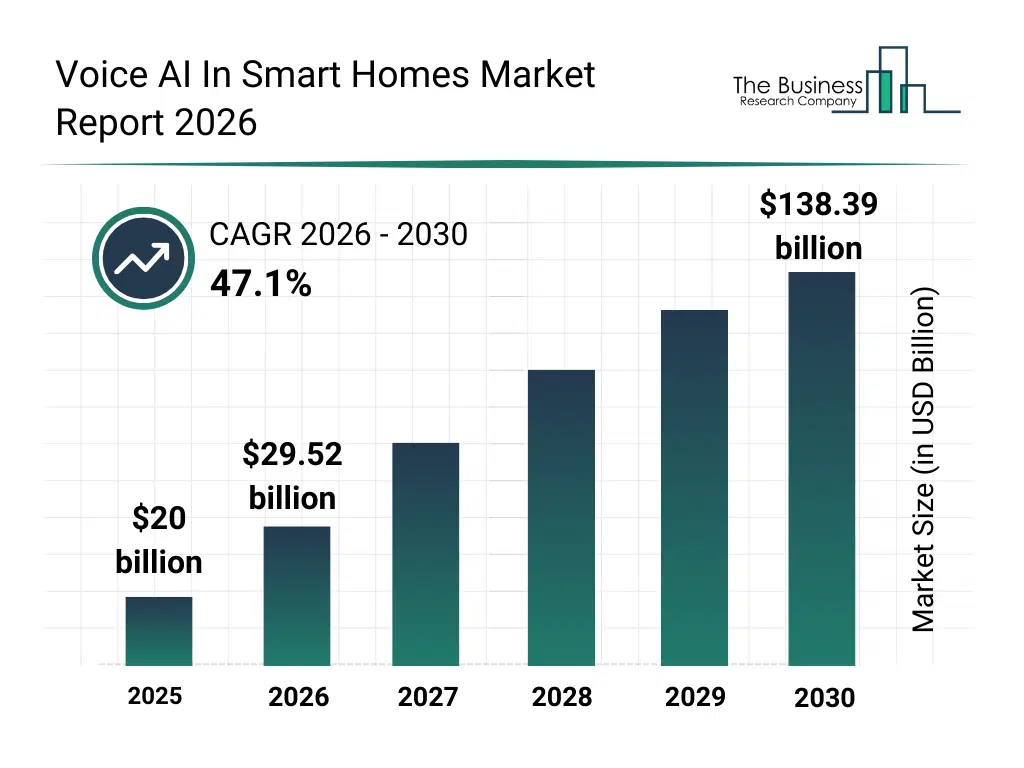
What Is The Voice AI In Smart Homes Market Size and Share 2026?
The voice AI in smart homes market size has grown exponentially in recent years. It will grow from $20 billion in 2025 to $29.52 billion in 2026 at a compound annual growth rate (CAGR) of 47.6%. The growth in the historic period can be attributed to growth of smart speaker adoption, expansion of home automation systems, rising consumer dem.What Is The Voice AI In Smart Homes Market Growth Forecast?
The voice AI in smart homes market size is expected to see exponential growth in the next few years. It will grow to $138.39 billion in 2030 at a compound annual growth rate (CAGR) of 47.1%. The growth in the forecast period can be attributed to integration of edge AI voice processing, growth of multilingual voice interfaces, rising adoption of smart home ecosystems, expansion of voice biometrics security, increasing personalization capabilities. Major trends in the forecast period include multi-language voice recognition, context-aware voice commands, personalized voice assistants, offline voice processing, voice-based home automation.
Global Voice AI In Smart Homes Market Segmentation
1) By Smart Home Device Type: Smart Speakers And Assistants, Smart Displays, Smart Thermostats And Environmental Control Systems, Smart Lighting Systems, Smart Security Devices, Other Smart Home Device Types 2) By Technology: Natural Language Processing (NLP), Machine Learning And Deep Learning, Edge Computing And On-Device Processing, Other Technologies 3) By Deployment Mode: Cloud-Based, On-Premise Subsegments: 1) By Smart Speakers And Assistants: Standalone Smart Speakers, Smart Assistants Integrated Into Devices, Voice-Controlled Hubs 2) By Smart Displays: Voice-Activated Smart Displays, Video Calling Smart Displays, Smart Displays With Integrated Hubs 3) By Smart Thermostats And Environmental Control Systems: Voice-Controlled Thermostats, Smart Air Conditioners And Heaters, Smart Air Quality Monitors, Voice-Activated Humidifiers Or Dehumidifiers 4) By Smart Lighting Systems: Voice-Activated Light Bulbs, Smart Light Switches And Dimmers, Smart Ambient And Mood Lighting, Lighting Control Hubs 5) By Smart Security Devices: Smart Door Locks, Voice-Controlled Security Cameras, Smart Doorbells, Smart Motion Sensors, Alarm Systems With Voice Control 6) By Other Smart Home Device Types: Voice-Controlled Smart Appliances, Smart TVs With Voice Assistants, Voice-Activated Irrigation Systems, Smart Plugs And Power Strips, Smart Garage Door OpenersWhat Is The Driver Of The Voice AI In Smart Homes Market?
The increasing consumer demand for automation is expected to fuel the growth of the voice AI in smart homes market going forward. Automation refers to using machines or systems to carry out tasks without human help, making processes more efficient and consistent. Consumer demand for automation is rising due to the increasing need for convenience, as automated systems simplify daily tasks and save time by performing routine functions without manual intervention. Consumer demand for automation supports voice AI in smart homes by driving the need for hands-free control, allowing users to effortlessly manage multiple devices and functions through simple voice commands, enhancing both comfort and efficiency. For instance, in September 2023, according to the International Federation of Robotics (IFR), a Germany-based robotics association, global industrial robot installations in factories reached 553,052 units, marking a 5 percent year-on-year increase in 2022, with 73 percent installed in Asia compared with 10 percent in the Americas. Therefore, the increasing consumer demand for automation will drive the growth of the voice AI in smart homes industry.Key Players In The Global Voice AI In Smart Homes Market
Major companies operating in the voice AI in smart homes market are Amazon.com Inc., Google LLC, Samsung Electronics Co. Ltd., Microsoft Corporation, Comcast Corporation, Huawei Technologies Co. Ltd., Siemens AG, Lenovo Group Limited, LG Electronics Inc., Orange S.A., GE Appliances a Haier company, Signify N.V., Bose Corporation, Sonos Inc., Miele & Cie. KG, Crestron Electronics Inc., Arlo Technologies Inc., SimpliSafe Inc., Control4 Corporation, Ecobee Inc., Wyze Labs Inc., Harman International Industries Inc.
This chart is for illustrative purposes; the full report includes a detailed competitor analysis and comprehensive overview of the top 10 companies in the market.
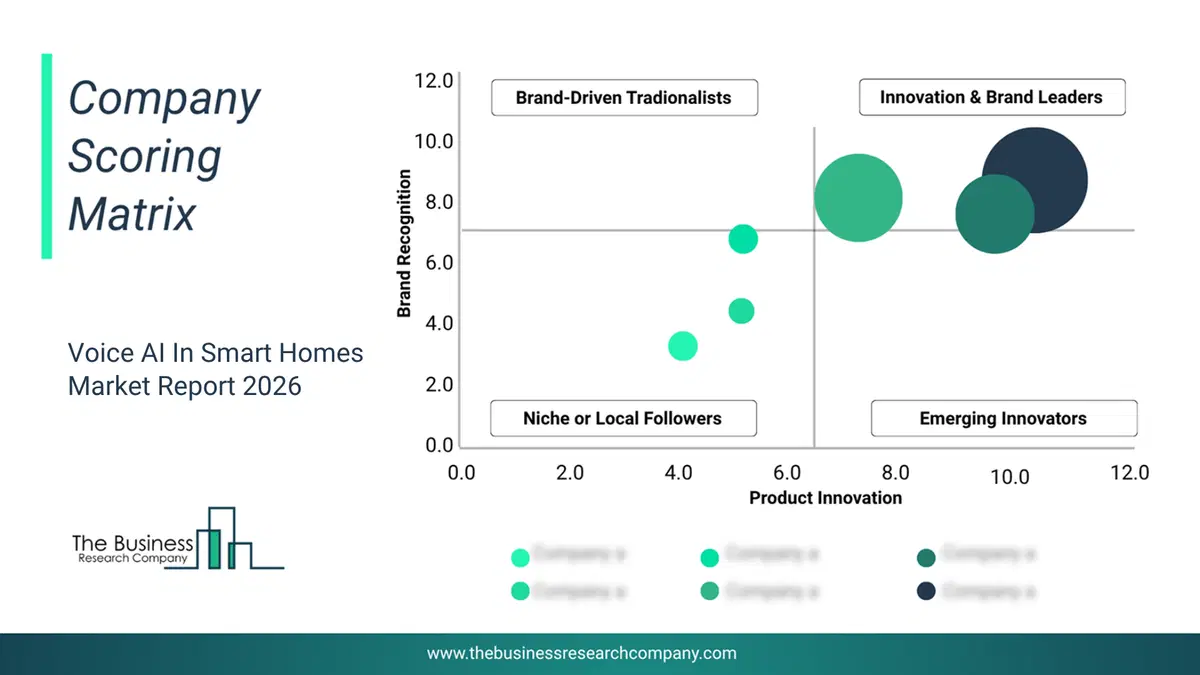
This chart maps companies by product innovation and brand strength, with bubble size indicating relative revenue, helping identify market leaders, challengers, and niche players. This is an illustrative chart; the full report provides a complete and accurate competitive analysis.
Global Voice AI In Smart Homes Market Trends and Insights
Major companies operating in the voice AI in smart homes market are developing technologically advanced solutions, such as AI-powered interactive toys, to enhance both learning and entertainment. AI-powered interactive toys are smart playthings embedded with artificial intelligence that can engage with users through speech, movement, and adaptive responses, creating personalized and immersive play experiences. For instance, in March 2025, Agora Inc., a US-based software company, launched the ConvoAI Device Kit, an advanced conversational AI toolkit for internet of things (IoT) devices. A unique feature of the ConvoAI Device Kit is its integration of Beken’s high-performance AI chip modules with Agora’s advanced Conversational AI technology, enabling ultra-low latency voice interactions and intelligent real-time dialogue processing. This powerful combination enhances the interactivity, intuitiveness, and emotional responsiveness of AI-powered interactive toys and robots, allowing them to engage in natural, lifelike conversations that create more immersive and engaging user experiences.What Are Latest Mergers And Acquisitions In The Voice AI In Smart Homes Market?
In November 2024, LG Electronics (LG), a South Korea-based provider of voice AI in smart homes, partnered with Tenstorrent to create systems and system-on-chips (SoCs) solutions for the worldwide market. Through this partnership, LG is strengthening its ability to design and develop AI chips specifically optimized for its products and services, in line with its vision of Affectionate Intelligence. This initiative supports the company’s focus on advancing AI-driven innovation across smart home solutions, home appliances, future mobility, and commercial applications. To strengthen its AI competitiveness, LG is combining in-house semiconductor development with collaborations with global tech leaders. Tenstorrent is a US-based computing company.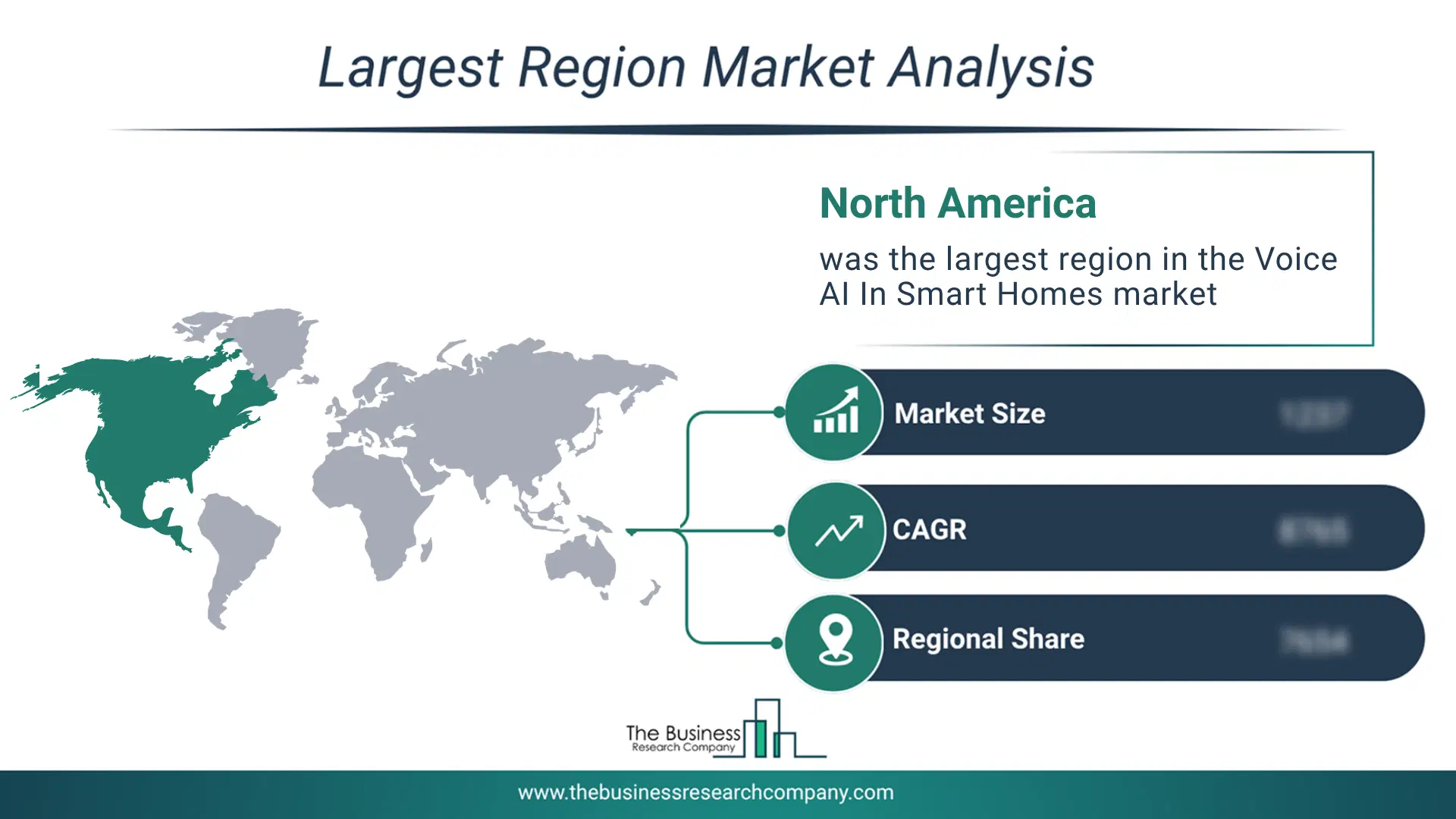
Regional Insights
North America was the largest region in the voice AI in smart homes market in 2025. Asia-Pacific is expected to be the fastest-growing region in the forecast period. The regions covered in this market report are Asia-Pacific, South East Asia, Western Europe, Eastern Europe, North America, South America, Middle East, Africa. The countries covered in this market report are Australia, Brazil, China, France, Germany, India, Indonesia, Japan, Taiwan, Russia, South Korea, UK, USA, Canada, Italy, Spain.What Defines the Voice AI In Smart Homes Market?
The voice AI in smart homes market consists of revenues earned by entities by providing services such as home security management, personal assistant services, and accessibility assistance. The market value includes the value of related goods sold by the service provider or included within the service offering. The voice AI in smart homes market also includes sales of voice-activated smart plugs, smart locks, smart streaming devices, and robot vacuums. Values in this market are ‘factory gate’ values, that is the value of goods sold by the manufacturers or creators of the goods, whether to other entities (including downstream manufacturers, wholesalers, distributors and retailers) or directly to end customers. The value of goods in this market includes related services sold by the creators of the goods.How is Market Value Defined and Measured?
The market value is defined as the revenues that enterprises gain from the sale of goods and/or services within the specified market and geography through sales, grants, or donations in terms of the currency (in USD unless otherwise specified). The revenues for a specified geography are consumption values that are revenues generated by organizations in the specified geography within the market, irrespective of where they are produced. It does not include revenues from resales along the supply chain, either further along the supply chain or as part of other products.
This chart presents market attractiveness based on a quantitative evaluation of growth, competition, strategic alignment, and risk, offering a clear view of opportunity areas for decision-making. This chart is for illustrative purposes; the full report contains the complete analysis.

This chart highlights the Total Addressable Market (TAM) by estimating the maximum revenue opportunity using an assumption-driven approach, supporting strategic planning and opportunity sizing across markets. The chart is illustrative; the full report provides a more comprehensive analysis.
What Key Data and Analysis Are Included in the Voice AI In Smart Homes Market Report 2026?
The voice ai in smart homes market research report is one of a series of new reports from The Business Research Company that provides market statistics, including industry global market size, regional shares, competitors with the market share, detailed market segments, market trends and opportunities, and any further data you may need to thrive in the voice ai in smart homes industry. The market research report delivers a complete perspective of everything you need, with an in-depth analysis of the current and future state of the industry.Voice AI In Smart Homes Market Report Forecast Analysis
| Report Attribute | Details |
|---|---|
| Market Size Value In 2026 | $29.52 billion |
| Revenue Forecast In 2030 | $138.39 billion |
| Growth Rate | CAGR of 47.1% from 2026 to 2030 |
| Base Year For Estimation | 2025 |
| Actual Estimates/Historical Data | 2020-2025 |
| Forecast Period | 2026 - 2030 |
| Market Representation | Revenue in USD Billion and CAGR from 2026 to 2030 |
| Segments Covered | Smart Home Device Type, Technology, Deployment Mode |
| Regional Scope | Asia-Pacific, Western Europe, Eastern Europe, North America, South America, Middle East, Africa |
| Country Scope | The Countries Covered In This Market Report Are Australia, Brazil, China, France, Germany, India, Indonesia, Japan, Taiwan, Russia, South Korea, Uk, Usa, Canada, Italy, Spain. |
| Key Companies Profiled | Amazon.com Inc., Google LLC, Samsung Electronics Co. Ltd., Microsoft Corporation, Comcast Corporation, Huawei Technologies Co. Ltd., Siemens AG, Lenovo Group Limited, LG Electronics Inc., Orange S.A., GE Appliances a Haier company, Signify N.V., Bose Corporation, Sonos Inc., Miele & Cie. KG, Crestron Electronics Inc., Arlo Technologies Inc., SimpliSafe Inc., Control4 Corporation, Ecobee Inc., Wyze Labs Inc., Harman International Industries Inc. |
| Customization Scope | Request for Customization |
| Pricing And Purchase Options | Explore Purchase Options |