
Vulnerable Road-User (VRU) Display Market Report 2026
Global Outlook – By Product Type (Head-Up Displays, External Displays, In-Vehicle Displays, Wearable Displays, Other Product Types), By Technology (Augmented Reality, Camera-Based Systems, Sensor-Based Systems, Other Technologies), By Application (Passenger Vehicles, Commercial Vehicles, Two-Wheelers, Other Applications), By End-User (Automotive Original Equipment Manufacturers (OEMs), Aftermarket, Public Transport, Other End-Users) – Market Size, Trends, Strategies, and Forecast to 2030
Vulnerable Road-User (VRU) Display Market Overview
• Vulnerable Road-User (VRU) Display market size has reached to $1.57 billion in 2025 • Expected to grow to $4.36 billion in 2030 at a compound annual growth rate (CAGR) of 22.6% • Growth Driver: Escalating Vehicle Production Driving The Market Growth Due To Next-Generation Safety Technology Deployment • North America was the largest region in 2025 and Asia-Pacific is the fastest growing region.What Is Covered Under Vulnerable Road-User (VRU) Display Market?
A vulnerable road-user (VRU) display is a system designed to detect and communicate the presence of pedestrians, cyclists, and other non-motorized travelers to vehicles. It enhances safety by providing visual or auditory alerts to prevent collisions. The display integrates with traffic and vehicle technologies to improve awareness in high-risk areas, helping drivers anticipate potential hazards and respond more effectively to the unpredictable movements of pedestrians and cyclists. The main product of vulnerable road-user (VRU) displays are head-up displays, external displays, in-vehicle displays, wearable displays, and other product types. A head-up display (HUD) is a transparent screen that projects key driving information onto the windshield, enabling drivers to access data without looking away from the road. They use technologies such as augmented reality, camera-based systems, sensor-based systems, and other technologies. They are used for applications including passenger vehicles, commercial vehicles, two-wheelers, and other applications, and are utilized by end-users including automotive original equipment manufacturers (OEMs), aftermarket suppliers, public transport operators, and other organizations.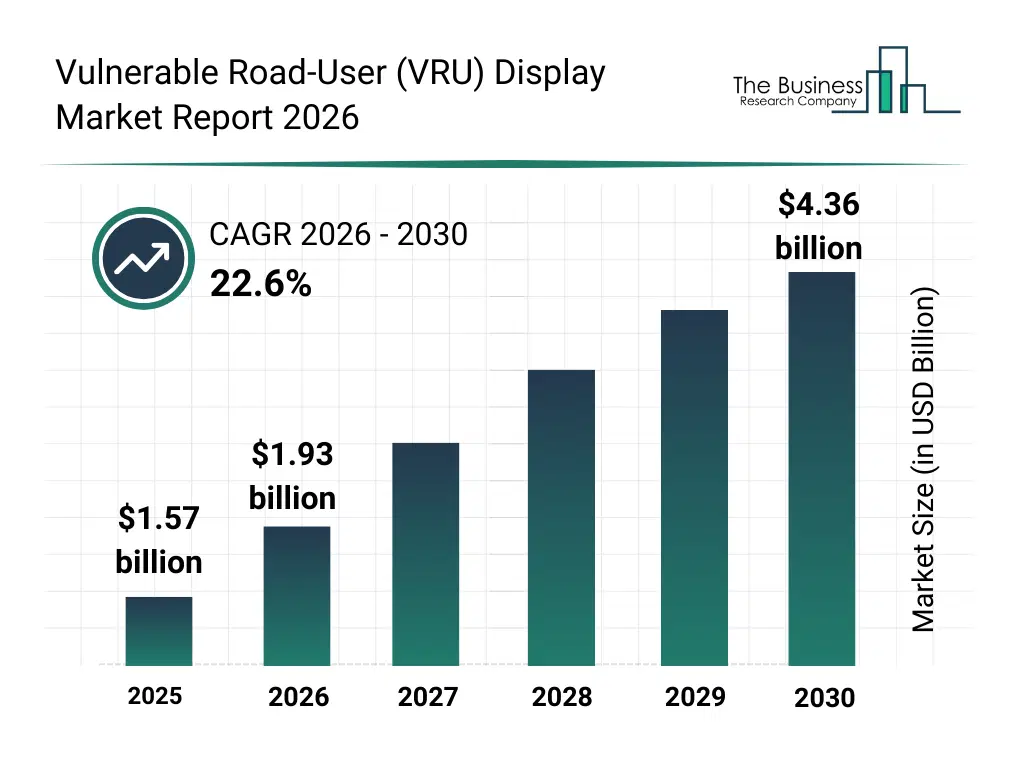
What Is The Vulnerable Road-User (VRU) Display Market Size and Share 2026?
The vulnerable road-user (vru) display market size has grown exponentially in recent years. It will grow from $1.57 billion in 2025 to $1.93 billion in 2026 at a compound annual growth rate (CAGR) of 22.9%. The growth in the historic period can be attributed to increase in urban traffic congestion, rising pedestrian accident rates, government road safety initiatives, deployment of smart traffic systems, growth in connected vehicle technologies.What Is The Vulnerable Road-User (VRU) Display Market Growth Forecast?
The vulnerable road-user (vru) display market size is expected to see exponential growth in the next few years. It will grow to $4.36 billion in 2030 at a compound annual growth rate (CAGR) of 22.6%. The growth in the forecast period can be attributed to mandatory safety regulations for vehicles, expansion of smart city infrastructure, integration with autonomous driving systems, rising adoption in commercial fleets, technological advancements in sensor displays. Major trends in the forecast period include integration of pedestrian detection displays, rising adoption in urban traffic systems, enhanced visual warning interfaces, expansion of vehicle to pedestrian communication, growing focus on road safety displays.
Global Vulnerable Road-User (VRU) Display Market Segmentation
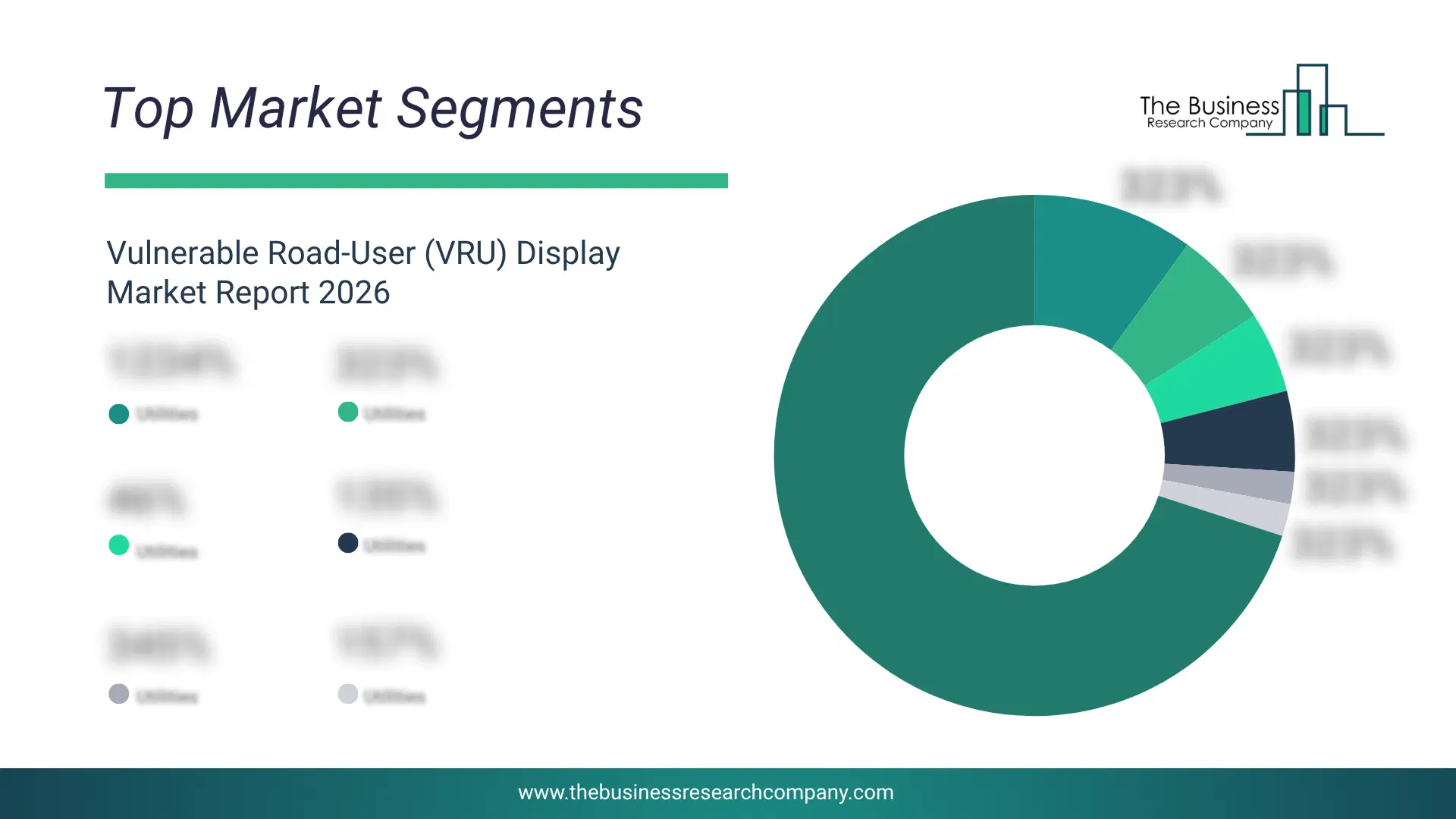
1) By Product Type: Head-Up Displays, External Displays, In-Vehicle Displays, Wearable Displays, Other Product Types 2) By Technology: Augmented Reality, Camera-Based Systems, Sensor-Based Systems, Other Technologies 3) By Application: Passenger Vehicles, Commercial Vehicles, Two-Wheelers, Other Applications 4) By End-User: Automotive Original Equipment Manufacturers (OEMs), Aftermarket, Public Transport, Other End-Users Subsegments: 1) By Head-Up Displays: Windshield Mounted Head-Up Displays, Combiner Head-Up Displays, Augmented Reality Head-Up Displays, Transparent Display Panels 2) By External Displays: Front Vehicle Mounted Displays, Rear Vehicle Mounted Displays, Side Vehicle Mounted Displays, Traffic Signal Integrated Displays 3) By In-Vehicle Displays: Dashboard Integrated Displays, Center Console Displays, Instrument Cluster Displays, Passenger Information Displays 4) By Wearable Displays: Helmet Mounted Displays, Smart Glasses Displays, Wrist-Mounted Displays, Clip-On Wearable Displays 5) By Other Product Types: Pedestrian Alert Displays, Cyclist Alert Displays, Motorcyclist Alert Displays, Custom Vulnerable Road-User (VRU) Display SolutionsWhat Are The Drivers Of The Vulnerable Road-User (VRU) Display Market?
The surge in vehicle production is expected to propel the growth of the vulnerable road-user (VRU) display market going forward. Vehicle production refers to the manufacturing and assembly of motor vehicles including passenger cars, commercial vehicles, and other automotive units by manufacturers worldwide. Vehicle production is rising due to growing consumer demand for personal mobility, as more people seek convenient, flexible, and independent transportation options to meet daily commuting, travel, and lifestyle needs. Vehicle production directly supports the vulnerable road-user (VRU) display market as manufacturers increasingly integrate these advanced safety systems into newly manufactured vehicles to meet safety regulations and enhance pedestrian protection capabilities. For instance, in May 2025, according to the European Automobile Manufacturers’ Association (ACEA), a Belgium-based motor vehicle manufacturing company, South American car production grew by 1.7% in 2024 compared to 2023, largely driven by Brazil, which experienced a 6.3% rise, producing approximately 1.9 million cars. Meanwhile, global bus production reached 362,005 units last year, marking a 10.3% increase from 2023. Therefore, the surge in vehicle production is driving the growth of the vulnerable road-user (VRU) display industry. The growing smart city initiatives is expected to propel the growth of the vulnerable road-user (VRU) display market going forward. Smart city initiatives are comprehensive urban development programs that integrate advanced technologies and digital solutions to improve city services, infrastructure efficiency, and quality of life for residents. Smart city initiatives are rising due to increasing urbanization, which is creating greater demand for efficient, connected, and inclusive urban infrastructure, advanced digital services, and accessible mobility solutions that can accommodate growing populations and enhance quality of life. Smart city initiatives, by integrating intelligent transportation systems, connected infrastructure, and advanced urban mobility technologies, support vulnerable road-user (VRU) display solutions through enhanced real-time data sharing, improved situational awareness, and safer multimodal interactions across increasingly complex urban environments. For instance, in March 2024, according to AXA Investment Managers, a France-based investment management firm, the global smart cities sector is projected to reach a valuation of US$3.7 trillion by 2030, indicating significant growth potential and strong investment opportunities. Therefore, the growing smart city initiatives is driving the growth of the vulnerable road-user (VRU) display industry.Key Players In The Global Vulnerable Road-User (VRU) Display Market
Major companies operating in the vulnerable road-user (vru) display market report include Toyota Motor Corporation, Ford Motor Company, General Motors Company, Robert Bosch GmbH, Nissan Motor Co. Ltd., Panasonic Corporation, Intel Corporation, Hyundai Mobis Co. Ltd., Continental AG, ZF Friedrichshafen AG, Magna International Inc., Mitsubishi Electric Corporation, Valeo SA, Aptiv PLC, Infineon Technologies AG, NXP Semiconductors N.V., Analog Devices Inc., Autoliv Inc., Renesas Electronics Corporation, Yunex GmbH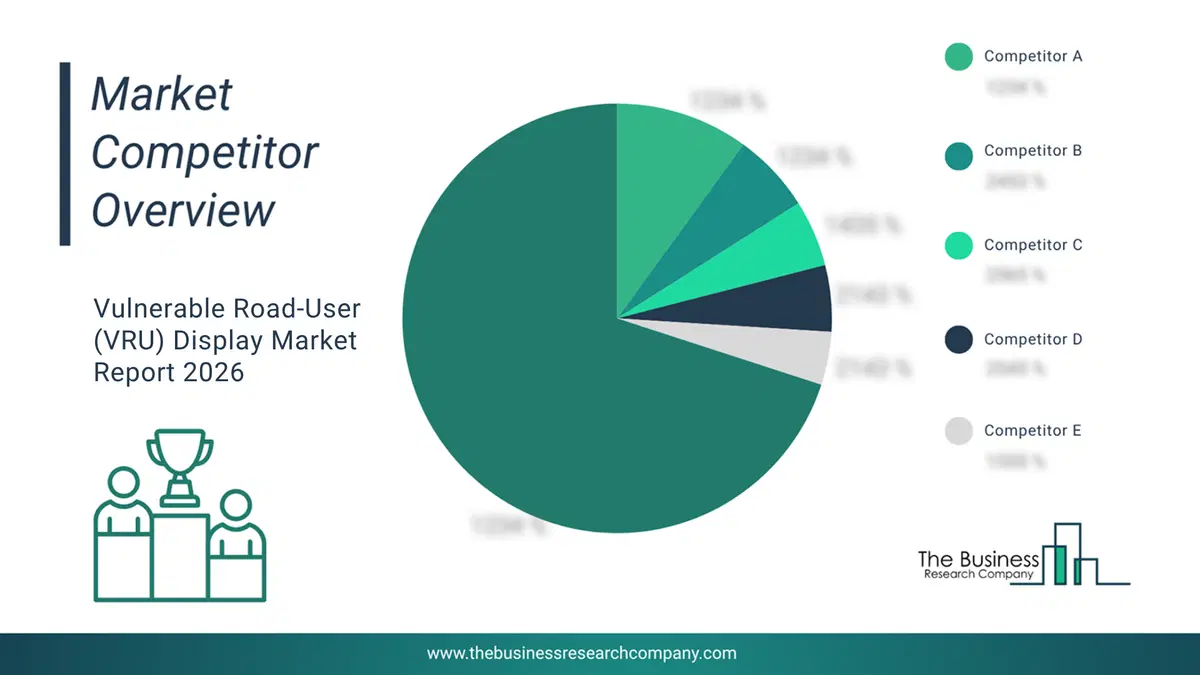
This chart is for illustrative purposes; the full report includes a detailed competitor analysis and comprehensive overview of the top 10 companies in the market.
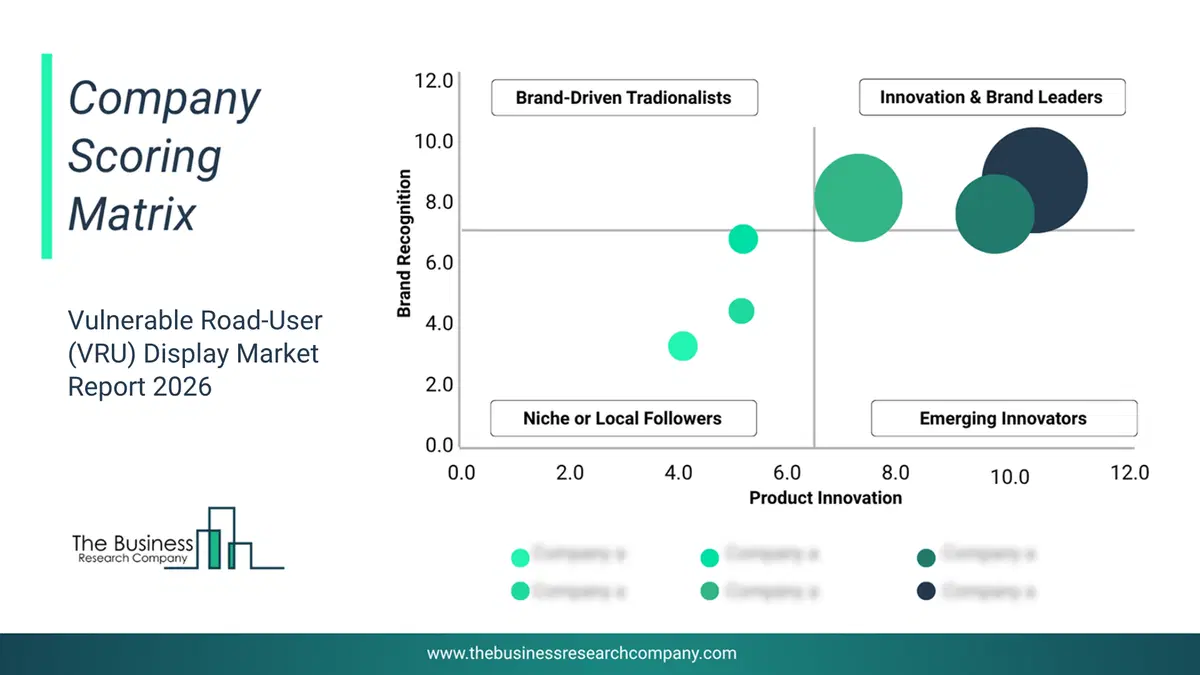
This chart maps companies by product innovation and brand strength, with bubble size indicating relative revenue, helping identify market leaders, challengers, and niche players. This is an illustrative chart; the full report provides a complete and accurate competitive analysis.
What Are Latest Mergers And Acquisitions In The Vulnerable Road-User (VRU) Display Market?
In March 2025, Nextbase Ltd., a UK-based manufacturing company, acquired Humanising Autonomy Ltd. (HA) for an undisclosed amount. With this acquisition, Nextbase aims to accelerate innovation in AI and computer vision, enhancing driver safety, security, and efficiency by integrating Humanising Autonomy Ltd.’s advanced technology into next-generation dash cam features such as Guardian Mode, Witness Mode, and Smart Sense Parking, while also strengthening its Crowd Sourced Imagery (CSI) platform to provide real-time, actionable insights for road safety, infrastructure management, and improved navigation on a scale. Humanising Autonomy Ltd. (HA) is a UK-based software development company that specializes in providing technology for Vulnerable Road-User (VRU) detection.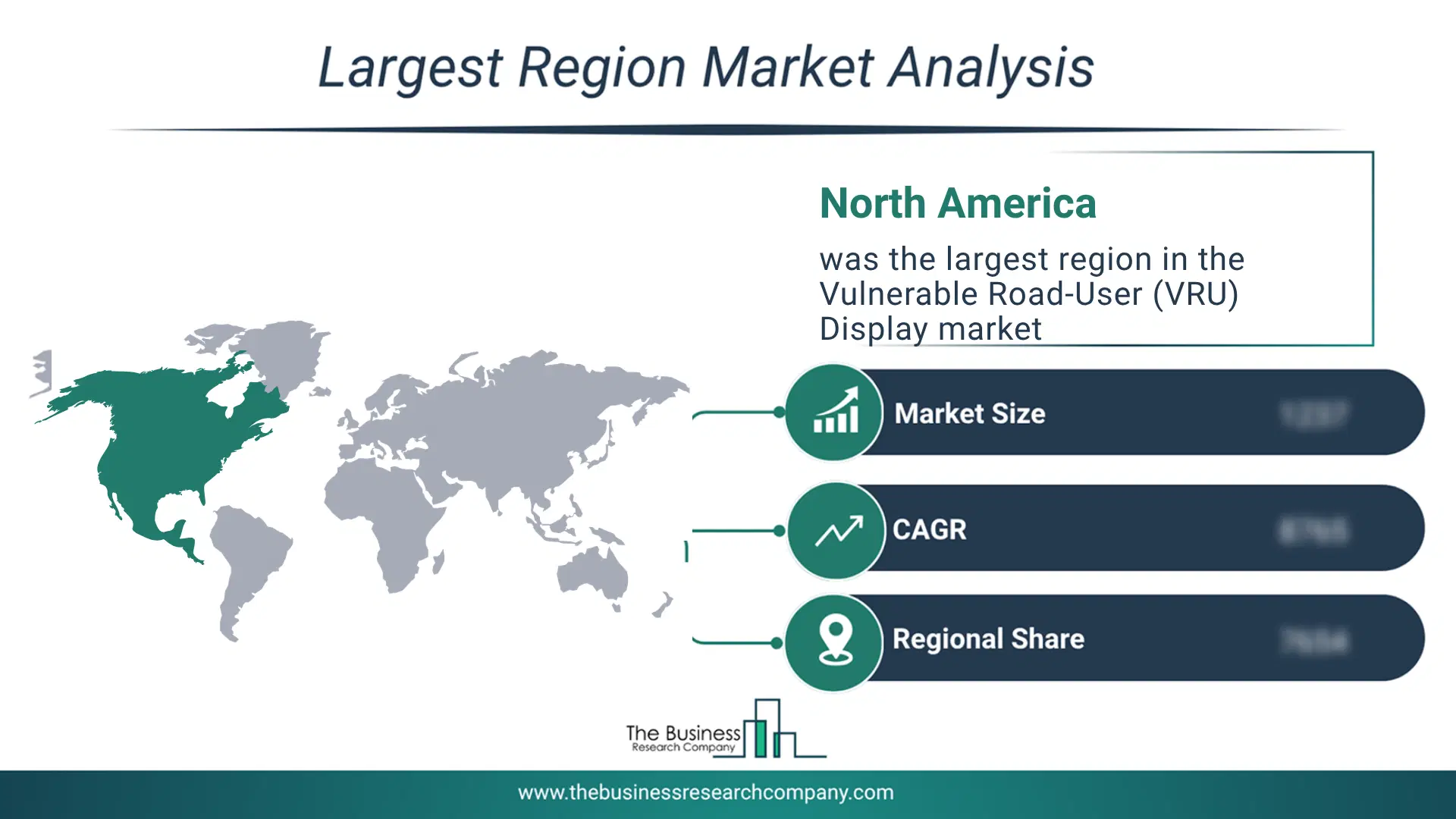
Regional Outlook
North America was the largest region in the vulnerable road-user (VRU) display market in 2025. Asia-Pacific is expected to be the fastest-growing region in the forecast period. The regions covered in this market report include Asia-Pacific, South East Asia, Western Europe, Eastern Europe, North America, South America, Middle East, Africa. The countries covered in this market report include Australia, Brazil, China, France, Germany, India, Indonesia, Japan, Taiwan, Russia, South Korea, UK, USA, Canada, Italy, SpainWhat Defines the Vulnerable Road-User (VRU) Display Market?
The vulnerable road-user (VRU) display Market consists of revenues earned by entities by providing services such as real-time hazard detection, predictive collision warning, data communication management, remote display monitoring, and software updates. The market value includes the value of related goods sold by the service provider or included within the service offering. The vulnerable road-user (VRU) display market also includes sales of led display panels, radar sensors, cameras, control units, and communication modules. Values in this market are ‘factory gate’ values, that is the value of goods sold by the manufacturers or creators of the goods, whether to other entities (including downstream manufacturers, wholesalers, distributors and retailers) or directly to end customers. The value of goods in this market includes related services sold by the creators of the goods.How is Market Value Defined and Measured?
The market value is defined as the revenues that enterprises gain from the sale of goods and/or services within the specified market and geography through sales, grants, or donations in terms of the currency (in USD unless otherwise specified). The revenues for a specified geography are consumption values that are revenues generated by organizations in the specified geography within the market, irrespective of where they are produced. It does not include revenues from resales along the supply chain, either further along the supply chain or as part of other products.
This chart presents market attractiveness based on a quantitative evaluation of growth, competition, strategic alignment, and risk, offering a clear view of opportunity areas for decision-making. This chart is for illustrative purposes; the full report contains the complete analysis.

This chart highlights the Total Addressable Market (TAM) by estimating the maximum revenue opportunity using an assumption-driven approach, supporting strategic planning and opportunity sizing across markets. The chart is illustrative; the full report provides a more comprehensive analysis.
What Key Data and Analysis Are Included in the Vulnerable Road-User (VRU) Display Market Report 2026?
The vulnerable road-user (vru) display market research report is one of a series of new reports from The Business Research Company that provides market statistics, including industry global market size, regional shares, competitors with the market share, detailed market segments, market trends and opportunities, and any further data you may need to thrive in the vulnerable road-user (vru) display industry. The market research report delivers a complete perspective of everything you need, with an in-depth analysis of the current and future state of the industry.Vulnerable Road-User (VRU) Display Market Report Forecast Analysis
| Report Attribute | Details |
|---|---|
| Market Size Value In 2026 | $1.93 billion |
| Revenue Forecast In 2030 | $4.36 billion |
| Growth Rate | CAGR of 22.9% from 2026 to 2030 |
| Base Year For Estimation | 2025 |
| Actual Estimates/Historical Data | 2020-2025 |
| Forecast Period | 2026 - 2030 - 2030 |
| Market Representation | Revenue in USD Billion and CAGR from 2026 to 2030 |
| Segments Covered | Product Type, Technology, Application, End-User |
| Regional Scope | Asia-Pacific, Western Europe, Eastern Europe, North America, South America, Middle East, Africa |
| Country Scope | The countries covered in the report are Australia, Brazil, China, France, Germany, India, Indonesia, Japan, Taiwan, Russia, South Korea, UK, USA, Canada, Italy, Spain. |
| Key Companies Profiled | Toyota Motor Corporation, Ford Motor Company, General Motors Company, Robert Bosch GmbH, Nissan Motor Co. Ltd., Panasonic Corporation, Intel Corporation, Hyundai Mobis Co. Ltd., Continental AG, ZF Friedrichshafen AG, Magna International Inc., Mitsubishi Electric Corporation, Valeo SA, Aptiv PLC, Infineon Technologies AG, NXP Semiconductors N.V., Analog Devices Inc., Autoliv Inc., Renesas Electronics Corporation, Yunex GmbH |
| Customization Scope | Request for Customization |
| Pricing And Purchase Options | Explore Purchase Options |