
Wafer Bonder And Debonder Market Report 2026
Global Outlook – By Type (Manual Wafer Bonders, Semi-Automatic Wafer Bonders, Fully Automatic Wafer Bonders), By Technology (Eutectic Bonding, Anodic Bonding, Fusion Bonding, Adhesive Bonding, Other Technologies), By Application (Micro-Electro-Mechanical Systems (MEMS) Devices, Power Devices, Optoelectronic Devices, Radio Frequency (RF) Devices, Interposers, Other Applications), By End-Use (Semiconductor, Electronics Automotive (Healthcare, Telecommunications, Other End Uses) – Market Size, Trends, Strategies, and Forecast to 2030
Wafer Bonder And Debonder Market Overview
• Wafer Bonder And Debonder market size has reached to $1.06 billion in 2025 • Expected to grow to $1.61 billion in 2030 at a compound annual growth rate (CAGR) of 8.5% • Growth Driver: Rising Demand For Advanced Semiconductor Devices Driving The Growth Of The Market Due To Adoption Of Advanced Technologies • Market Trend: Next-Generation Platforms Driving High-Density Semiconductor Packaging • Asia-Pacific was the largest region and fastest growing region.What Is Covered Under Wafer Bonder And Debonder Market?
A wafer bonder and debonder is a semiconductor processing system used to temporarily or permanently join wafers together (bonding) for processes such as thinning or handling, and later separate them (debonding) without damaging the wafers, ensuring precision and alignment throughout the process. The main types of wafer bonders and debonders are manual wafer bonders, semi-automatic wafer bonders, and fully automatic wafer bonders. Manual wafer bonders refer to semiconductor bonding machines that require operator control and adjustment to align and bond wafers, typically used for research, prototyping, and low-volume production. They use different technologies such as eutectic bonding, anodic bonding, fusion bonding, adhesive bonding, and others, which are applied in various applications, including micro-electro-mechanical systems (MEMS) devices, power devices, optoelectronic devices, radio frequency (RF) devices, interposers, and others. The key end-use industries include semiconductors, electronics, automotive, healthcare, telecommunications, and others.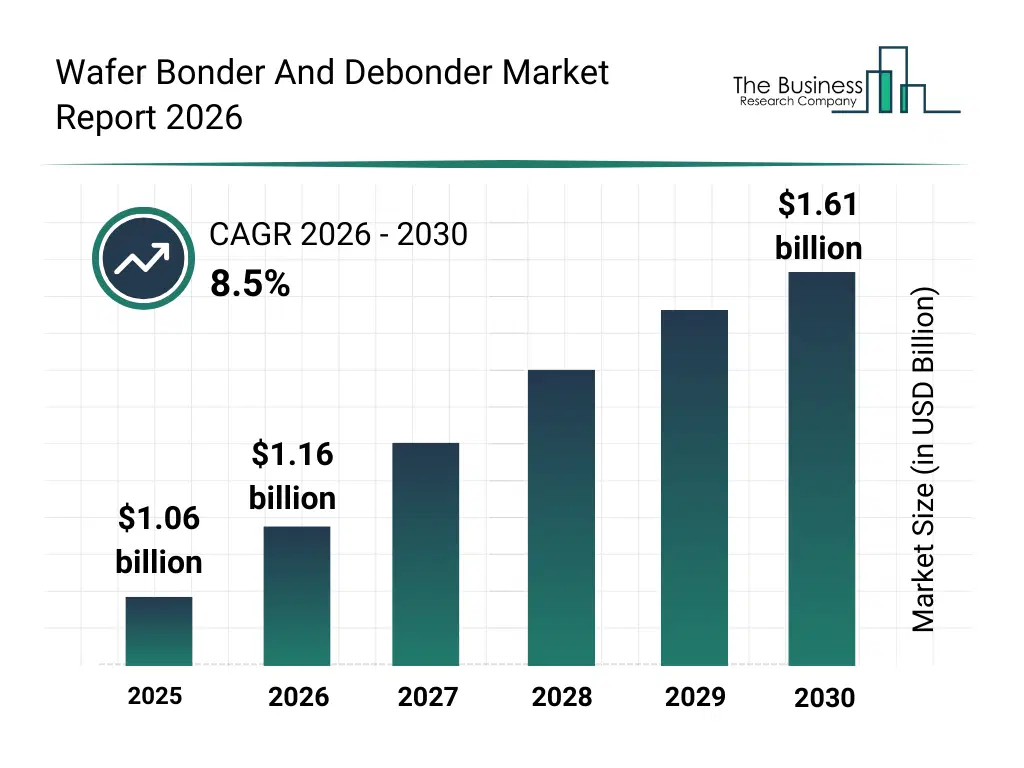
What Is The Wafer Bonder And Debonder Market Size and Share 2026?
The wafer bonder and debonder market size has grown strongly in recent years. It will grow from $1.06 billion in 2025 to $1.16 billion in 2026 at a compound annual growth rate (CAGR) of 9.4%. The growth in the historic period can be attributed to growth of semiconductor fabrication, expansion of mems devices, demand for wafer thinning processes, advancement in bonding technologies, increase in electronic device production.What Is The Wafer Bonder And Debonder Market Growth Forecast?
The wafer bonder and debonder market size is expected to see strong growth in the next few years. It will grow to $1.61 billion in 2030 at a compound annual growth rate (CAGR) of 8.5%. The growth in the forecast period can be attributed to growth of advanced packaging technologies, rising demand for power semiconductors, expansion of electric vehicle electronics, increasing semiconductor miniaturization, investment in high volume wafer manufacturing. Major trends in the forecast period include increasing adoption of advanced wafer bonding processes, growing demand for precision alignment and damage free debonding, rising use in advanced semiconductor packaging, expansion of mems and sensor manufacturing, higher focus on high volume automated wafer bonding.Tariff Impact On Wafer Bonder And Debonder Market
Tariffs have increased costs of precision components, control systems, and bonding materials used in wafer bonder and debonder equipment. Asia pacific semiconductor manufacturing hubs are most affected due to reliance on imported equipment parts. Fully automatic systems face higher cost pressure. However, tariffs are encouraging localized semiconductor equipment manufacturing and supply chain diversification.
Global Wafer Bonder And Debonder Market Segmentation
1) By Type: Manual Wafer Bonders, Semi-Automatic Wafer Bonders, Fully Automatic Wafer Bonders 2) By Technology: Eutectic Bonding, Anodic Bonding, Fusion Bonding, Adhesive Bonding, Other Technologies 3) By Application: Micro-Electro-Mechanical Systems (MEMS) Devices, Power Devices, Optoelectronic Devices, Radio Frequency (RF) Devices, Interposers, Other Applications 4) By End-Use: Semiconductor, Electronics Automotive: Healthcare, Telecommunications, Other End Uses Subsegments: 1) By Manual Wafer Bonders: Research And Development Bonding, Low-Volume Production Bonding, Prototype Device Bonding 2) By Semi-Automatic Wafer Bonders: Small-Scale Production Bonding, Pilot Line Applications, Academic And Laboratory Bonding 3) By Fully Automatic Wafer Bonders: High-Volume Manufacturing Bonding, Advanced Packaging Bonding, Micro-Electro-Mechanical Systems (MEMS) And Sensor Mass ProductionWhat Is The Driver Of The Wafer Bonder And Debonder Market?
The increasing demand for advanced semiconductor devices is expected to propel the growth of the wafer bonder and debonder market going forward. Semiconductor devices refer to electronic components that make use of the electrical properties of semiconductor materials to control the flow of electric current. The rising demand for advanced semiconductor devices is mainly driven by the rapid adoption of emerging technologies such as artificial intelligence (AI), the internet of things (IOT), and fifth-generation (5G) wireless technology, which require faster processing power and higher energy efficiency. Wafer bonders and debonders are highly useful in semiconductor device manufacturing as they enable the precise joining and separation of wafers during advanced packaging and fabrication processes. For instance, in July 2024, according to the Semiconductor Industry Association, a US-based trade association, global semiconductor industry sales reached $49.1 billion in May 2024, representing a 19.3% year-on-year increase from $41.2 billion in May 2023 and a 4.1% month-on-month growth compared to $47.2 billion in April 2024. Therefore, the increasing demand for advanced semiconductor devices is driving the growth of the wafer bonder and debonder industry.Key Players In The Global Wafer Bonder And Debonder Market
Major companies operating in the wafer bonder and debonder market are Canon Inc., Applied Materials Inc., Tokyo Electron Limited, Nitto Denko Corporation, ASM Pacific Technology Ltd., Shibaura Mechatronics Corporation, SÜSS MicroTec SE, EV Group, Palomar Technologies Inc., Toray Engineering Co. Ltd., Bondtech Co. Ltd., Applied Microengineering Ltd., Shanghai Micro Electronics Equipment Co. Ltd., Hybond Inc., SiSTEM Technology Ltd., Ayumi Industry Co. Ltd., Disco Corporation, Tokyo Seimitsu Co. Ltd., FINEPLACER, Test Research Inc., EVG Group, DNP
This chart is for illustrative purposes; the full report includes a detailed competitor analysis and comprehensive overview of the top 10 companies in the market.
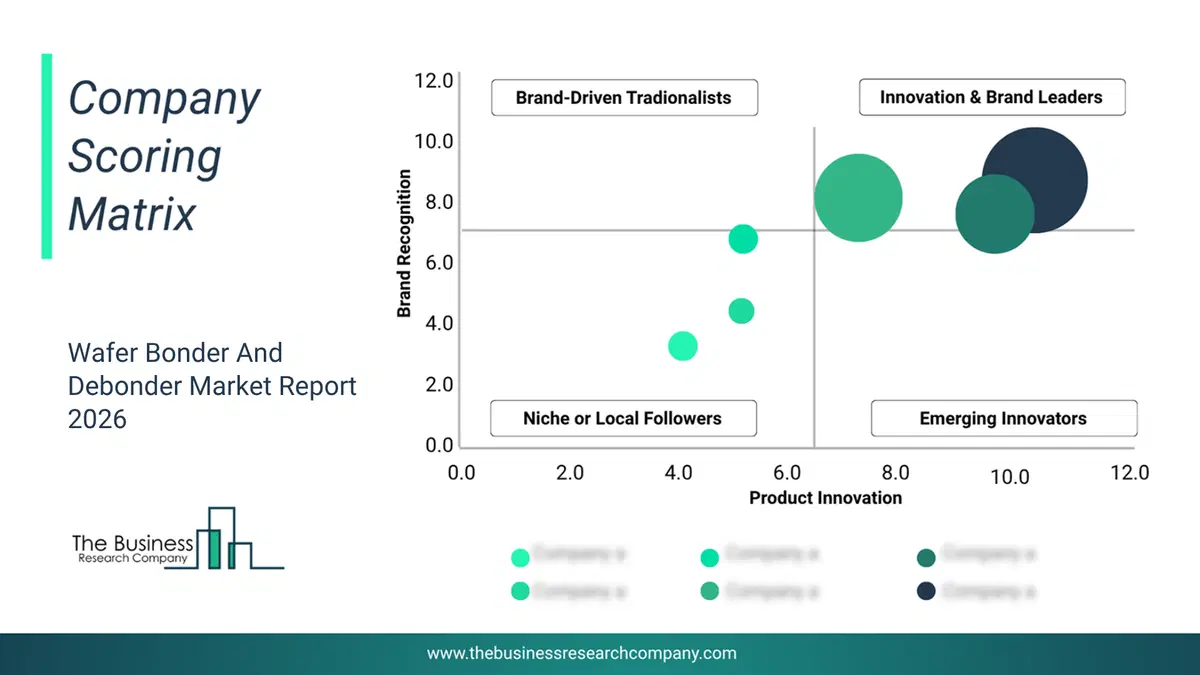
This chart maps companies by product innovation and brand strength, with bubble size indicating relative revenue, helping identify market leaders, challengers, and niche players. This is an illustrative chart; the full report provides a complete and accurate competitive analysis.
Global Wafer Bonder And Debonder Market Trends and Insights
Major companies operating in the wafer bonder and debonder market are focusing on developing innovative solutions, such as automated die-to-wafer (D2W) hybrid bonding systems, to enhance precision, scalability, and throughput in advanced semiconductor packaging and 3D integration applications. An automated die-to-wafer (D2W) hybrid bonding system refers to advanced semiconductor equipment that enables the precise alignment and bonding of individual dies onto a wafer using both mechanical and electrical chemical interconnections for high-density 3D integration. For instance, in May 2025, SUSS MicroTec SE, a Germany-based manufacturer of equipment and process solutions for microstructuring, launched the XBC300 Gen2 D2W platform, a customized bonding solution that completes the company’s hybrid bonding portfolio. This new platform underscores SUSS’s position as an industry leader in providing a fully integrated D2W hybrid bonding solution for demanding manufacturing requirements. The new SUSS process solution enables die-to-wafer (D2W) bonding on 200 mm and 300 mm substrates and meets the most demanding inter-die spacing requirements. It is an ideal platform to produce high-precision chips thanks to industry-leading footprint savings of up to 40% and a post-bond accuracy of < ±200 nm.What Are Latest Mergers And Acquisitions In The Wafer Bonder And Debonder Market?
In April 2025, Applied Materials Inc., a US-based semiconductor wafer fabrication equipment company, acquired a 9% stake in BE Semiconductor Industries N.V. for an undisclosed amount. Through this acquisition, it aims to accelerate the development and commercialization of hybrid bonding technology for advanced chip packaging, enabling higher performance, improved energy efficiency, and greater integration density. BE Semiconductor Industries is a Netherlands-based manufacturer of wafer bonding equipment.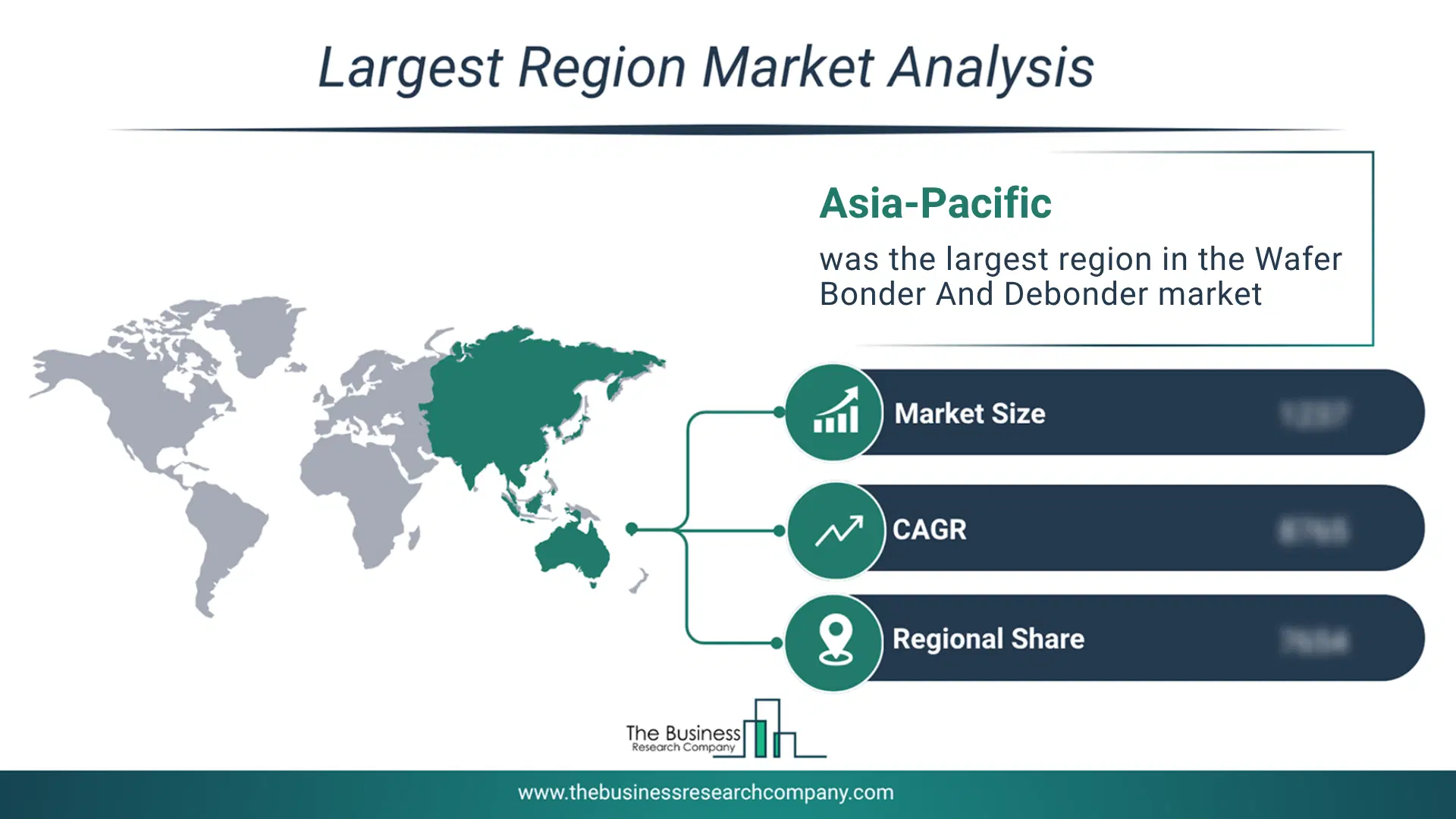
Regional Outlook
Asia-Pacific was the largest region in the wafer bonder and debonder market in 2025, and it is expected to be the fastest-growing region in the forecast period. The regions covered in this market report are Asia-Pacific, South East Asia, Western Europe, Eastern Europe, North America, South America, Middle East, Africa The countries covered in this market report are Australia, Brazil, China, France, Germany, India, Indonesia, Japan, Taiwan, Russia, South Korea, UK, USA, Canada, Italy, Spain.What Defines the Wafer Bonder And Debonder Market?
The wafer bonder and debonder market consists of sales of die attach systems, temporary bonding equipment, carrier wafers, and wafer alignment systems. Values in this market are ‘factory gate’ values, that is, the value of goods sold by the manufacturers or creators of the goods, whether to other entities (including downstream manufacturers, wholesalers, distributors, and retailers) or directly to end customers. The value of goods in this market includes related services sold by the creators of the goods.How is Market Value Defined and Measured?
The market value is defined as the revenues that enterprises gain from the sale of goods and/or services within the specified market and geography through sales, grants, or donations in terms of the currency (in USD unless otherwise specified). The revenues for a specified geography are consumption values that are revenues generated by organizations in the specified geography within the market, irrespective of where they are produced. It does not include revenues from resales along the supply chain, either further along the supply chain or as part of other products.
This chart presents market attractiveness based on a quantitative evaluation of growth, competition, strategic alignment, and risk, offering a clear view of opportunity areas for decision-making. This chart is for illustrative purposes; the full report contains the complete analysis.

This chart highlights the Total Addressable Market (TAM) by estimating the maximum revenue opportunity using an assumption-driven approach, supporting strategic planning and opportunity sizing across markets. The chart is illustrative; the full report provides a more comprehensive analysis.
What Key Data and Analysis Are Included in the Wafer Bonder And Debonder Market Report 2026?
The wafer bonder and debonder market research report is one of a series of new reports from The Business Research Company that provides market statistics, including industry global market size, regional shares, competitors with the market share, detailed market segments, market trends and opportunities, and any further data you may need to thrive in the wafer bonder and debonder industry. The market research report delivers a complete perspective of everything you need, with an in-depth analysis of the current and future state of the industry.Wafer Bonder And Debonder Market Report Forecast Analysis
| Report Attribute | Details |
|---|---|
| Market Size Value In 2026 | $1.16 billion |
| Revenue Forecast In 2030 | $1.61 billion |
| Growth Rate | CAGR of 8.5% from 2026 to 2030 |
| Base Year For Estimation | 2025 |
| Actual Estimates/Historical Data | 2020-2025 |
| Forecast Period | 2026 - 2030 |
| Market Representation | Revenue in USD Billion and CAGR from 2026 to 2030 |
| Segments Covered | Type, Technology, Application, End-Use |
| Regional Scope | Asia-Pacific, Western Europe, Eastern Europe, North America, South America, Middle East, Africa |
| Key Companies Profiled | Canon Inc., Applied Materials Inc., Tokyo Electron Limited, Nitto Denko Corporation, ASM Pacific Technology Ltd., Shibaura Mechatronics Corporation, SÜSS MicroTec SE, EV Group, Palomar Technologies Inc., Toray Engineering Co. Ltd., Bondtech Co. Ltd., Applied Microengineering Ltd., Shanghai Micro Electronics Equipment Co. Ltd., Hybond Inc., SiSTEM Technology Ltd., Ayumi Industry Co. Ltd., Disco Corporation, Tokyo Seimitsu Co. Ltd., FINEPLACER, Test Research Inc., EVG Group, DNP |
| Customization Scope | Request for Customization |
| Pricing And Purchase Options | Explore Purchase Options |