
Warehouse Automation Market Report 2026
Global Outlook – By Type (Conveyor Or Sortation Systems, Automated Storage And Retrieval Systems (AS Or RS), Mobile Robots, Warehouse Management Systems (WMS), Automatic Identification And Data Capture (AIDC)), By Component (Hardware, Software), By Function (Inbound, Picking, Outbound), By End User (General Merchandise, Healthcare, FMCG Or Non-Durable Goods, Other End Users) – Market Size, Trends, Strategies, and Forecast to 2030
Warehouse Automation Market Overview
• Warehouse Automation market size has reached to $23.92 billion in 2025 • Expected to grow to $47 billion in 2030 at a compound annual growth rate (CAGR) of 14.4% • Growth Driver: Growing Demand From E-Commerce Spurs Expansion Of Warehouse Automation Market • Market Trend: Advanced Warehouse Automation Solutions Enhance Efficiency and Accuracy • North America was the largest region in 2025 and Asia-Pacific is the fastest growing region.What Is Covered Under Warehouse Automation Market?
The warehouse automation refer to devices or systems used to streamline repetitive warehouse operations and make them less labor intensive to generate greater operational efficiencies. Warehouse automation is an integral part of supply chain optimization, as it reduces time, effort, and errors caused by manual or repetitive tasks. These automated systems are transforming operational facilities by increasing the speed of inventory movement, increasing storage density, reducing labor costs, and improving human safety inside the facility. The main types of warehouse automation are conveyor/sortation systems, automated storage and retrieval systems (AS/RS), mobile robots, warehouse management systems (WMS), and automatic identification and data capture (AIDC). Sortation is the act of detecting individual objects on a conveyor system and routing them to the appropriate areas with the help of a variety of devices controlled by task-specific software. They are divided based on components in hardware and software that can perform activities such as inbound, picking, and outbound. There are various end users of warehouse automation, such as general merchandise, healthcare, FMCG/non-durable goods, and other end users.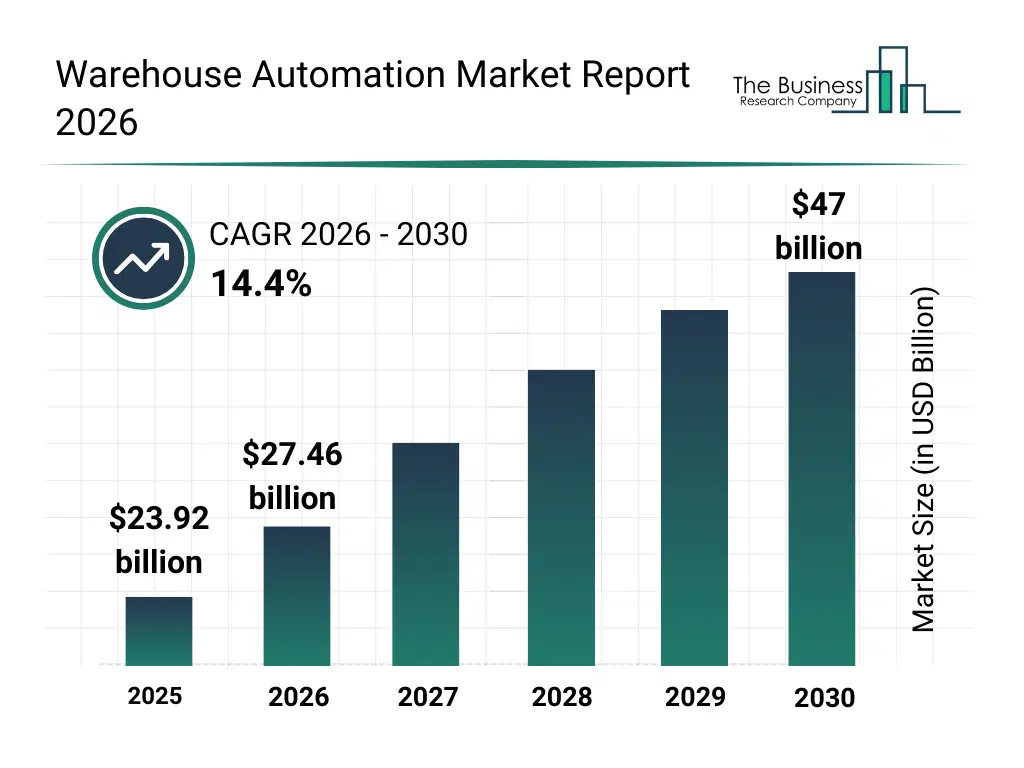
What Is The Warehouse Automation Market Size and Share 2026?
The warehouse automation market size has grown rapidly in recent years. It will grow from $23.92 billion in 2025 to $27.46 billion in 2026 at a compound annual growth rate (CAGR) of 14.8%. The growth in the historic period can be attributed to high labor costs in warehousing, manual inventory errors, inefficiencies in order fulfillment, limited warehouse space optimization, rising demand for faster delivery.What Is The Warehouse Automation Market Growth Forecast?
The warehouse automation market size is expected to see rapid growth in the next few years. It will grow to $47 billion in 2030 at a compound annual growth rate (CAGR) of 14.4%. The growth in the forecast period can be attributed to growing e-commerce penetration, adoption of ai-driven automation, expansion of smart warehouses, integration of mobile robots, increasing demand for real-time data analytics. Major trends in the forecast period include real-time inventory tracking, automated order fulfillment, predictive maintenance solutions, robotics integration for material handling, cloud-based warehouse management.
Global Warehouse Automation Market Segmentation
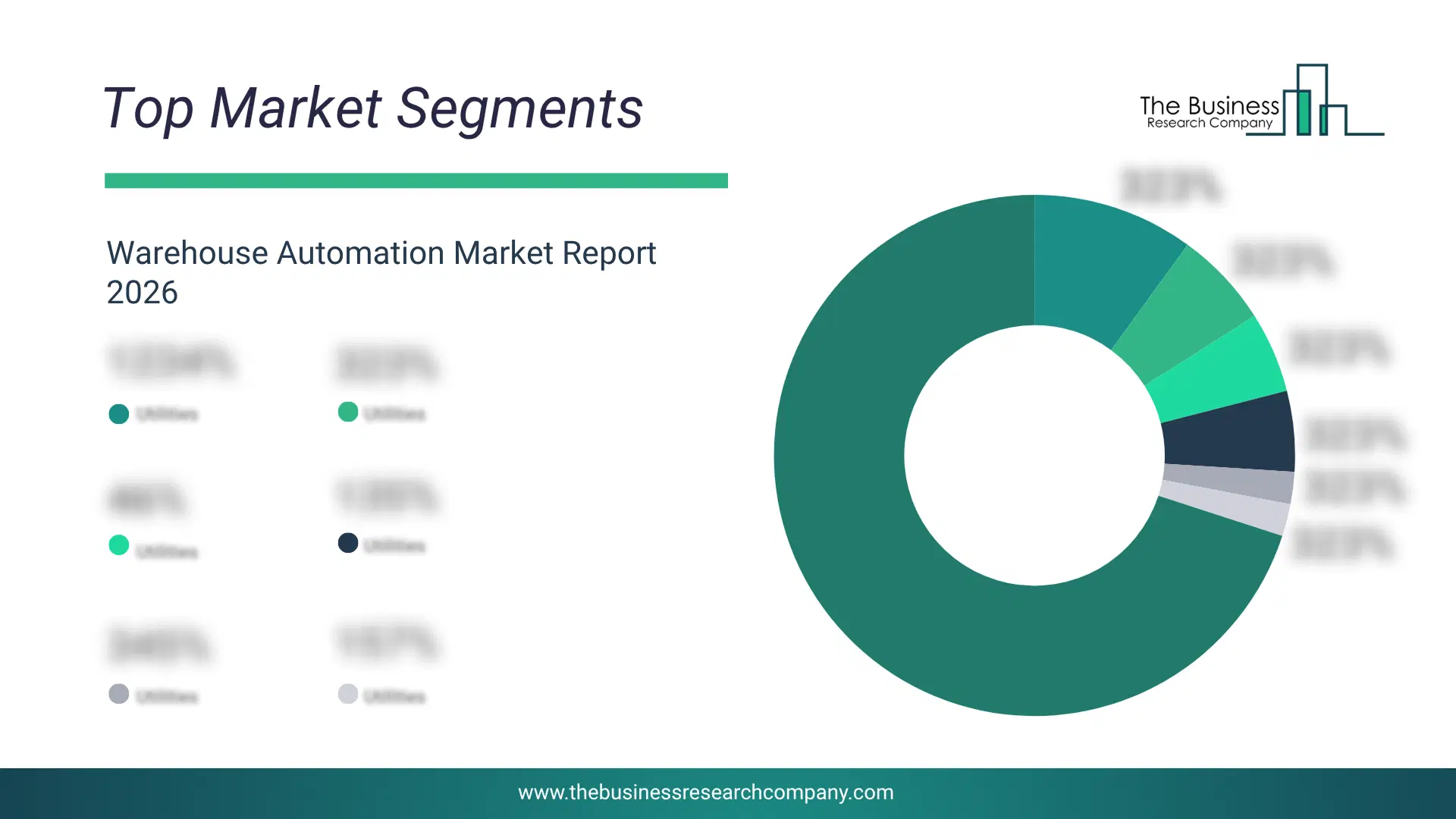
1) By Type: Conveyor Or Sortation Systems, Automated Storage And Retrieval Systems (AS Or RS), Mobile Robots, Warehouse Management Systems (WMS), Automatic Identification And Data Capture (AIDC) 2) By Component: Hardware, Software 3) By Function: Inbound, Picking, Outbound 4) By End User: General Merchandise, Healthcare, FMCG Or Non-Durable Goods, Other End Users Subsegments: 1) By Conveyor Or Sortation Systems: Belt Conveyors, Roller Conveyors, Sortation Systems 2) By Automated Storage And Retrieval Systems (AS Or RS): Unit Load AS Or RS, Mini-Load AS Or RS, Automated Tote and Bin Systems 3) By Mobile Robots: Autonomous Mobile Robots (AMRs), Automated Guided Vehicles (AGVs) 4) By Warehouse Management Systems (WMS): Cloud-based WMS, On-premise WMS 5) By Automatic Identification and Data Capture (AIDC): Barcode Scanners, RFID Systems, Voice Recognition SystemsWhat Is The Driver Of The Warehouse Automation Market?
The rise in e-commerce sales will drive the growth of the warehouse automation market. As retailers struggle to keep up with the increasing volume of orders and their last-mile delivery needs, warehouse automation is briskly turning into the trump card for those who are looking for a leg up on the competition, especially in the competitive e-grocery market. For instance, in May 2024, according to the United States Census Bureau, a US-based government agency, the first quarter of 2024 e-commerce estimate increased 8.5 percent from the first quarter of 2023, while total retail sales increased 2.8 percent in the same period. Therefore, the rise in the e-commerce sector is expected to boost the warehouse automation industry during the forecast period.Key Players In The Global Warehouse Automation Market
Major companies operating in the warehouse automation market are Viastore Systems Inc.; ABB Ltd.; Toyota Industries Corporation; Kion Group AG; Omron Corporation; Daifuku Co Ltd.; Yaskawa Electric Corp Inc.; KUKA Group; Schaefer Systems International Pvt Ltd.; Honeywell Intelligrated Systems Inc.; KNAPP Group; Vanderlande Industries BV; SSI Schaefer AG; Material Handling Systems Inc.; WITRON Logistik + Informatik GmbH; Mecalux SA; Beumer Group; TGW Logistics Group; Swisslog Holding; Interroll Group; Bastian Solutions LLC; Kardex Group; Grenzebach Group; System Logistics SpA; Locus Robotics; Murata Machinery Ltd.; Kardex Remstar LLC; Godrej Koerber Supply Chain Limited; Space Magnum Equipments Pvt Ltd.; Fives Group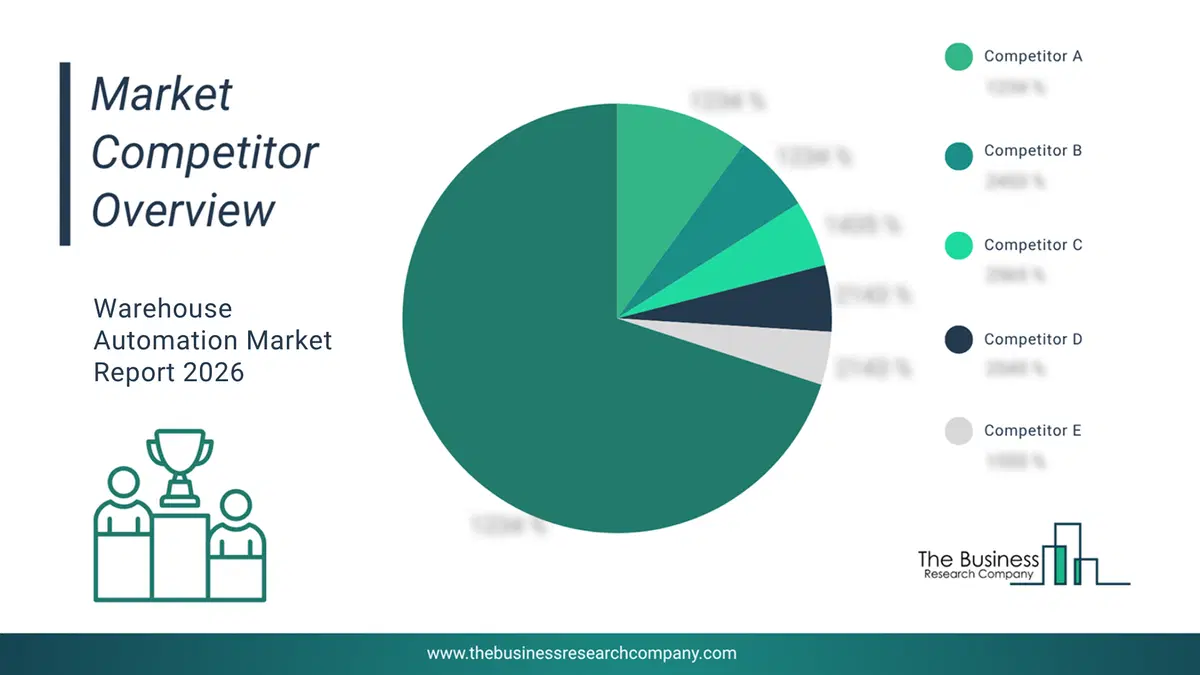
This chart is for illustrative purposes; the full report includes a detailed competitor analysis and comprehensive overview of the top 10 companies in the market.
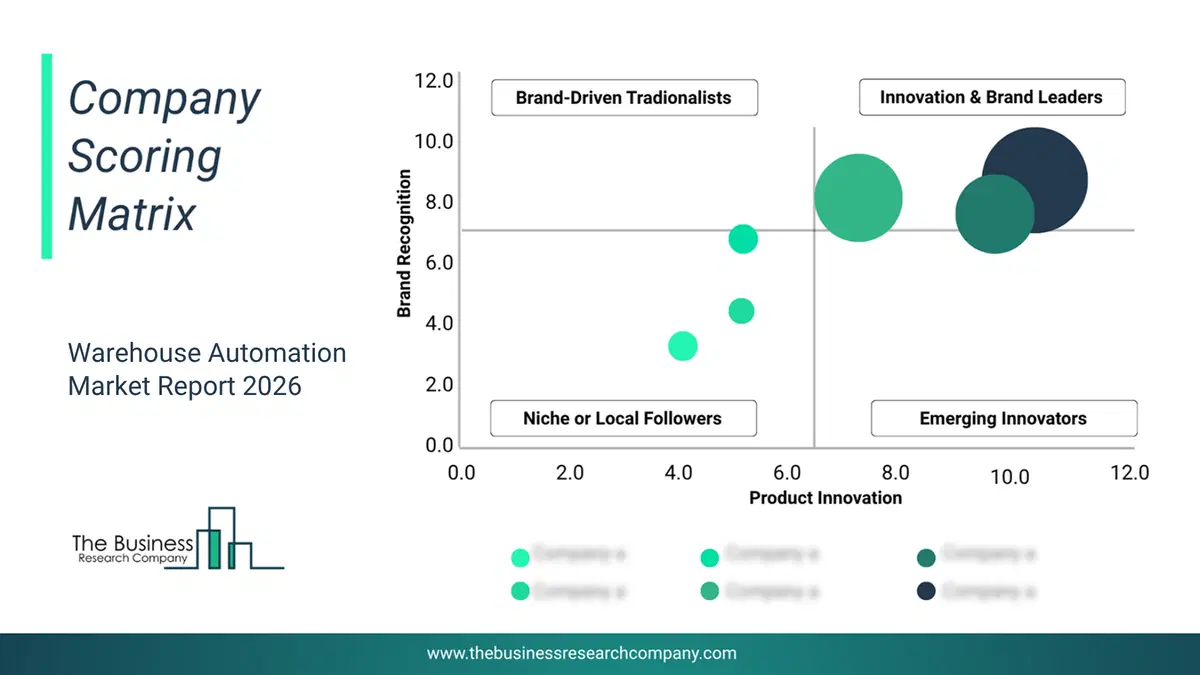
This chart maps companies by product innovation and brand strength, with bubble size indicating relative revenue, helping identify market leaders, challengers, and niche players. This is an illustrative chart; the full report provides a complete and accurate competitive analysis.
Global Warehouse Automation Market Trends and Insights
Major companies operating in the warehouse automation market are focusing on advanced solution, to provide reliable services to customers. For instance, in September 2024, Stow Group a Belgium-based warehouse automation provider launched Movu Robotics. It provides a suite of advanced solutions to optimize warehouse operations. Movu Atlas enhances pallet storage density, while Movu Escala streamlines bin transport. The Movu iFollow AMR works alongside operators to move pallets, and Movu Eligo improves order-picking accuracy. Together, these products offer a plug-and-play automation ecosystem for efficient handling and storage across sectors.What Are Latest Mergers And Acquisitions In The Warehouse Automation Market?
In March 2023, Jungheinrich AG, a Germany-based sales financing company acquired Storage Solutions, Inc. for an undisclosed amount. This acquisition is part of Jungheinrich's strategy to enhance its presence in the material handling and warehouse solutions market, as it aims to leverage Storage Solutions' expertise in providing tailored storage solutions and optimizing warehouse space. Storage Solutions, Inc. is a US-based provider of warehouse automation solutions.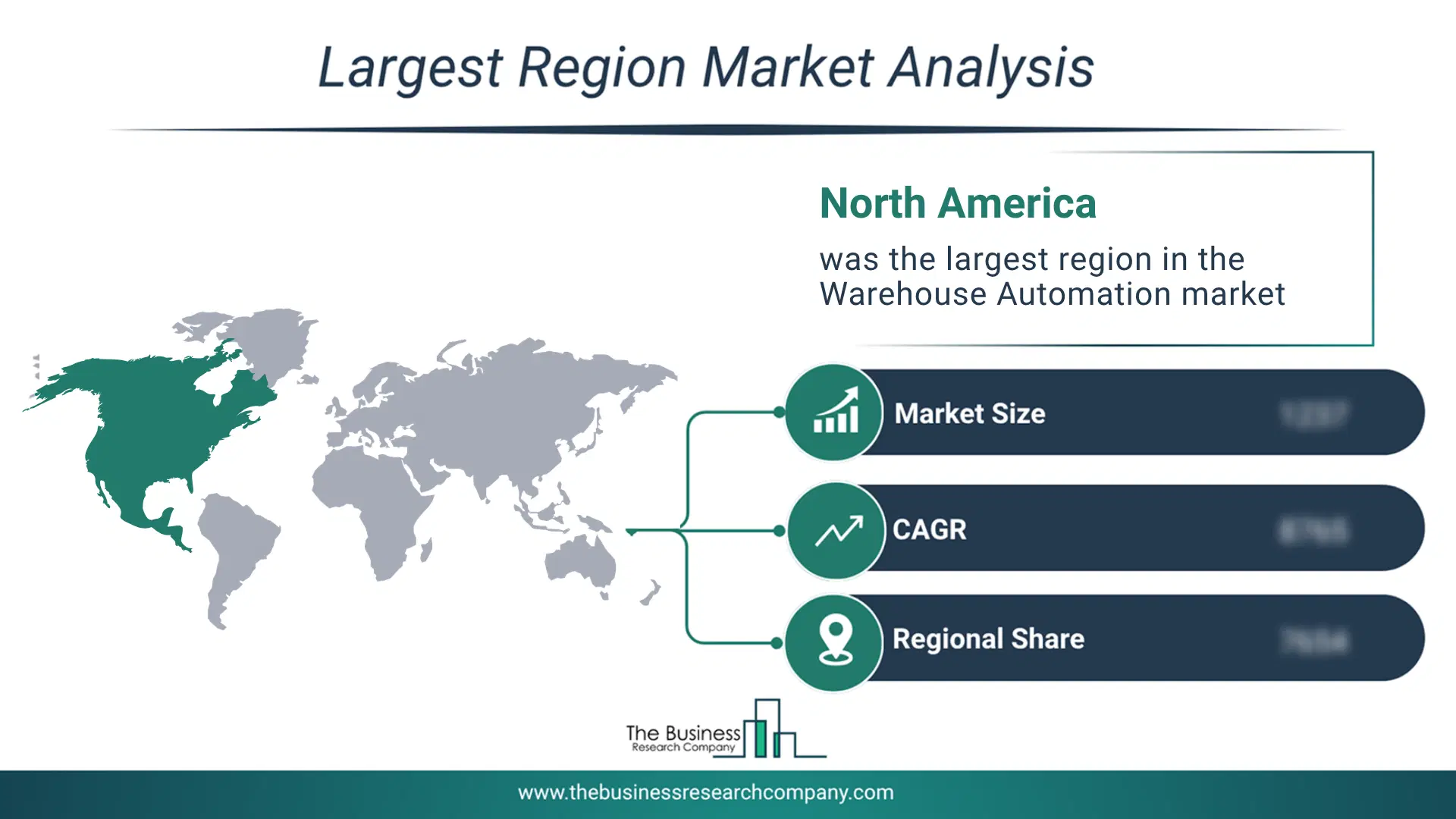
Regional Insights
North America was the largest region in the warehouse automation market in 2025. Asia-Pacific is expected to be the fastest-growing region in the forecast period. The regions covered in this market report are Asia-Pacific, South East Asia, Western Europe, Eastern Europe, North America, South America, Middle East, Africa. The countries covered in this market report are Australia, Brazil, China, France, Germany, India, Indonesia, Japan, Taiwan, Russia, South Korea, UK, USA, Canada, Italy, SpainWhat Defines the Warehouse Automation Market?
The warehouse automation market includes revenues earned by entities by providing services such as inbound logistics and outbound logistics tools for picking and packing processes, resource utilization, analytics, and others. The market value includes the value of related goods sold by the service provider or included within the service offering. Only goods and services traded between entities or sold to end consumers are included.How is Market Value Defined and Measured?
The market value is defined as the revenues that enterprises gain from the sale of goods and/or services within the specified market and geography through sales, grants, or donations in terms of the currency (in USD unless otherwise specified). The revenues for a specified geography are consumption values that are revenues generated by organizations in the specified geography within the market, irrespective of where they are produced. It does not include revenues from resales along the supply chain, either further along the supply chain or as part of other products.
This chart presents market attractiveness based on a quantitative evaluation of growth, competition, strategic alignment, and risk, offering a clear view of opportunity areas for decision-making. This chart is for illustrative purposes; the full report contains the complete analysis.

This chart highlights the Total Addressable Market (TAM) by estimating the maximum revenue opportunity using an assumption-driven approach, supporting strategic planning and opportunity sizing across markets. The chart is illustrative; the full report provides a more comprehensive analysis.
What Key Data and Analysis Are Included in the Warehouse Automation Market Report 2026?
The warehouse automation market research report is one of a series of new reports from The Business Research Company that provides market statistics, including industry global market size, regional shares, competitors with the market share, detailed market segments, market trends and opportunities, and any further data you may need to thrive in the warehouse automation industry. The market research report delivers a complete perspective of everything you need, with an in-depth analysis of the current and future state of the industry.Warehouse Automation Market Report Forecast Analysis
| Report Attribute | Details |
|---|---|
| Market Size Value In 2026 | $27.46 billion |
| Revenue Forecast In 2030 | $47 billion |
| Growth Rate | CAGR of 14.4% from 2026 to 2030 |
| Base Year For Estimation | 2025 |
| Actual Estimates/Historical Data | 2020-2025 |
| Forecast Period | 2026 - 2030 |
| Market Representation | Revenue in USD Billion and CAGR from 2026 to 2030 |
| Segments Covered | Type, Component, Function, End User |
| Regional Scope | Asia-Pacific, Western Europe, Eastern Europe, North America, South America, Middle East, Africa |
| Country Scope | The Countries Covered In This Market Report Are Australia, Brazil, China, France, Germany, India, Indonesia, Japan, Taiwan, Russia, South Korea, Uk, Usa, Canada, Italy, Spain. |
| Key Companies Profiled | Viastore Systems Inc., ABB Ltd., Toyota Industries Corporation, Kion Group AG, Omron Corporation, Daifuku Co Ltd., Yaskawa Electric Corp Inc., KUKA Group, Schaefer Systems International Pvt Ltd., Honeywell Intelligrated Systems Inc., KNAPP Group, Vanderlande Industries BV, SSI Schaefer AG, Material Handling Systems Inc., WITRON Logistik + Informatik GmbH, Mecalux SA, Beumer Group, TGW Logistics Group, Swisslog Holding, Interroll Group, Bastian Solutions LLC, Kardex Group, Grenzebach Group, System Logistics SpA, Locus Robotics, Murata Machinery Ltd., Kardex Remstar LLC, Godrej Koerber Supply Chain Limited, Space Magnum Equipments Pvt Ltd., Fives Group |
| Customization Scope | Request for Customization |
| Pricing And Purchase Options | Explore Purchase Options |