
Warehouse Automation Systems Market Report 2026
Global Outlook – By Component (Solution, Service), By Automation Type (Physical Automation, Digital Automation), By Enterprise Size (Large Enterprises, Small And Midsize Enterprises (SMEs)), By Industry Vertical (Retail And Consumer Goods, Healthcare And Pharmaceuticals, Manufacturing, Food And Beverages, Transportation And Logistics, Automotive, Other Industry Verticals) – Market Size, Trends, Strategies, and Forecast to 2030
Warehouse Automation Systems Market Overview
• Warehouse Automation Systems market size has reached to $31.71 billion in 2025 • Expected to grow to $58.37 billion in 2030 at a compound annual growth rate (CAGR) of 12.5% • Growth Driver: E-commerce Surge Fuels Warehouse Automation Systems Market Growth • Market Trend: Rise Of Plug-and-Play Cube Storage Technology Embracing Modular Automation • North America was the largest region in 2025.What Is Covered Under Warehouse Automation Systems Market?
Warehouse automation systems refer to technological solutions designed to optimize and streamline the processes of inventory management and order fulfillment within a warehouse or distribution center. These systems employ various tools such as robotics, conveyor systems, and software algorithms, to increase efficiency, accuracy, and throughput while reducing labor costs and human error. The main types of components of warehouse automation systems are solutions and services. The solution segment in the warehouse automation systems market encompasses comprehensive packages tailored to meet specific warehouse automation needs. The automation types of warehouse automation systems include physical automation and digital automation, and they are used by different enterprise sizes such as large enterprises and small and midsize enterprises (SMEs) in various industry verticals including retail and consumer goods, healthcare and pharmaceuticals, manufacturing, food and beverages, transportation and logistics, automotive, and others.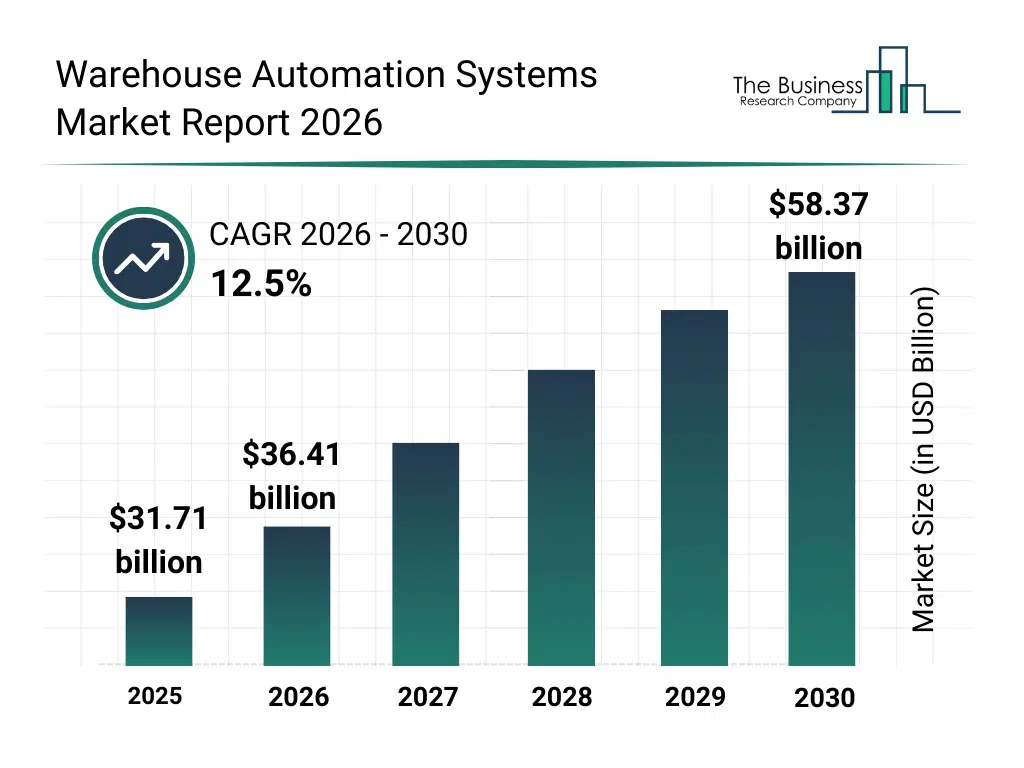
What Is The Warehouse Automation Systems Market Size and Share 2026?
The warehouse automation systems market size has grown rapidly in recent years. It will grow from $31.71 billion in 2025 to $36.41 billion in 2026 at a compound annual growth rate (CAGR) of 14.8%. The growth in the historic period can be attributed to expansion of large-scale distribution centers, growth of retail and e-commerce logistics, rising labor cost pressures, adoption of conveyor-based automation, increasing warehouse throughput requirements.What Is The Warehouse Automation Systems Market Growth Forecast?
The warehouse automation systems market size is expected to see rapid growth in the next few years. It will grow to $58.37 billion in 2030 at a compound annual growth rate (CAGR) of 12.5%. The growth in the forecast period can be attributed to increasing investments in smart logistics infrastructure, rising demand for scalable automation solutions, expansion of omnichannel fulfillment models, growing focus on real-time inventory visibility, increasing adoption among small and midsize enterprises. Major trends in the forecast period include increasing deployment of robotics and agvs in warehouses, rising adoption of automated storage and retrieval systems, growing integration of warehouse management software, expansion of high-speed sorting and picking solutions, enhanced focus on error-free order fulfillment.
Global Warehouse Automation Systems Market Segmentation
1) By Component: Solution, Service 2) By Automation Type: Physical Automation, Digital Automation 3) By Enterprise Size: Large Enterprises, Small And Midsize Enterprises (SMEs) 4) By Industry Vertical: Retail And Consumer Goods, Healthcare And Pharmaceuticals, Manufacturing, Food And Beverages, Transportation And Logistics, Automotive, Other Industry Verticals Subsegments: 1) By Solution: Automated Storage And Retrieval Systems, Conveyors And Sortation Systems, Robotic Systems, Automated Guided Vehicles, Warehouse Control Software, Warehouse Management Software, Picking And Sorting Solutions 2) By Service: Integration And Implementation Services, Consulting And Design Services, Maintenance And Support Services, Training And Managed ServicesWhat Is The Driver Of The Warehouse Automation Systems Market?
A rise in e-commerce sales is expected to propel the growth of the warehouse automation systems market going forward. The rise in e-commerce sales can be attributed to increased internet penetration and convenience, offering consumers a wide range of products accessible anywhere. Warehouse automation systems are integral to e-commerce for optimizing order fulfillment, reducing labor costs, and enhancing efficiency through technologies like robotic picking and automated conveyor systems. These systems streamline operations, minimize errors, and enable rapid processing of orders, improving customer satisfaction and scaling businesses. For instance, in February 2024, according to the Census Bureau of the Department of Commerce, a US-based government department, in the fourth quarter of 2023, e-commerce sales surged by 7.5% compared to the same period in 2022. Therefore, a rise in e-commerce sales is driving the growth of the warehouse automation systems industry.Key Players In The Global Warehouse Automation Systems Market
Major companies operating in the warehouse automation systems market are KION Group, Daifuku Co. Ltd., Fritz SchäFer GmbH, Vanderlande Industries B.V., Dematic GmbH, KNAPP AG, Fives S.A.S., Murata Machinery Ltd., Intelligrated Inc., Beumer Group GmbH & Co. KG, Interlake Mecalux Inc., TGW Logistics Group, Bastian Solutions, Swisslog Holding AG, Cimcorp Group, Geek+ Robotics, System Logistics Spa, GreyOrange Inc., viastore Systems Inc., Grenzebach Maschinenbau GmbH, Locus Robotics, Westfalia Technologies Inc., Fetch Robotics Inc., Clearpath Robotics Inc.
This chart is for illustrative purposes; the full report includes a detailed competitor analysis and comprehensive overview of the top 10 companies in the market.
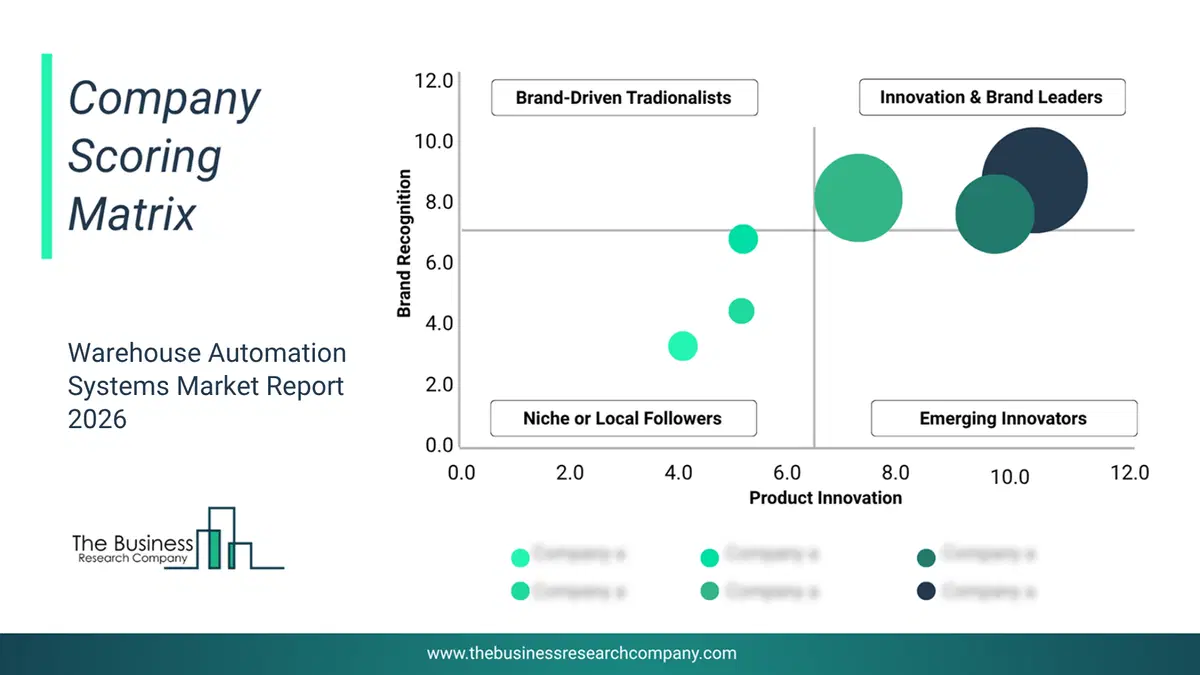
This chart maps companies by product innovation and brand strength, with bubble size indicating relative revenue, helping identify market leaders, challengers, and niche players. This is an illustrative chart; the full report provides a complete and accurate competitive analysis.
Global Warehouse Automation Systems Market Trends and Insights
Major companies operating in the warehouse automation systems market are focusing on modular and easy-to-implement solutions in warehouse automation such as plug-and-play cube storage technology, to gain a competitive edge and provide better warehousing solutions. Plug-and-play cube storage technology offers a modular system with standardized components such as storage bins, robotic shuttles, and control systems, enabling easy deployment and customization for efficient goods storage. For instance, in January 2023, AutoStore AS, a Norway-based provider of automated storage and retrieval systems (ASRS), launched Pio, a plug-and-play version of its cube storage technology tailored for small and medium-sized businesses (SMBs). Pio operates on a pay-per-pick service model, making robotic automation accessible to small and medium-sized businesses (SMBs) at a modest investment. This democratizes access to top-tier automation technology, empowering independent brands. Its design facilitates same-day order processing, quicker and more economical item processing, and enhances picking and packing operations by up to five times the speed.What Are Latest Mergers And Acquisitions In The Warehouse Automation Systems Market?
In March 2024, Wincanton plc, a UK-based logistics company, acquired Invar Group Limited (Invar) for an undisclosed amount. The acquisition is part of Wincanton's broader efforts to transform warehouse operations for its customers and accelerate its robotics and automation roadmap. Invar Group Limited (Invar) is a UK-based provider of warehouse automation systems.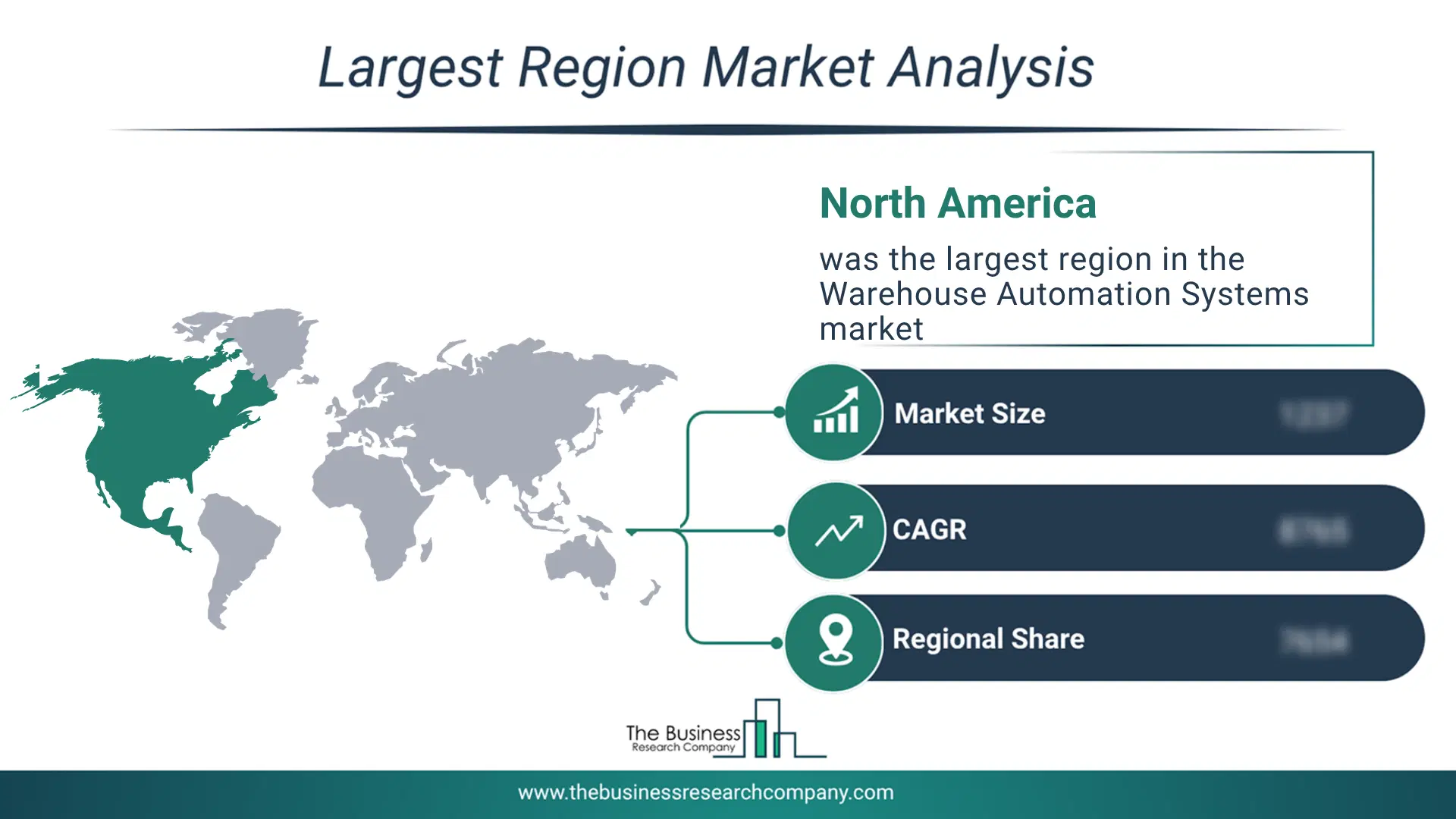
Regional Insights
North America was the largest region in the warehouse automation systems market in 2025. The regions covered in this market report are Asia-Pacific, South East Asia, Western Europe, Eastern Europe, North America, South America, Middle East, Africa. The countries covered in this market report are Australia, Brazil, China, France, Germany, India, Indonesia, Japan, Taiwan, Russia, South Korea, UK, USA, Canada, Italy, Spain.What Defines the Warehouse Automation Systems Market?
The warehouse automation systems market consists of revenues earned by entities by providing services such as inventory management, order fulfillment, picking and packing, transportation management, and robotic material handling. The market value includes the value of related goods sold by the service provider or included within the service offering. The warehouse automation market also includes sales of conveyors, sortation systems, automated storage and retrieval systems (AS/RS), barcode scanners, radio frequency identification (RFID) readers, sensors (proximity sensors, weight sensors, etc.), and computerized control systems. Values in this market are ‘factory gate’ values, that is, the value of goods sold by the manufacturers or creators of the goods, whether to other entities (including downstream manufacturers, wholesalers, distributors, and retailers) or directly to end customers. The value of goods in this market includes related services sold by the creators of the goods.How is Market Value Defined and Measured?
The market value is defined as the revenues that enterprises gain from the sale of goods and/or services within the specified market and geography through sales, grants, or donations in terms of the currency (in USD unless otherwise specified). The revenues for a specified geography are consumption values that are revenues generated by organizations in the specified geography within the market, irrespective of where they are produced. It does not include revenues from resales along the supply chain, either further along the supply chain or as part of other products.
This chart presents market attractiveness based on a quantitative evaluation of growth, competition, strategic alignment, and risk, offering a clear view of opportunity areas for decision-making. This chart is for illustrative purposes; the full report contains the complete analysis.

This chart highlights the Total Addressable Market (TAM) by estimating the maximum revenue opportunity using an assumption-driven approach, supporting strategic planning and opportunity sizing across markets. The chart is illustrative; the full report provides a more comprehensive analysis.
What Key Data and Analysis Are Included in the Warehouse Automation Systems Market Report 2026?
The warehouse automation systems market research report is one of a series of new reports from The Business Research Company that provides market statistics, including industry global market size, regional shares, competitors with the market share, detailed market segments, market trends and opportunities, and any further data you may need to thrive in the warehouse automation systems industry. The market research report delivers a complete perspective of everything you need, with an in-depth analysis of the current and future state of the industry.Warehouse Automation Systems Market Report Forecast Analysis
| Report Attribute | Details |
|---|---|
| Market Size Value In 2026 | $36.41 billion |
| Revenue Forecast In 2030 | $58.37 billion |
| Growth Rate | CAGR of 12.5% from 2026 to 2030 |
| Base Year For Estimation | 2025 |
| Actual Estimates/Historical Data | 2020-2025 |
| Forecast Period | 2026 - 2030 |
| Market Representation | Revenue in USD Billion and CAGR from 2026 to 2030 |
| Segments Covered | Component, Automation Type, Enterprise Size, Industry Vertical |
| Regional Scope | Asia-Pacific, Western Europe, Eastern Europe, North America, South America, Middle East, Africa |
| Country Scope | The Countries Covered In This Market Report Are Australia, Brazil, China, France, Germany, India, Indonesia, Japan, Taiwan, Russia, South Korea, Uk, Usa, Canada, Italy, Spain. |
| Key Companies Profiled | KION Group, Daifuku Co. Ltd., Fritz SchäFer GmbH, Vanderlande Industries B.V., Dematic GmbH, KNAPP AG, Fives S.A.S., Murata Machinery Ltd., Intelligrated Inc., Beumer Group GmbH & Co. KG, Interlake Mecalux Inc., TGW Logistics Group, Bastian Solutions, Swisslog Holding AG, Cimcorp Group, Geek+ Robotics, System Logistics Spa, GreyOrange Inc., viastore Systems Inc., Grenzebach Maschinenbau GmbH, Locus Robotics, Westfalia Technologies Inc., Fetch Robotics Inc., Clearpath Robotics Inc. |
| Customization Scope | Request for Customization |
| Pricing And Purchase Options | Explore Purchase Options |