
Warehouse Vehicle Telematics Market Report 2026
Global Outlook – By Component (Hardware, Software, Services), By Vehicle Type (Forklifts, Pallet Jacks, Automated Guided Vehicles, Other Vehicle Types), By Application (Fleet Management, Asset Tracking, Safety And Security, Maintenance Management, Other Applications), By End-Users (Logistics, Retail, Manufacturing, Food And Beverage, E-commerce, Other End-Users) – Market Size, Trends, Strategies, and Forecast to 2030
Warehouse Vehicle Telematics Market Overview
• Warehouse Vehicle Telematics market size has reached to $3.11 billion in 2025 • Expected to grow to $7.22 billion in 2030 at a compound annual growth rate (CAGR) of 18.3% • Growth Driver: Increasing Use Of Warehouse Vehicles Fueling The Growth Of The Market Due To Rising E-Commerce And Demand For Faster Order Fulfillment • Market Trend: Advanced Telematics Systems Transform Fleet Efficiency • North America was the largest region in 2025 and Asia-Pacific is the fastest growing region.What Is Covered Under Warehouse Vehicle Telematics Market?
Warehouse vehicle telematics is the use of connected hardware, sensors, software, and communication systems installed on forklifts, pallet movers, and other material-handling vehicles to collect, transmit, and analyze operational, safety, and performance data. Its purpose is to help operators improve fleet efficiency, enhance worker safety, reduce equipment downtime, and optimize real-time decision-making inside warehouse and distribution environments. The main components of the warehouse vehicle telematics market include hardware, software, and services. Hardware is the collection of physical devices and components such as telematics control units, onboard sensors, global positioning receivers, vehicle mounted cameras, diagnostic modules, antennae, wiring harnesses, operator display terminals, ruggedized gateways, power supply units, and mounting fixtures that are fitted to material handling vehicles to capture operational, positional, environmental, and safety data and to enable secure transmission of that information to processing systems. The key vehicle types equipped with telematics solutions include forklifts, pallet jacks, automated guided vehicles (AGVs), and other warehouse vehicle types, each requiring tailored tracking and monitoring functionalities. The multiple applications of warehouse vehicle telematics include fleet management, asset tracking, safety and security, maintenance management, and other operational use cases aimed at optimizing warehouse workflows. These solutions are used across several end-user industries, such as logistics, retail, manufacturing, food and beverage, and e-commerce, where efficient material handling and real-time operational visibility are essential.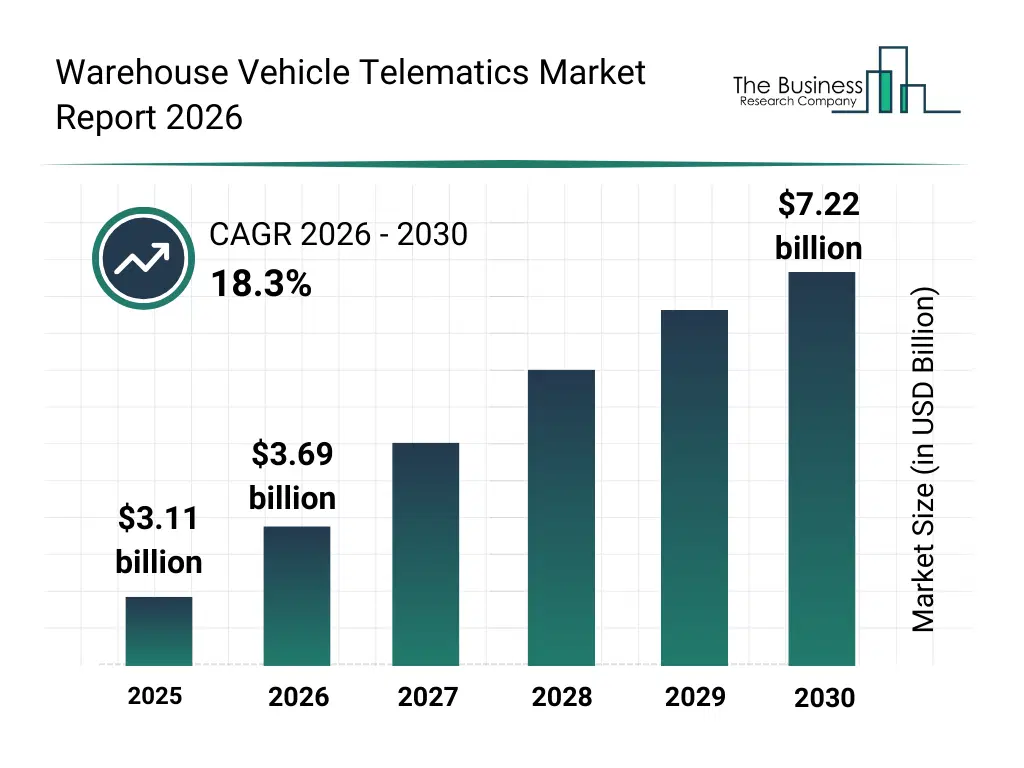
What Is The Warehouse Vehicle Telematics Market Size and Share 2026?
The warehouse vehicle telematics market size has grown rapidly in recent years. It will grow from $3.11 billion in 2025 to $3.69 billion in 2026 at a compound annual growth rate (CAGR) of 18.4%. The growth in the historic period can be attributed to increasing e-commerce order volumes, rising focus on worker safety and compliance, growing demand for faster order fulfilment, increasing fleet size of material handling vehicles, and rising costs of labour prompting efficiency measures.What Is The Warehouse Vehicle Telematics Market Growth Forecast?
The warehouse vehicle telematics market size is expected to see rapid growth in the next few years. It will grow to $7.22 billion in 2030 at a compound annual growth rate (CAGR) of 18.3%. The growth in the forecast period can be attributed to increasing demand for same-day and next-day delivery services, rising emphasis on improving labour productivity and workforce utilization, growing investment in supply chain resilience and redundancy, increasing focus on sustainability and energy efficiency goals, and rising need for real-time data to support decision-making. Major trends in the forecast period include wider adoption of artificial intelligence-driven predictive maintenance systems, increased use of machine learning-based route and task optimization, growth of cloud-native fleet management platforms with centralized analytics, deployment of fifth-generation-enabled connectivity for high-throughput telemetry, and integration of video analytics for operator behaviour monitoring and safety enforcement.
Global Warehouse Vehicle Telematics Market Segmentation
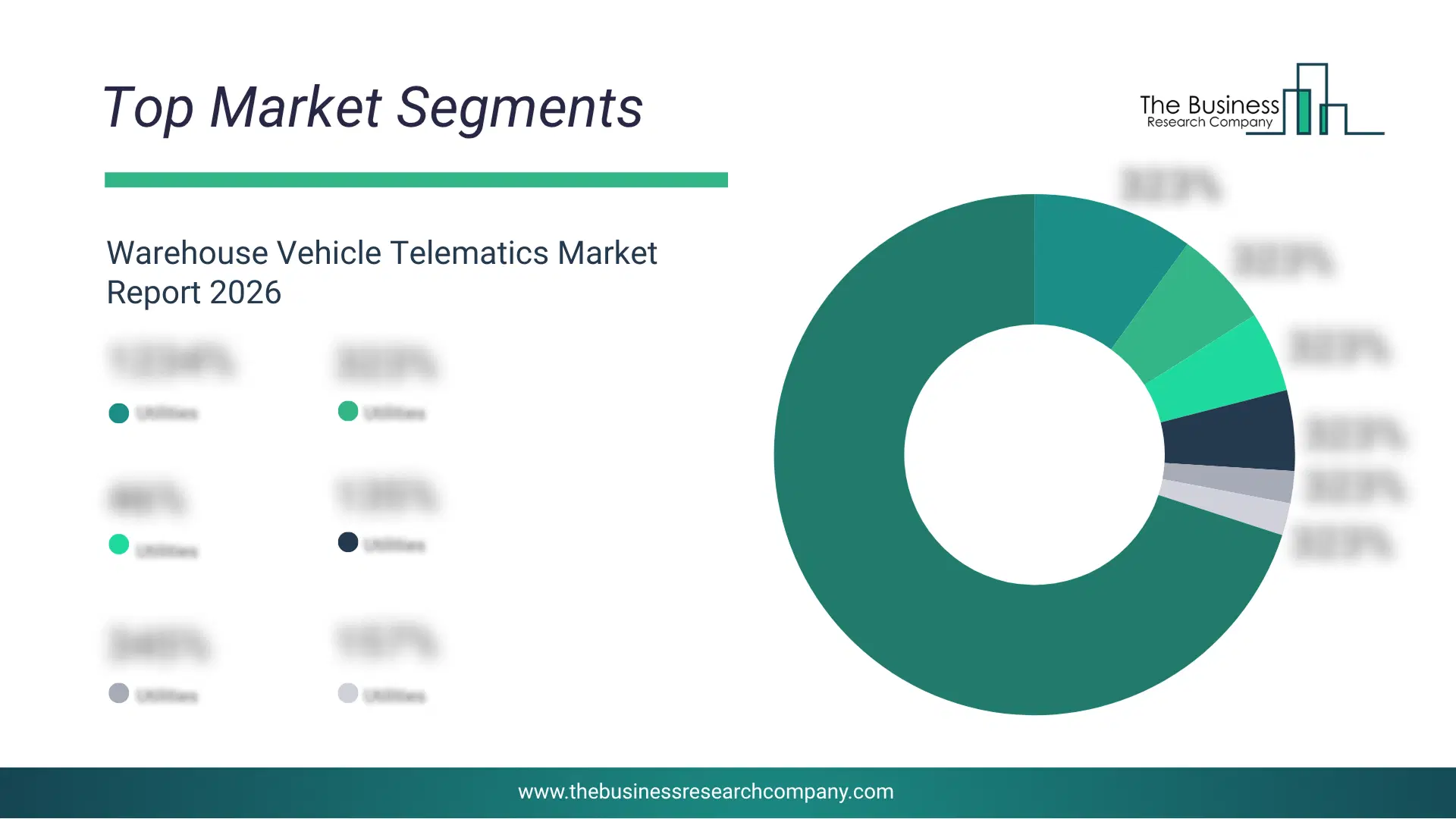
1) By Component: Hardware, Software, Services 2) By Vehicle Type: Forklifts, Pallet Jacks, Automated Guided Vehicles, Other Vehicle Types 3) By Application: Fleet Management, Asset Tracking, Safety And Security, Maintenance Management, Other Applications 4) By End-Users: Logistics, Retail, Manufacturing, Food And Beverage, E-commerce, Other End-Users Subsegments: 1) By Hardware: Telematics Control Units, Onboard Sensor Modules, Global Positioning Receivers, Vehicle Mounted Cameras, Operator Display Terminals, Wireless Communication Gateways 2) By Software: Fleet Management Software, Real Time Monitoring Platform, Data Analytics And Reporting Software, Maintenance Management Software, Safety Compliance Management Software, Route And Task Optimization Software 3) By Services: Installation And Commissioning Services, System Integration And Configuration Services, Preventive Maintenance Services, Remote Monitoring And Managed Services, Training And Technical Support Services, Data Hosting And Management ServicesWhat Is The Driver Of The Warehouse Vehicle Telematics Market?
The increasing use of warehouse vehicles is expected to propel the growth of the warehouse vehicle telematics market going forward. Warehouse vehicles refer to any mechanized or motorized equipment used to move, lift, or transport materials within a warehouse, distribution center, or storage facility. The increasing use of warehouse vehicles is rapid growth of e-commerce, which demands faster and more efficient order fulfillment. Warehouse vehicle telematics solutions support the increasing use of warehouse vehicles by offering real-time tracking, fleet management, and operational analytics that improve decision-making and resource utilization. For instance, in August 2024, according to Industrial Forklifts Inc., a US-based forklift solutions provider, the use of electric rider trucks in facilities increased from 55% in 2023 to 58% in 2024. Therefore, the increasing use of warehouse vehicles is driving the growth of the warehouse vehicle telematics industry.Key Players In The Global Warehouse Vehicle Telematics Market
Major companies operating in the warehouse vehicle telematics market are Komatsu Ltd., Toyota Industries Corporation, KION Group AG, HD Hyundai Heavy Industries, Doosan Bobcat Inc., Jungheinrich AG, Mitsubishi Logisnext Group, Zebra Technologies Corporation, Konecranes Plc, Hyster-Yale Materials Handling Inc., Sensata Technologies Holding plc, Cargotec Corporation, Hangcha Group Co. Ltd., Samsara Inc., Powerfleet Inc., Locus Robotics, Seegrid, Balyo Robotics, Anhui Heli Co. Ltd, BlueBotics (ANT Navigation), JBT Corporation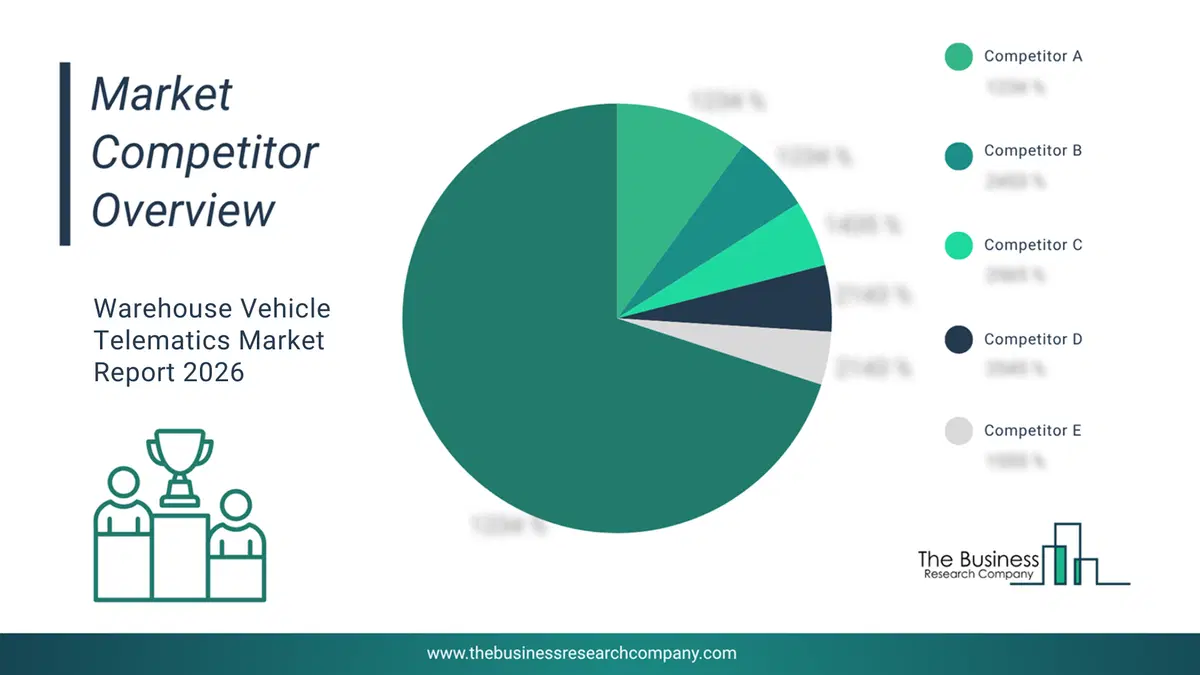
This chart is for illustrative purposes; the full report includes a detailed competitor analysis and comprehensive overview of the top 10 companies in the market.
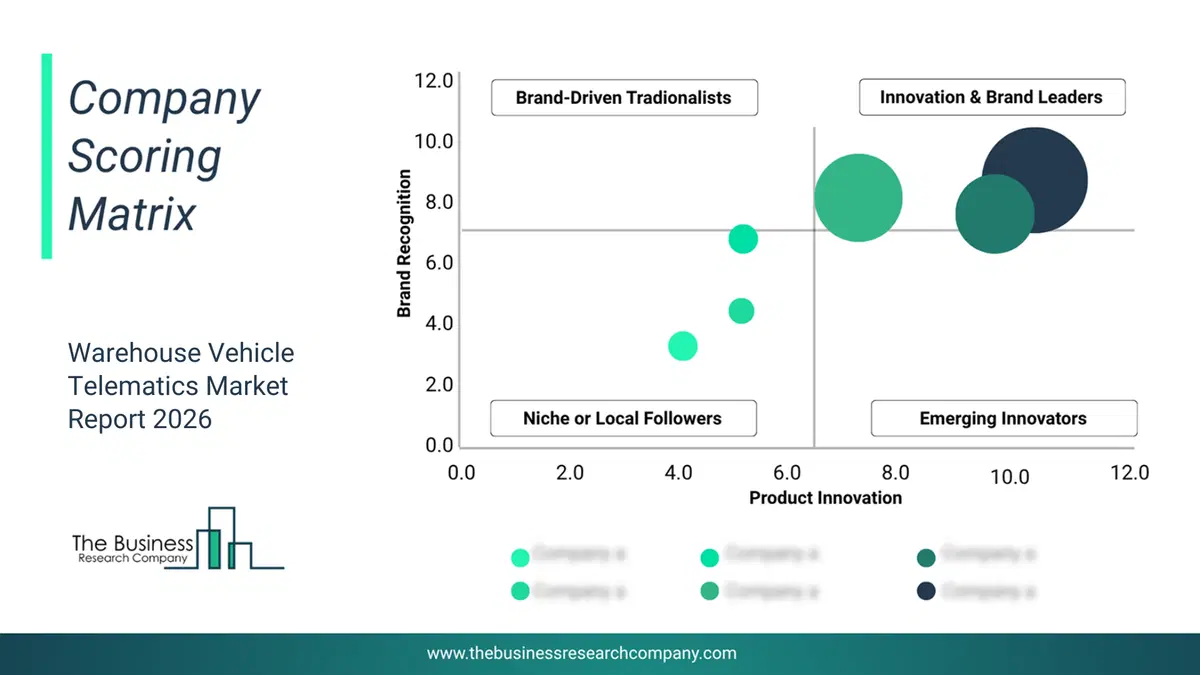
This chart maps companies by product innovation and brand strength, with bubble size indicating relative revenue, helping identify market leaders, challengers, and niche players. This is an illustrative chart; the full report provides a complete and accurate competitive analysis.
Global Warehouse Vehicle Telematics Market Trends and Insights
Major companies operating in the warehouse vehicle telematics market are focusing on developing advanced telematics solutions, such as next-generation fleet management systems, to boost efficiency, enhance safety, and reduce operational costs and downtime. Next-generation telematics solutions refer to integrated systems that collect, transmit, and analyze data from lift trucks to provide insights into fleet utilization, operator behavior, maintenance needs, and location tracking. For instance, in August 2023, Mitsubishi Logisnext Americas, a US-based material handling and automation solutions company, launched the Lift Link telematics solution, a next-generation fleet management system providing real-time, fleet-wide visibility across forklifts and warehouse equipment. It is an advanced, cloud-based platform featuring enhanced remote monitoring and real-time diagnostic capabilities. It includes automated fleet reporting and customizable alerts, enabling proactive maintenance and seamless fleet optimization without extensive manual oversight. It also incorporates intuitive data visualization tools and energy usage monitoring, extending asset life and reducing total cost of ownership for warehouse and distribution operators.What Are Latest Mergers And Acquisitions In The Warehouse Vehicle Telematics Market?
In October 2024, Powerfleet Inc., a US-based material-asset telematics provider, acquired Fleet Complete for $200 million. With this acquisition, Powerfleet aims to expand its North American footprint, accelerate top-line growth in Europe and Australia, enhance its AI-driven fleet and asset management offerings, and leverage Fleet Complete’s indirect channel partnerships to strengthen its global market leadership. Fleet Complete is a Canada-based fleet telematics solutions company that provides telematics and monitoring systems for warehouse and material-handling vehicles.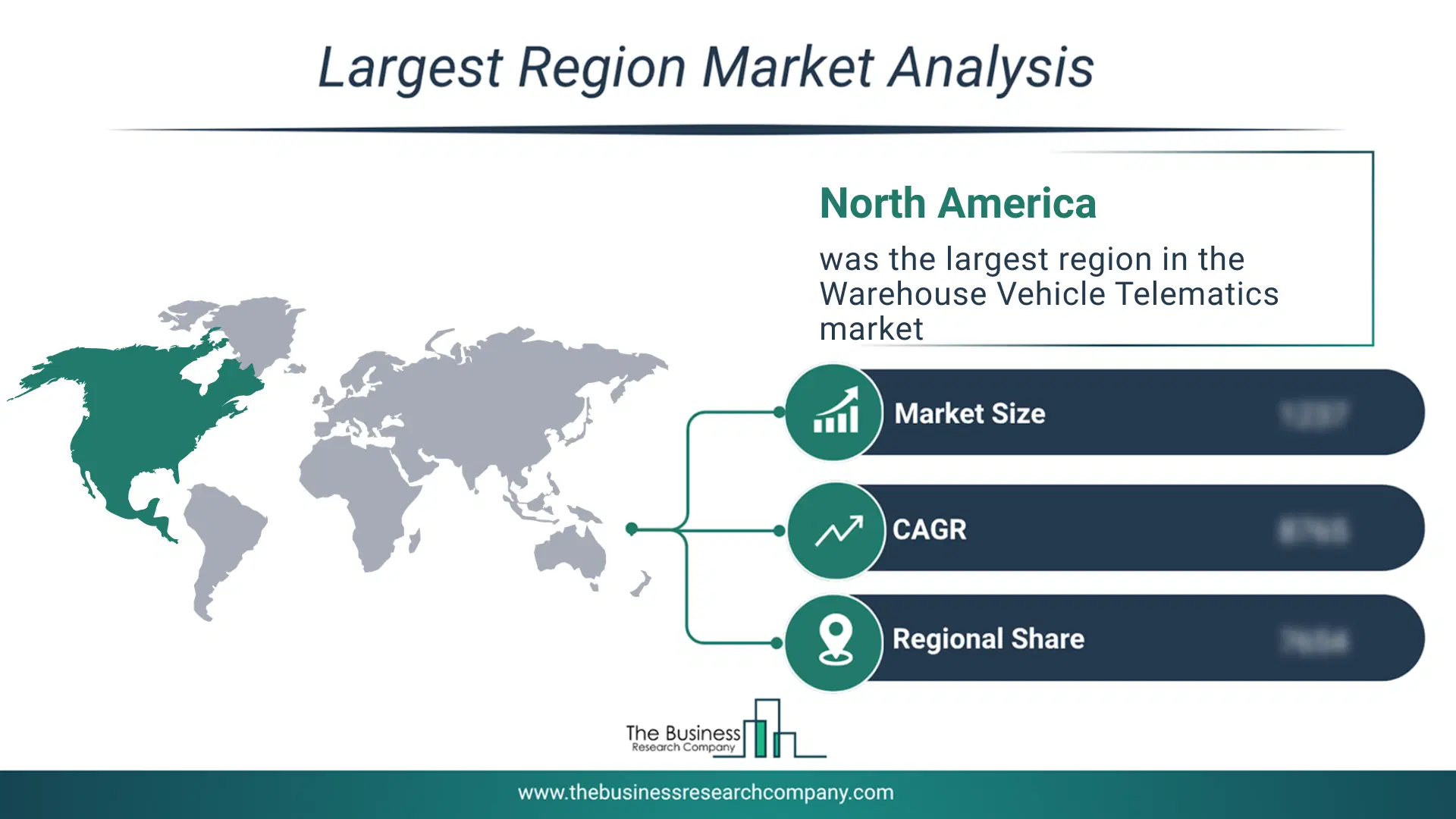
Regional Insights
North America was the largest region in the warehouse vehicle telematics market in 2025. Asia-Pacific is expected to be the fastest-growing region in the forecast period. The regions covered in this market report are Asia-Pacific, South East Asia, Western Europe, Eastern Europe, North America, South America, Middle East, Africa. The countries covered in this market report are Australia, Brazil, China, France, Germany, India, Indonesia, Japan, Taiwan, Russia, South Korea, UK, USA, Canada, Italy, Spain.What Defines the Warehouse Vehicle Telematics Market?
The warehouse vehicle telematics market consists of revenues earned by entities by providing services such as installation and commissioning services, real-time fleet monitoring and tracking services, data analytics and reporting services, predictive maintenance and diagnostic services, and system integration and customization services. The market value includes the value of related goods sold by the service provider or included within the service offering. The warehouse vehicle telematics market also includes sales of telematics control units, onboard diagnostic and sensor modules, vehicle-mounted cameras and recording systems, wireless connectivity gateways and routers, and operator display terminals. Values in this market are ‘factory gate’ values, that is, the value of goods sold by the manufacturers or creators of the goods, whether to other entities (including downstream manufacturers, wholesalers, distributors, and retailers) or directly to end customers. The value of goods in this market includes related services sold by the creators of the goods.How is Market Value Defined and Measured?
The market value is defined as the revenues that enterprises gain from the sale of goods and/or services within the specified market and geography through sales, grants, or donations in terms of the currency (in USD unless otherwise specified). The revenues for a specified geography are consumption values that are revenues generated by organizations in the specified geography within the market, irrespective of where they are produced. It does not include revenues from resales along the supply chain, either further along the supply chain or as part of other products.
This chart presents market attractiveness based on a quantitative evaluation of growth, competition, strategic alignment, and risk, offering a clear view of opportunity areas for decision-making. This chart is for illustrative purposes; the full report contains the complete analysis.

This chart highlights the Total Addressable Market (TAM) by estimating the maximum revenue opportunity using an assumption-driven approach, supporting strategic planning and opportunity sizing across markets. The chart is illustrative; the full report provides a more comprehensive analysis.
What Key Data and Analysis Are Included in the Warehouse Vehicle Telematics Market Report 2026?
The warehouse vehicle telematics market research report is one of a series of new reports from The Business Research Company that provides market statistics, including industry global market size, regional shares, competitors with the market share, detailed market segments, market trends and opportunities, and any further data you may need to thrive in the warehouse vehicle telematics industry. The market research report delivers a complete perspective of everything you need, with an in-depth analysis of the current and future state of the industry.Warehouse Vehicle Telematics Market Report Forecast Analysis
| Report Attribute | Details |
|---|---|
| Market Size Value In 2026 | $3.69 billion |
| Revenue Forecast In 2030 | $7.22 billion |
| Growth Rate | CAGR of 18.4% from 2026 to 2030 |
| Base Year For Estimation | 2025 |
| Actual Estimates/Historical Data | 2020-2025 |
| Forecast Period | 2026 - 2030 - 2030 |
| Market Representation | Revenue in USD Billion and CAGR from 2026 to 2030 |
| Segments Covered | Component, Vehicle Type, Application, End-Users |
| Regional Scope | Asia-Pacific, Western Europe, Eastern Europe, North America, South America, Middle East, Africa |
| Country Scope | The countries covered in the report are Australia, Brazil, China, France, Germany, India, Indonesia, Japan, Taiwan, Russia, South Korea, UK, USA, Canada, Italy, Spain. |
| Key Companies Profiled | Komatsu Ltd., Toyota Industries Corporation, KION Group AG, HD Hyundai Heavy Industries, Doosan Bobcat Inc., Jungheinrich AG, Mitsubishi Logisnext Group, Zebra Technologies Corporation, Konecranes Plc, Hyster-Yale Materials Handling Inc., Sensata Technologies Holding plc, Cargotec Corporation, Hangcha Group Co. Ltd., Samsara Inc., Powerfleet Inc., Locus Robotics, Seegrid, Balyo Robotics, Anhui Heli Co. Ltd, BlueBotics (ANT Navigation), JBT Corporation |
| Customization Scope | Request for Customization |
| Pricing And Purchase Options | Explore Purchase Options |