
Waste And Recycling Market Report 2026
Global Outlook – By Type (Municipal Waste, Industrial Waste, Hazardous Waste, Other Types), By Service Type (Collection, Transportation, Disposal, Other Service Types), By Application (Packaging And Consumer Goods, Construction, Landscaping Or Street, Other Applications) – Market Size, Trends, Strategies, and Forecast to 2030
Waste And Recycling Market Overview
• Waste And Recycling market size has reached to $32.26 billion in 2025 • Expected to grow to $41.91 billion in 2030 at a compound annual growth rate (CAGR) of 5.4% • Growth Driver: Rising E-Waste Generation To Accelerate Growth In Waste And Recycling Market • Market Trend: Low-Code Platforms To Revolutionize Waste Management • North America was the largest region in 2025 and Asia-Pacific is the fastest growing region.Market Gains By 2030 – Top Opportunities By Segment
Market Gain identifies the most promising market opportunities by highlighting the segments or products expected to generate the highest incremental revenue growth over the next five years.
What Is Covered Under Waste And Recycling Market?
Waste and recycling refer to the processes involved in managing, processing, and reusing discarded materials, typically to reduce environmental impact and conserve natural resources. Waste can include a wide variety of materials, such as household garbage, industrial waste, electronic waste, and hazardous substances. Recycling involves collecting and processing these materials to transform them into new products or raw materials for further use. The main types of waste and recycling include municipal waste, industrial waste, and hazardous waste. Municipal waste refers to the everyday garbage produced by households, businesses, and institutions, including items such as food scraps, paper, plastics, and yard waste which is typically collected by local authorities and includes non-hazardous materials that are managed through recycling, composting, and landfill disposal methods. The service types include collection, transportation, disposal for applications such as packaging and consumer goods, construction, landscaping or street, and others.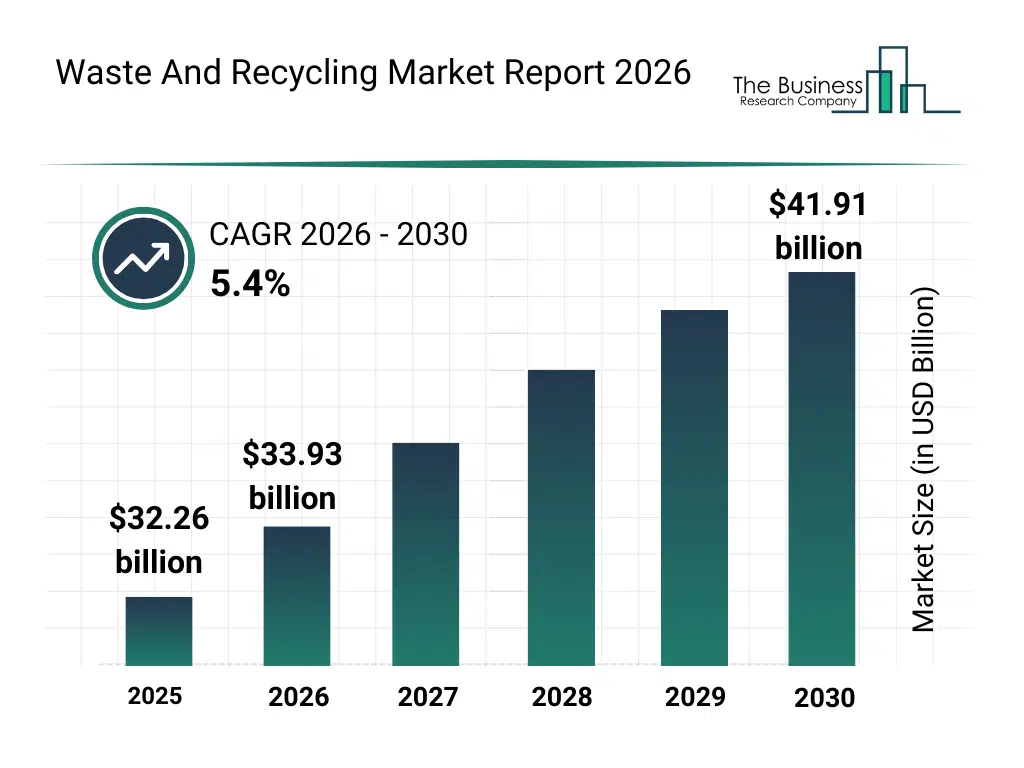
What Is The Waste And Recycling Market Size and Share 2026?
The waste and recycling market size has grown strongly in recent years. It will grow from $32.26 billion in 2025 to $33.93 billion in 2026 at a compound annual growth rate (CAGR) of 5.2%. The growth in the historic period can be attributed to urban population growth, expansion of municipal waste services, rising industrial waste generation, increasing regulatory focus on waste management, development of organized recycling facilities.What Is The Waste And Recycling Market Growth Forecast?
The waste and recycling market size is expected to see strong growth in the next few years. It will grow to $41.91 billion in 2030 at a compound annual growth rate (CAGR) of 5.4%. The growth in the forecast period can be attributed to increasing investments in advanced recycling technologies, rising adoption of waste-to-energy solutions, expansion of smart city waste programs, growing demand for sustainable waste management services, increasing automation in recycling operations. Major trends in the forecast period include increasing adoption of smart waste sorting systems, rising focus on circular economy practices, growing integration of recycling automation, expansion of municipal waste management infrastructure, enhanced use of data-driven waste monitoring.
Global Waste And Recycling Market Segmentation
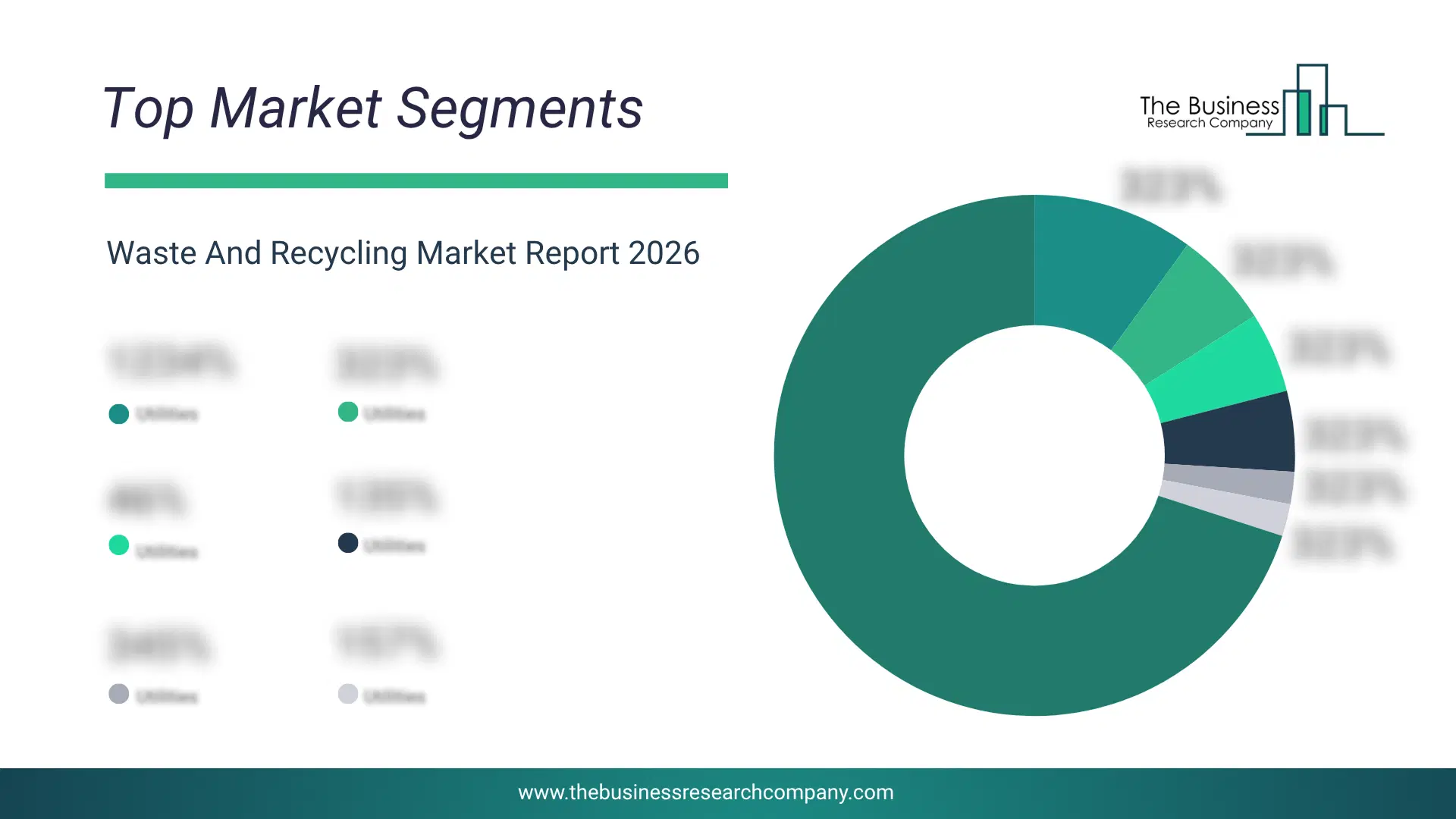
1) By Type: Municipal Waste, Industrial Waste, Hazardous Waste, Other Types 2) By Service Type: Collection, Transportation, Disposal, Other Service Types 3) By Application: Packaging And Consumer Goods, Construction, Landscaping Or Street, Other Applications Subsegments: 1) By Municipal Waste: Household Waste, Commercial Waste, Construction and Demolition Debris, Yard Waste 2) By Industrial Waste: Manufacturing Waste, Mining Waste, Energy Production Waste, Agricultural Waste 3) By Hazardous Waste: Chemical Waste, Biomedical Waste, Electronic Waste (E-Waste), Radioactive Waste 4) By Others Types: Organic Waste, Recyclable Materials, Specialty Waste, Construction and Demolition Recyclables The top segments in the waste and recycling market will be: • Industrial Waste will reach $45.7 Billion by 2030. • Municipal Waste will reach $29.57 Billion by 2030. • Hazardous Waste will reach $14.35 Billion by 2030. • Other Types will reach $6.45 Billion by 2030.What Is The Driver Of The Waste And Recycling Market?
The increasing e-waste generation is expected to propel the growth of the waste and recycling market going forward. E-waste generation refers to the production of electronic waste, which includes discarded electronic devices and components resulting from replacing, upgrading, or disposing of electronic products. Increasing e-waste generation is primarily driven by the rapid advancement of technology, leading to more frequent upgrades and disposals of electronic devices. Waste and recycling systems help manage increasing e-waste generation by facilitating the proper disposal, recycling, and recovery of valuable materials from discarded electronic devices. For instance, in March 2024, the United Nations Institute for Training and Research (UNITAR), a Switzerland-based dedicated training arm of the United Nations system, in 2022, global e-waste production reached a record 62 million metric tons, and it is projected to increase by 32% to 82 million metric tons by 2030. Therefore, increasing e-waste generation will drive the growth of the waste and recycling industry.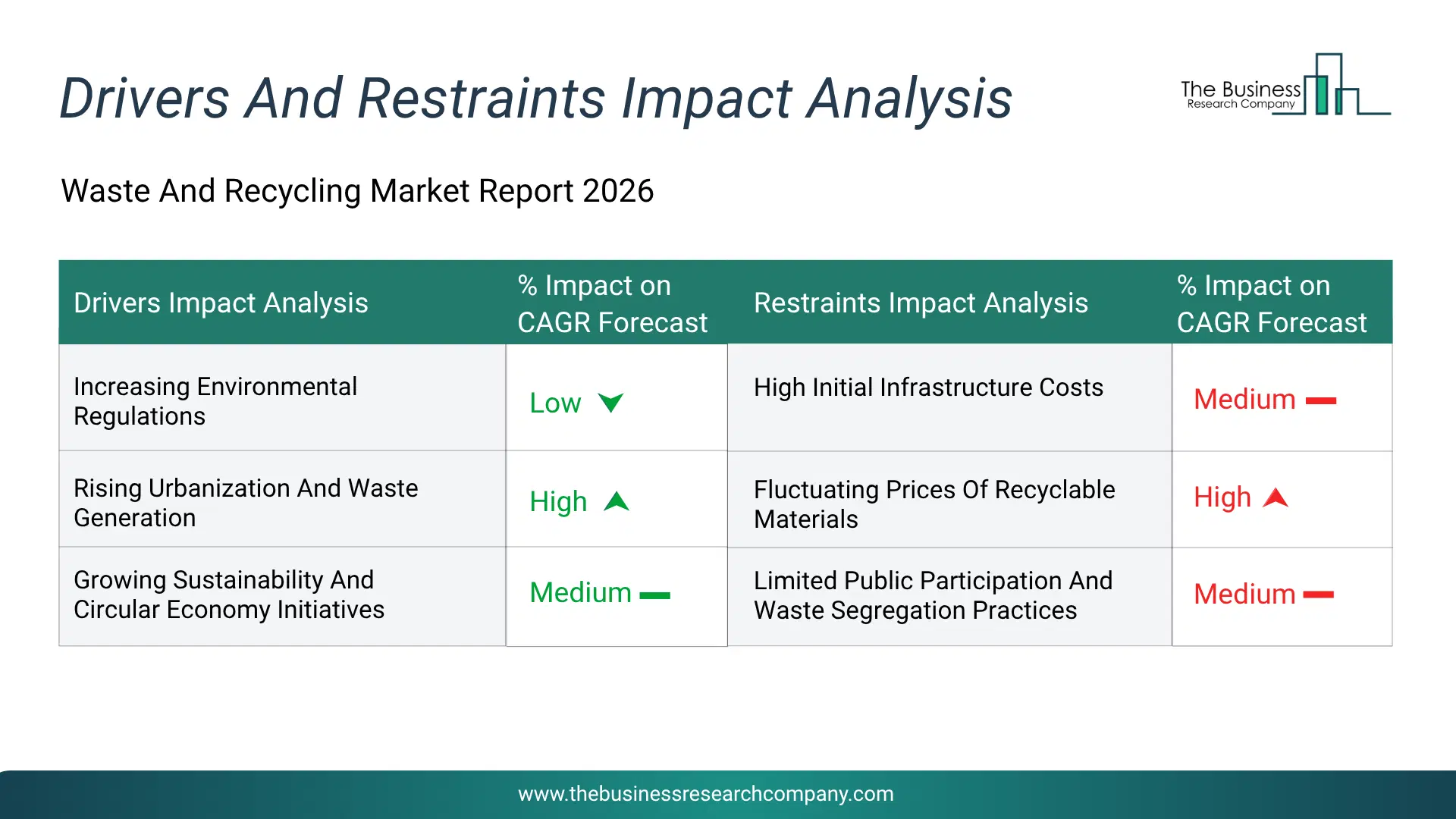
Infographic Chart Showing Key Market Drivers Analysis And Restraints For Waste And Recycling Market
The chart presents an impact analysis of key drivers and restraints, quantifying their relative influence on the market's growth rate and helping assess the balance between growth enablers and limiting factors. This chart offers a high-level perspective; the full report contains more detailed insights.
How Will The Drivers Impact Growth In The Global Waste And Recycling Market?
• Increasing Environmental Regulations (Low) – During the forecast period, the increasing environmental regulations is expected to become a key growth driver for the waste and recycling market by 2030. Increasing environmental regulations act as a major driver for the Waste and Recycling Market by compelling businesses, municipalities, and industries to adopt proper waste management practices. Governments across the world are implementing stricter rules related to landfill disposal, waste segregation, recycling targets, and emissions control. These regulations encourage organizations to invest in recycling infrastructure and advanced waste treatment technologies to remain compliant. Regulatory mandates also promote the recovery of valuable materials from waste streams instead of relying on landfills. As penalties for non-compliance become more severe, demand for professional waste collection and recycling services continues to grow. • Rising Urbanization And Waste Generation (High) – During the forecast period, the rising urbanization and waste generation is expected to emerge as a major factor driving the expansion of the waste and recycling market by 2030. Rising urbanization and waste generation significantly drive the Waste and Recycling Market as growing populations in urban areas produce larger volumes of municipal solid waste. Rapid city development increases consumption of packaged goods, food products, electronics, and household materials, leading to greater waste accumulation. Municipal authorities are therefore investing in efficient collection, sorting, and recycling systems to manage increasing waste levels. The need to prevent environmental pollution and maintain public health further boosts demand for recycling services. Urban centers also create opportunities for deploying smart waste management technologies and modern recycling facilities. • Growing Sustainability And Circular Economy Initiatives (Medium) – During the forecast period, the growing sustainability and circular economy initiatives is expected to act as a key growth catalyst for the waste and recycling market by 2030. Growing sustainability and circular economy initiatives serve as a strong driver for the Waste and Recycling Market by encouraging the reuse, recovery, and recycling of materials. Businesses are increasingly adopting circular economy models to reduce resource consumption and minimize environmental impact. Recycling helps convert waste into valuable secondary raw materials, lowering dependence on virgin resources. Consumers are also showing greater preference for environmentally responsible products and packaging, motivating companies to improve recycling efforts. Governments and organizations are promoting sustainability goals that prioritize waste reduction and material recovery.How Will The Restraints Impact Growth In The Global Waste And Recycling Market?
• High Initial Infrastructure Costs (Low) – During the forecast period, the high Initial Infrastructure Costs act as a significant restraint on the Waste and Recycling Market because establishing modern recycling facilities, waste processing plants, collection networks, and sorting systems requires substantial capital investment. Many municipalities and private operators, particularly in developing regions, face financial challenges in funding such large-scale infrastructure projects. Advanced recycling technologies and automated waste management systems also involve considerable installation and maintenance expenses. These high upfront costs can delay project implementation and limit the expansion of recycling capacity. Smaller companies may struggle to compete due to limited financial resources, reducing market participation. As a result, infrastructure-related investment barriers can slow the overall growth and modernization of the waste and recycling industry. • Fluctuating Prices Of Recyclable Materials (High) – During the forecast period, the fluctuating Prices of Recyclable Materials restrain the Waste and Recycling Market by creating uncertainty in revenue generation for recycling companies. The value of recovered materials such as paper, plastics, metals, and glass is heavily influenced by global commodity market conditions and changes in supply-demand dynamics. When material prices decline, recycling operations become less profitable, making it difficult for companies to recover processing and operational costs. Price volatility can discourage investments in new recycling facilities and technology upgrades. It may also reduce incentives for waste collection and material recovery programs. This unpredictable financial environment affects long-term planning and operational stability, thereby limiting market growth potential. • Limited Public Participation And Waste Segregation Practices (Medium) – During the forecast period, the limited public participation and waste segregation practices act as a significant restraint on the Waste and Recycling Market because effective recycling operations depend on proper waste collection, sorting, and separation at the source. In many regions, inadequate awareness, poor waste disposal habits, and limited participation in recycling programs result in contamination of recyclable materials. Mixed waste streams reduce processing efficiency and increase operational costs for recycling facilities. Municipalities and waste management companies often require additional investments in awareness campaigns, collection systems, and sorting infrastructure to improve participation. These challenges reduce recycling efficiency and limit the availability of high-quality recyclable materials, thereby restraining market growth.Key Players In The Global Waste And Recycling Market
Major companies operating in the waste and recycling market report are Veolia Environnement S.A., Waste Management Inc., Remondis SE & Co. KG, Republic Services Inc., Suez S.A., Waste Connections Inc., Clean Harbors Inc., Stericycle Inc., Biffa plc, Reworld Waste LLC, Recology Inc., FCC Environment Limited, Daiseki Co. Ltd., Urbaser S.A., Biomedical Waste Solutions LLC, Landbell Group, Verdeco Recycling LLC, Bigbelly Inc., Valicor Environmental Services Inc., Envision Plastics Industries LLC.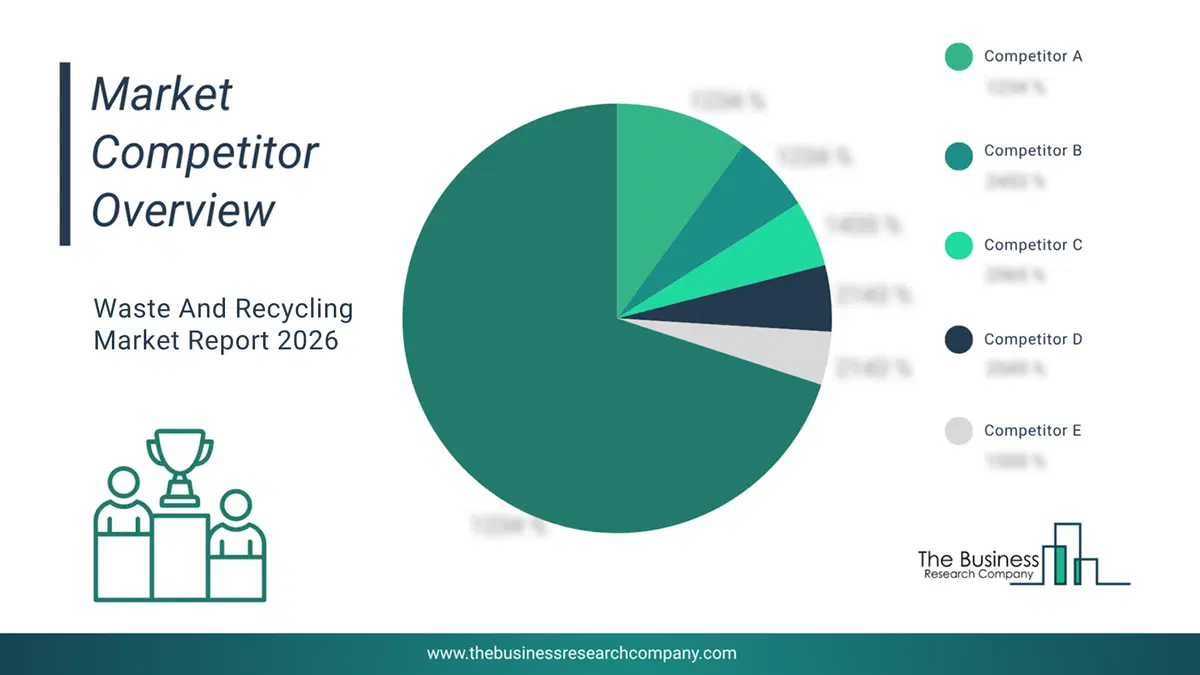
This chart is for illustrative purposes; the full report includes a detailed competitor analysis and comprehensive overview of the top 10 companies in the market.
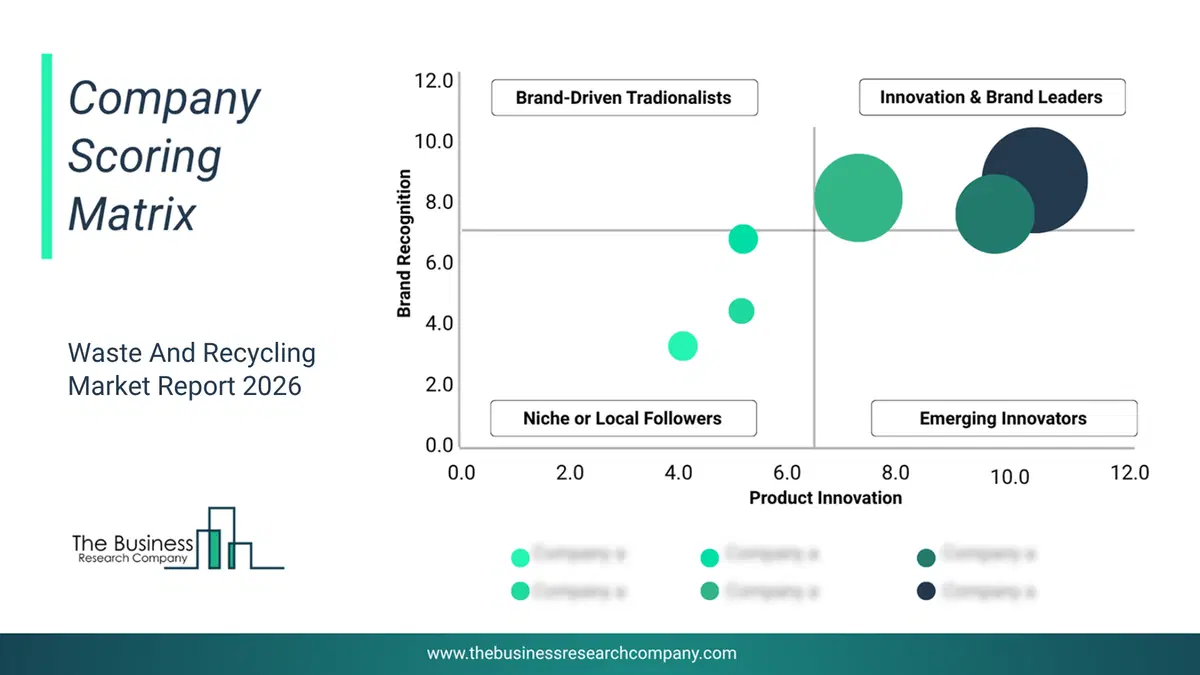
This chart maps companies by product innovation and brand strength, with bubble size indicating relative revenue, helping identify market leaders, challengers, and niche players. This is an illustrative chart; the full report provides a complete and accurate competitive analysis.
Global Waste And Recycling Market Trends and Insights
Major companies operating in the waste and recycling market are focusing on digital transformation and automation with solutions, such as Low-code platforms, to optimize operations and provide real-time data analytics for better decision-making and resource management. Low-code platforms used in waste recycling streamline and automate processes, integrate with existing systems, and provide real-time insights, enhancing operational efficiency and compliance. For instance, in May 2024, ISB Global Ltd., a UK-based software company, launched the Waste and Recycling One (WR1) program in the U.S. WR1 standardizes and automates waste and recycling processes, integrating with ERP systems like SAP to provide a unified master data source. It is built on the OutSystems low-code platform that enhances operational efficiency, reduces costs, and replaces outdated legacy systems without requiring new software integration. It also improves compliance reporting by adapting to regulatory changes and offering real-time operational visibility.What Are Latest Mergers And Acquisitions In The Waste And Recycling Market?
In November 2023, Biffa Limited, a UK-based waste management company, acquired Hamilton Waste & Recycling Ltd. for an undisclosed amount. This acquisition supports Biffa's dedication to low-carbon collection and material processing, capitalizing on HWR's strong sustainability record. This strategic move will empower more customers to achieve their carbon reduction goals by leveraging Biffa's central role in the circular economy. Hamilton Waste & Recycling Ltd. is a UK-based company specializing in waste management and recycling services for residential and commercial clients.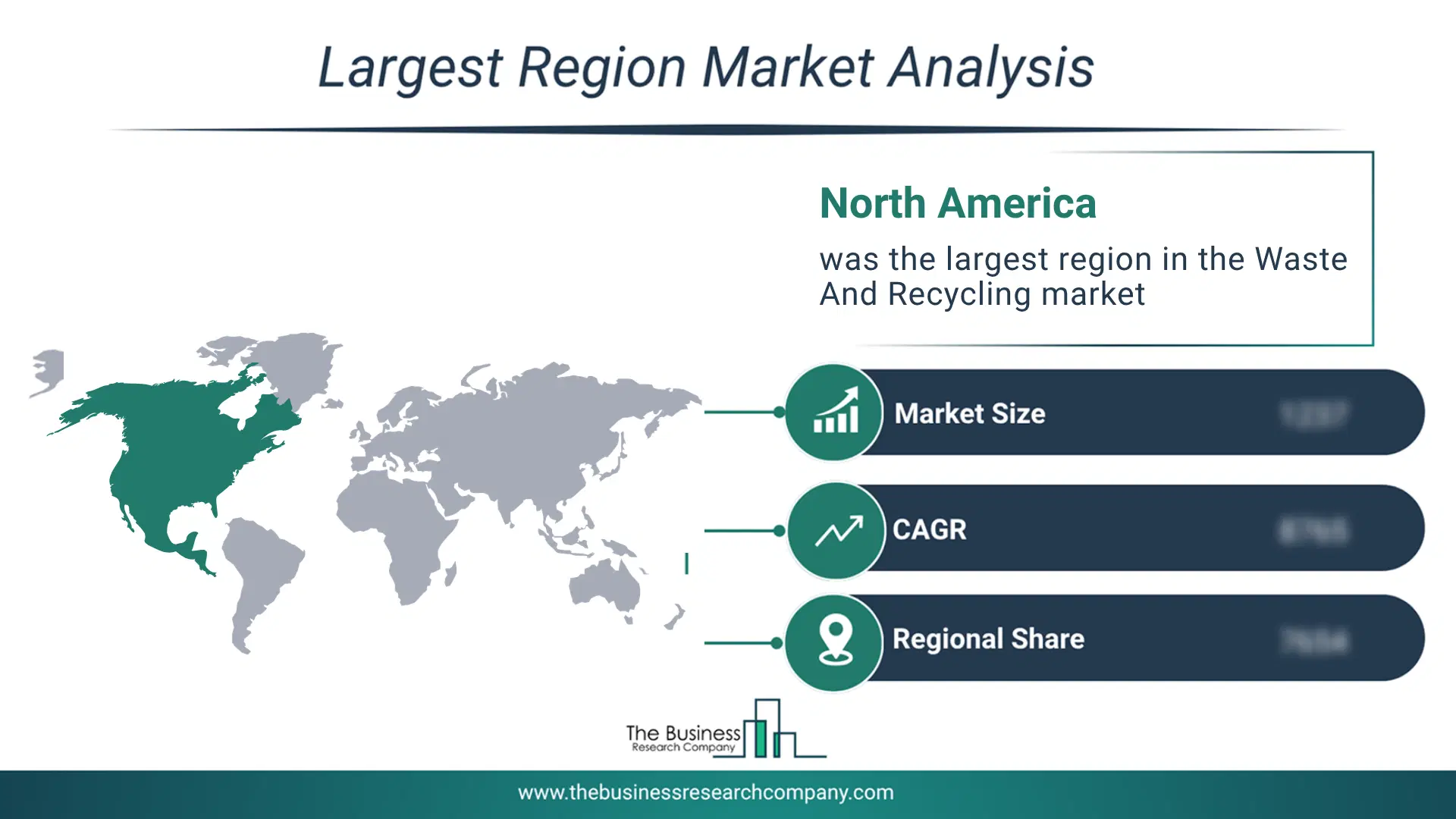
Regional Outlook
North America was the largest region in the waste and recycling market in 2025. Asia-Pacific is expected to be the fastest-growing region in the forecast period. The regions covered in this market report are Asia-Pacific, South East Asia, Western Europe, Eastern Europe, North America, South America, Middle East, Africa. The countries covered in this market report are Australia, Brazil, China, France, Germany, India, Indonesia, Japan, Taiwan, Russia, South Korea, UK, USA, Canada, Italy, SpainWhat Defines the Waste And Recycling Market?
The waste and recycling market includes revenues earned by entities through waste sorting and processing, recycling equipment sales, hazardous waste management, consulting, and auditing services. The market value includes the value of related goods sold by the service provider or included within the service offering. Only goods and services traded between entities or sold to end consumers are included.How is Market Value Defined and Measured?
The market value is defined as the revenues that enterprises gain from the sale of goods and/or services within the specified market and geography through sales, grants, or donations in terms of the currency (in USD unless otherwise specified). The revenues for a specified geography are consumption values that are revenues generated by organizations in the specified geography within the market, irrespective of where they are produced. It does not include revenues from resales along the supply chain, either further along the supply chain or as part of other products.
This chart presents market attractiveness based on a quantitative evaluation of growth, competition, strategic alignment, and risk, offering a clear view of opportunity areas for decision-making. This chart is for illustrative purposes; the full report contains the complete analysis.

This chart highlights the Total Addressable Market (TAM) by estimating the maximum revenue opportunity using an assumption-driven approach, supporting strategic planning and opportunity sizing across markets. The chart is illustrative; the full report provides a more comprehensive analysis.
What Key Data and Analysis Are Included in the Waste And Recycling Market Report 2026?
The waste and recycling market research report is one of a series of new reports from The Business Research Company that provides market statistics, including industry global market size, regional shares, competitors with the market share, detailed market segments, market trends and opportunities, and any further data you may need to thrive in the waste and recycling industry. The market research report delivers a complete perspective of everything you need, with an in-depth analysis of the current and future state of the industry.Waste And Recycling Market Report Forecast Analysis
| Report Attribute | Details |
|---|---|
| Market Size Value In 2026 | $33.93 billion |
| Revenue Forecast In 2030 | $41.91 billion |
| Growth Rate | CAGR of 5.2% from 2026 to 2030 |
| Base Year For Estimation | 2025 |
| Actual Estimates/Historical Data | 2020-2025 |
| Forecast Period | 2026 - 2030 |
| Market Representation | Revenue in USD Billion and CAGR from 2026 to 2030 |
| Segments Covered | Type, Service Type, Application |
| Regional Scope | Asia-Pacific, Western Europe, Eastern Europe, North America, South America, Middle East, Africa |
| Country Scope | The countries covered in the report are Australia, Brazil, China, France, Germany, India, ... |
| Key Companies Profiled | Veolia Environnement S.A., Waste Management Inc., Remondis SE & Co. KG, Republic Services Inc., Suez S.A., Waste Connections Inc., Clean Harbors Inc., Stericycle Inc., Biffa plc, Reworld Waste LLC, Recology Inc., FCC Environment Limited, Daiseki Co. Ltd., Urbaser S.A., Biomedical Waste Solutions LLC, Landbell Group, Verdeco Recycling LLC, Bigbelly Inc., Valicor Environmental Services Inc., Envision Plastics Industries LLC. |
| Customization Scope | Request for Customization |
| Pricing And Purchase Options | Explore Purchase Options |