
Waste Heat to Power Market Report 2026
Global Outlook – By Product (Steam Rankine Cycle, Organic Rankine Cycle, Kalina Cycle), By Application (Preheating, Steam and Electricity Generation, Other Applications), By End Users (Petroleum Refining and Oil and Gas Extraction, Cement Industry, Heavy Metal Production, Chemical Industry, Pulp and Paper, Food and Beverage, Glass Industry, Other End Users) – Market Size, Trends, Strategies, and Forecast to 2030
Waste Heat to Power Market Overview
• Waste Heat to Power market size has reached to $20.61 billion in 2025 • Expected to grow to $36.07 billion in 2030 at a compound annual growth rate (CAGR) of 11.8% • Growth Driver: Industrial Sector Expansion Fuels Surge In Waste Heat Power Market • Market Trend: Growing Focus On Advanced Waste Heat Recovery Technologies To Enhance Industrial Energy Efficiency • Europe was the largest region in 2025.What Is Covered Under Waste Heat to Power Market?
Waste heat to power refers to the process of capturing heat discarded by an existing thermal process and using that heat to generate power. Waste heat to power reduces pollution, equipment size, and auxiliary energy consumption. The main types of products in waste heat to power are the steam Rankine cycle, the organic Rankine cycle, and the Kalina cycle. The steam Rankine cycle is a simplified thermodynamic cycle of a constant-pressure heat engine that turns some heat into mechanical work. Heat is provided externally to a closed loop in this cycle, which typically uses water (in both liquid and vapor phases) as the working fluid. The various applications include preheating, steam, and electricity generation, among others, and are used by several sectors such as petroleum refining and oil and gas extraction, cement industry, heavy metal production, chemical industry, pulp and paper, food and beverage, glass industry, and others.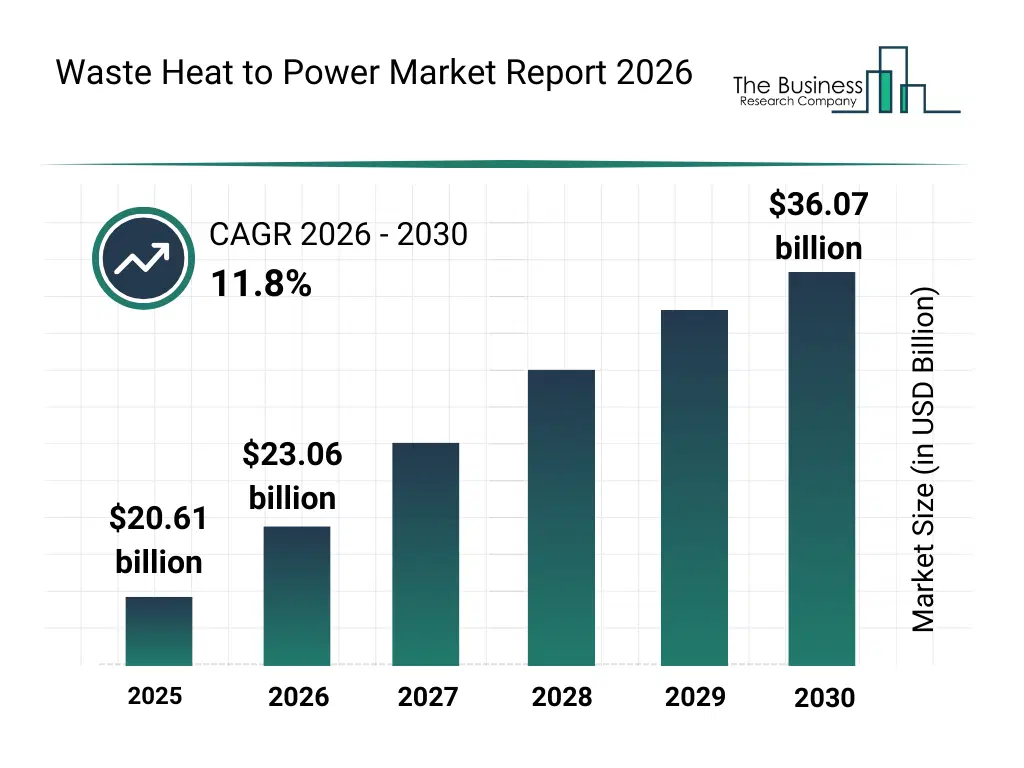
What Is The Waste Heat to Power Market Size and Share 2026?
The waste heat to power market size has grown rapidly in recent years. It will grow from $20.61 billion in 2025 to $23.06 billion in 2026 at a compound annual growth rate (CAGR) of 11.9%. The growth in the historic period can be attributed to high levels of industrial thermal energy loss, expansion of energy-intensive manufacturing processes, rising industrial electricity demand, early adoption of cogeneration systems, increasing fuel cost pressures.What Is The Waste Heat to Power Market Growth Forecast?
The waste heat to power market size is expected to see rapid growth in the next few years. It will grow to $36.07 billion in 2030 at a compound annual growth rate (CAGR) of 11.8%. The growth in the forecast period can be attributed to increasing investments in industrial decarbonization, rising adoption of energy efficiency regulations, expansion of waste heat recovery in heavy industries, growing focus on on-site power generation, increasing deployment of modular waste heat systems. Major trends in the forecast period include increasing adoption of organic rankine cycle systems, rising deployment of industrial waste heat recovery units, growing integration of digital performance monitoring, expansion of low-temperature waste heat applications, enhanced focus on energy efficiency optimization.
Global Waste Heat to Power Market Segmentation
1) By Product: Steam Rankine Cycle, Organic Rankine Cycle, Kalina Cycle 2) By Application: Preheating, Steam and Electricity Generation, Other Applications 3) By End Users: Petroleum Refining and Oil and Gas Extraction, Cement Industry, Heavy Metal Production, Chemical Industry, Pulp and Paper, Food and Beverage, Glass Industry, Other End Users Subsegments: 1) By Steam Rankine Cycle: Conventional Steam Rankine Cycle, Supercritical Steam Rankine Cycle 2) By Organic Rankine Cycle: Dry Organic Rankine Cycle, Wet Organic Rankine Cycle, Isothermal Organic Rankine Cycle 3) By Kalina Cycle: Ammonia-Water Kalina Cycle, Ethanol-Water Kalina CycleWhat Is The Driver Of The Waste Heat to Power Market?
The growth in the industrial sector is expected to propel the growth of waste heat in the power market going forward. Capital investment, labor input, financial investment, and technological innovation are the major factors influencing industrial growth. Non-metallic mineral production, petroleum refining, and heavy metal production are some of the key application areas with considerable waste heat recovery potential. For instance, in February 2024, according to the Xinhua News Agency, a China-based government agency, Mexico's industrial activity increased by 3.5 percent in 2023 compared to the prior year. Therefore, the growth in the industrial sector is driving the growth of waste heat in the power market.Key Players In The Global Waste Heat to Power Market
Major companies operating in the waste heat to power market are Mitsubishi Heavy Industries Ltd, Bosch Thermotechnology, Ormat Technologies, IHI Corporation, Dürr Group, Thermax Limited, Exergy SPA, Siemens Energy, ElectraTherm, Enogia SAS, Shenzhen Energy Group, Kawasaki Heavy Industries Ltd, Siemens AG, Orcan Energy, Vital Energi, EDF Energy, E. ON Next, ScottishPower, Shell Energy, Hitachi Zosen Inova (HZI), EcoTerra BioGas, CEZ Group, Romelectro, ZiO-Podolsk, Notus Energy, Polish Energy Group
This chart is for illustrative purposes; the full report includes a detailed competitor analysis and comprehensive overview of the top 10 companies in the market.
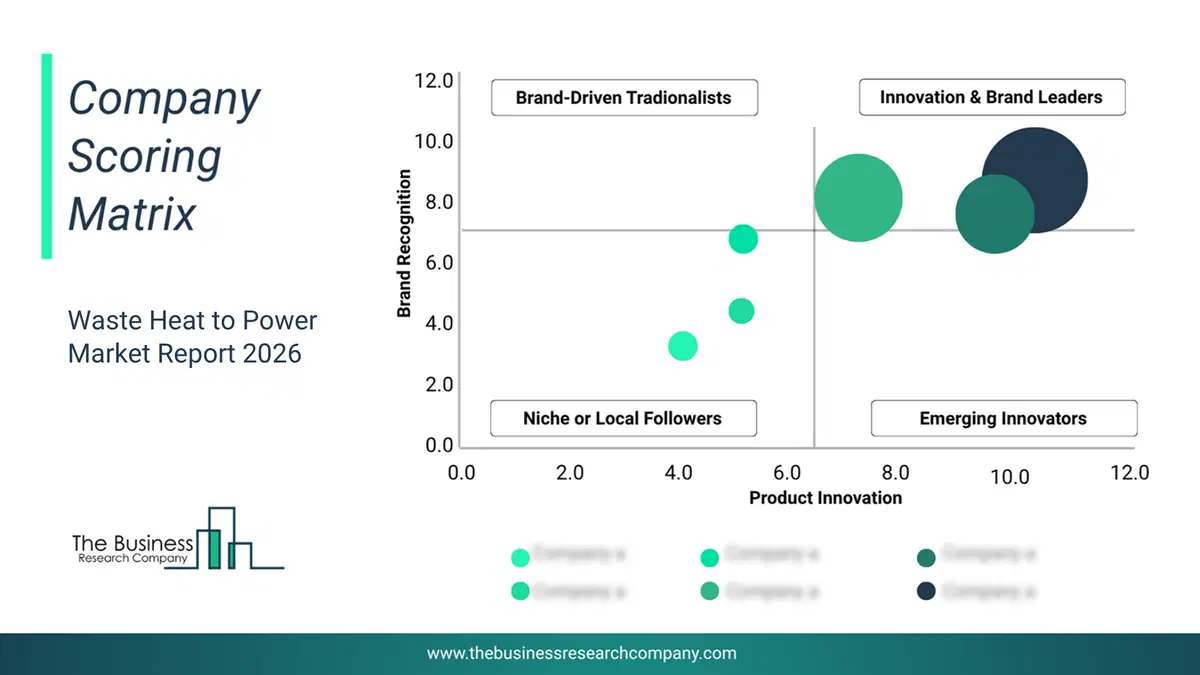
This chart maps companies by product innovation and brand strength, with bubble size indicating relative revenue, helping identify market leaders, challengers, and niche players. This is an illustrative chart; the full report provides a complete and accurate competitive analysis.
Global Waste Heat to Power Market Trends and Insights
Major companies operating in the waste heat-to-power market are focusing on developing innovative solutions, such as modular and scalable units to grow or shrink efficiently based on energy needs. Modular and scalable units are systems designed so that individual modules can be easily added or removed, allowing the plant’s capacity to grow or shrink efficiently based on energy needs. For instance, in October 2025, Turboden S.p.A., an Italy-based subsidiary of Mitsubishi Heavy Industries specializing in power generation solutions, commissioned a 19 MW ORC-based waste heat to power plant at Strathcona’s Orion SAGD facility in Alberta, Canada, the first of its kind in North America. This plant is designed to recover low-grade heat (~150°C) from produced steam and non-condensable gases that were previously vented and convert it into carbon-free electricity capable of offsetting up to approximately 80% of the site’s grid electricity consumption.What Are Latest Mergers And Acquisitions In The Waste Heat to Power Market?
In May 2023, Kalina Power Limited, a US-based energy technology company, entered into a partnership with the University of Calgary to advance collaborative research in geothermal energy and waste heat-to-power systems. With this partnership, Kalina Power aimed to enhance its technological capabilities and accelerate innovation by leveraging academic research expertise and industry collaboration to improve the efficiency and commercial viability of clean energy power generation solutions. The University of Calgary is a Canada-based research and education institution that specializes in conducting advanced research in energy systems, geothermal technologies, and sustainable power generation, supporting industry-focused innovation and applied energy solutions.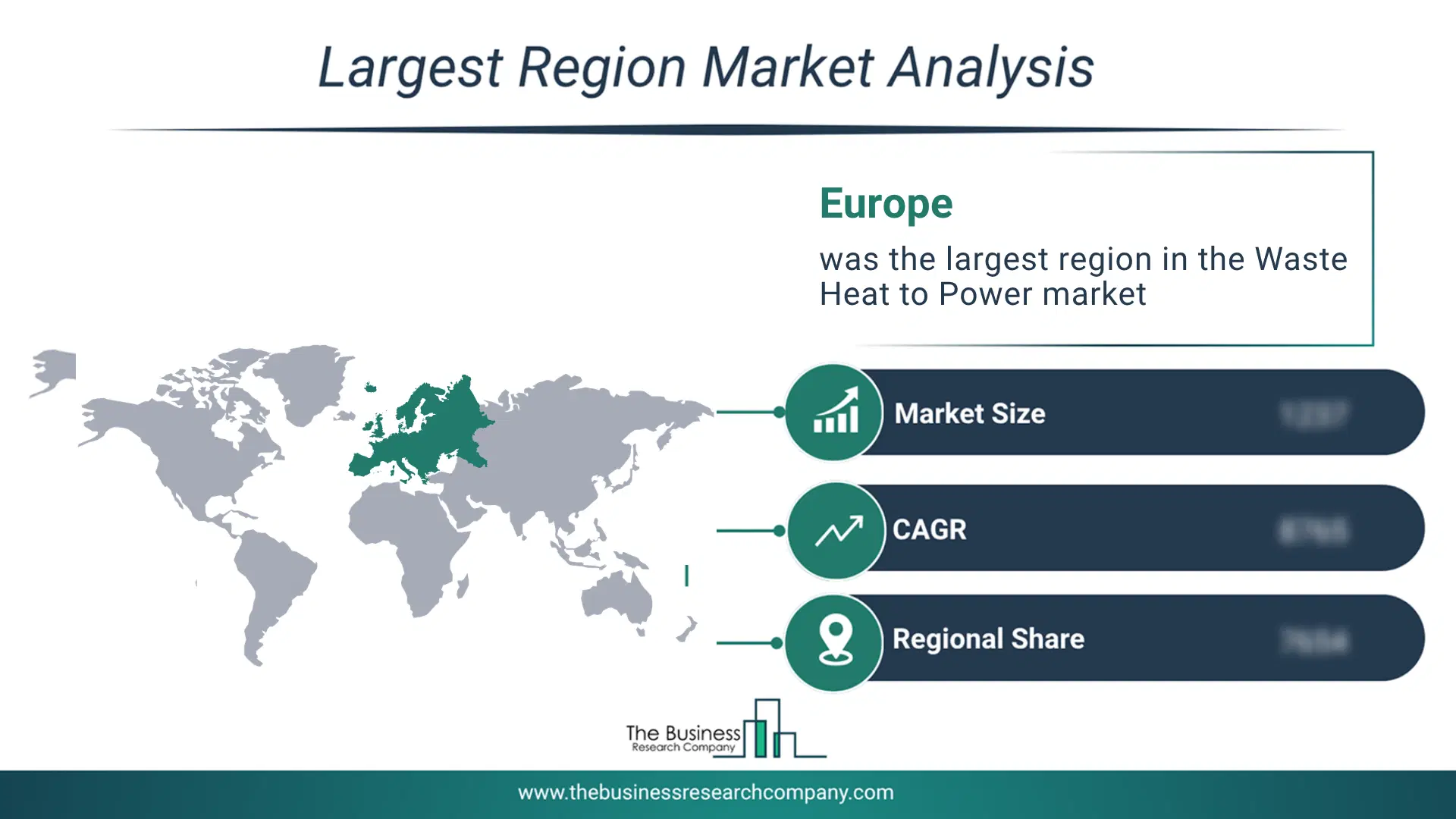
Regional Outlook
Europe was the largest region in the waste heat to power market in 2025. The regions covered in this market report are Asia-Pacific, South East Asia, Western Europe, Eastern Europe, North America, South America, Middle East, Africa. The countries covered in this market report are Australia, Brazil, China, France, Germany, India, Indonesia, Japan, Taiwan, Russia, South Korea, UK, USA, Canada, Italy, SpainWhat Defines the Waste Heat to Power Market?
The waste heat to power market includes revenues earned by entities by providing services such as ORC, steam cycle, and cascaded steam-organic cycle. The market value includes the value of related goods sold by the service provider or included within the service offering. Only goods and services traded between entities or sold to end consumers are included.How is Market Value Defined and Measured?
The market value is defined as the revenues that enterprises gain from the sale of goods and/or services within the specified market and geography through sales, grants, or donations in terms of the currency (in USD unless otherwise specified). The revenues for a specified geography are consumption values that are revenues generated by organizations in the specified geography within the market, irrespective of where they are produced. It does not include revenues from resales along the supply chain, either further along the supply chain or as part of other products.
This chart presents market attractiveness based on a quantitative evaluation of growth, competition, strategic alignment, and risk, offering a clear view of opportunity areas for decision-making. This chart is for illustrative purposes; the full report contains the complete analysis.

This chart highlights the Total Addressable Market (TAM) by estimating the maximum revenue opportunity using an assumption-driven approach, supporting strategic planning and opportunity sizing across markets. The chart is illustrative; the full report provides a more comprehensive analysis.
What Key Data and Analysis Are Included in the Waste Heat to Power Market Report 2026?
The waste heat to power market research report is one of a series of new reports from The Business Research Company that provides market statistics, including Market Report 2026?global market size, regional shares, competitors with the market share, detailed market segments, market trends and opportunities, and any further data you may need to thrive in the waste heat to power Market Report 2026? The market research report delivers a complete perspective of everything you need, with an in-depth analysis of the current and future state of the Market Report 2026?Waste Heat to Power Market Report Forecast Analysis
| Report Attribute | Details |
|---|---|
| Market Size Value In 2026 | $23.06 billion |
| Revenue Forecast In 2030 | $36.07 billion |
| Growth Rate | CAGR of 11.9% from 2026 to 2030 |
| Base Year For Estimation | 2025 |
| Actual Estimates/Historical Data | 2020-2025 |
| Forecast Period | 2026 - 2030 - 2030 |
| Market Representation | Revenue in USD Billion and CAGR from 2026 to 2030 |
| Segments Covered | Product, Application, End Users |
| Regional Scope | Asia-Pacific, Western Europe, Eastern Europe, North America, South America, Middle East, Africa |
| Country Scope | The countries covered in the report are Australia, Brazil, China, France, Germany, India, Indonesia, Japan, Taiwan, Russia, South Korea, UK, USA, Canada, Italy, Spain. |
| Key Companies Profiled | Mitsubishi Heavy Industries Ltd, Bosch Thermotechnology, Ormat Technologies, IHI Corporation, Dürr Group, Thermax Limited, Exergy SPA, Siemens Energy, ElectraTherm, Enogia SAS, Shenzhen Energy Group, Kawasaki Heavy Industries Ltd, Siemens AG, Orcan Energy, Vital Energi, EDF Energy, E. ON Next, ScottishPower, Shell Energy, Hitachi Zosen Inova (HZI), EcoTerra BioGas, CEZ Group, Romelectro, ZiO-Podolsk, Notus Energy, Polish Energy Group |
| Customization Scope | Request for Customization |
| Pricing And Purchase Options | Explore Purchase Options |