
Waste To Energy Market Report 2026
Global Outlook – By Waste Type (Municipal Solid Waste, Agricultural Waste, Other Waste Types), By Technology (Thermal, Biochemical, Other Technologies), By Application (Heat, Electricity) – Market Size, Trends, Strategies, and Forecast to 2030
Waste To Energy Market Overview
• Waste To Energy market size has reached to $40.7 billion in 2025 • Expected to grow to $59.28 billion in 2030 at a compound annual growth rate (CAGR) of 7.8% • Growth Driver: Sustainable Waste Management Initiatives Propel Growth In The Waste-To-Energy Market • Market Trend: New Technology Revolutionizes Waste-To-Biofuel Processes • Europe was the largest region in 2025 and Asia-Pacific is the fastest growing region.Market Gains By 2030 – Top Opportunities By Segment
Market Gain identifies the most promising market opportunities by highlighting the segments or products expected to generate the highest incremental revenue growth over the next five years.
What Is Covered Under Waste To Energy Market?
The waste-to-energy process refers to a technique that converts municipal solid waste, which is generated by industrial, commercial, and domestic sectors, into energy. The energy generated can be used directly by the plant or exported to the local utility or nearby businesses. The types of waste involved in waste to energy market are municipal solid waste, agricultural waste, and others. Municipal solid waste refers to waste collected by the municipality or disposed of at the municipal waste disposal site and includes residential, industrial, institutional, commercial, municipal, construction, and demolition waste. The technologies involved are thermal, biochemical, and others that are used for heat and electricity applications.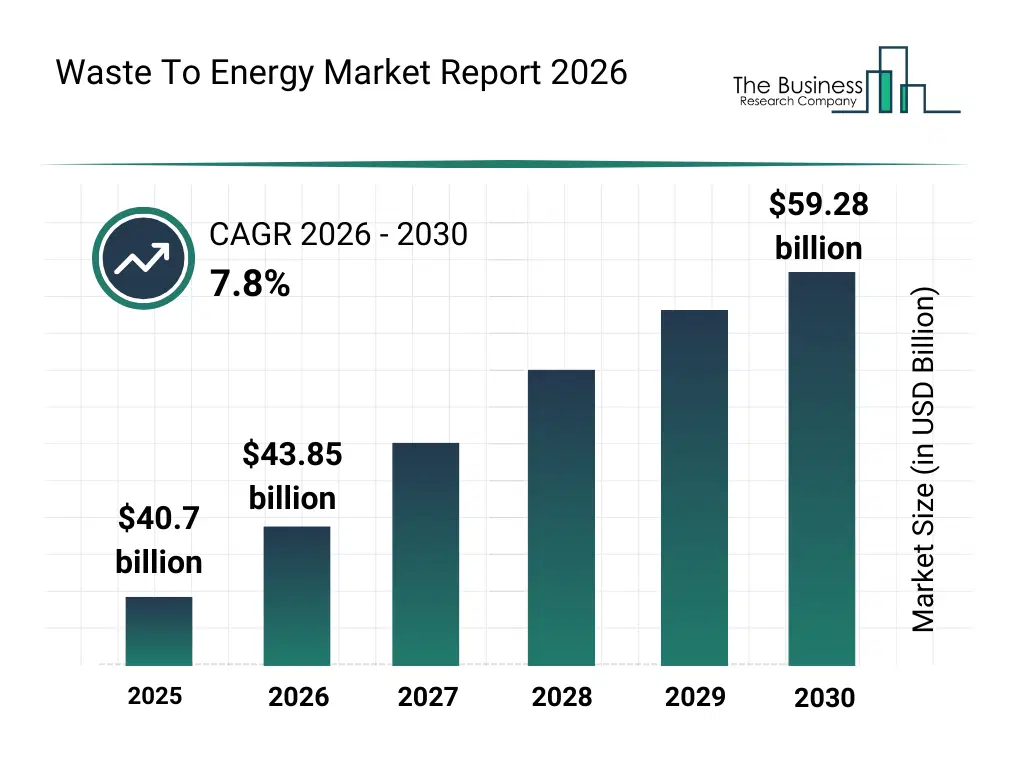
What Is The Waste To Energy Market Size and Share 2026?
The waste to energy market size has grown strongly in recent years. It will grow from $40.7 billion in 2025 to $43.85 billion in 2026 at a compound annual growth rate (CAGR) of 7.8%. The growth in the historic period can be attributed to growth in municipal solid waste generation, limited landfill availability, early adoption of incineration technologies, expansion of urban waste management systems, rising energy recovery initiatives.What Is The Waste To Energy Market Growth Forecast?
The waste to energy market size is expected to see strong growth in the next few years. It will grow to $59.28 billion in 2030 at a compound annual growth rate (CAGR) of 7.8%. The growth in the forecast period can be attributed to increasing investments in circular economy infrastructure, rising focus on waste diversion from landfills, expansion of waste-to-energy capacity in emerging economies, growing adoption of advanced thermal technologies, increasing regulatory support for waste valorization. Major trends in the forecast period include increasing deployment of thermal waste-to-energy plants, rising adoption of advanced emission control systems, growing integration of power and heat recovery, expansion of municipal waste processing capacity, enhanced focus on operational efficiency and compliance.
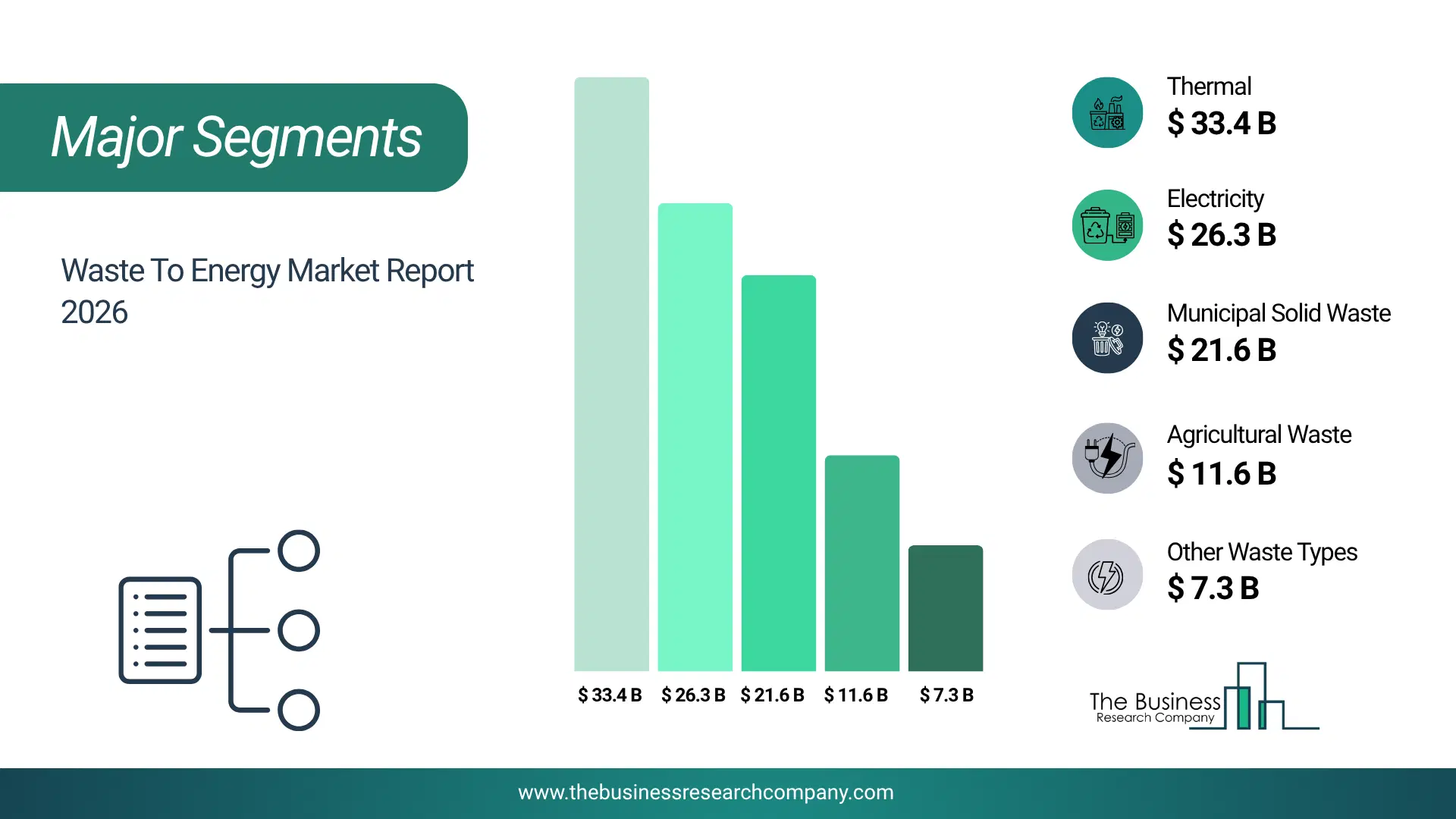
Global Waste To Energy Market Segmentation
1) By Waste Type: Municipal Solid Waste, Agricultural Waste, Other Waste Types 2) By Technology: Thermal, Biochemical, Other Technologies 3) By Application: Heat, Electricity Subsegments: 1) By Municipal Solid Waste: Household Waste, Commercial Waste, Industrial Waste 2) By Agricultural Waste: Crop Residues, Livestock Manure, Food Processing Waste 3) By Other Waste Types: Biomass Waste, Hazardous Waste, Construction And Demolition Waste, Waste From Landfills The top segments in the waste to energy market will be: • Municipal Solid Waste will reach $30.82 Billion by 2030. • Agricultural Waste will reach $17 Billion by 2030. • Other Waste Types will reach $11.47 Billion by 2030.What Is The Driver Of The Waste To Energy Market?
Increasing efficient waste management is expected to propel the growth of the waste-to-energy market going forward. Efficient waste management refers to the proper segregation of waste at source and ensuring that the waste goes through different streams of recycling and resource recovery. The most efficient waste management solution will be the sustainable method of waste to energy that produces heat that can generate electricity. For instance, in April 2024, according to an article by the World Economic Forum, a Switzerland-based International Organization for Public-Private Cooperation, by 2050, the volume of municipal solid waste could reduce from more than 4.5 billion tonnes a year to less than 2 billion tonnes. Moving to a fully zero waste circular economy model, where 60% of all municipal solid waste – the rubbish local authorities collect from homes and businesses – is recycled and the rest is managed safely. Therefore, increasing efficient waste management is driving the growth of the waste-to-energy market.
Infographic Chart Showing Key Market Drivers Analysis And Restraints For Waste To Energy Market
The chart presents an impact analysis of key drivers and restraints, quantifying their relative influence on the market's growth rate and helping assess the balance between growth enablers and limiting factors. This chart offers a high-level perspective; the full report contains more detailed insights.
How Will The Drivers Impact Growth In The Global Waste To Energy Market?
• Shift Towards Renewable Energy (Medium) – During the forecast period, the shift towards renewable energy is expected to become a key growth driver for the waste to energy market by 2030. Governments worldwide are accelerating the transition toward low-carbon and renewable energy sources to meet climate goals and reduce dependence on fossil fuels. Waste-to-energy (WtE) facilities provide a dual benefit by generating electricity and heat while diverting waste from landfills. Increasing renewable energy targets, supportive policies, and carbon reduction initiatives continue to drive investment in WtE projects. • Rapid Urbanization (Low) – During the forecast period, the rapid urbanization is expected to emerge as a major factor driving the expansion of the waste to energy market by 2030. Growing urban populations are placing significant pressure on municipal waste management systems. Urban areas generate large volumes of solid waste that require efficient treatment and disposal solutions. Waste-to-energy plants help cities address land constraints while simultaneously producing energy, making them an attractive option for rapidly urbanizing regions. • Increasing Efficient Waste Management (High) – During the forecast period, the increasing efficient waste management is expected to act as a key growth catalyst for the waste to energy market by 2030. Governments and municipalities are prioritizing advanced waste management solutions to reduce landfill dependence, improve resource recovery, and meet environmental regulations. Waste-to-energy technologies offer an effective method for processing non-recyclable waste while reducing environmental impacts.How Will The Restraints Impact Growth In The Global Waste To Energy Market?
• Economic Downturns (Medium) – During the forecast period, the economic slowdowns can delay investments in large-scale infrastructure projects, including waste-to-energy facilities, due to budget constraints and reduced access to financing. Municipalities may prioritize essential expenditures over new waste treatment projects during periods of economic uncertainty. Additionally, fluctuations in energy demand and lower government spending can negatively impact project development and expansion plans. • High Capital And Operational Costs (Low) – During the forecast period, the high capital and operational costs act as a major restraint for the waste-to-energy market because the construction of waste-to-energy plants requires substantial investments in combustion, gasification, anaerobic digestion, emission control systems, and grid connection infrastructure. In addition to high upfront expenditures, operators incur significant costs for plant maintenance, environmental compliance, feedstock handling, and skilled workforce requirements. These financial challenges can discourage municipalities and private investors from undertaking new projects, particularly in developing regions with limited funding. Consequently, high project costs slow the adoption and expansion of waste-to-energy technologies. • Stringent Environmental Regulations And Emission Standards (High) – During the forecast period, the stringent environmental regulations and emission standards act as a significant restraint for the waste-to-energy market because facility operators must comply with strict limits on air pollutants, greenhouse gas emissions, ash disposal, and wastewater management. Meeting these regulatory requirements often requires advanced emission control technologies, continuous environmental monitoring, and regular compliance audits, increasing project costs and operational complexity. Lengthy environmental approval processes and public scrutiny can further delay project development. These regulatory challenges can discourage investment and limit the expansion of waste-to-energy facilities across various regions.Key Players In The Global Waste To Energy Market
Major companies operating in the waste to energy market are Veolia Environnement, Covanta Holding Corporation, SUEZ, Waste Management Inc., Babcock & Wilcox, Air Products and Chemicals Inc., Hitachi Zosen Corporation, Wheelabrator Technologies, Dalkia, Enerkem, Siemens, Tetra Tech, Viresco Solutions, Biogas Energy, CapitaSymonds, Bioenergy Infrastructure Group, MRF Solutions, Plasco Energy Group, Green Energy Technologies, Klean Industries, Amec Foster Wheeler, RWE AG, A2A, Remondis, O2 Energy, ReEnergy Holdings, GWE Biogas, 8 Rivers Networks, INDEMA
This chart is for illustrative purposes; the full report includes a detailed competitor analysis and comprehensive overview of the top 10 companies in the market.

This chart maps companies by product innovation and brand strength, with bubble size indicating relative revenue, helping identify market leaders, challengers, and niche players. This is an illustrative chart; the full report provides a complete and accurate competitive analysis.
Global Waste To Energy Market Trends and Insights
Major companies operating in the waste-to-energy market are focusing on developing innovative technologies, such as the conversion of oil and fats waste into biofuels, to enhance sustainability, reduce emissions, and support decarbonization in hard-to-abate sectors. Waste-to-biofuel conversion involves using advanced anaerobic digestion (AD) and oil separation processes to produce Bio Crude, a renewable intermediate that can be refined into sustainable aviation fuel (SAF), helping the aviation industry reduce its carbon footprint. For instance, in December 2023, Alfa Laval, a Swedan-based leader of design and manufacture of fluid handling equipment epitomizing innovation, efficiency and reliability and Bisviridi, a UK- based producer of sustainable oil producer designed for efficient oil separation, with AD to convert oil and fats waste into biofuel called Bio Crude. Bio Crude can be refined into sustainable aviation fuel (SAF), aligning with the aviation industry's decarbonization goals and entering an emerging market.What Are Latest Mergers And Acquisitions In The Waste To Energy Market?
In February 2024, Blue Planet Environmental Solution India Pvt. Ltd, a Singapore-based integrated waste management company acquired Mahindra Waste to Energy Solutions Limited (MWTESL), a subsidiary of the Mahindra Group for an undisclosed amount. This acquisition leads to fosters innovation in waste-to- energy sector, leveraging unique technologies, research capabilities. Joint efforts in research aim to drive in sustainable energy production and waste management. Mahindra Waste to Energy Solutions Limited, an India- based company which specializes in converting municipal wet waste into Bio-CNG through Bio-Methanation, complementing the expertise of Blue Planet in carbon capture and utilization technologies.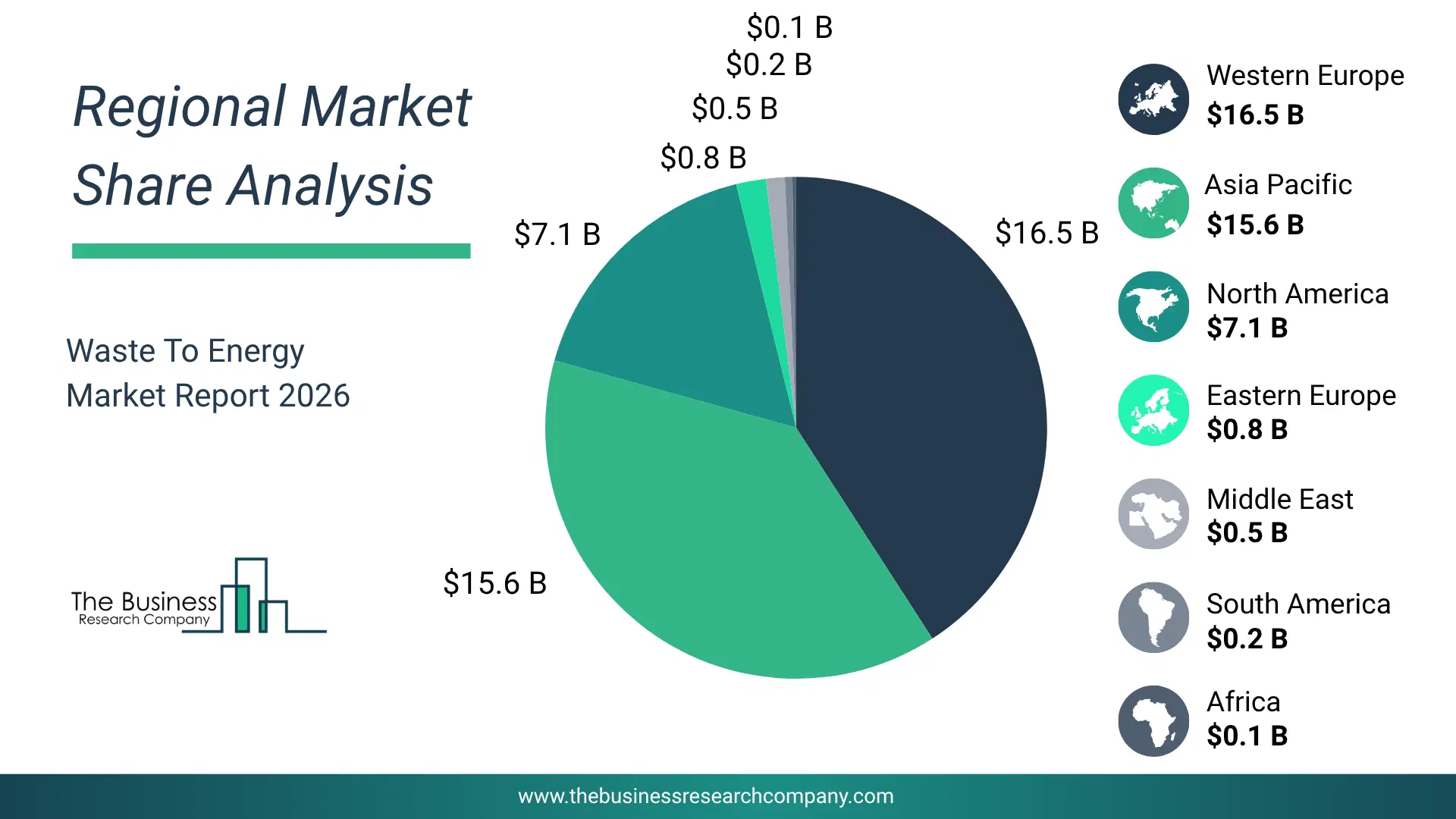
Regional Outlook
Europe was the largest region in the waste to energy market share in 2025. Asia-Pacific is expected to be the fastest-growing region in the forecast period. The regions covered in this market report are Asia-Pacific, South East Asia, Western Europe, Eastern Europe, North America, South America, Middle East, Africa. The countries covered in this market report are Australia, Brazil, China, France, Germany, India, Indonesia, Japan, Taiwan, Russia, South Korea, UK, USA, Canada, Italy, SpainWhat Defines the Waste To Energy Market?
The waste-to-energy market includes revenues earned by entities by the combustion of wastes, which heats water, generates steam, or makes electricity via a steam-powered turbine. The market value includes the value of related goods sold by the service provider or included within the service offering. Only goods and services traded between entities or sold to end consumers are included.How is Market Value Defined and Measured?
The market value is defined as the revenues that enterprises gain from the sale of goods and/or services within the specified market and geography through sales, grants, or donations in terms of the currency (in USD unless otherwise specified). The revenues for a specified geography are consumption values that are revenues generated by organizations in the specified geography within the market, irrespective of where they are produced. It does not include revenues from resales along the supply chain, either further along the supply chain or as part of other products.
This chart presents market attractiveness based on a quantitative evaluation of growth, competition, strategic alignment, and risk, offering a clear view of opportunity areas for decision-making. This chart is for illustrative purposes; the full report contains the complete analysis.

This chart highlights the Total Addressable Market (TAM) by estimating the maximum revenue opportunity using an assumption-driven approach, supporting strategic planning and opportunity sizing across markets. The chart is illustrative; the full report provides a more comprehensive analysis.
What Key Data and Analysis Are Included in the Waste To Energy Market Report 2026?
The waste to energy market research report is one of a series of new reports from The Business Research Company that provides market statistics, including Market Report 2026?global market size, regional shares, competitors with the market share, detailed market segments, market trends and opportunities, and any further data you may need to thrive in the waste to energy Market Report 2026? The market research report delivers a complete perspective of everything you need, with an in-depth analysis of the current and future state of the Market Report 2026?Waste To Energy Market Report Forecast Analysis
| Report Attribute | Details |
|---|---|
| Market Size Value In 2026 | $43.85 billion |
| Revenue Forecast In 2030 | $59.28 billion |
| Growth Rate | CAGR of 7.8% from 2026 to 2030 |
| Base Year For Estimation | 2025 |
| Actual Estimates/Historical Data | 2020-2025 |
| Forecast Period | 2026 - 2030 |
| Market Representation | Revenue in USD Billion and CAGR from 2026 to 2030 |
| Segments Covered | Waste Type, Technology, Application |
| Regional Scope | Asia-Pacific, Western Europe, Eastern Europe, North America, South America, Middle East, Africa |
| Country Scope | The countries covered in the report are Australia, Brazil, China, France, Germany, India, ... |
| Key Companies Profiled | Veolia Environnement, Covanta Holding Corporation, SUEZ, Waste Management Inc., Babcock & Wilcox, Air Products and Chemicals Inc., Hitachi Zosen Corporation, Wheelabrator Technologies, Dalkia, Enerkem, Siemens, Tetra Tech, Viresco Solutions, Biogas Energy, CapitaSymonds, Bioenergy Infrastructure Group, MRF Solutions, Plasco Energy Group, Green Energy Technologies, Klean Industries, Amec Foster Wheeler, RWE AG, A2A, Remondis, O2 Energy, ReEnergy Holdings, GWE Biogas, 8 Rivers Networks, INDEMA |
| Customization Scope | Request for Customization |
| Pricing And Purchase Options | Explore Purchase Options |