

Wastegate Turbocharger Market Report 2026
Global Outlook – By Type (Single-Stage Turbocharger, Two-Stage Turbocharger), By Fuel Type (Gasoline, Diesel, Alternative Fuel Vehicles), By Technology (Internal Wastegate Turbocharger, External Wastegate Turbocharger), By Application (Passenger Vehicles, Commercial Vehicles, Other Applications), By End Use (Automotive, Aerospace, Other End Uses) – Market Size, Trends, Strategies, and Forecast to 2030
Wastegate Turbocharger Market Overview
• Wastegate Turbocharger market size has reached to $1.82 billion in 2025 • Expected to grow to $2.67 billion in 2030 at a compound annual growth rate (CAGR) of 7.9% • Growth Driver: Surge In Demand For Fuel-Efficient Vehicles Fueling The Growth Of The Market Due To Improving Fuel Efficiency • Market Trend: Innovations In Electronic Wastegate Technology Enhance Turbocharger Control And Reliability • Asia-Pacific was the largest region and fastest growing region.What Is Covered Under Wastegate Turbocharger Market?
A wastegate turbocharger is a forced induction system that uses a wastegate valve to regulate exhaust gas flow through the turbine, controlling boost pressure and preventing overboost. It delivers compressed air to improve engine performance, fuel efficiency, and combustion efficiency across varying operating conditions. A wastegate turbocharger maintains optimal boost levels, enhances engine durability, reduces emissions, and protects turbocharger components. The main types of wastegate turbochargers include single-stage turbochargers and two-stage turbochargers. Single-stage turbochargers refer to turbocharging systems that use one turbocharger unit to increase engine air intake pressure and improve engine performance and efficiency. These turbochargers are used with gasoline, diesel, and alternative fuel vehicles and are available with internal wastegate turbocharger and external wastegate turbocharger technologies. The key applications include passenger vehicles, commercial vehicles, and others, while the end-uses include automotive, aerospace, and others.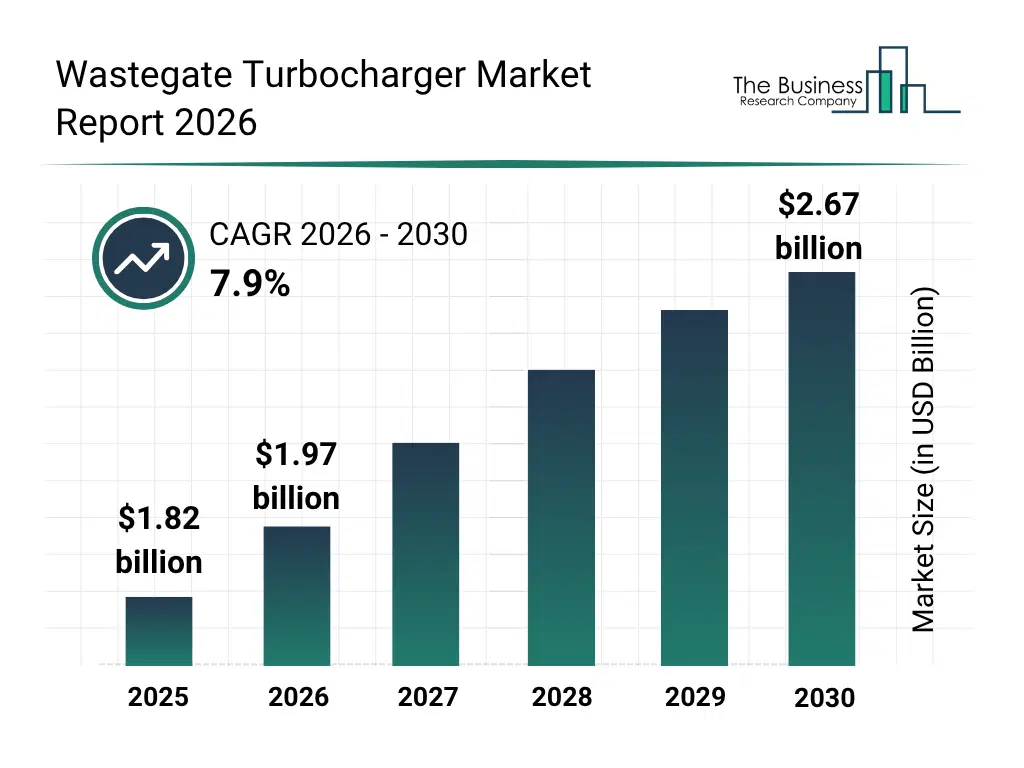
What Is The Wastegate Turbocharger Market Size and Share 2026?
The wastegate turbocharger market size has grown strongly in recent years. It will grow from $1.82 billion in 2025 to $1.97 billion in 2026 at a compound annual growth rate (CAGR) of 8.3%. The growth in the historic period can be attributed to increasing vehicle production, growing demand for fuel-efficient engines, tightening vehicle emission requirements, rising adoption of engine downsizing, increasing demand for improved combustion efficiency.What Is The Wastegate Turbocharger Market Growth Forecast?
The wastegate turbocharger market size is expected to see strong growth in the next few years. It will grow to $2.67 billion in 2030 at a compound annual growth rate (CAGR) of 7.9%. The growth in the forecast period can be attributed to growing demand for high-efficiency powertrains, rising adoption of turbocharged gasoline engines, increasing demand for low-emission commercial vehicles, expanding use of advanced boost control systems, growing demand for improved engine durability. Major trends in the forecast period include increasing adoption of high-efficiency turbocharging, growing demand for variable geometry turbochargers, rising use of electrically assisted turbochargers, increasing demand for compact engine downsizing solutions, growing adoption of advanced boost pressure control systems.Tariff Impact On Wastegate Turbocharger Market
Tariffs are impacting the wastegate turbocharger market by increasing the cost of imported turbocharger assemblies, precision wastegate valves, turbine components, and other automotive powertrain parts required for turbocharger production. This is raising manufacturing costs and affecting supply availability across passenger vehicles, commercial vehicles, and turbocharged engine applications, particularly in regions dependent on imported automotive components such as North America, Europe, and Asia-Pacific. Component-intensive segments such as two-stage turbochargers and external wastegate turbochargers are most affected due to global automotive supply chain dependencies. However, tariffs are also encouraging local component manufacturing, regional supplier diversification, and increased sourcing from domestic automotive suppliers, strengthening supply chain resilience in the wastegate turbocharger market.
Global Wastegate Turbocharger Market Segmentation
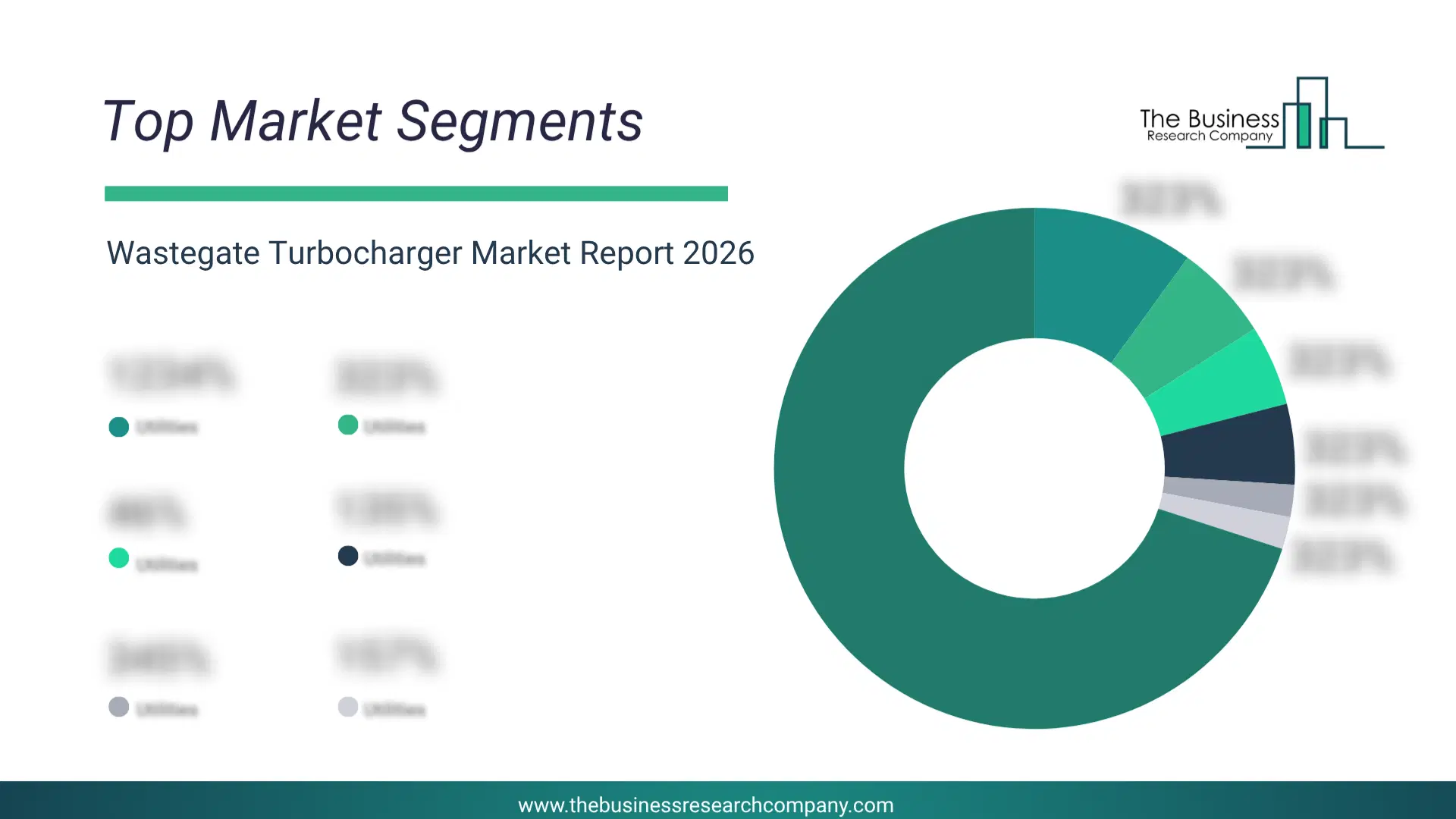
1) By Type: Single-Stage Turbocharger, Two-Stage Turbocharger 2) By Fuel Type: Gasoline, Diesel, Alternative Fuel Vehicles 3) By Technology: Internal Wastegate Turbocharger, External Wastegate Turbocharger 4) By Application: Passenger Vehicles, Commercial Vehicles, Other Applications 5) By End Use: Automotive, Aerospace, Other End Uses Subsegments: 1) By Single-Stage Turbocharger: Fixed Geometry Turbocharger, Variable Geometry Turbocharger, Electrically Assisted Turbocharger 2) By Two-Stage Turbocharger: Sequential Two-Stage Turbocharger, Series Two-Stage Turbocharger, Parallel Two-Stage TurbochargerWhat Is The Driver Of The Wastegate Turbocharger Market?
The increasing demand for fuel-efficient vehicles is expected to propel the growth of the wastegate turbocharger market going forward. Fuel-efficient vehicles refer to passenger cars and light-duty vehicles designed to maximize fuel economy by consuming less fuel while maintaining driving performance and complying with emission standards. The increasing demand for fuel-efficient vehicles is driven by rising fuel costs, as consumers are increasingly seeking vehicles that offer better mileage and lower operating expenses while reducing overall fuel consumption. The increasing demand for fuel-efficient vehicles supports the wastegate turbocharger by accelerating the adoption of turbocharging technologies that enhance engine efficiency, improve power output, reduce fuel consumption, and lower emissions by optimizing boost pressure and combustion performance. For instance, in April 2026, according to the United States Energy Information Administration (EIA), a US-based government agency, vehicle miles traveled increased by 1.2% in 2025 compared with 2024, while estimated vehicle fleet fuel economy, measured in miles per gallon, improved by 1.9% during the same period. Therefore, the increasing demand for fuel-efficient vehicles is driving the growth of the wastegate turbocharger industry.Key Players In The Global Wastegate Turbocharger Market
Major companies operating in the wastegate turbocharger market are BorgWarner Inc., Mitsubishi Heavy Industries Engine & Turbocharger Ltd., Garrett Motion Inc., IHI Corporation, Cummins Inc., Continental AG, MAHLE GmbH, Weifu High-Technology Group Co. Ltd., BMTS Technology GmbH & Co. KG, Turbo Energy Private Limited, ČZ a.s., HKS Co. Ltd., Precision Turbo & Engine Inc., Turbo Engineering Logistics S.r.l., Owen Developments Ltd., TiAL Sport Inc., Xona Rotor Inc., Ningbo Motor Industrial Co. Ltd., Pulsar Turbos, Comp Turbo Technology Inc., Turbo International B.V., Turbosmart Pty Ltd, Kangyue Technology Co. Ltd., Motair Turbolader GmbH, Cloyes Gear & Products Inc.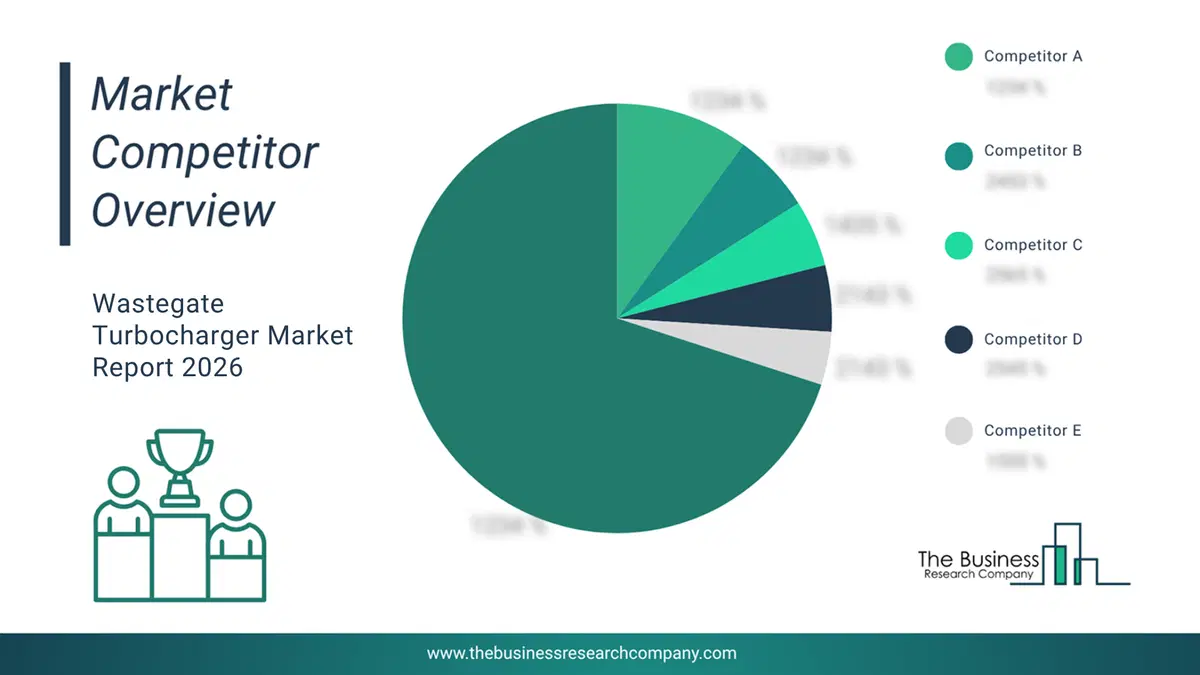
This chart is for illustrative purposes; the full report includes a detailed competitor analysis and comprehensive overview of the top 10 companies in the market.
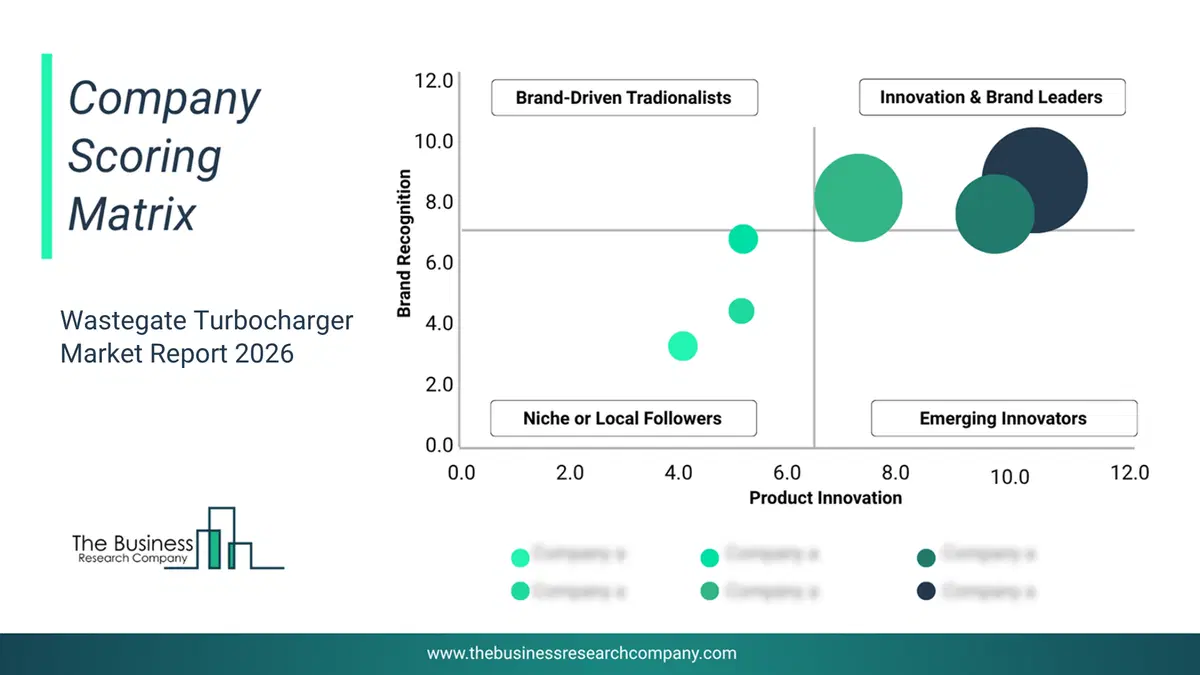
This chart maps companies by product innovation and brand strength, with bubble size indicating relative revenue, helping identify market leaders, challengers, and niche players. This is an illustrative chart; the full report provides a complete and accurate competitive analysis.
Global Wastegate Turbocharger Market Trends and Insights
Major companies operating in the wastegate turbocharger market are focusing on developing advanced electronic wastegate solutions to improve turbocharger control, responsiveness, reliability, and maintenance efficiency. Electronic wastegates use electronically controlled actuation to regulate exhaust pressure and manage turbocharger speed more precisely. For instance, in May 2025, Hartzell Engine Tech, a US-based aerospace engine component manufacturer, delivered its first developmental AeroForce electronic wastegate prototype to an undisclosed aircraft engine manufacturer for functional testing. It is designed as a plug-and-play replacement for hydro-pneumatic wastegates on aircraft engines equipped with Full Authority Digital Engine Controls (FADEC). The prototype integrates a linear actuator and proprietary driver with a single-point electrical connection while retaining the existing butterfly valve and housing. The electronic wastegate provides faster responsiveness to engine parameters and direct FADEC integration, while potentially reducing oil leak paths, maintenance costs, and engine oil heat load, and improving manifold absolute pressure control.What Are Latest Mergers And Acquisitions In The Wastegate Turbocharger Market?
In August 2026, Cooper Machinery Services, a US-based manufacturer and supplier of engine and compressor equipment, acquired Alamo Industries Ltd. and Alamo Turbocharger Services for an undisclosed amount. Through this acquisition, Cooper aims to expand its turbocharger capabilities, strengthen its presence across the western United States and Canada, and broaden its aftermarket repair, parts supply, and service capabilities for large-, mid-, and small-frame turbochargers and related components. Alamo Industries Ltd. is a Canada-based turbocharger repair and supply specialist that provides turbocharger overhaul, repair, parts supply, and exchange services, including components such as wastegates, manifolds, and intercoolers.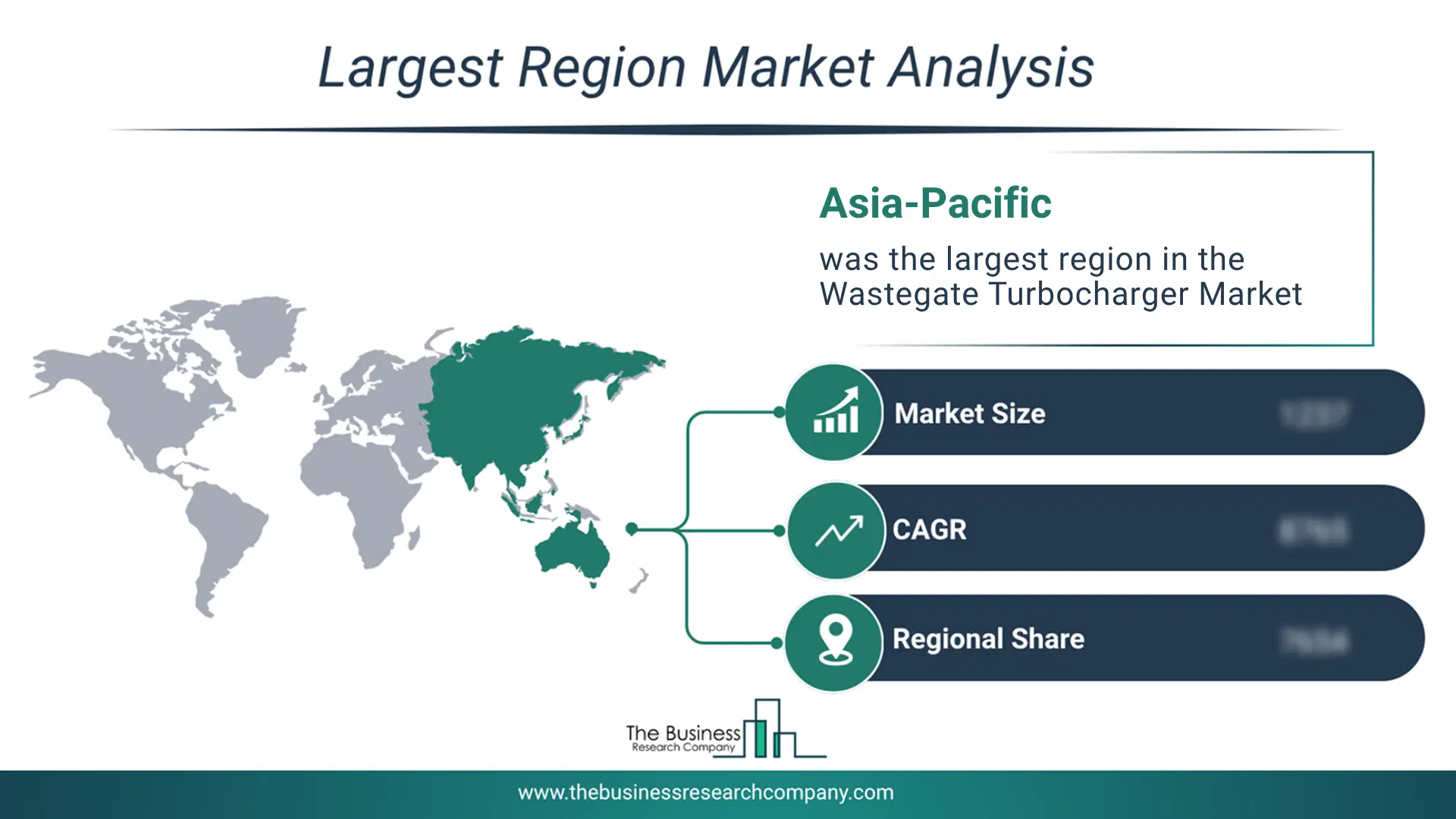
Regional Outlook
Asia-Pacific was the largest region in the wastegate turbocharger market in 2025. Asia-Pacific is expected to be the fastest-growing region in the forecast period. The regions covered in this market report are Asia-Pacific, South East Asia, Western Europe, Eastern Europe, North America, South America, Middle East, Africa. The countries covered in this market report are Australia, Brazil, China, France, Germany, India, Indonesia, Japan, Taiwan, Russia, South Korea, UK, USA, Canada, Italy, Spain.What Defines the Wastegate Turbocharger Market?
The wastegate turbocharger market consists of sales of wastegate valves, actuator rods, boost control valves, and turbocharger housings. Values in this market are ‘factory gate’ values, that is the value of goods sold by the manufacturers or creators of the goods, whether to other entities (including downstream manufacturers, wholesalers, distributors and retailers) or directly to end customers. The value of goods in this market includes related services sold by the creators of the goods.How is Market Value Defined and Measured?
The market value is defined as the revenues that enterprises gain from the sale of goods and/or services within the specified market and geography through sales, grants, or donations in terms of the currency (in USD unless otherwise specified). The revenues for a specified geography are consumption values that are revenues generated by organizations in the specified geography within the market, irrespective of where they are produced. It does not include revenues from resales along the supply chain, either further along the supply chain or as part of other products.
This chart presents market attractiveness based on a quantitative evaluation of growth, competition, strategic alignment, and risk, offering a clear view of opportunity areas for decision-making. This chart is for illustrative purposes; the full report contains the complete analysis.

This chart highlights the Total Addressable Market (TAM) by estimating the maximum revenue opportunity using an assumption-driven approach, supporting strategic planning and opportunity sizing across markets. The chart is illustrative; the full report provides a more comprehensive analysis.
What Key Data and Analysis Are Included in the Wastegate Turbocharger Market Report 2026?
The wastegate turbocharger market research report is one of a series of new reports from The Business Research Company that provides market statistics, including industry global market size, regional shares, competitors with the market share, detailed market segments, market trends and opportunities, and any further data you may need to thrive in the wastegate turbocharger industry. The market research report delivers a complete perspective of everything you need, with an in-depth analysis of the current and future state of the industry.Wastegate Turbocharger Market Report Forecast Analysis
| Report Attribute | Details |
|---|---|
| Market Size Value In 2026 | $1.97 billion |
| Revenue Forecast In 2030 | $2.67 billion |
| Growth Rate | CAGR of 7.9% from 2026 to 2030 |
| Base Year For Estimation | 2025 |
| Actual Estimates/Historical Data | 2020-2025 |
| Forecast Period | 2026 - 2030 |
| Market Representation | Revenue in USD Billion and CAGR from 2026 to 2030 |
| Segments Covered | Type, Fuel Type, Technology, Application, End Use |
| Regional Scope | Asia-Pacific, Western Europe, Eastern Europe, North America, South America, Middle East, Africa |
| Country Scope | The countries covered in the report are Australia, Brazil, China, France, Germany, India, Indonesia, Japan, Taiwan, Russia, South Korea, UK, USA, Canada, Italy, Spain. |
| Key Companies Profiled | BorgWarner Inc., Mitsubishi Heavy Industries Engine & Turbocharger Ltd., Garrett Motion Inc., IHI Corporation, Cummins Inc., Continental AG, MAHLE GmbH, Weifu High-Technology Group Co. Ltd., BMTS Technology GmbH & Co. KG, Turbo Energy Private Limited, ČZ a.s., HKS Co. Ltd., Precision Turbo & Engine Inc., Turbo Engineering Logistics S.r.l., Owen Developments Ltd., TiAL Sport Inc., Xona Rotor Inc., Ningbo Motor Industrial Co. Ltd., Pulsar Turbos, Comp Turbo Technology Inc., Turbo International B.V., Turbosmart Pty Ltd, Kangyue Technology Co. Ltd., Motair Turbolader GmbH, Cloyes Gear & Products Inc. |
| Customization Scope | Request for Customization |
| Pricing And Purchase Options | Explore Purchase Options |