
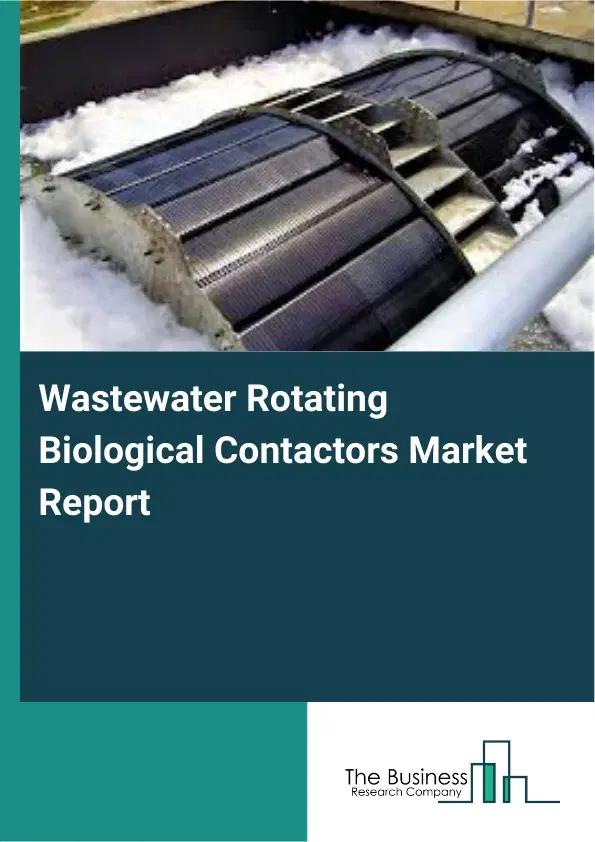
Wastewater Rotating Biological Contactors Market Report 2026
Global Outlook – By Product Type (Rotating Biological Contactors, Hybrid Rotating Biological Contactors Systems), By Disc Media Material (Polyvinyl Chloride Or Polyethylene, Other Composites), By Flow Capacity (Small-Scale (Greater Than 10 Million Litres Per Day), Medium-Scale (1–10 Million Litres Per Day), Large-Scale (>10 Million Litres Per Day) ), By Application (Secondary Treatment, Tertiary Treatment), By End-User (Municipal Wastewater, Industrial Wastewater, Chemical And Petrochemical, Food And Beverage Or Dairy, Pharmaceuticals, Oil And Gas) – Market Size, Trends, Strategies, and Forecast to 2035
Wastewater Rotating Biological Contactors Market Overview
• Wastewater Rotating Biological Contactors market size has reached to $1.79 billion in 2025 • Expected to grow to $2.28 billion in 2030 at a compound annual growth rate (CAGR) of 4.9% • Growth Driver: Rising Focus On Reducing Industrial Effluent Discharge Fueling The Growth Of The Market Due To Demand For Effective Effluent Treatment Solutions • Market Trend: • North America was the largest region in 2025 and Asia-Pacific is the fastest growing region.What Is Covered Under Wastewater Rotating Biological Contactors Market?
Wastewater rotating biological contactors are fixed-film biological treatment systems that use a series of slowly rotating discs partially submerged in wastewater to support the growth of microorganisms that degrade organic pollutants. These help to efficiently reduce biochemical oxygen demand and remove contaminants from wastewater, improving effluent quality before discharge or further treatment. The main product types in wastewater rotating biological contactors include rotating biological contactors and hybrid rotating biological contactor systems. Rotating biological contactors are widely used for biological wastewater treatment due to their efficient organic load removal, low energy consumption, and stable performance under variable flow conditions. These systems utilize disc media made from polyvinyl chloride, polyethylene, and others and are designed for small, medium, and large-scale flow capacities. Wastewater rotating biological contactors are applied in secondary and tertiary treatment processes, serving end-users such as municipal wastewater facilities, industrial wastewater plants, chemical and petrochemical operations, food and beverage or dairy facilities, pharmaceutical units, and oil and gas.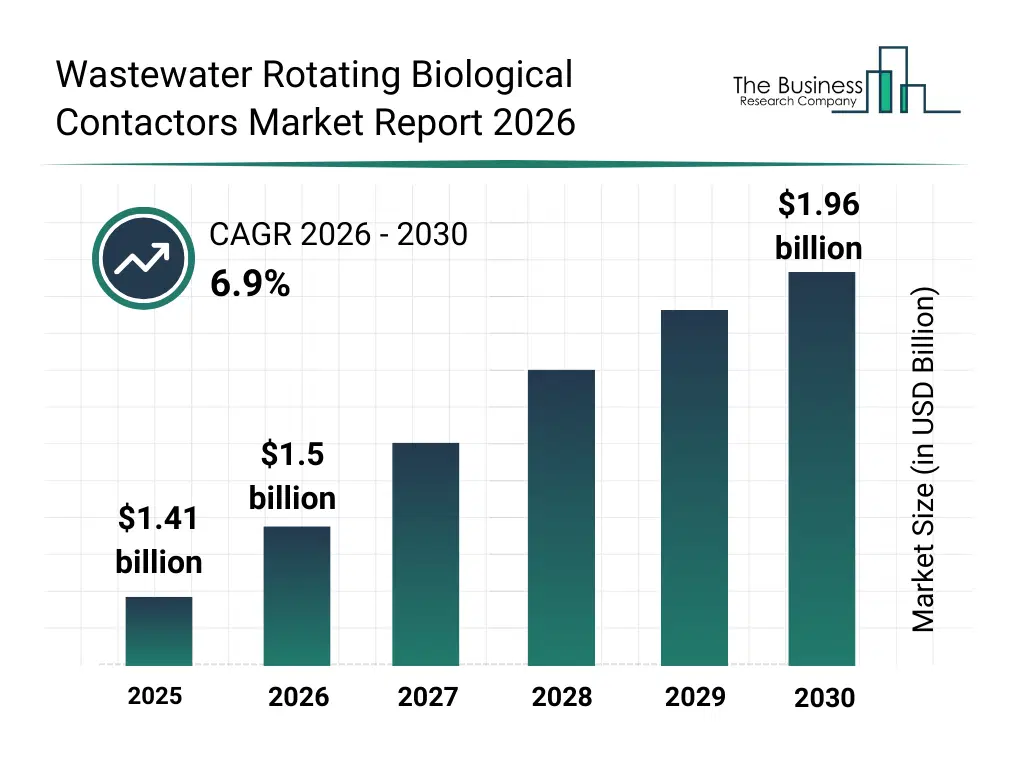
What Is The Wastewater Rotating Biological Contactors Market Size and Share 2026?
The wastewater rotating biological contactors market size has grown strongly in recent years. It will grow from $1.79 billion in 2025 to $1.89 billion in 2026 at a compound annual growth rate (CAGR) of 5.1%. The growth in the historic period can be attributed to increasing adoption of energy-efficient secondary treatment systems, growing urban wastewater treatment infrastructure, rising awareness of environmental regulations, expansion of small and medium municipal wastewater plants, and increasing demand for low-operational-cost treatment technologies.What Is The Wastewater Rotating Biological Contactors Market Growth Forecast?
The wastewater rotating biological contactors market size is expected to see steady growth in the next few years. It will grow to $2.28 billion in 2030 at a compound annual growth rate (CAGR) of 4.9%. The growth in the forecast period can be attributed to growing focus on decentralized wastewater treatment, increasing investments in hybrid rotating biological contactors (RBC) systems, rising implementation of stricter effluent discharge standards, expansion of industrial wastewater treatment facilities, and increasing government incentives for sustainable water management. Major trends in the forecast period include technological advancements in biofilm media design, innovation in smart monitoring and automation systems, ongoing research in energy-efficient drives, development of modular and scalable rotating biological contactors (RBC) systems, and technology upgrades for antimicrobial-resistant media and odor mitigation.
Global Wastewater Rotating Biological Contactors Market Segmentation
1) By Product Type: Rotating Biological Contactors, Hybrid Rotating Biological Contactors Systems 2) By Disc Media Material: Polyvinyl Chloride Or Polyethylene, Other Composites 3) By Flow Capacity: Small-Scale (Greater Than 10 Million Litres Per Day), Medium-Scale (1–10 Million Litres Per Day), Large-Scale (>10 Million Litres Per Day) 4) By Application: Secondary Treatment, Tertiary Treatment 5) By End-User: Municipal Wastewater, Industrial Wastewater, Chemical And Petrochemical, Food And Beverage Or Dairy, Pharmaceuticals, Oil And Gas Subsegments: 1) By Rotating Biological Contactors: Standard Disc-Based Units, Multi-Stage Rotating Units, Energy-Efficient Low-Speed Units, Packaged Modular RBC Units 2) By Hybrid Rotating Biological Contactors Systems: Rotating Biological Contactor And Fixed-Film Media Combination Systems, Rotating Biological Contactor And Activated Sludge Integrated Systems, Rotating Biological Contactor And Membrane Bioreactor Hybrid Systems, Rotating Biological Contactor And Biofilm Carrier Enhanced SystemsWhat Are The Drivers Of The Wastewater Rotating Biological Contactors Market?
The rising focus on reducing industrial effluent discharge is expected to propel the growth of the wastewater rotating biological contactors market going forward. Reducing industrial effluent discharge refers to regulatory, environmental, and corporate efforts to lower the volume and pollutant load of wastewater released from manufacturing, processing, and industrial facilities. The rising focus on reducing industrial effluent discharge is increasing due to stricter environmental regulations and sustainability mandates, as industries face penalties, legal action, and reputational risks for releasing untreated or poorly treated wastewater. Wastewater rotating biological contactors support the goal of effluent reduction by providing a robust secondary biological treatment solution that removes organic pollutants and reduces the environmental impact of discharged water. For instance, in August 2025, according to the U.S. Environmental Protection Agency (EPA), a US-based government agency, the discharges to water fell by 11 million pounds, a 6% decrease from 2022 to 2023 and is largely due to reduced nitrate compound releases from primary metals and petroleum product facilities. Nitrate compounds accounted for 90% of all toxics release inventory (TRI) chemical releases to water. Therefore, the rising focus on reducing industrial effluent discharge is driving the growth of the wastewater rotating biological contactors industry. The growing investment in municipal wastewater infrastructure is expected to propel the growth of the wastewater rotating biological contactors market going forward. Municipal wastewater infrastructure investment refers to the allocation of financial resources by governments and municipalities to develop, upgrade, and maintain sewage collection and treatment systems to ensure public health and environmental protection. The investment in municipal wastewater infrastructure is increasing due to aging and overburdened sewage systems in many cities, as they struggle to handle increasing wastewater loads, leading to failures, pollution risks, and the urgent need for modernization. The wastewater rotating biological contactors supports investment in municipal wastewater infrastructure. For instance, in June 2025, according to the United States Congress, a US-based federal government agency, the U.S. Environmental Protection Agency’s 2024 assessment estimates $630 billion in national wastewater infrastructure needs over the next 20 years. Therefore, the growing investment in municipal wastewater infrastructure is driving the growth of the wastewater rotating biological contactors industry.Key Players In The Global Wastewater Rotating Biological Contactors Market
Major companies operating in the wastewater rotating biological contactors market are Veolia Water Technologies, Suez S.A., Sekisui Chemical Co. Ltd., Xylem Inc., Evoqua Water Technologies LLC, Ovivo Inc., Triveni Engineering & Industries Ltd., WesTech Engineering LLC, VA Tech Wabag Ltd., ION Exchange India Ltd., Smith & Loveless Inc., Parkson Corporation, Mecana AG, Premier Tech Water and Environment, AZU Water Srl, Euroteck Environmental Pvt Ltd., Lakeside Equipment Corporation, Napier-Reid Ltd., Butler Manufacturing Services Ltd., SKD Consultancy & ServicesWhat Are Latest Mergers And Acquisitions In The Wastewater Rotating Biological Contactors Market?
In October 2024, Miranda Water Technologies, a Canada-based wastewater and water purification innovator, partnered with Fleming College. With this partnership, Miranda aims to integrate advanced real-time monitoring, predictive data analytics, and improved system control to deliver more reliable and cost-efficient wastewater treatment performance. Fleming College is a Canada-based applied research and education institution specializing in machine intelligence and water technology innovation.Regional Insights
North America was the largest region in the wastewater rotating biological contactors market in 2025. Asia-Pacific is expected to be the fastest-growing region in the forecast period. The regions covered in this market report are Asia-Pacific, South East Asia, Western Europe, Eastern Europe, North America, South America, Middle East, Africa. The countries covered in this market report are Australia, Brazil, China, France, Germany, India, Indonesia, Japan, Taiwan, Russia, South Korea, UK, USA, Canada, Italy, Spain.What Defines the Wastewater Rotating Biological Contactors Market?
The wastewater rotating biological contactors market consists of sales of rotating biological contactor units, biological treatment discs, drive mechanisms, enclosed treatment modules, and secondary clarifier support components. Values in this market are ‘factory gate’ values, that is the value of goods sold by the manufacturers or creators of the goods, whether to other entities (including downstream manufacturers, wholesalers, distributors and retailers) or directly to end customers. The value of goods in this market includes related services sold by the creators of the goods.How is Market Value Defined and Measured?
The market value is defined as the revenues that enterprises gain from the sale of goods and/or services within the specified market and geography through sales, grants, or donations in terms of the currency (in USD unless otherwise specified). The revenues for a specified geography are consumption values that are revenues generated by organizations in the specified geography within the market, irrespective of where they are produced. It does not include revenues from resales along the supply chain, either further along the supply chain or as part of other products.What Key Data and Analysis Are Included in the Wastewater Rotating Biological Contactors Market Report 2026?
The wastewater rotating biological contactors market research report is one of a series of new reports from The Business Research Company that provides market statistics, including industry global market size, regional shares, competitors with the market share, detailed market segments, market trends and opportunities, and any further data you may need to thrive in the wastewater rotating biological contactors industry. The market research report delivers a complete perspective of everything you need, with an in-depth analysis of the current and future state of the industry.Wastewater Rotating Biological Contactors Market Report Forecast Analysis
| Report Attribute | Details |
|---|---|
| Market Size Value In 2026 | $1.89 billion |
| Revenue Forecast In 2035 | $2.28 billion |
| Growth Rate | CAGR of 5.1% from 2026 to 2035 |
| Base Year For Estimation | 2025 |
| Actual Estimates/Historical Data | 2020-2025 |
| Forecast Period | 2026 - 2030 - 2035 |
| Market Representation | Revenue in USD Billion and CAGR from 2026 to 2035 |
| Segments Covered | Product Type, Disc Media Material, Flow Capacity, Application, End-User |
| Regional Scope | Asia-Pacific, Western Europe, Eastern Europe, North America, South America, Middle East, Africa |
| Country Scope | The countries covered in the report are Australia, Brazil, China, France, Germany, India, ... |
| Key Companies Profiled | Veolia Water Technologies, Suez S.A., Sekisui Chemical Co. Ltd., Xylem Inc., Evoqua Water Technologies LLC, Ovivo Inc., Triveni Engineering & Industries Ltd., WesTech Engineering LLC, VA Tech Wabag Ltd., ION Exchange India Ltd., Smith & Loveless Inc., Parkson Corporation, Mecana AG, Premier Tech Water and Environment, AZU Water Srl, Euroteck Environmental Pvt Ltd., Lakeside Equipment Corporation, Napier-Reid Ltd., Butler Manufacturing Services Ltd., SKD Consultancy & Services |
| Customization Scope | Request for Customization |
| Pricing And Purchase Options | Explore Purchase Options |