
Water Free Skincare Market Report 2026
Global Outlook – By Product Type (Oil Based Skincare, Balm Based Skincare, Anhydrous Creams, Powdered Skincare, Solid Skincare), By Skin Type (Dry Skin, Oily Or Acne Prone Skin, Sensitive Skin, Normal Or Combination Skin), By Functionality (Hydration, Cleansing, Treatment, Protection), By Sales Channel (Hypermarkets Or Supermarkets, Specialty Stores, Drug Stores And Pharmacies, Convenience Stores, Online Retailers, Other Sales Channels) – Market Size, Trends, Strategies, and Forecast to 2030
Water Free Skincare Market Overview
• Water Free Skincare market size has reached to $17.15 billion in 2025 • Expected to grow to $23.69 billion in 2030 at a compound annual growth rate (CAGR) of 6.4% • Growth Driver: Impact Of E-Commerce On Water-Free Skincare Market • Market Trend: Water-Free Skincare Innovations Meeting Sustainability Demands • Asia-Pacific was the largest region and fastest growing region.What Is Covered Under Water Free Skincare Market?
Water-free skincare refers to skincare products that do not contain water (aqua) as one of their primary ingredients. These products are often formulated with a focus on anhydrous (waterless) formulations, relying on oils, emollients, and other hydrating ingredients to moisturize and nourish the skin without needing water. The main product types of water-free skincare are oil-based, balm-based, anhydrous creams, powdered, and solid skincare. Oil-based skincare refers to products that primarily contain oils as their main ingredients. The skin types involved are dry skin, oily or acne-prone skin, sensitive skin, and normal or combination skin with hydration, cleansing, treatment, and protection functionality. The sales channels involved are hypermarkets or supermarkets, specialty stores, drug stores and pharmacies, convenience stores, online retailers, and other sales channels.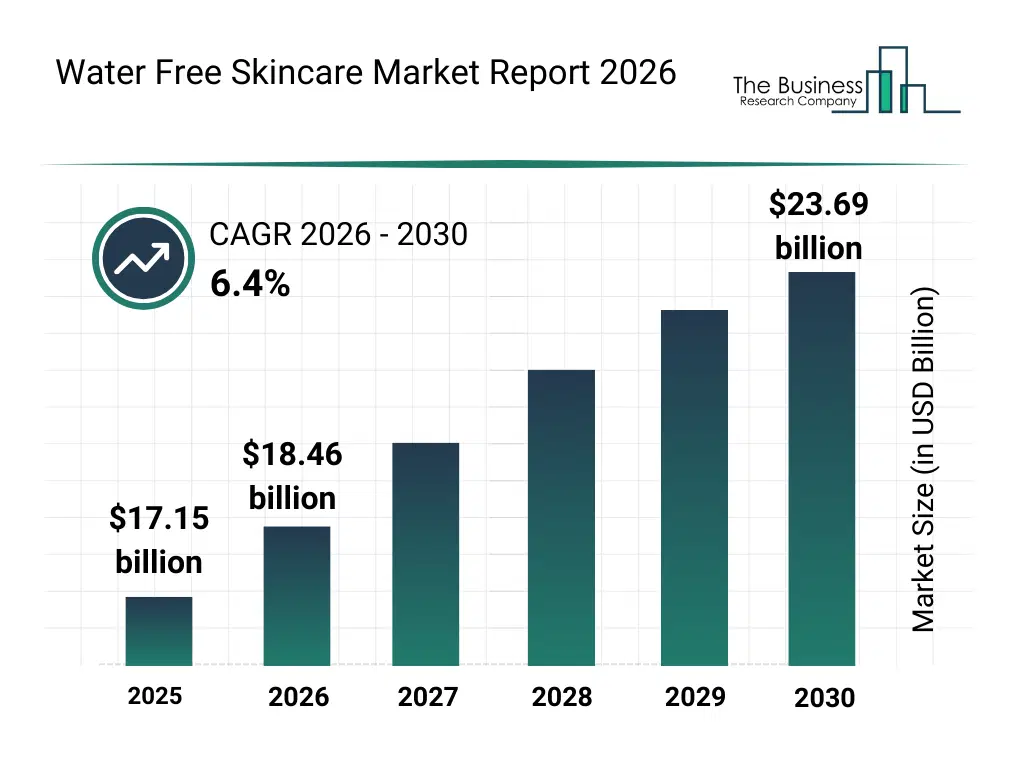
What Is The Water Free Skincare Market Size and Share 2026?
The water free skincare market size has grown strongly in recent years. It will grow from $17.15 billion in 2025 to $18.46 billion in 2026 at a compound annual growth rate (CAGR) of 7.6%. The growth in the historic period can be attributed to consumer interest in natural skincare, growth of premium beauty brands, demand for long shelf life products, reduction of preservatives in cosmetics, rise of clean beauty movement.What Is The Water Free Skincare Market Growth Forecast?
The water free skincare market size is expected to see strong growth in the next few years. It will grow to $23.69 billion in 2030 at a compound annual growth rate (CAGR) of 6.4%. The growth in the forecast period can be attributed to increasing sustainability awareness, growth in eco conscious consumers, innovation in oil based formulations, expansion of online beauty retail, rising demand for travel friendly skincare. Major trends in the forecast period include rising demand for anhydrous skincare products, growing popularity of clean beauty formulations, increasing adoption of solid and balm based skincare, expansion of waterless products in premium cosmetics, higher focus on sustainable and minimalist beauty.
Global Water Free Skincare Market Segmentation
1) By Product Type: Oil Based Skincare, Balm Based Skincare, Anhydrous Creams, Powdered Skincare, Solid Skincare 2) By Skin Type: Dry Skin, Oily Or Acne Prone Skin, Sensitive Skin, Normal Or Combination Skin 3) By Functionality: Hydration, Cleansing, Treatment, Protection 4) By Sales Channel: Hypermarkets Or Supermarkets, Specialty Stores, Drug Stores And Pharmacies, Convenience Stores, Online Retailers, Other Sales Channels Subsegments: 1) By Oil-Based Skincare: Facial Oils, Body Oils, Cleansing Oils 2) By Balm-Based Skincare: Hydrating Balms, Lip Balms, Soothing Balms 3) By Anhydrous Creams: Moisturizing Creams, Night Creams, Anti-Aging Creams 4) By Powdered Skincare: Powder Cleansers, Powder Masks, Powder Sunscreens 5) By Solid Skincare: Solid Moisturizers, Solid Cleansers, Solid SunscreensWhat Is The Driver Of The Water Free Skincare Market?
The increase in e-commerce sales is expected to propel the growth of the water-free skincare market going forward. E-commerce, short for electronic commerce, refers to the buying and selling of goods and services over the internet or through electronic channels. The increase in e-commerce sales is due to convenience, accessibility, product variety, personalization, and competitive pricing. E-commerce platforms often provide detailed product descriptions, ingredient lists, and customer reviews, empowering consumers to make informed purchasing decisions. Transparent product information allows consumers to assess water-free skincare products' efficacy, safety, and suitability based on their preferences, skin sensitivities, and environmental concerns. For instance, in February 2024, according to the United States Census Bureau, a US-based government agency, in 2023, the total e-commerce sales were projected to reach $1,118.7 billion, reflecting a growth of 7.6% (with a margin of error of ±1.2%) compared to 2022. Therefore, the increase in e-commerce sales is driving the growth of the water-free skincare market.Key Players In The Global Water Free Skincare Market
Major companies operating in the water free skincare market are Johnson & Johnson, Procter & Gamble, Unilever, L’Oréal SA, Henkel AG & Co. KGaA, Estee Lauder Companies Incorporation, Kao Corporation, Amway, Shiseido Company Limited, Coty Inc., Avon Products Incorporation, Clarins Group, Nu Skin Enterprises, Revlon Incorporation, Oriflame, Oriflame Cosmetics Global SA, Tata Harper, Indie Lee & Co. LLC, Herbivore Botanicals LLC, Biotique Botanicals Pvt. Ltd., Biossance Corp., Cocokind Inc., Farmacy Beauty LLC, KW Brand Holdings LLC, Bybi Beauty Limited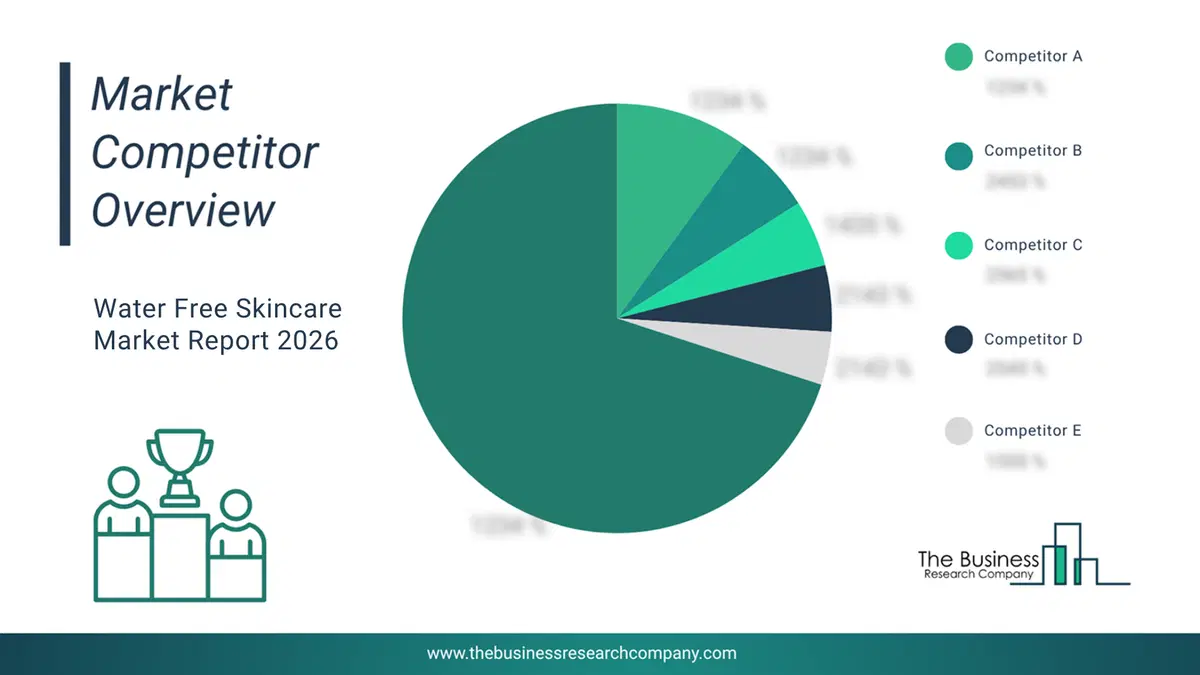
This chart is for illustrative purposes; the full report includes a detailed competitor analysis and comprehensive overview of the top 10 companies in the market.
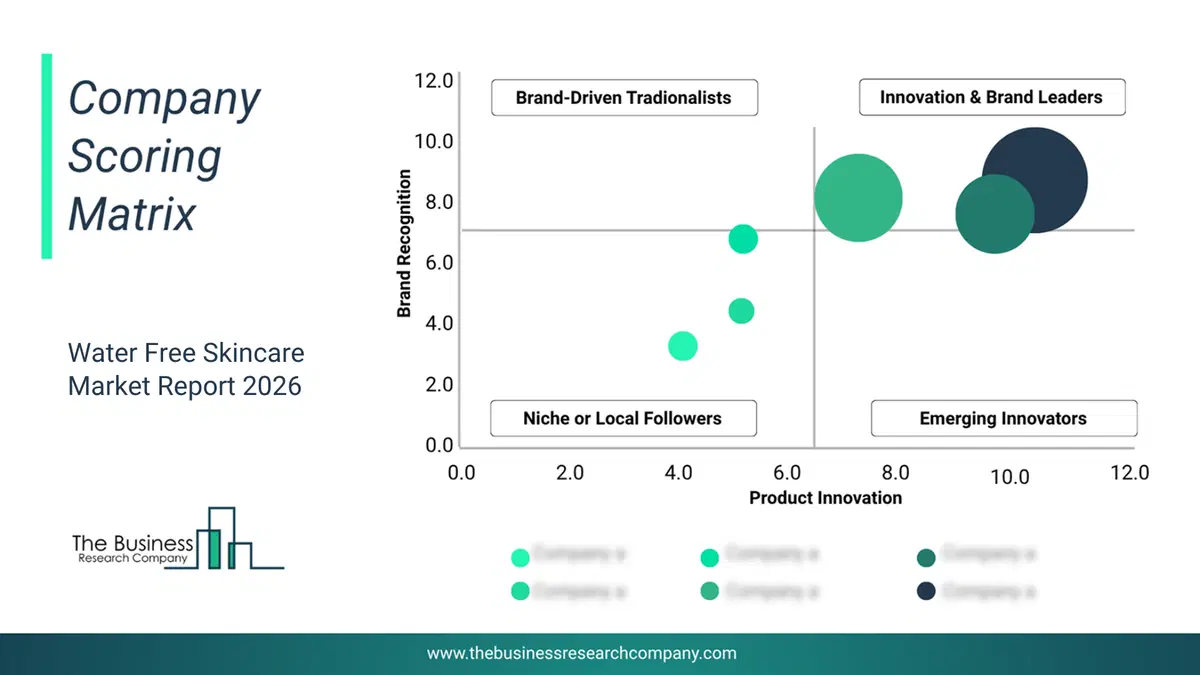
This chart maps companies by product innovation and brand strength, with bubble size indicating relative revenue, helping identify market leaders, challengers, and niche players. This is an illustrative chart; the full report provides a complete and accurate competitive analysis.
Global Water Free Skincare Market Trends and Insights
Major companies operating in the water-free skincare market are focusing on developing innovative products, such as waterless beauty products, to enhance sustainability and address consumer demand for eco-friendly alternatives. Waterless beauty products are formulations with minimal water, prioritizing efficacy and sustainability through alternative ingredients and innovative techniques. For instance, in August 2023, Vegreen Skincare, a South Korea-based eco-friendly skincare brand, launched its first waterless product, the intensive waterless Vitamin C ampoule 20%, to address common issues with traditional Vitamin C products such as oxidation and potency loss. This innovative product uses an oil-based ethyl ascorbyl (6%) to maintain high absorbency and slow down antioxidant activity, ensuring a vitamin C concentration above 80%.What Are Latest Mergers And Acquisitions In The Water Free Skincare Market?
In January 2023, Starco Brands, a US-based provider of consumer products, acquired Skylar for an undisclosed amount. Through this acquisition, Starco aims to expand its portfolio with clean fragrance products, leveraging Skylar's success to introduce breakthroughs and build it into an industry-leading brand supported by strong retail partnerships and a commitment to innovation. Skylar is a US-based operator of a skincare brand that offers water-free skincare.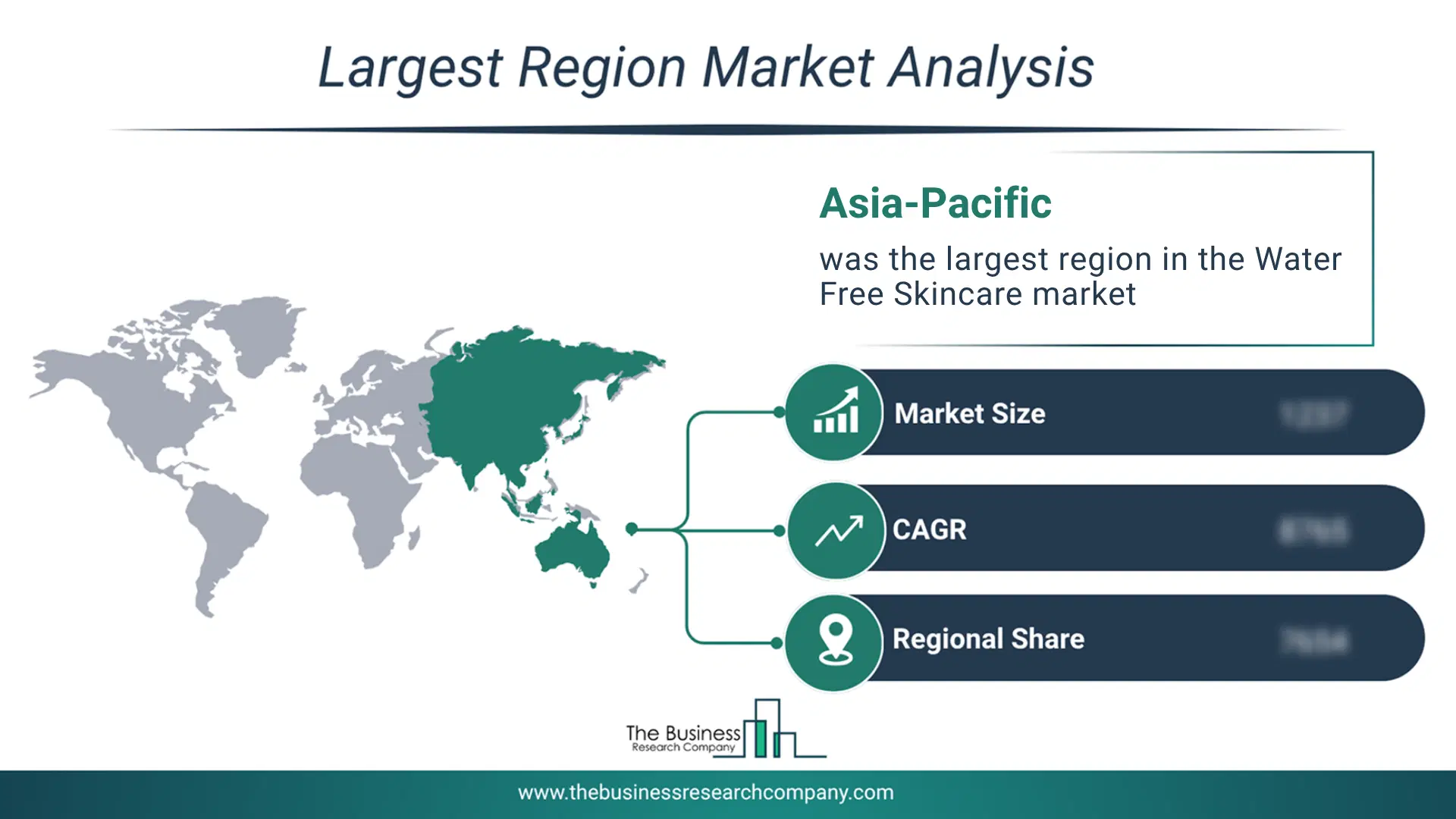
Regional Insights
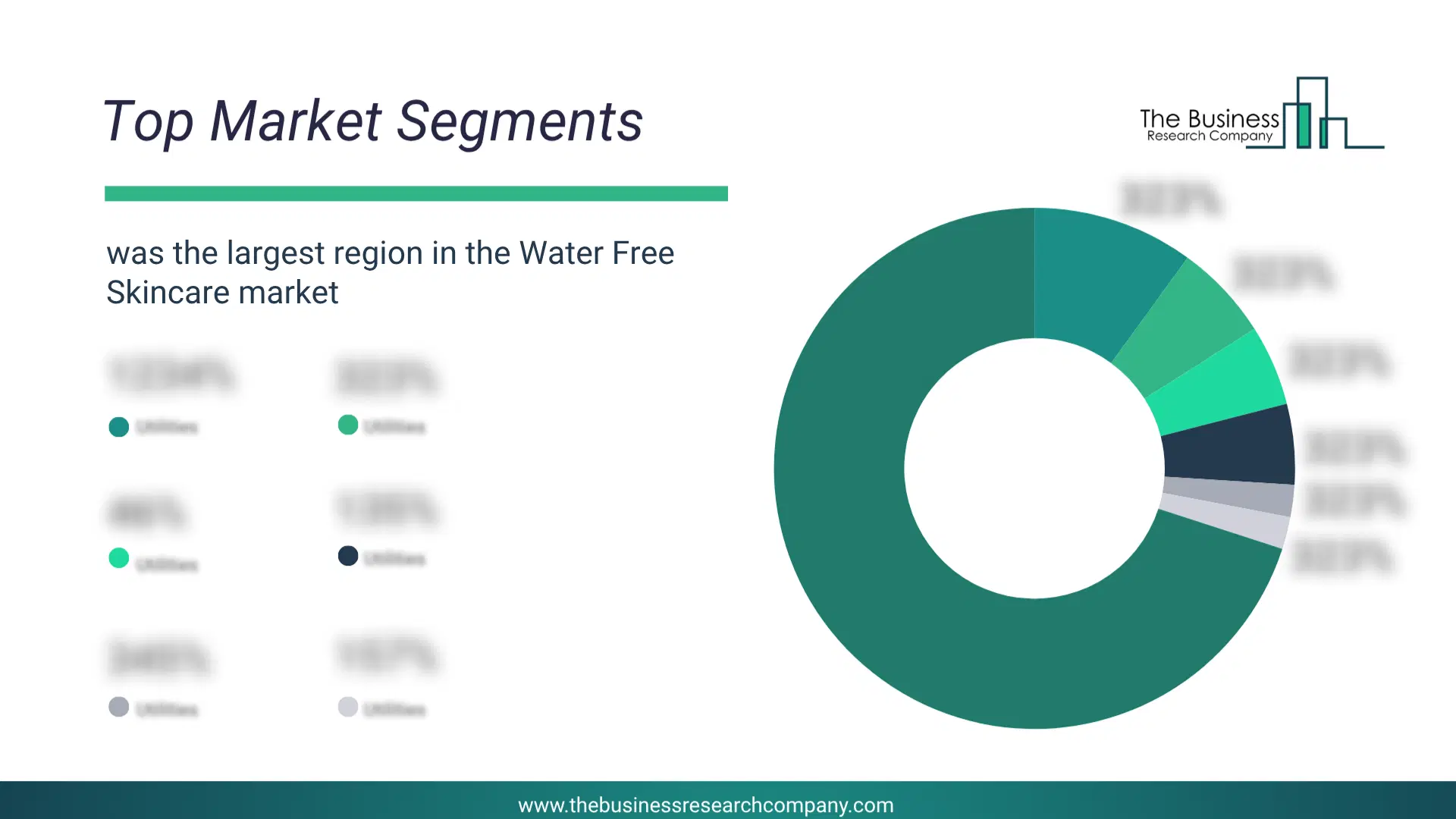
Asia-Pacific was the largest region in the water free skincare market in 2025. North America is expected to be the fastest-growing region in the forecast period. The regions covered in this market report are Asia-Pacific, South East Asia, Western Europe, Eastern Europe, North America, South America, Middle East, Africa The countries covered in this market report are Australia, Brazil, China, France, Germany, India, Indonesia, Japan, Taiwan, Russia, South Korea, UK, USA, Canada, Italy, SpainWhat Defines the Water Free Skincare Market?
The water-free skincare market consists of sales solid skincare bars, serums, facial oils, and cleansing oil. Values in this market are ‘factory gate’ values, that is, the value of goods sold by the manufacturers or creators of the goods, whether to other entities (including downstream manufacturers, wholesalers, distributors, and retailers) or directly to end customers. The value of goods in this market includes related services sold by the creators of the goods.How is Market Value Defined and Measured?
The market value is defined as the revenues that enterprises gain from the sale of goods and/or services within the specified market and geography through sales, grants, or donations in terms of the currency (in USD unless otherwise specified). The revenues for a specified geography are consumption values that are revenues generated by organizations in the specified geography within the market, irrespective of where they are produced. It does not include revenues from resales along the supply chain, either further along the supply chain or as part of other products.
This chart presents market attractiveness based on a quantitative evaluation of growth, competition, strategic alignment, and risk, offering a clear view of opportunity areas for decision-making. This chart is for illustrative purposes; the full report contains the complete analysis.

This chart highlights the Total Addressable Market (TAM) by estimating the maximum revenue opportunity using an assumption-driven approach, supporting strategic planning and opportunity sizing across markets. The chart is illustrative; the full report provides a more comprehensive analysis.
What Key Data and Analysis Are Included in the Water Free Skincare Market Report 2026?
The water free skincare market research report is one of a series of new reports from The Business Research Company that provides market statistics, including industry global market size, regional shares, competitors with the market share, detailed market segments, market trends and opportunities, and any further data you may need to thrive in the water free skincare industry. The market research report delivers a complete perspective of everything you need, with an in-depth analysis of the current and future state of the industry.Water Free Skincare Market Report Forecast Analysis
| Report Attribute | Details |
|---|---|
| Market Size Value In 2026 | $18.46 billion |
| Revenue Forecast In 2030 | $23.69 billion |
| Growth Rate | CAGR of 7.6% from 2026 to 2030 |
| Base Year For Estimation | 2025 |
| Actual Estimates/Historical Data | 2020-2025 |
| Forecast Period | 2026 - 2030 |
| Market Representation | Revenue in USD Billion and CAGR from 2026 to 2030 |
| Segments Covered | Product Type, Skin Type, Functionality, Sales Channel |
| Regional Scope | Asia-Pacific, Western Europe, Eastern Europe, North America, South America, Middle East, Africa |
| Country Scope | The countries covered in this market report are Australia, Brazil, China, France, Germany, India, Indonesia, Japan, Taiwan, Russia, South Korea, UK, USA, Canada, Italy, Spain |
| Key Companies Profiled | Johnson & Johnson, Procter & Gamble, Unilever, L’Oréal SA, Henkel AG & Co. KGaA, Estee Lauder Companies Incorporation, Kao Corporation, Amway, Shiseido Company Limited, Coty Inc., Avon Products Incorporation, Clarins Group, Nu Skin Enterprises, Revlon Incorporation, Oriflame, Oriflame Cosmetics Global SA, Tata Harper, Indie Lee & Co. LLC, Herbivore Botanicals LLC, Biotique Botanicals Pvt. Ltd., Biossance Corp., Cocokind Inc., Farmacy Beauty LLC, KW Brand Holdings LLC, Bybi Beauty Limited |
| Customization Scope | Request for Customization |
| Pricing And Purchase Options | Explore Purchase Options |