
Water Management Systems Market Report 2026
Global Outlook – By Offering (Hardware, Software, Services), By Application (Water Management, Leak Detection, Water Quality And Quantity Monitoring), By End User (Residential, Industrial, Commercial) – Market Size, Trends, Strategies, and Forecast to 2030
Water Management Systems Market Overview
• Water Management Systems market size has reached to $17.01 billion in 2025 • Expected to grow to $29.29 billion in 2030 at a compound annual growth rate (CAGR) of 11.4% • Growth Driver: Impact Of Growing Industrialization On The Water Management Systems Market • Market Trend: WINT Water Intelligence Unveils AI-Powered WINT3 Platform For Advanced Leak Detection And Mitigation • North America was the largest region in 2025 and Asia-Pacific is the fastest growing region.Market Gains By 2030 – Top Opportunities By Segment
Market Gain identifies the most promising market opportunities by highlighting the segments or products expected to generate the highest incremental revenue growth over the next five years.
What Is Covered Under Water Management Systems Market?
Water management systems refer to the infrastructure, technologies, and practices implemented to monitor, control, and optimize water resource usage, distribution, and treatment. They are used to monitor water usage, control distribution networks, optimize resource allocation, treat water for various purposes, and detect leaks within the infrastructure. The main offerings in water management systems are hardware, software, and services. Hardware in the water management systems market refers to physical equipment such as sensors, meters, pumps, valves, and controllers used to monitor, control, and manage water resources. The various applications include water management, leak detection, water quality and quantity monitoring, and other applications used by various end users such as residential, industrial, and commercial.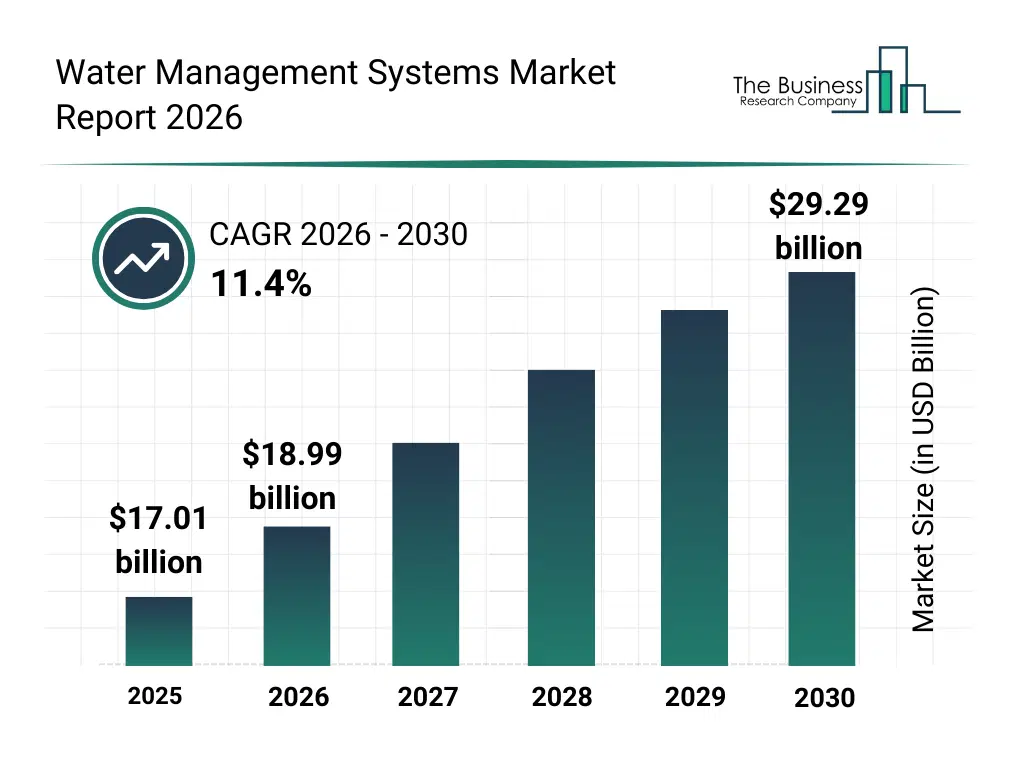
What Is The Water Management Systems Market Size and Share 2026?
The water management systems market size has grown rapidly in recent years. It will grow from $17.01 billion in 2025 to $18.99 billion in 2026 at a compound annual growth rate (CAGR) of 11.6%. The growth in the historic period can be attributed to expansion of urban water infrastructure, increasing municipal water demand, adoption of early scada-based systems, rising investments in pipeline networks, growing awareness of water loss management.What Is The Water Management Systems Market Growth Forecast?
The water management systems market size is expected to see rapid growth in the next few years. It will grow to $29.29 billion in 2030 at a compound annual growth rate (CAGR) of 11.4%. The growth in the forecast period can be attributed to increasing investments in smart city water projects, rising focus on water conservation policies, growing adoption of ai-based water analytics, expansion of digital water utilities, increasing demand for resilient water infrastructure. Major trends in the forecast period include increasing deployment of smart water monitoring platforms, rising adoption of leak detection systems, growing integration of real-time analytics in water networks, expansion of automated control and distribution systems, enhanced focus on non-revenue water reduction.
Global Water Management Systems Market Segmentation
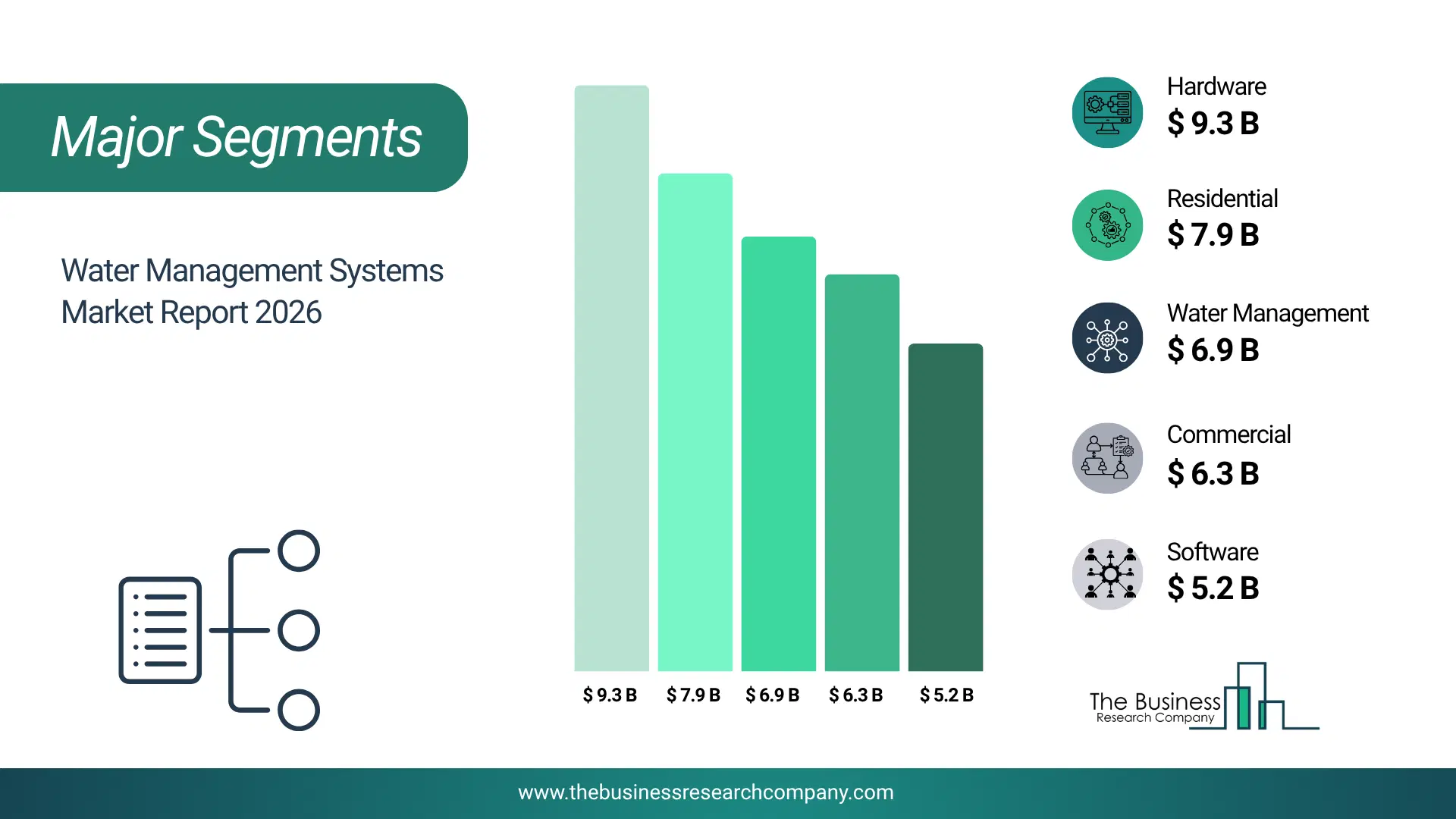
1) By Offering: Hardware, Software, Services 2) By Application: Water Management, Leak Detection, Water Quality And Quantity Monitoring 3) By End User: Residential, Industrial, Commercial Subsegments: 1) By Hardware: Sensors And Meters, Pumps And Valves, Controllers And Actuators, Water Treatment Equipment 2) By Software: Water Quality Monitoring Software, Leak Detection Software, SCADA (Supervisory Control And Data Acquisition) Systems, Data Analytics And Reporting Software 3) By Services: Consulting Services, Installation And Maintenance Services, Managed Services, System Integration Services The top segments in the water management systems market will be: • Hardware will reach $9331.13 Million by 2025. • Residential will reach $7966.61 Million by 2025. • Water Management will reach $6996.79 Million by 2025. • Commercial will reach $6354.5 Million by 2025. • Software will reach $5217.06 Million by 2025.What Is The Driver Of The Water Management Systems Market?
Growing industrialization is expected to propel the growth of the water management systems market going forward. Industrialization refers to the process of transforming an economy from primarily rural and handicraft-based to one dominated by industry, manufacturing, and mechanized production methods. Growing industrialization is due to technological advancements, government initiatives supporting industrial growth, globalization, and increasing demand for manufactured goods. The growing industrialization trend creates a significant opportunity for water management systems providers as industries seek solutions to address water-related challenges, enhance operational efficiency, and achieve sustainable growth in the face of increasing water scarcity and environmental pressures. For instance, in February 2024, according to the Xinhua News Agency, a China-based government agency, Mexico's industrial activity increased by 3.5 percent in 2023 compared to the prior year. Therefore, growing industrialization is driving the growth of the water management systems industry.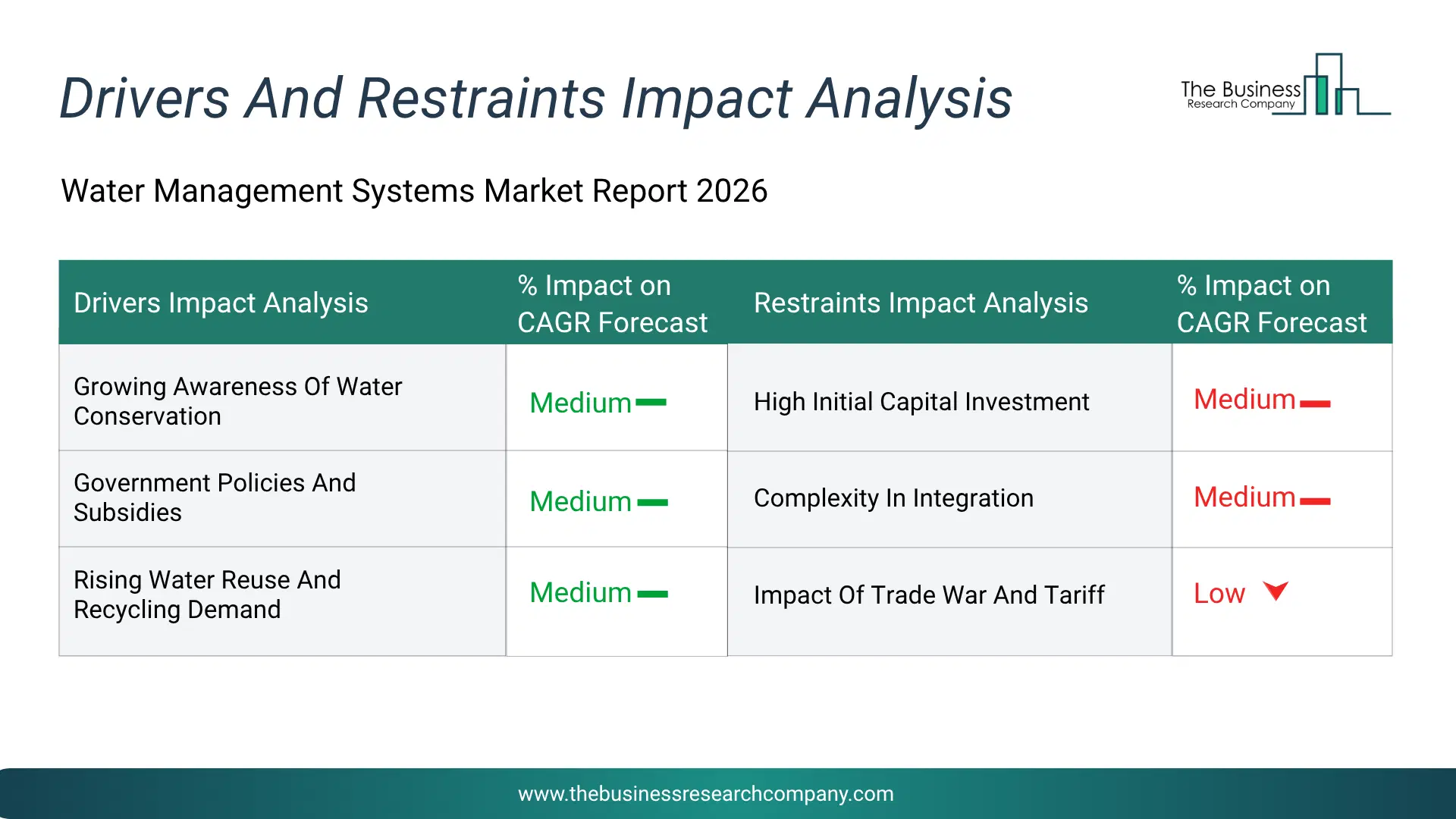
Infographic Chart Showing Key Market Drivers Analysis And Restraints For Water Management Systems Market
The chart presents an impact analysis of key drivers and restraints, quantifying their relative influence on the market's growth rate and helping assess the balance between growth enablers and limiting factors. This chart offers a high-level perspective; the full report contains more detailed insights.
How Will The Drivers Impact Growth In The Global Water Management Systems Market?
• Growing Awareness Of Water Conservation (Medium) – The growing awareness of water conservation will become a key driver of growth in the water management systems market by 2030. Increasing public concern over water scarcity and droughts drives demand for leak detection, smart metering, and sensor-based monitoring to minimize losses. Businesses are adopting water-efficient practices to meet sustainability goals and respond to consumer preferences, driving the adoption of smart water management systems. Community-driven initiatives and educational campaigns are fostering a culture of water conservation, leading to increased demand for water-saving technologies. As a result, the growing awareness of water conservation is anticipated to contributing to a 1.5% annual growth in the market. • Government Policies And Subsidies (Medium) – The government policies and subsidies will emerge as a major factor driving the expansion of the water management systems market by 2030. Governments enacting stricter discharge norms and water usage regulations force industries and municipalities to upgrade or adopt water treatment, reuse, and monitoring systems. Subsidies and tax incentives for rainwater harvesting, wastewater reuse and smart metering reduce the initial cost barrier, increasing uptake. Public infrastructure spending, like budget allocations for water, stormwater and wastewater treatment, ensures demand for equipment, construction and tech. Policies mandating water efficiency and conservation are compelling industries to adopt technologies that monitor and manage water usage effectively. Consequently, government policies and subsidies are projected to contributing to a 1.2% annual growth in the market. • Rising Water Reuse And Recycling Demand (Medium) – The rising water reuse and recycling demand as a major factor driving the expansion of the water management systems market by 2030. Scarcity of freshwater sources pushes industries (e.g., power, chemical, food, and beverage) to reuse treated wastewater to reduce dependency on fresh supplies. Urban areas with growing population burdens on water supply promote reuse of greywater and treated wastewater to reduce fresh water demand. Agricultural sectors in arid regions increasingly rely on recycled water for irrigation when fresh water is expensive or limited. Cities are integrating water reuse strategies into urban planning to address water scarcity and ensure a sustainable water supply. Consequently, rising water reuse and recycling demand is projected to contributing to a 1.0% annual growth in the market. • Growing Investments In Water Management (Low) – The growing investments in water management will emerge as a major factor driving the expansion of the water management systems market by 2030. Cross-border electricity trade requires clean, reliable, and regulation-compliant sources of power and water management systems projects are well positioned to meet these needs. Small hydropower projects (SHP) plants provide stable renewable generation, support grid balancing and can be easily integrated into regional energy exchanges, making them ideal for international power trade. Moreover, their location in border states and hilly regions enhances their potential for export to neighbouring countries. As emerging countries around the world, such as Nepal, Bhutan, and Bangladesh, increasingly participate in cross-border electricity trade to diversify energy sources and meet climate targets, the demand for flexible and dependable renewable energy from small hydro projects is expected to rise. Consequently, the growing investments in water management are projected to contributing to a 0.7% annual growth in the market.How Will The Restraints Impact Growth In The Global Water Management Systems Market?
• High Initial Capital Investment (Medium) – High Initial Capital Investment will restrict the growth of the Water Management Systems market during the forecast period. Water management systems require significant capital investment in infrastructure, equipment, and technology. High upfront costs create barriers for smaller municipalities and organizations with limited budgets. Investment requirements can delay project implementation and limit the adoption of comprehensive water management solutions. • Complexity In Integration (Medium) – Complexity In Integration will restrict the growth of the Water Management Systems market during the forecast period. Water management system integration with existing infrastructure presents technical challenges and compatibility issues. Integration complexity can lead to project delays and increased costs. The need for system customization and specialized expertise affects implementation timelines and market growth. • Impact Of Trade War And Tariff (Low) – Impact Of Trade War And Tariff will restrict the growth of the Water Management Systems market during the forecast period. Water management systems rely on imported components and equipment subject to trade tariffs. Trade barriers can increase project costs and affect system affordability. Trade tensions may also impact water infrastructure investment and funding availability.Key Players In The Global Water Management Systems Market
Major companies operating in the water management systems market are Siemens Water Technologies LLC, General Electric Company, International Business Machines Corporation, Veolia Environnement SA, Asea Brown Boveri Ltd, Emerson Electric Co, Xylem Inc, Pentair plc, Tetra Tech Inc, Kurita Water Industries Ltd, Horiba Ltd, Evoqua Water Technologies Inc, Landis+Gyr, Aclara Technologies, Kamstrup, Schneider Electric SE, Aquatech International LLC, Nijhuis Industries BV, Eco Tec Inc, Schlumberger Limited, Aker Solutions ASA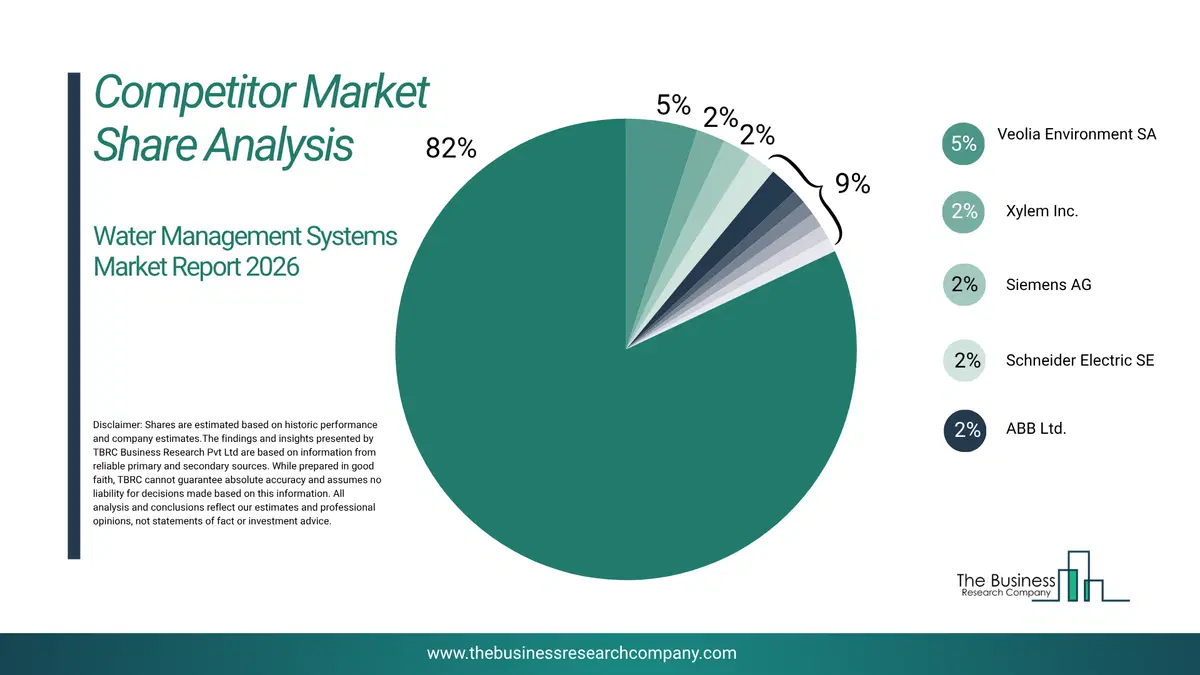
This chart is for illustrative purposes; the full report includes a detailed competitor analysis and comprehensive overview of the top 10 companies in the market.
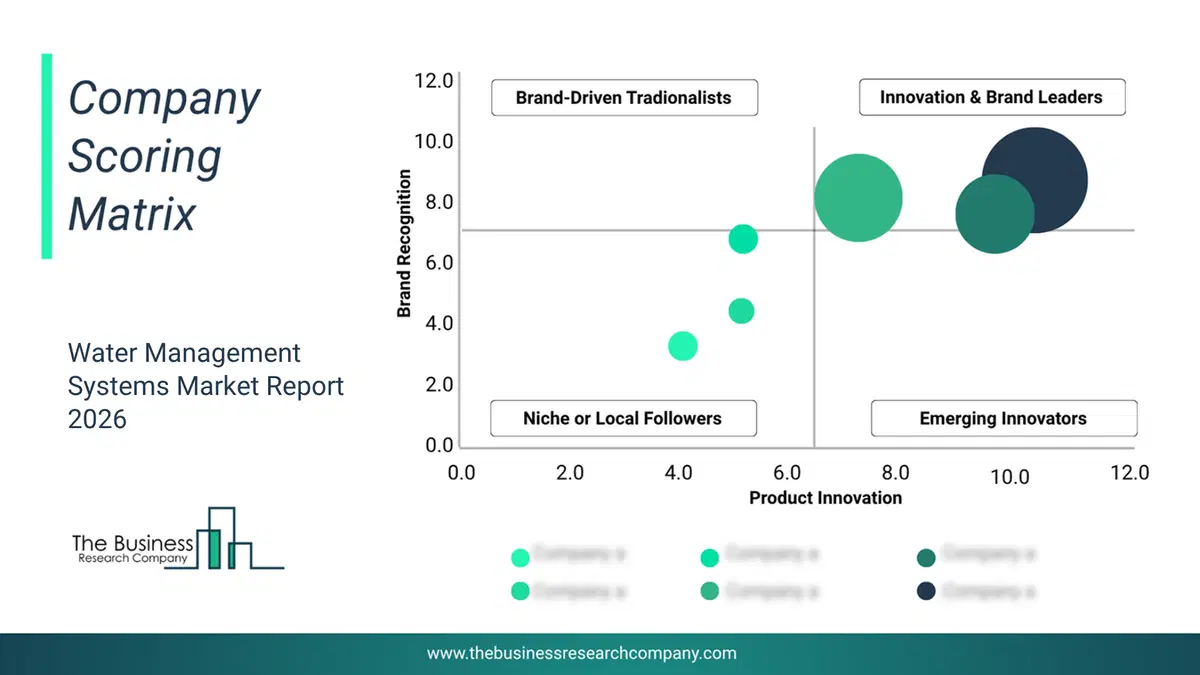
This chart maps companies by product innovation and brand strength, with bubble size indicating relative revenue, helping identify market leaders, challengers, and niche players. This is an illustrative chart; the full report provides a complete and accurate competitive analysis.
Global Water Management Systems Market Trends and Insights
Major companies operating in the water management systems market are focusing on developing innovative solutions, such as next-generation water management solutions, to strengthen their position in the market. A next-generation water management solution typically refers to an advanced system or approach that leverages technology, data analytics, and innovation to improve water resource management's efficiency, sustainability, and resilience. For instance, in March 2023, WINT Water Intelligence, a US-based provider of AI-based water management technologies, launched its new WINT3 platform to enhance its water management capabilities. The platform uses artificial intelligence to detect and stop leaks at the source, reducing water waste and damage to buildings and construction sites. The system includes automated leak mitigation with real-time detection and auto shutoff, unparalleled anomaly detection and analytics powered by advanced AI algorithms, and enterprise-grade management for operation in large and mid-sized facilities.What Are Latest Mergers And Acquisitions In The Water Management Systems Market?
In October 2023, BW Water Pte. Ltd., a Singapore-based provider of industrial water and wastewater systems, acquired SafBon Water Technology Inc. for an undisclosed amount. With the acquisition, BW Water aims to expand its global presence, increase its footprint for industrial and municipal solution sales in the US, and diversify into the desalination market. SafBon Water Technology Inc. is a US-based company that provides comprehensive solutions for cutting-edge wastewater and water treatment systems.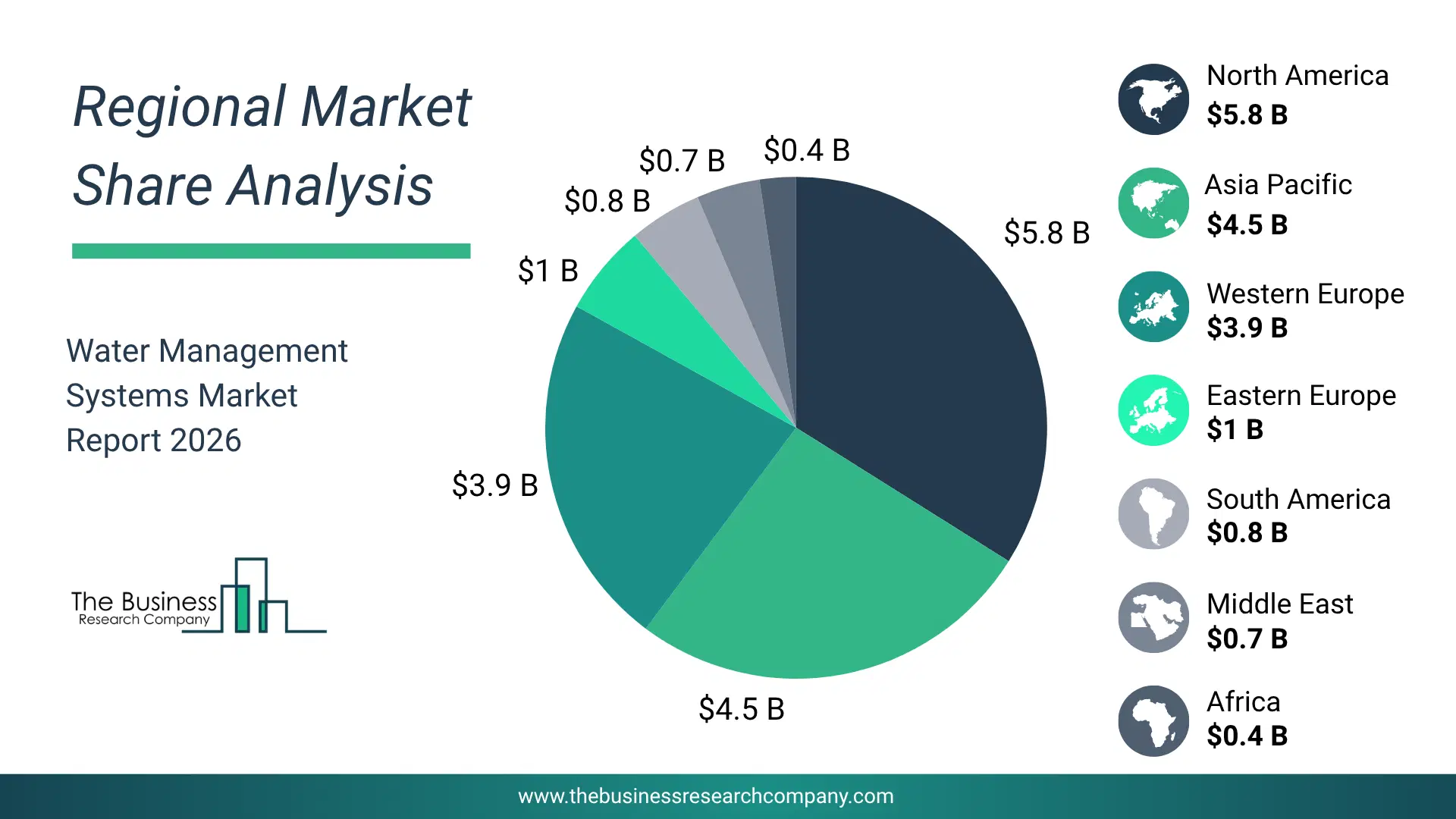
Regional Outlook
North America was the largest region in the market in water management systems 2025. Asia-Pacific is expected to be the fastest-growing region in the forecast period. The regions covered in this market report are Asia-Pacific, South East Asia, Western Europe, Eastern Europe, North America, South America, Middle East, Africa. The countries covered in this market report are Australia, Brazil, China, France, Germany, India, Indonesia, Japan, Taiwan, Russia, South Korea, UK, USA, Canada, Italy, SpainWhat Defines the Water Management Systems Market?
The water management systems market consists of revenues earned by entities providing services such as water treatment, purification, distribution, water audits and assessments, and water metering and monitoring. The market value includes the value of related goods sold by the service provider or included within the service offering. The water management systems market also includes sales of water treatment equipment, pumps and pumping systems, valves and flow control devices, rainwater harvesting systems, and monitoring and control systems. Values in this market are ‘factory gate’ values, that is the value of goods sold by the manufacturers or creators of the goods, whether to other entities (including downstream manufacturers, wholesalers, distributors and retailers) or directly to end customers. The value of goods in this market includes related services sold by the creators of the goods.How is Market Value Defined and Measured?
The market value is defined as the revenues that enterprises gain from the sale of goods and/or services within the specified market and geography through sales, grants, or donations in terms of the currency (in USD unless otherwise specified). The revenues for a specified geography are consumption values that are revenues generated by organizations in the specified geography within the market, irrespective of where they are produced. It does not include revenues from resales along the supply chain, either further along the supply chain or as part of other products.
This chart presents market attractiveness based on a quantitative evaluation of growth, competition, strategic alignment, and risk, offering a clear view of opportunity areas for decision-making. This chart is for illustrative purposes; the full report contains the complete analysis.

This chart highlights the Total Addressable Market (TAM) by estimating the maximum revenue opportunity using an assumption-driven approach, supporting strategic planning and opportunity sizing across markets. The chart is illustrative; the full report provides a more comprehensive analysis.
What Key Data and Analysis Are Included in the Water Management Systems Market Report 2026?
The water management systems market research report is one of a series of new reports from The Business Research Company that provides market statistics, including Market Report 2026?global market size, regional shares, competitors with the market share, detailed market segments, market trends and opportunities, and any further data you may need to thrive in the water management systems Market Report 2026? The market research report delivers a complete perspective of everything you need, with an in-depth analysis of the current and future state of the Market Report 2026?Water Management Systems Market Report Forecast Analysis
| Report Attribute | Details |
|---|---|
| Market Size Value In 2026 | $18.99 billion |
| Revenue Forecast In 2030 | $29.29 billion |
| Growth Rate | CAGR of 11.6% from 2026 to 2030 |
| Base Year For Estimation | 2025 |
| Actual Estimates/Historical Data | 2020-2025 |
| Forecast Period | 2026 - 2030 |
| Market Representation | Revenue in USD Billion and CAGR from 2026 to 2030 |
| Segments Covered | Offering, Application, End User |
| Regional Scope | Asia-Pacific, Western Europe, Eastern Europe, North America, South America, Middle East, Africa |
| Country Scope | The countries covered in the report are Australia, Brazil, China, France, Germany, India, Indonesia, Japan, Taiwan, Russia, South Korea, UK, USA, Canada, Italy, Spain. |
| Key Companies Profiled | Siemens Water Technologies LLC, General Electric Company, International Business Machines Corporation, Veolia Environnement SA, Asea Brown Boveri Ltd, Emerson Electric Co, Xylem Inc, Pentair plc, Tetra Tech Inc, Kurita Water Industries Ltd, Horiba Ltd, Evoqua Water Technologies Inc, Landis+Gyr, Aclara Technologies, Kamstrup, Schneider Electric SE, Aquatech International LLC, Nijhuis Industries BV, Eco Tec Inc, Schlumberger Limited, Aker Solutions ASA |
| Customization Scope | Request for Customization |
| Pricing And Purchase Options | Explore Purchase Options |