

Water Management Systems Market 2026
By Offering (Hardware, Software, Services), By Application (Water Management, Leak Detection, Water Quality And Quantity Monitoring, Other Applications), By End User (Residential, Industrial, Commercial), And By Region, Opportunities And Strategies – Global Forecast To 2035
Water Management Systems Market Definition
Water management systems refer to integrated solutions designed to monitor, control and optimize the use, distribution and conservation of water resources. These systems combine a range of physical infrastructure, digital technologies and services to ensure the efficient utilization of water while reducing waste, detecting anomalies and maintaining quality standards. The water management systems market consists of revenues generated by entities that are used by municipalities, industrial facilities, commercial establishments and residential households to address growing concerns around water scarcity, regulatory compliance and sustainability. Water management systems are used continuously in contexts such as urban water supply networks, irrigation systems, industrial production facilities and residential complexes, where consistent monitoring and control of water flow, pressure and quality are required to ensure reliable access and minimize losses.
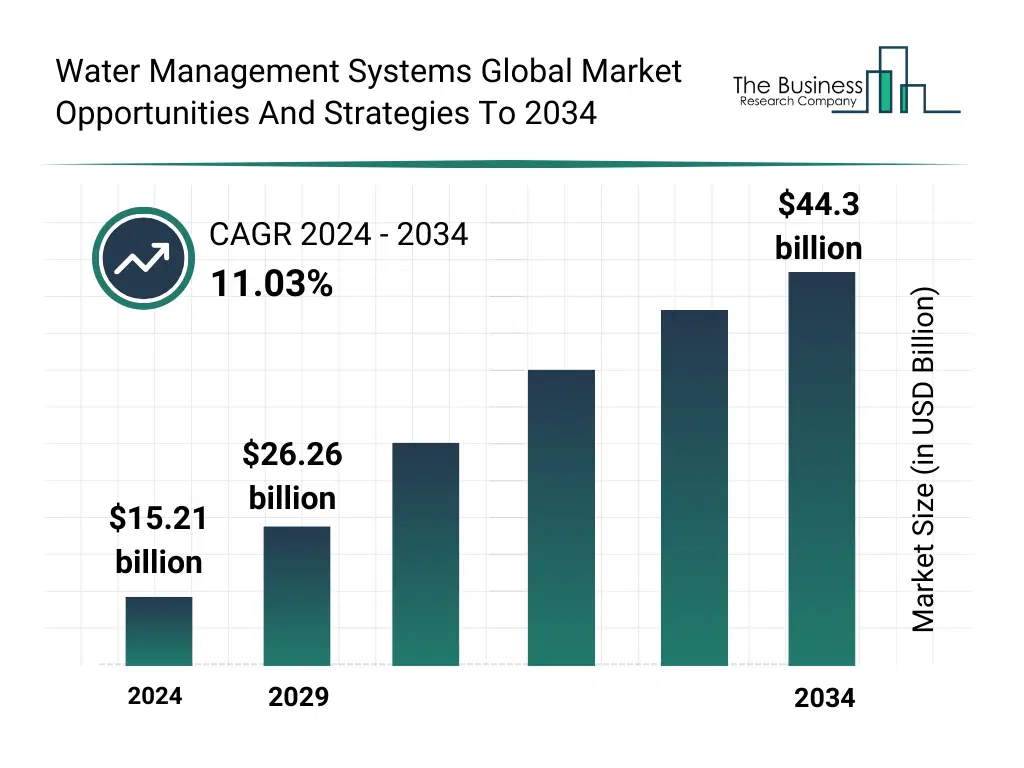
Water Management Systems Market Size
The global water management systems market reached a value of nearly $15,206.63 million in 2024, having grown at a compound annual growth rate (CAGR) of 9.70% since 2019. The market is expected to grow from $15,206.63 million in 2024 to $26,257.11 million in 2029 at a rate of 11.54%. The market is then expected to grow at a CAGR of 11.03% from 2029 and reach $44,302.92 million in 2034. Growth in the historic period resulted from expansion of smart city initiatives, rising water scarcity concerns, expansion of residential and commercial construction and expansion of agriculture and irrigation needs. Factors that negatively affected growth in the historic period were limited skilled workforce availability and data security and privacy concerns in smart water systems. Going forward, growing awareness of water conservation, government policies and subsidies, rising water reuse and recycling demand and growing investments in water management will drive growth. Factors that could hinder the growth of the water management systems market in the future includes high initial capital investment, complexity in integration and impact of trade war and tariffy.Water Management Systems Market Drivers
The key drivers of the water management systems market include: Growing Awareness Of Water Conservation Water Management Systems Market Restraints The key restraints on the water management systems market include: High Initial Capital Investment During the forecast period, the high initial capital investment will restrain the growth of the water management systems market. Water management systems, especially advanced solutions like smart metering, IoT (internet of things) based monitoring and large-scale treatment plants, require significant upfront capital for infrastructure, hardware and installation. For municipalities, small enterprises and farmers in developing regions, these costs often become a barrier, slowing adoption despite the long-term savings they provide. Additionally, return on investment may take years to realize, which discourages short-term budget planners from approving projects. This limits large-scale rollouts, especially in regions with limited government funding or weak private sector participation. Growth affected by high initial capital investment during the forecast period in 2024 is -1.50%.Water Management Systems Market Trends
Major trends shaping the water management systems market include: Adoption of Solar-Powered Water Treatment Solutions Key players operating in the water management systems market are focusing on integrating renewable energy-powered water treatment technologies such as solar-driven desalination to enhance sustainability and provide reliable water access in remote or resource-constrained regions. These innovations are designed to reduce dependency on conventional energy sources, address freshwater scarcity, and ensure long-term resilience against climate change impacts. For instance, in September 2025, Vietnam launched a solar-powered water treatment pilot on Con Linh Island, Tan Hao Commune, Vinh Long Province, under the P-LINK project, led by the UN Office for South-South Cooperation (UNOSSC) in partnership with the Republic of Korea’s Ministry of Science and ICT (MSIT), to convert brackish water into potable water for households and agriculture in the Mekong Delta region. Integration of Advanced Cloud-Based Water Treatment Design Platforms Major companies in the water management systems market are focusing on developing digital and cloud-based platforms that integrate advanced modeling tools to enhance the design, simulation, and optimization of water treatment systems. These innovations are designed to improve system accuracy, enable collaborative workflows, and support efficient planning for municipal and industrial water applications. For instance, in September 2025, DuPont, a US-based chemicals, materials, and industrial science company, launched an enhanced version of its WAVE PRO water treatment design software, integrating DuPont AmberLite ion exchange resins (IER), to enable precise simulation of ultrafiltration and ion exchange processes, accessible via its WaterApp in English and Chinese.Opportunities And Recommendations In The Water Management Systems Market
Opportunities – The top opportunities in the water management systems market segmented by source will arise in the hardware segment, which will gain $5,450.75 million of global annual sales by 2029. The top opportunities in the water management systems market segmented by application will arise in the water management segment, which will gain $4,047.55 million of global annual sales by 2029. The top opportunities in the water management systems market segmented by application will arise in the residential segment, which will gain $4,360.00 million of global annual sales by 2029. The water management systems market size will gain the most in the USA at $2,753.73 million. Recommendations- To take advantage of the opportunities, The Business Research Company recommends the water management systems market companies to the focus on solar-powered water treatment systems, focus on wastewater recycling and reuse systems, focus on smart sensors and advanced meters, focus on managed services and remote monitoring, focus on cloud-based digital water platforms, focus on predictive analytics and scada-enabled water systems, focus on iot and ai-enabled smart water systems, focus on software-driven water management systems, expand in emerging markets, continue to focus on developed markets, provide competitively priced offerings, continue to use b2b promotions, continue to use b2c promotions, focus on leak detection solutions to accelerate growth, focus on the industrial segment to capture the highest growth potential.Water Management Systems Market Segmentation
The water management systems market is segmented by offering, by application and by end user.By Offering –
The water management systems market is segmented by offering into:
- a) Hardware
- b) Software
- c) Services
By Application –
The water management systems market is segmented by application into:
- a) Water Management
- b) Leak Detection
- c) Water Quality And Quantity Monitoring
- d) Other Applications
By End User –
The water management systems market is segmented by end user into:
- a) Residential
- b) Industrial
- c) Commercial
By Geography - The water management systems market is segmented by geography into:
- • China
- • India
- • Japan
- • Australia
- • Indonesia
- • South Korea
- • USA
- • Canada
- • Brazil
- • France
- • Germany
- • UK
- • Italy
- • Spain
- • Russia
-
o Asia Pacific
o Africa