
Water Quality Testing Equipment Market Report 2026
Global Outlook – By Device Type (Stationary Or Bench-Top, Portable), By Test Type (pH (Power Of hydrogen) Test, Dissolved Oxygen Test, Conductivity Test, Turbidity Test), By End User (Industrial, Commercial, Government, Other End Users) – Market Size, Trends, Strategies, and Forecast to 2030
Water Quality Testing Equipment Market Overview
• Water Quality Testing Equipment market size has reached to $4.83 billion in 2025 • Expected to grow to $6.54 billion in 2030 at a compound annual growth rate (CAGR) of 6.3% • Growth Driver: Rising Water Contamination Instances Fuel Growth Of Water Quality Testing Equipment Market • Market Trend: Standardized Water Quality Test Device Protocol For Drinking Water • North America was the largest region in 2025.Market Gains By 2030 – Top Opportunities By Segment
Market Gain identifies the most promising market opportunities by highlighting the segments or products expected to generate the highest incremental revenue growth over the next five years.
What Is Covered Under Water Quality Testing Equipment Market?
Water quality testing equipment refers to a wide range of instruments, tools, and systems used to monitor and evaluate various characteristics and pollutants in water sources. These tools are made to measure things like chemical concentrations and microbiological contaminants, assisting in ensuring water safety and quality for various purposes. The main types of devices included in water quality testing equipment are stationary or bench-top and portable. A stationery or bench-top item is suited (in terms of size or arrangement) for practical usage on a lab workstation. The various types of tests are included, such as pH (power of hydrogen) tests, dissolved oxygen tests, conductivity tests, turbidity tests, and TDC (tissue dielectric constant) tests. These are used by several end users, including industrial, commercial, government, and others.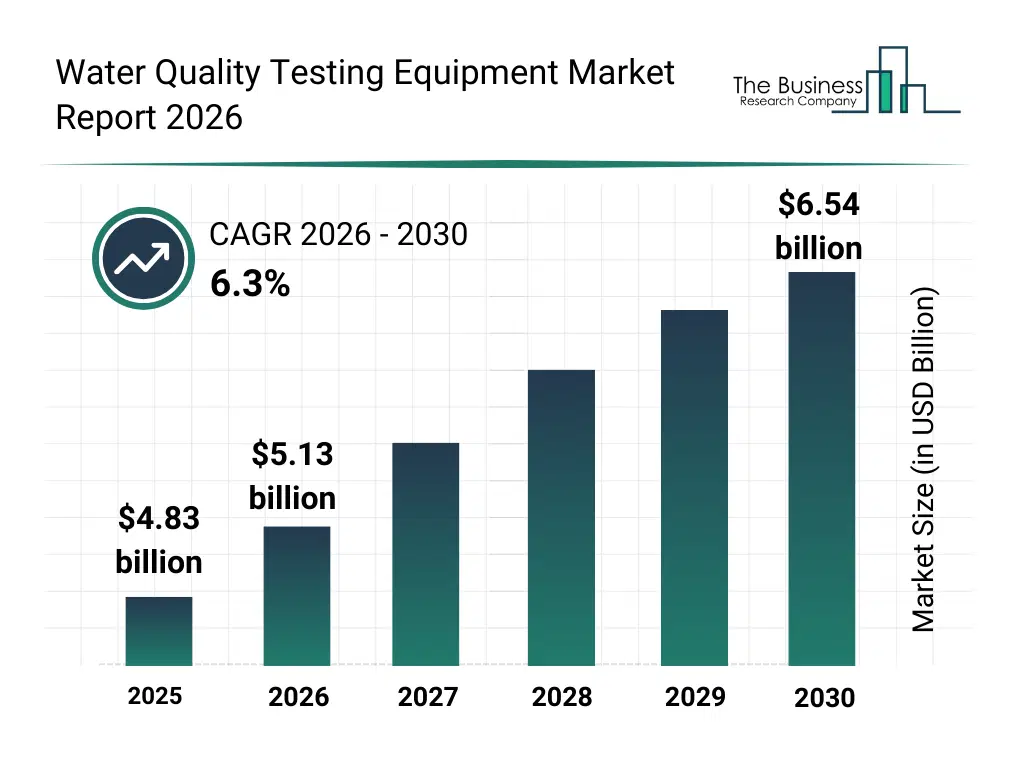
What Is The Water Quality Testing Equipment Market Size and Share 2026?
The water quality testing equipment market size has grown strongly in recent years. It will grow from $4.83 billion in 2025 to $5.13 billion in 2026 at a compound annual growth rate (CAGR) of 6.1%. The growth in the historic period can be attributed to implementation of water quality regulations, industrial pollution monitoring needs, growth of laboratory testing services, public health concerns, expansion of wastewater treatment plants.What Is The Water Quality Testing Equipment Market Growth Forecast?
The water quality testing equipment market size is expected to see strong growth in the next few years. It will grow to $6.54 billion in 2030 at a compound annual growth rate (CAGR) of 6.3%. The growth in the forecast period can be attributed to smart water network deployment, rising environmental monitoring programs, growth of industrial compliance testing, increasing demand for field testing, investments in water safety infrastructure. Major trends in the forecast period include growth of portable testing devices, expansion of real time water monitoring, rising adoption of multi parameter testing, integration of digital data logging, demand for rapid contaminant detection.
Global Water Quality Testing Equipment Market Segmentation
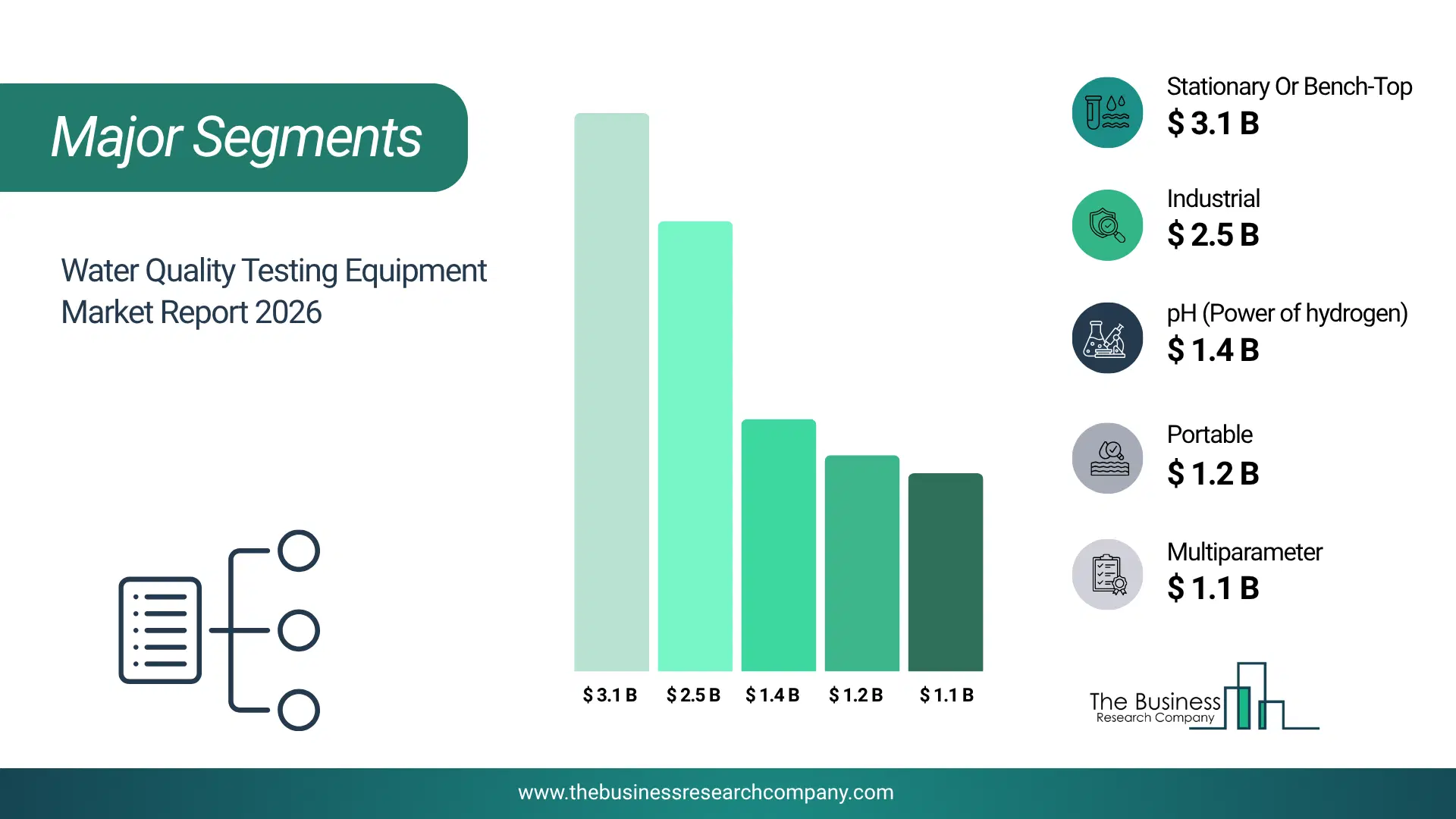
1) By Device Type: Stationary Or Bench-Top, Portable 2) By Test Type: pH (Power Of hydrogen) Test, Dissolved Oxygen Test, Conductivity Test, Turbidity Test 3) By End User: Industrial, Commercial, Government, Other End Users Subsegments: 1) By Stationary Or Bench-Top: Laboratory Analyzers, Multi-Parameter Bench-Top Meters, Spectrophotometers 2) By Portable: Handheld Meters, Portable Multi-Parameter Testers, Field Testing Kits The top segments in the water quality testing equipment market will be: • Stationary Or Bench-Top will reach $3168.77 Million by 2025. • Industrial will reach $2554.95 Million by 2025. • pH (Power of hydrogen) will reach $1417.45 Million by 2025. • Portable will reach $1286.97 Million by 2025. • Multiparameter will reach $1170.52 Million by 2025.What Is The Driver Of The Water Quality Testing Equipment Market?
Increasing instances of water contamination are expected to propel the growth of the water quality testing equipment market going forward. Water contamination refers to the spreading of pollutants into subterranean groundwater or into bodies of water such as lakes, streams, rivers, estuaries, and seas to the point that they obstruct ecosystems' ability to operate naturally or people's ability to use the water for good. Water quality testing equipment is used to identify contaminants and evaluate different aspects of water quality. It aids in determining the presence and concentrations of numerous compounds and contaminants in water sources. For instance, in September 2024, according to the World Health Organization (WHO), a Switzerland-based intergovernmental organization, reported that in 2023, cholera cases rose by 13% and fatalities surged by 71% compared to 2022, with over 4,000 lives lost to this preventable and treatable disease. Therefore, the increasing instances of water contamination are driving the growth of the quality testing equipment market.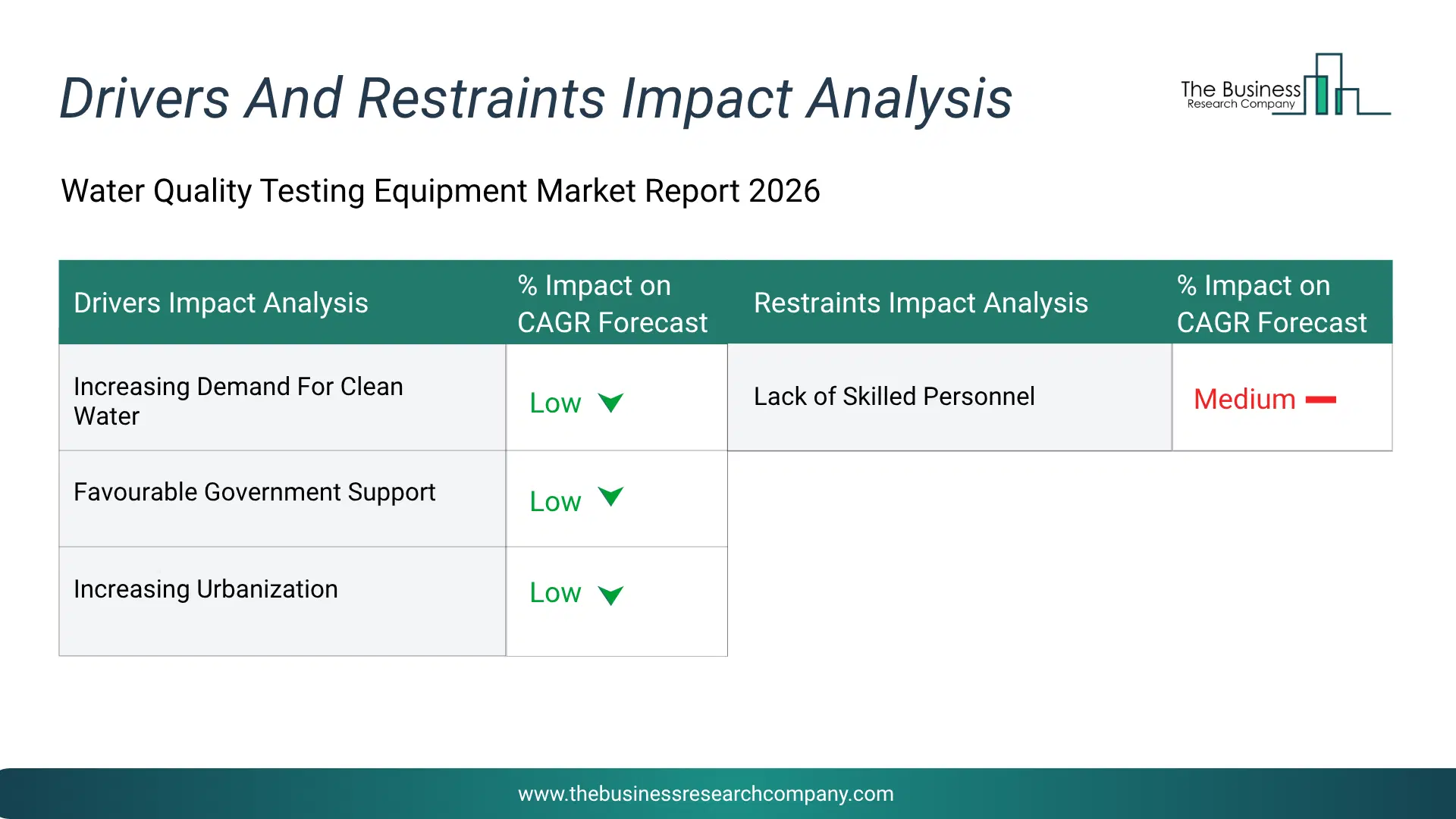
Infographic Chart Showing Key Market Drivers Analysis And Restraints For Water Quality Testing Equipment Market
The chart presents an impact analysis of key drivers and restraints, quantifying their relative influence on the market's growth rate and helping assess the balance between growth enablers and limiting factors. This chart offers a high-level perspective; the full report contains more detailed insights.
How Will The Drivers Impact Growth In The Global Water Quality Testing Equipment Market?
• Increasing Demand For Clean Water (Low) – The increasing demand for clean water will become a key driver of growth in the water quality testing equipment market by 2030. As the importance of clean and safe water becomes more recognized, there is a growing focus on monitoring and maintaining water quality. Testing equipment plays a crucial role in detecting contaminants like bacteria, heavy metals, and chemicals, ensuring water safety for consumption and sanitation. As a result, the increasing demand for clean water is anticipated to contributing to annual growth in the market. • Favourable Government Support (Low) – The favourable government support will emerge as a major factor driving the expansion of the water quality testing equipment market by 2030. Governments are increasingly prioritizing public health initiatives to monitor and enhance water quality, particularly in areas with limited access to safe drinking water. Additionally, there is a growing emphasis on environmental sustainability and resource management, with governments supporting efforts aimed at improving water resource management, controlling pollution, and promoting sustainable agriculture. These actions are driving the demand for water quality testing equipment to effectively monitor and address environmental challenges. Consequently, the favourable government support is projected to contributing to annual growth in the market. • Increasing Urbanization (Low) – The increasing urbanization will emerge as a major factor driving the expansion of the water quality testing equipment market by 2030. As urban populations increase, the demand for safe drinking water grows, along with the need to address higher pollution levels and more complex water systems. This drives the need for regular water quality monitoring to meet health and safety standards. Efficient water management becomes crucial, and testing equipment plays a key role in detecting contamination, optimizing water use, and ensuring sustainable urban water practices. Consequently, increasing urbanization is projected to contributing to annual growth in the market. • Increasing Smart City Initiatives (Low) – The increasing smart city initiatives will emerge as a major factor driving the expansion of the water quality testing equipment market by 2030. Smart city initiatives are driving demand for advanced water quality testing equipment as urban centres focus on sustainable resource management. The integration of smart technologies enables real-time monitoring, which is critical for effective decision-making and ensuring public health. These systems deliver vital data that support timely responses and help meet regulatory requirements, thereby fuelling the growth of water quality testing equipment as cities adopt automated, data-driven solutions for water management. Consequently, the increasing smart city initiatives is projected to contributing to annual growth in the market.How Will The Restraints Impact Growth In The Global Water Quality Testing Equipment Market?
• Lack of Skilled Personnel (Low) – Lack of Skilled Personnel will restrict the growth of the Water Quality Testing Equipment market during the forecast period. Water quality testing requires trained laboratory technicians for sample collection, analysis, and result interpretation. The shortage of qualified professionals in environmental testing limits the capacity of testing facilities. Skill gaps can affect testing accuracy and availability, particularly in regions with limited training infrastructure, constraining market growth.Key Players In The Global Water Quality Testing Equipment Market
Major companies operating in the water quality testing equipment market are General Electric Company, Thermo Fisher Scientific Inc., Danaher Corporation, ABB Ltd., Emerson Electric Co., Eurofins Scientific SE, Agilent Technologies Inc., Xylem Inc., Endress+Hauser AG, Shimadzu Corporation, Horiba Ltd., HACH GmbH & Co., In-Situ Inc., Hanna Instruments Inc., Metrohm AG, Omega Engineering Inc., Analytik Jena AG, Myron L Co., Sea-Bird Electronics Inc., Palintest Ltd., Aquaphoenix Scientific Inc., LaMotte Company, CHEMetrics LLC, Luminultra Technologies Ltd., Sensorex Inc., Tintometer GmbH, Real Tech Inc., Electro-Chemical Devices Inc., Process Insights Inc., Aquaread Ltd.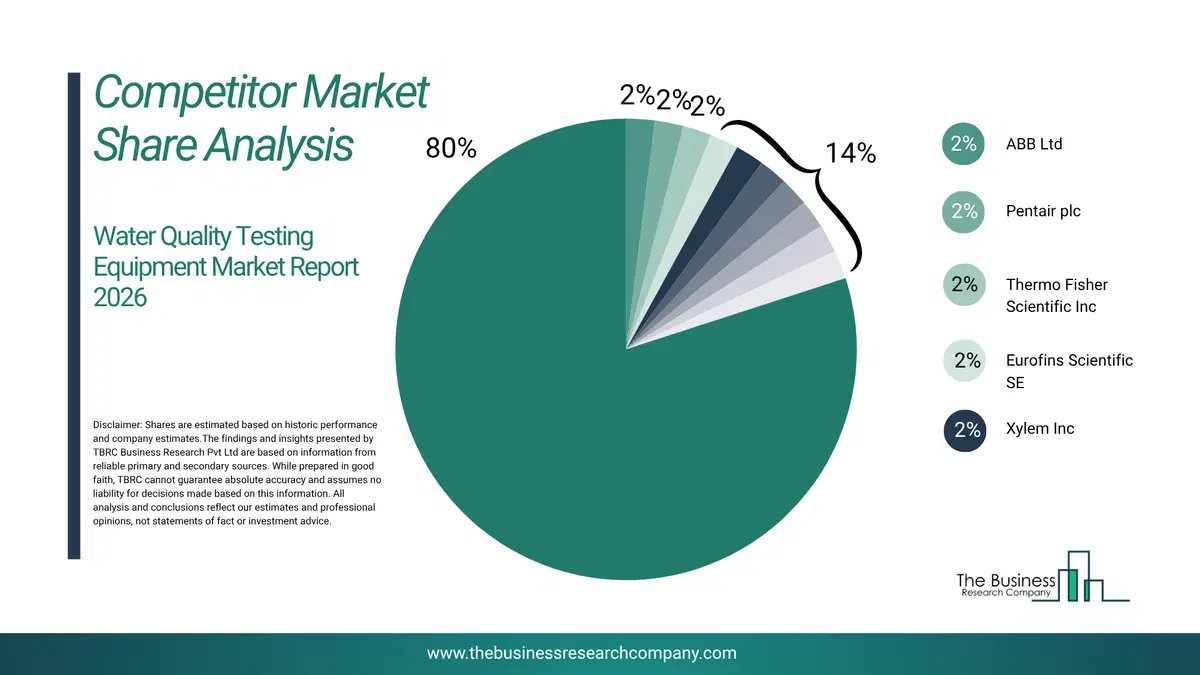
This chart is for illustrative purposes; the full report includes a detailed competitor analysis and comprehensive overview of the top 10 companies in the market.
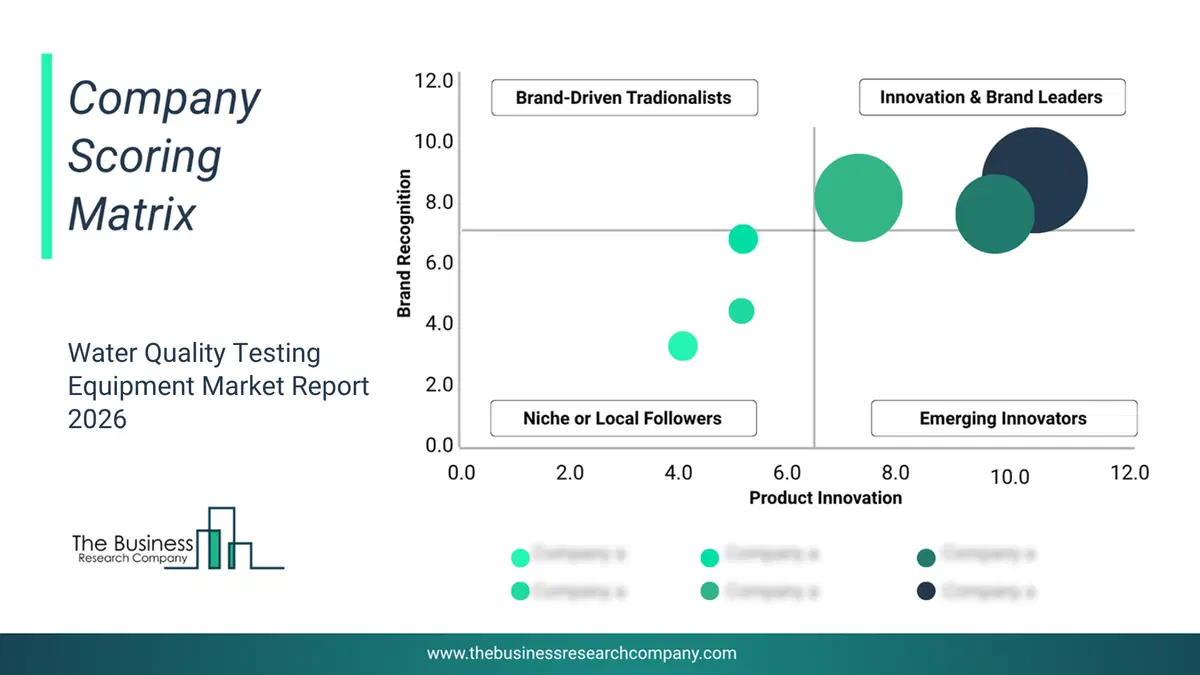
This chart maps companies by product innovation and brand strength, with bubble size indicating relative revenue, helping identify market leaders, challengers, and niche players. This is an illustrative chart; the full report provides a complete and accurate competitive analysis.
Global Water Quality Testing Equipment Market Trends and Insights
Major companies operating in the water quality testing equipment market are focusing on product innovations such as water quality test device to sustain their position in the market. A water quality test device is an instrument used to measure the physical, chemical, and biological characteristics of water. For instance, in March 2023, NSF, a US-based renowned public health and safety organization, introduced a groundbreaking initiative, NSF P524, a water quality test device for drinking water. This marks the first-ever protocol designed to ensure the reliability of water quality testing devices (WQTD) used in drinking water. Unlike previous practices where manufacturers validated their devices independently, NSF P524 establishes a standardized third-party validation process. Developed in collaboration with industry and public health experts, the protocol covers devices, sensors, or test kits measuring water quality parameters in drinking water. Crucially, these kits provide real-time or quickly available results without needing lab facilities. The protocol rigorously assesses the claimed accuracy and precision of the devices within their operational range, using certification testing to compare measurements against established laboratory reference methods.What Are Latest Mergers And Acquisitions In The Water Quality Testing Equipment Market?
In April 2023, HORIBA Advanced Techno Co. Ltd., a Japan-based provider of services and products in the measurement of water and other liquids, acquired Tethys Instruments SAS for an undisclosed amount. The acquisition improves market-ready solution offerings and analytical system research and development at HORIBA Advanced Techno Co. Ltd. to monitor water quality. Further, HORIBA Advanced Techno Co. Ltd. will benefit from Tethys' expertise in UV spectroscopy, which creates positive synergy with HORIBA's core capabilities in electrochemistry and sampling. Tethys Instruments SAS is a France-based manufacturer of measurement technologies for water quality measurements.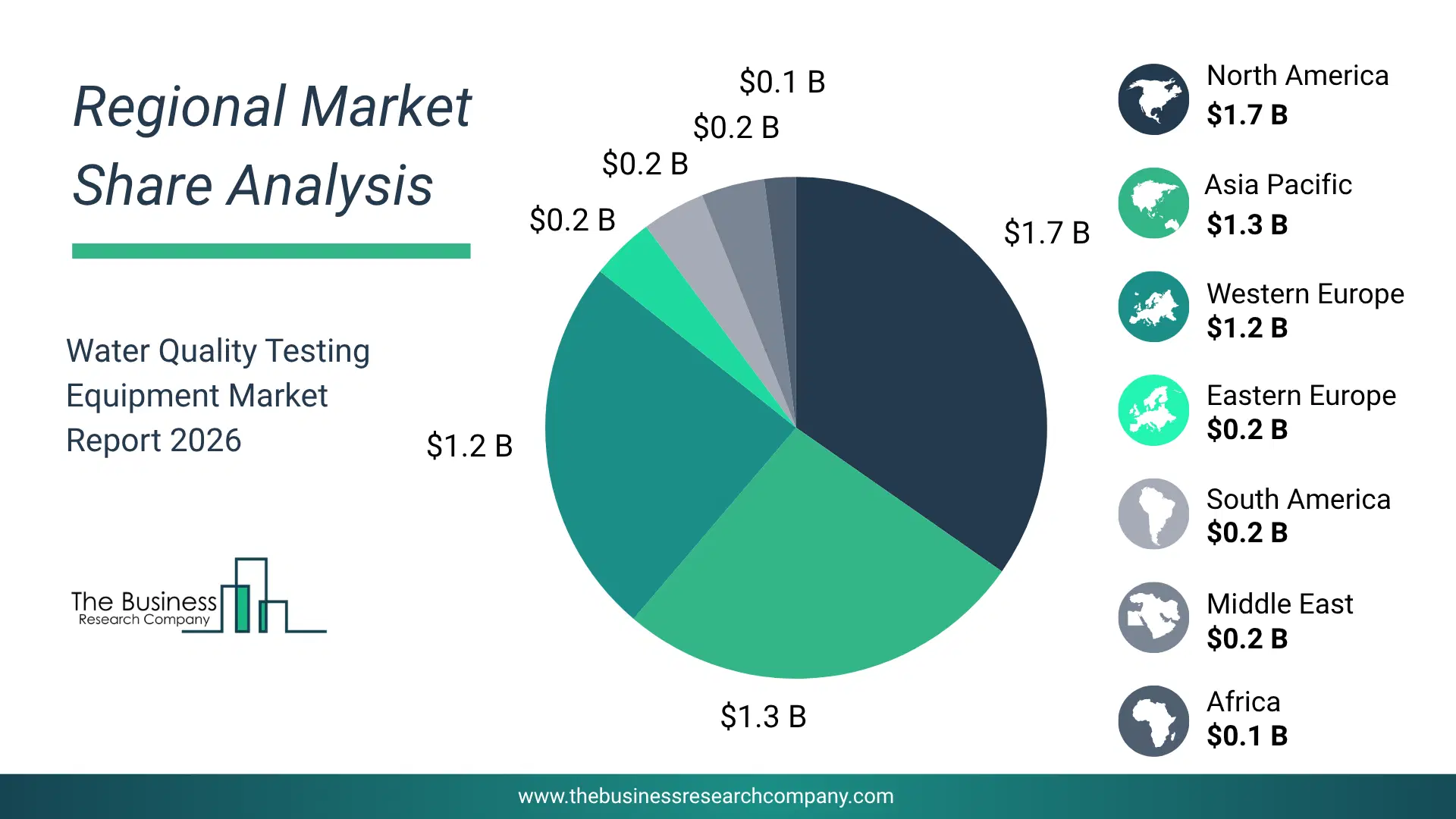
Regional Outlook
North America was the largest region in the water quality testing equipment market in 2025. The regions covered in this market report are Asia-Pacific, South East Asia, Western Europe, Eastern Europe, North America, South America, Middle East, Africa The countries covered in this market report are Australia, Brazil, China, France, Germany, India, Indonesia, Japan, Taiwan, Russia, South Korea, UK, USA, Canada, Italy, Spain.What Defines the Water Quality Testing Equipment Market?
The water quality testing equipment market consists of sales of photometers, silk density index testers (SDI), dissolved oxygen meters, conductivity meters, total hydrocarbon analyzers, and turbidimeters. Values in this market are ‘factory gate’ values, that is, the value of goods sold by the manufacturers or creators of the goods, whether to other entities (including downstream manufacturers, wholesalers, distributors, and retailers) or directly to end customers. The value of goods in this market includes related services sold by the creators of the goods.How is Market Value Defined and Measured?
The market value is defined as the revenues that enterprises gain from the sale of goods and/or services within the specified market and geography through sales, grants, or donations in terms of the currency (in USD unless otherwise specified). The revenues for a specified geography are consumption values that are revenues generated by organizations in the specified geography within the market, irrespective of where they are produced. It does not include revenues from resales along the supply chain, either further along the supply chain or as part of other products.
This chart presents market attractiveness based on a quantitative evaluation of growth, competition, strategic alignment, and risk, offering a clear view of opportunity areas for decision-making. This chart is for illustrative purposes; the full report contains the complete analysis.

This chart highlights the Total Addressable Market (TAM) by estimating the maximum revenue opportunity using an assumption-driven approach, supporting strategic planning and opportunity sizing across markets. The chart is illustrative; the full report provides a more comprehensive analysis.
What Key Data and Analysis Are Included in the Water Quality Testing Equipment Market Report 2026?
The water quality testing equipment market research report is one of a series of new reports from The Business Research Company that provides market statistics, including industry global market size, regional shares, competitors with the market share, detailed market segments, market trends and opportunities, and any further data you may need to thrive in the water quality testing equipment industry. The market research report delivers a complete perspective of everything you need, with an in-depth analysis of the current and future state of the industry.Water Quality Testing Equipment Market Report Forecast Analysis
| Report Attribute | Details |
|---|---|
| Market Size Value In 2026 | $5.13 billion |
| Revenue Forecast In 2030 | $6.54 billion |
| Growth Rate | CAGR of 6.1% from 2026 to 2030 |
| Base Year For Estimation | 2025 |
| Actual Estimates/Historical Data | 2020-2025 |
| Forecast Period | 2026 - 2030 |
| Market Representation | Revenue in USD Billion and CAGR from 2026 to 2030 |
| Segments Covered | Device Type, Test Type, End User |
| Regional Scope | Asia-Pacific, Western Europe, Eastern Europe, North America, South America, Middle East, Africa |
| Country Scope | The countries covered in the report are Australia, Brazil, China, France, Germany, India, Indonesia, Japan, Taiwan, Russia, South Korea, UK, USA, Canada, Italy, Spain. |
| Key Companies Profiled | General Electric Company, Thermo Fisher Scientific Inc., Danaher Corporation, ABB Ltd., Emerson Electric Co., Eurofins Scientific SE, Agilent Technologies Inc., Xylem Inc., Endress+Hauser AG, Shimadzu Corporation, Horiba Ltd., HACH GmbH & Co., In-Situ Inc., Hanna Instruments Inc., Metrohm AG, Omega Engineering Inc., Analytik Jena AG, Myron L Co., Sea-Bird Electronics Inc., Palintest Ltd., Aquaphoenix Scientific Inc., LaMotte Company, CHEMetrics LLC, Luminultra Technologies Ltd., Sensorex Inc., Tintometer GmbH, Real Tech Inc., Electro-Chemical Devices Inc., Process Insights Inc., Aquaread Ltd. |
| Customization Scope | Request for Customization |
| Pricing And Purchase Options | Explore Purchase Options |