
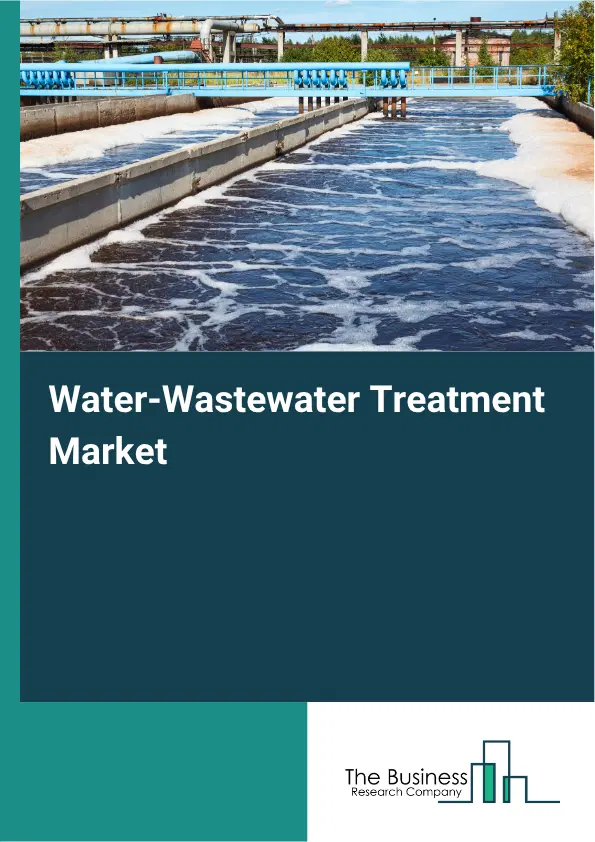
Water-Wastewater Treatment Market Report 2026
Global Outlook – By Offering (Treatment Technologies, Equipment And Machinery, Consumables And Chemicals, Aftermarket Services And Maintenance), By Operation (Treatment Plants, Operation And Maintenance Services), By Process Type (Physical Treatment, Chemical Treatment, Biological Treatment, Thermal Treatment, Electrochemical Treatment), By Application (Drinking Water Treatment, Wastewater And Sewage Treatment, Industrial Effluent Management, Recycled And Reuse Water Systems), By End User (Municipalities And Utilities, Industrial Enterprises, Agricultural Facilities, Commercial Establishments) – Market Size, Trends, Strategies, and Forecast to 2035
Water-Wastewater Treatment Market Overview
• Water-Wastewater Treatment market size has reached to $349.6 billion in 2025 • Expected to grow to $657.12 billion in 2030 at a compound annual growth rate (CAGR) of 13.5% • Growth Driver: Surge In Water Scarcity Fueling The Growth Of The Market Due To Climate Change–Induced Reductions In Rainfall Disrupting Freshwater Availability And Increasing Dependence On Recycling And Reuse Solutions • Market Trend: Advancements In Ultrafiltration Membrane Technologies Enhance Water Purification Efficiency • Asia-Pacific was the largest region and fastest growing region.What Is Covered Under Water-Wastewater Treatment Market?
Water-wastewater treatment is the process of removing physical, chemical, and biological contaminants from water to make it suitable for reuse or safe discharge into the environment. It involves a series of treatment steps that help reduce pollutants such as suspended solids, organic matter, pathogens, and harmful chemicals. Water-wastewater treatment ensures the protection of natural water resources and helps maintain environmental and public health standards. The main offerings of water-wastewater treatment include treatment technologies, equipment and machinery, consumables and chemicals, and aftermarket services and maintenance. Treatment technologies refer to advanced systems and methods used to remove contaminants and ensure safe water quality across different treatment stages. The different operations include treatment plants and operation and maintenance services and the various process types include physical treatment, chemical treatment, biological treatment, thermal treatment, and electrochemical treatment. They find applications involved are drinking water treatment, wastewater and sewage treatment, industrial effluent management, and recycled and reuse water systems, and they are utilized by end users including municipalities and utilities, industrial enterprises, agricultural facilities, and commercial establishments.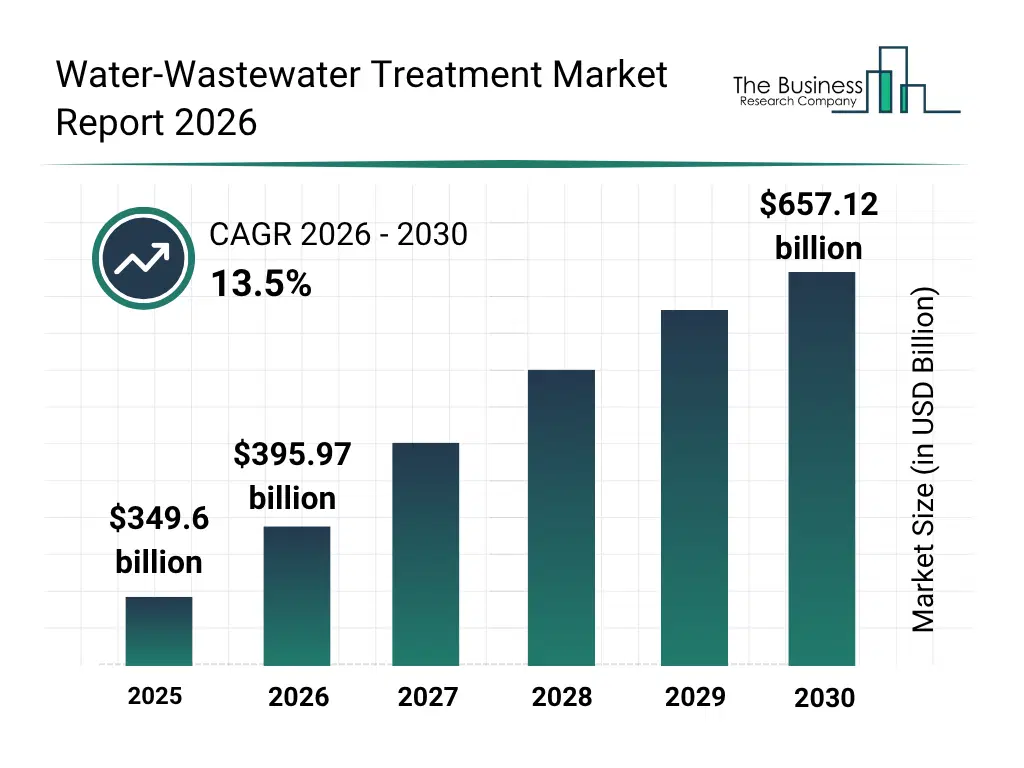
What Is The Water-Wastewater Treatment Market Size and Share 2026?
The water-wastewater treatment market size has grown rapidly in recent years.It will grow from $349.6 billion in 2025 to $395.97 billion in 2026 at a compound annual growth rate (CAGR) of 13.3%. The growth in the historic period can be attributed to rising industrialization leading to higher wastewater generation, increasing urban population driving municipal water treatment demand, tightening environmental regulations on effluent discharge standards, expansion of centralized sewage treatment infrastructure, growing awareness of waterborne disease prevention and sanitation.What Is The Water-Wastewater Treatment Market Growth Forecast?
The water-wastewater treatment market size is expected to see rapid growth in the next few years.It will grow to $657.12 billion by 2030 at a compound annual growth rate (CAGR) of 13.5%. The growth in the forecast period can be attributed to increasing adoption of smart water management systems with ai analytics, expansion of decentralized wastewater treatment solutions in rural and remote areas, rising investments in water reuse and recycling infrastructure, integration of advanced sensor-based real-time monitoring systems, growing demand for sustainable and energy-efficient treatment technologies.Major trends in the forecast period include rising adoption of ai-enabled predictive maintenance systems in wastewater treatment plants, increasing deployment of iot-based smart water quality monitoring networks, expansion of energy-efficient membrane filtration and advanced treatment technologies, growing implementation of circular water reuse and zero-liquid-discharge systems, integration of digital twin models for real-time optimization of treatment operations.
Global Water-Wastewater Treatment Market Segmentation
1) By Offering: Treatment Technologies, Equipment And Machinery, Consumables And Chemicals, Aftermarket Services And Maintenance 2) By Operation: Treatment Plants, Operation And Maintenance Services 3) By Process Type: Physical Treatment, Chemical Treatment, Biological Treatment, Thermal Treatment, Electrochemical Treatment 4) By Application: Drinking Water Treatment, Wastewater And Sewage Treatment, Industrial Effluent Management, Recycled And Reuse Water Systems 5) By End User: Municipalities And Utilities, Industrial Enterprises, Agricultural Facilities, Commercial Establishments Subsegments: 1) By Treatment Technologies: Membrane Filtration, Sludge Treatment, Disinfection Technologies 2) By Equipment And Machinery: Pumps And Pumping Systems, Filtration Systems, Aeration Equipment, Clarifiers And Sedimentation Tanks, Mixing And Agitation Equipment, Membrane Modules And Systems 3) By Consumables And Chemicals: Coagulants, Flocculants, Disinfectants, pH Adjusters, Activated Carbon, Filter Media 4) By Aftermarket Services And Maintenance: Installation Services, Operation And Maintenance Services, Repair And Replacement Services, Performance Monitoring Services, Spare Parts SupplyWhat Is The Driver Of The Water-Wastewater Treatment Market?
The increasing water scarcity is expected to propel the growth of the water–wastewater treatment market going forward.Water scarcity refers to the condition where the available freshwater resources are insufficient to meet the demand of a region or population.The increasing water scarcity is driven by climate change-induced reductions in rainfall, which disrupt natural water availability and reduce the replenishment of freshwater resources.Water-wastewater treatment helps alleviate water scarcity by enabling the recycling and reuse of treated wastewater, thereby increasing the availability of usable water resources and reducing dependence on freshwater sources.For instance, in November 2024, according to the United Nations Educational, Scientific, and Cultural Organization, a France-based non-profit organization, roughly half of the world’s population experiences severe water scarcity for at least part of the year, and millions lack access to safely managed water resources.With 3.6 billion people currently facing water shortages, projected to exceed 5 billion by 2050.Therefore, the increasing water scarcity is driving the growth of the water–wastewater treatment marketKey Players In The Global Water-Wastewater Treatment Market
Major companies operating in the water-wastewater treatment market are Hitachi Ltd., Veolia Environnement S. A., Mitsubishi Heavy Industries Ltd., 3M Company, Danaher Corporation, Ecolab Inc., Doosan Enerbility, Solenis LLC, Xylem Inc., Alfa Laval AB, SNF Group, Grundfos Holding A/S, Pentair plc, Sulzer Ltd., Fluence Corporation Limited, Ovivo Inc., Aquatech International LLC, VA Tech Wabag Limited, IDE Technologies Ltd., Kurita Water Industries Ltd., Metito Holdings Limited, BWT AktiengesellschaftGlobal Water-Wastewater Treatment Market Trends and Insights
Major companies operating in the water-wastewater treatment market are focusing on developing advanced solutions, such as next-generation ultrafiltration (UF) membrane technologies, to enhance contaminant removal efficiency, reduce energy consumption, and improve operational reliability in water purification systems. Next-generation ultrafiltration (UF) membrane technologies refer to advanced filtration systems designed to efficiently remove suspended solids, bacteria, and macromolecules from water while improving energy efficiency, permeability, and operational performance in water and wastewater treatment. For instance, in March 2023, DuPont, a US-based science and technology company, launched DuPont Multibore PRO, a next-generation ultrafiltration (UF) membrane designed to improve filtration performance and operational efficiency in municipal and industrial water treatment applications. The solution enhances fouling resistance, increases membrane durability, and reduces lifecycle costs, enabling water utilities and industries to achieve more reliable and energy-efficient water purification and wastewater treatment outcomes.What Are Latest Mergers And Acquisitions In The Water-Wastewater Treatment Market?
In May 2023, Xylem Inc., a US-based provider of water and wastewater treatment technologies and services, acquired Evoqua Water Technologies for approximately $7. 5 billion. Through this acquisition, Xylem aims to create the world’s largest pure-play water technology company, expanding its global footprint and enhancing its ability to address critical water challenges, including scarcity, quality, and resilience. Evoqua Water Technologies is a US-based provider of comprehensive water and wastewater treatment solutions for municipal and industrial customers.Regional Insights
Asia-Pacific was the largest region in the water-wastewater treatment market in 2025. Asia-Pacific is expected to be the fastest-growing region in the forecast period. The regions covered in this market report are Asia-Pacific, South East Asia, Western Europe, Eastern Europe, North America, South America, Middle East and Africa. The countries covered in this market report are Australia, Brazil, China, France, Germany, India, Indonesia, Japan, Taiwan, Russia, South Korea, UK, USA, Canada, Italy, Spain.What Defines the Water-Wastewater Treatment Market?
The water-wastewater treatment market consists of revenues earned by entities by providing services such as sludge dewatering and handling, membrane filtration system maintenance, biological treatment optimization, disinfection, and pathogen removal. The market value includes the value of related goods sold by the service provider or included within the service offering. The water-wastewater treatment market also includes sales of activated carbon filters, pressure vessels, flow meters, valves, control panels, and dissolved air flotation units. Values in this market are ‘factory gate’ values, that is, the value of goods sold by the manufacturers or creators of the goods, whether to other entities (including downstream manufacturers, wholesalers, distributors, and retailers) or directly to end customers. The value of goods in this market includes related services sold by the creators of the goods.What is the Market Assessment and Strategic Outlook for the Water-Wastewater Treatment Industry?
The water-wastewater treatment market research report is one of a series of new reports from The Business Research Company that provides market statistics, including industry global market size, regional shares, competitors with the market share, detailed market segments, market trends and opportunities, and any further data you may need to thrive in the water-wastewater treatment industry. The market research report delivers a complete perspective of everything you need, with an in-depth analysis of the current and future state of the industry.What is the Market Assessment and Strategic Outlook for the Water-Wastewater Treatment Market Report 2026?
The water-wastewater treatment market research report is one of a series of new reports from The Business Research Company that provides water-wastewater treatment market statistics, including water-wastewater treatment industry global market size, regional shares, competitors with a water-wastewater treatment market share, detailed water-wastewater treatment market segments, market trends and opportunities, and any further data you may need to thrive in the water-wastewater treatment industry. This water-wastewater treatment market research report delivers a complete perspective of everything you need, with an in-depth analysis of the current and future scenario of the industry.Water-Wastewater Treatment Market Report Forecast Analysis
| Report Attribute | Details |
|---|---|
| Market Size Value In 2026 | $395.97 billion |
| Revenue Forecast In 2035 | $657.12 billion |
| Growth Rate | CAGR of 13.5% from 2026 to 2035 |
| Base Year For Estimation | 2025 |
| Actual Estimates/Historical Data | 2020-2025 |
| Forecast Period | 2026 - 2030 - 2035 |
| Market Representation | Revenue in USD Billion and CAGR from 2026 to 2035 |
| Segments Covered | Offering, Operation, Process Type, Application, End User |
| Regional Scope | Asia-Pacific, Western Europe, Eastern Europe, North America, South America, Middle East, Africa |
| Country Scope | The countries covered in the report are Australia, Brazil, China, France, Germany, India, Indonesia, Japan, Taiwan, Russia, South Korea, UK, USA, Canada, Italy, Spain. |
| Key Companies Profiled | Hitachi Ltd., Veolia Environnement S. A., Mitsubishi Heavy Industries Ltd., 3M Company, Danaher Corporation, Ecolab Inc., Doosan Enerbility, Solenis LLC, Xylem Inc., Alfa Laval AB, SNF Group, Grundfos Holding A/S, Pentair plc, Sulzer Ltd., Fluence Corporation Limited, Ovivo Inc., Aquatech International LLC, VA Tech Wabag Limited, IDE Technologies Ltd., Kurita Water Industries Ltd., Metito Holdings Limited, BWT Aktiengesellschaft |
| Customization Scope | Request for Customization |
| Pricing And Purchase Options | Explore Purchase Options |