
Waterproofing Chemicals Market Report 2026
Global Outlook – By Product (Bitumen, Elastomers, PVC, TPO, EPDM), By Technology (Preformed Membranes, Coatings And LAMS (Liquid Applied Membrane Systems), Integral Systems), By Application (Roofing And walls, Floors And basements, Waste And water Management, Tunnel liners, Other Applications) – Market Size, Trends, Strategies, and Forecast to 2030
Waterproofing Chemicals Market Overview
• Waterproofing Chemicals market size has reached to $26.16 billion in 2025 • Expected to grow to $42.98 billion in 2030 at a compound annual growth rate (CAGR) of 10.3% • Growth Driver: Growth Of The Automotive Industry Is Anticipated To Waterproofing Chemicals Market • Market Trend: Innovations In Waterproof Chemicals: Shalimar Paints Launches Advanced Home Protect Waterproofing Solutions • Asia-Pacific was the largest region in 2025 and Asia-Pacific is the fastest growing region.Market Gains By 2030 – Top Opportunities By Segment
Market Gain identifies the most promising market opportunities by highlighting the segments or products expected to generate the highest incremental revenue growth over the next five years.
What Is Covered Under Waterproofing Chemicals Market?
Waterproofing chemicals refer to chemicals that are used to make a building or object waterproof, such as concrete, paints, paper packaging, electronics, and cosmetics. The main products of waterproofing chemicals are bitumen, elastomers, PVC, TPO, and EPDM. Bitumen refers to dark, gooey material, such as tar or asphalt, that is applied to roads and roofs. The technology involved is preformed membranes, coatings, and lams (liquid applied membrane systems), integral systems that are used for roofing and walls, floors and basements, waste and water management, tunnel liners, and other applications.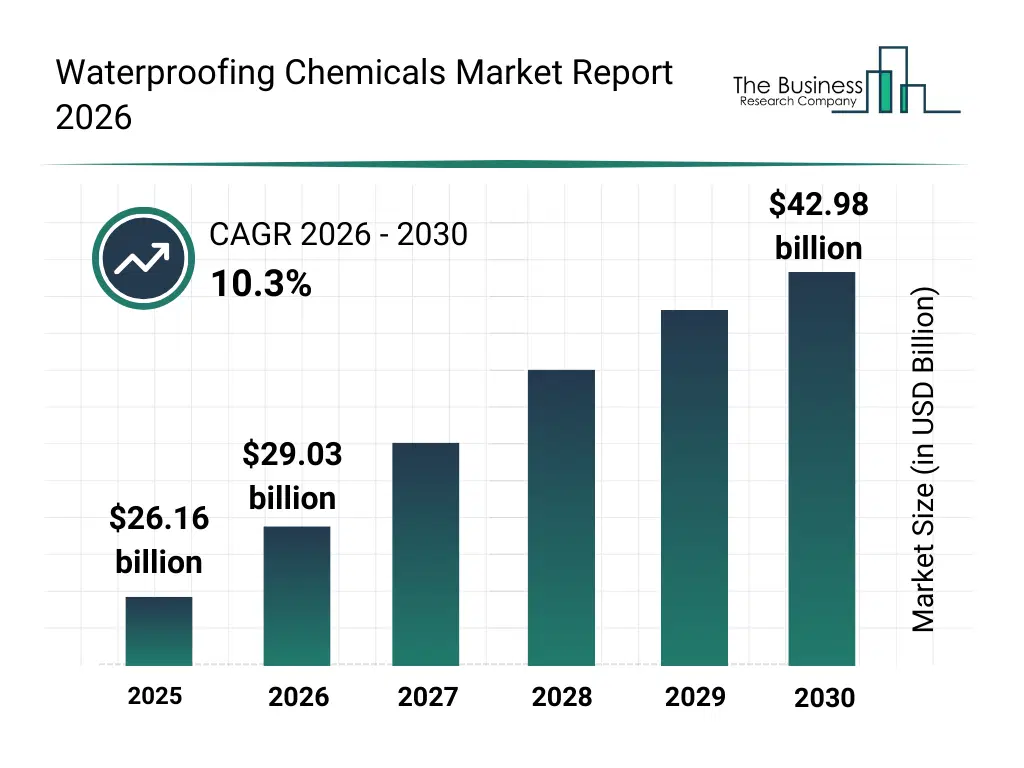
What Is The Waterproofing Chemicals Market Size and Share 2026?
The waterproofing chemicals market size has grown rapidly in recent years. It will grow from $26.16 billion in 2025 to $29.03 billion in 2026 at a compound annual growth rate (CAGR) of 11.0%. The growth in the historic period can be attributed to expansion of urban infrastructure development, rising use of concrete waterproofing additives, growth of commercial construction projects, increasing demand for basement and roofing protection, availability of advanced chemical formulations.What Is The Waterproofing Chemicals Market Growth Forecast?
The waterproofing chemicals market size is expected to see rapid growth in the next few years. It will grow to $42.98 billion in 2030 at a compound annual growth rate (CAGR) of 10.3%. The growth in the forecast period can be attributed to growing investments in smart city infrastructure, rising demand for sustainable waterproofing solutions, expansion of underground construction projects, increasing focus on climate-resilient buildings, growing adoption of high-performance membrane systems. Major trends in the forecast period include increasing adoption of liquid applied waterproofing systems, rising use of elastomeric and bituminous membranes, growing demand for infrastructure protection solutions, expansion of chemical-based roofing systems, enhanced focus on long-term structural durability.
Global Waterproofing Chemicals Market Segmentation
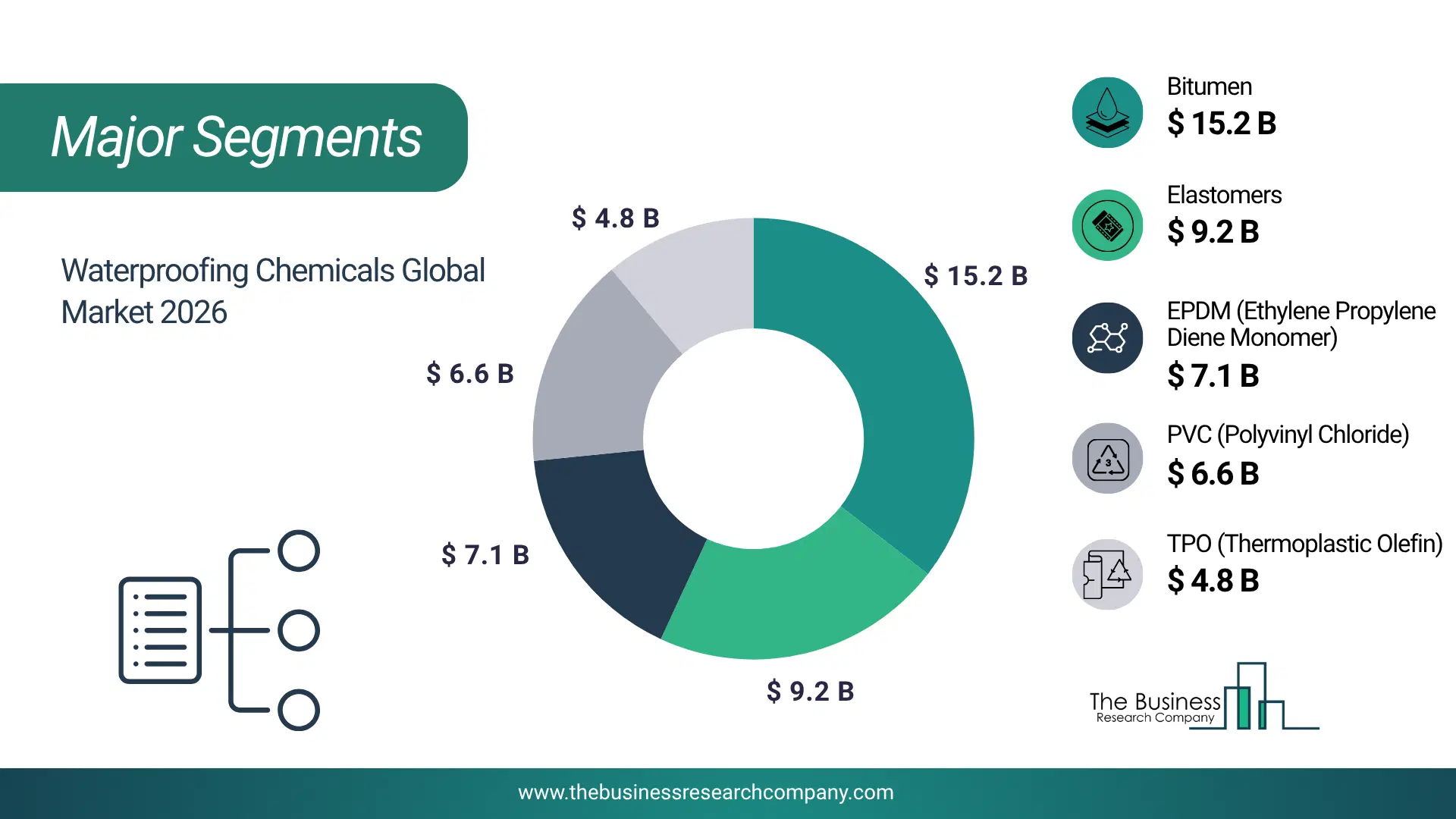
1) By Product: Bitumen, Elastomers, PVC, TPO, EPDM 2) By Technology: Preformed Membranes, Coatings And LAMS (Liquid Applied Membrane Systems), Integral Systems 3) By Application: Roofing And walls, Floors And basements, Waste And water Management, Tunnel liners, Other Applications Subsegments: 1) By Bitumen: Bitumen Emulsions, Modified Bitumen Membranes, Bituminous Coatings 2) By Elastomers: Thermoplastic Elastomers (TPE), Synthetic Rubber-Based Waterproofing 3) By PVC (Polyvinyl Chloride): PVC Membranes, PVC Coatings 4) By TPO (Thermoplastic Olefin): TPO Membranes, TPO Coatings 5) By EPDM (Ethylene Propylene Diene Monomer): EPDM Membranes, EPDM Coatings The top segments in the waterproofing chemicals market will be: • Bitumen will reach $15.25 billion by 2030. • Elastomers will reach $9.21 billion by 2030. • EPDM (Ethylene Propylene Diene Monomer) will reach $7.1 billion by 2030. • PVC (Polyvinyl Chloride) will reach $6.64 billion by 2030. • TPO (Thermoplastic Olefin) will reach $4.79 billion by 2030.What Is The Driver Of The Waterproofing Chemicals Market?
The growth of the automotive industry is expected to propel the waterproofing chemicals market going forward. The automotive industry refers to the collective group of companies, organizations, and activities involved in the design, development, production, marketing, selling, and maintenance of motor vehicles. Waterproofing chemicals are used to protect electronic components, wiring, and sensitive parts from water damage, enhancing vehicle durability and reliability. For instance, in 2023, according to the Organisation Internationale des Constructeurs d'Automobiles (OICA), a France-based international association of automobile manufacturers, the global automotive industry in 2023 experienced notable growth, with total vehicle production reaching 93546599 units, a significant increase from the 85016728 units produced in 2022. Therefore, the growth of the automotive industry is driving the growth of the waterproofing chemicals industry.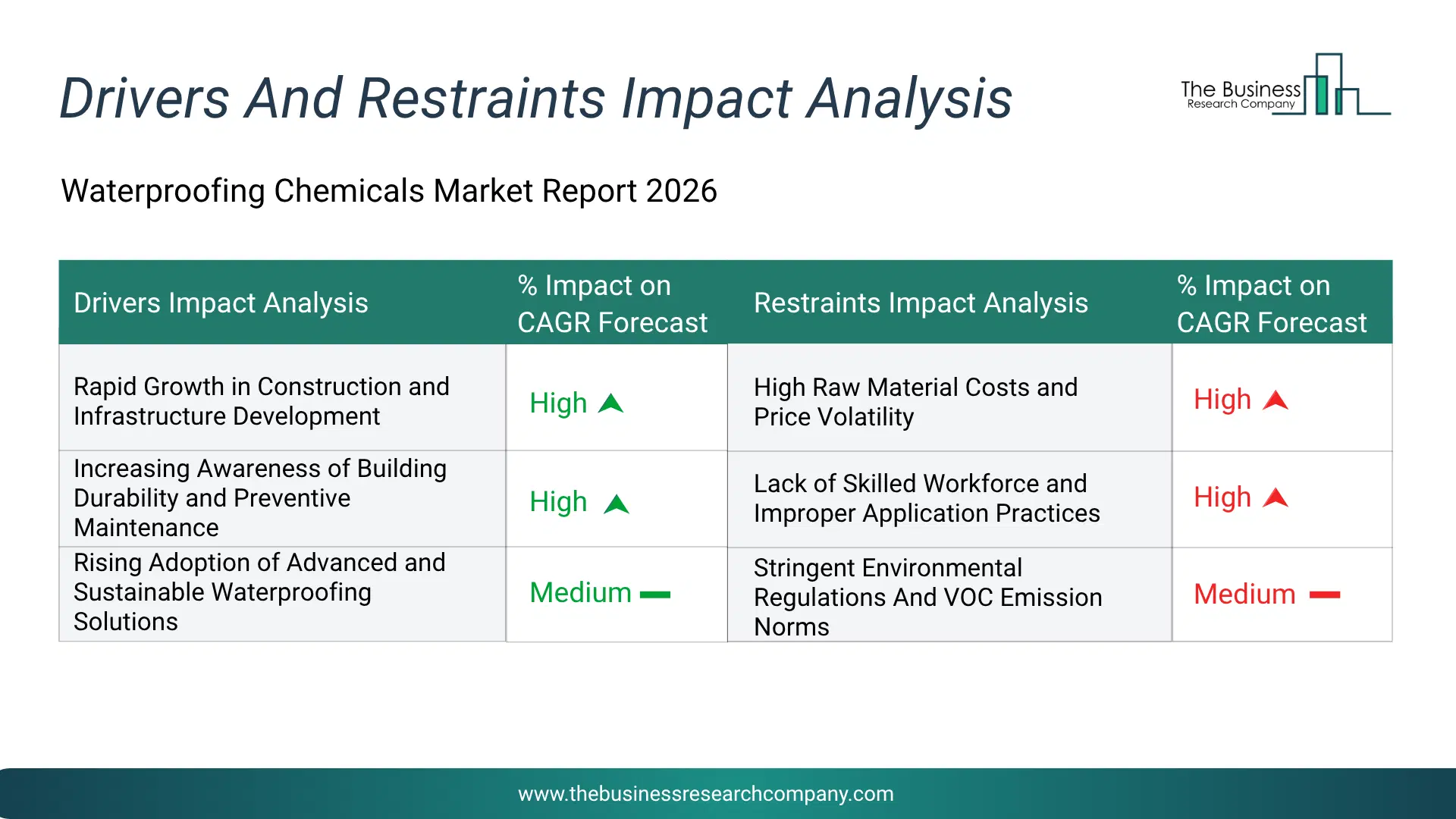
Infographic Chart Showing Key Market Drivers Analysis And Restraints For Waterproofing Chemicals Market
The chart presents an impact analysis of key drivers and restraints, quantifying their relative influence on the market's growth rate and helping assess the balance between growth enablers and limiting factors. This chart offers a high-level perspective; the full report contains more detailed insights.
How Will The Drivers Impact Growth In The Global Waterproofing Chemicals Market?
• Rapid Growth in Construction and Infrastructure Development (High) – During the forecast period, the rapid growth in construction and infrastructure development is expected to become a key growth driver for the waterproofing chemicals market by 2030. The accelerating pace of residential, commercial, and infrastructure construction projects worldwide is a major driver for the waterproofing chemicals market. Increasing urbanization, population growth, and government investments in transportation, housing, industrial facilities, and public infrastructure are significantly boosting demand for durable and long -lasting waterproofing solutions. Waterproofing chemicals play a critical role in enhancing structural integrity, preventing water infiltration, and extending the lifespan of buildings and infrastructure assets. As construction standards increasingly emphasize durability, safety, and sustainability, the adoption of advanced waterproofing materials continues to rise, strongly supporting market growth. • Increasing Awareness of Building Durability and Preventive Maintenance (High) – During the forecast period, the increasing awareness of building durability and preventive maintenance is expected to emerge as a major factor driving the expansion of the waterproofing chemicals market by 2030. Growing awareness regarding the importance of preventive maintenance, structural protection, and moisture control is driving demand for high-performance waterproofing chemicals. Property owners, contractors, and infrastructure developers are increasingly focusing on proactive waterproofing to minimize repair costs, prevent mold growth, and avoid long-term structural deterioration. This shift toward preventive construction practices is accelerating the adoption of advanced coatings, membranes, sealants, and admixtures. As lifecycle cost optimization becomes a key priority, demand for durable and efficient waterproofing solutions continues to expand. • Rising Adoption of Advanced and Sustainable Waterproofing Solutions (Medium) – During the forecast period, the rising adoption of advanced and sustainable waterproofing solutions is expected to act as a key growth catalyst for the waterproofing chemicals market by 2030. The market is witnessing a growing shift toward environmentally friendly, low-voc, and sustainable waterproofing chemicals driven by stringent environmental regulations and rising sustainability awareness. Manufacturers are increasingly developing eco-friendly membranes, water-based coatings, and green admixtures that meet regulatory standards without compromising performance. In addition, technological advancements such as polymer-modified membranes, crystalline waterproofing, and nano-coatings are improving durability and efficiency. These innovations are significantly enhancing product performance and driving wider adoption across diverse construction applications.How Will The Restraints Impact Growth In The Global Waterproofing Chemicals Market?
• High Raw Material Costs and Price Volatility (High) – During the forecast period, the waterproofing chemical formulations rely on petroleum-based polymers, resins, and specialty additives, which are subject to frequent price fluctuations due to supply chain disruptions and crude oil price volatility. Rising raw material costs directly increase production expenses, impacting profit margins and final product pricing. This cost pressure may reduce affordability, particularly in price-sensitive markets, slowing down adoption. Persistent fluctuations in material pricing thus act as a key restraint on market growth. • Lack of Skilled Workforce and Improper Application Practices (High) – During the forecast period, the effective waterproofing performance heavily depends on correct application methods, skilled labor, and quality control during installation. In many developing regions, the shortage of trained applicators and limited technical knowledge leads to improper application, reducing product efficiency and durability. This can result in premature failures, increasing repair costs and discouraging end users from adopting advanced waterproofing solutions. Such operational challenges restrain faster market penetration and widespread adoption. • Stringent Environmental Regulations And VOC Emission Norms (Medium) – During the forecast period, the stringent environmental regulations and voc emission norms act as a restraint for the waterproofing chemicals market by restricting the use of certain chemical formulations and increasing compliance requirements for manufacturers. Governments across regions are enforcing stricter limits on volatile organic compound emissions, pushing companies to reformulate products with eco-friendly alternatives. This transition often requires significant investment in research and development and can increase production costs. Smaller manufacturers may struggle to comply with these evolving standards, limiting their competitiveness. Overall, regulatory pressures slow product innovation cycles and restrain market expansion.Key Players In The Global Waterproofing Chemicals Market
Major companies operating in the waterproofing chemicals market are Sika AG, BASF SE, RPM International Inc., Mapei S.p.A., Saint-Gobain, Dow Inc., Arkema SA, Henkel AG & Co. KGaA, Carlisle Companies, Soprema Group, MBCC Group, Fosroc International, Tremco Incorporated, Pidilite Industries Ltd., Asian Paints Limited, Berger Paints India Limited, Chembond Chemicals, GCP Applied Technologies, Wacker Chemie AG, Evonik Industries AG, Johns Manville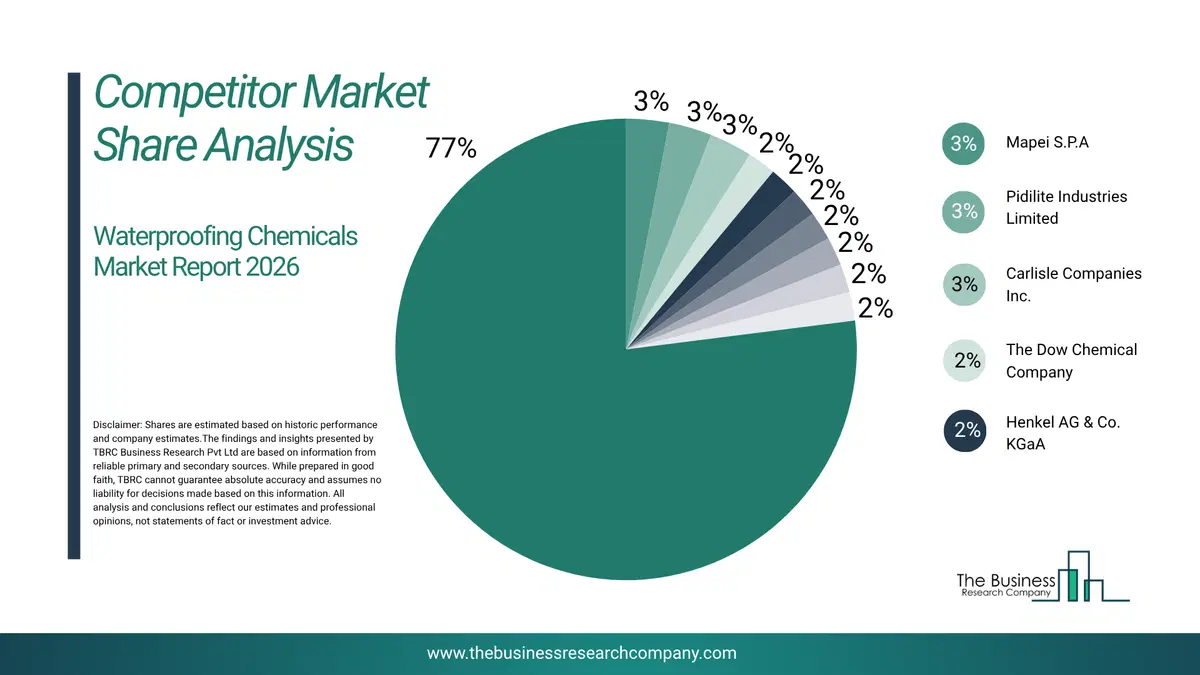
This chart is for illustrative purposes; the full report includes a detailed competitor analysis and comprehensive overview of the top 10 companies in the market.
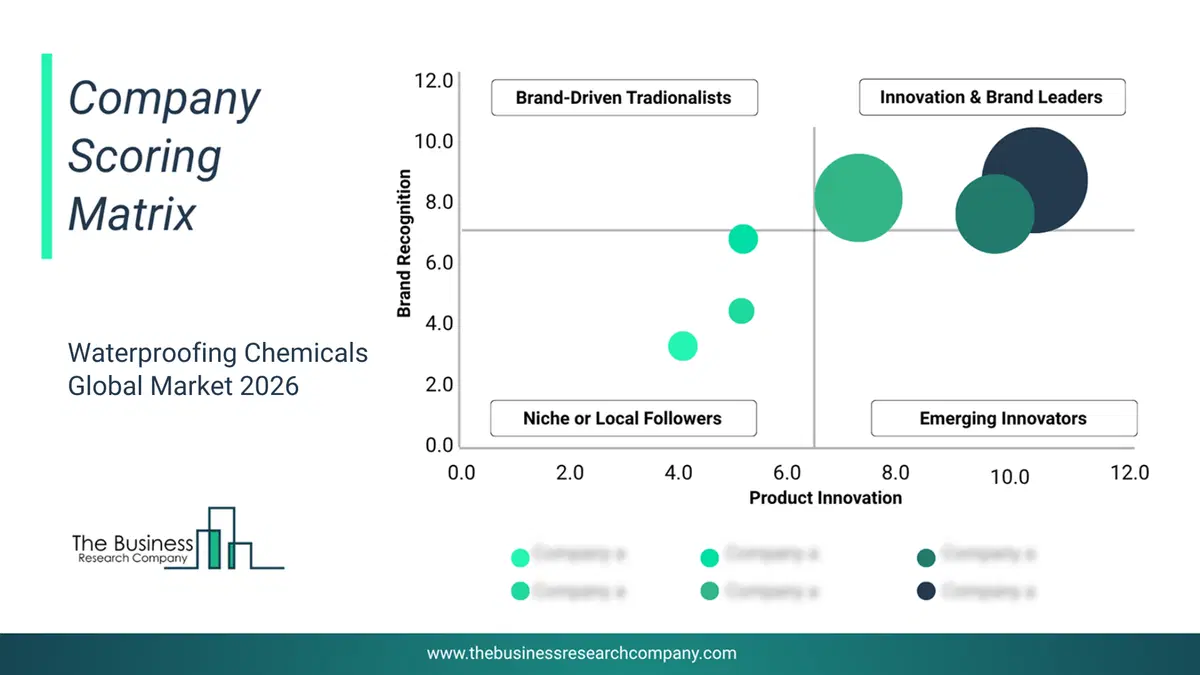
This chart maps companies by product innovation and brand strength, with bubble size indicating relative revenue, helping identify market leaders, challengers, and niche players. This is an illustrative chart; the full report provides a complete and accurate competitive analysis.
Global Waterproofing Chemicals Market Trends and Insights
Major companies operating in the waterproof chemicals market are focused on developing Home Protect Waterproofing to enhance the durability and longevity of construction materials, protect structures from water damage, and meet the growing demand for sustainable and effective waterproofing solutions in residential and commercial applications. Home Protect Waterproofing refers to services and products designed to prevent water intrusion and protect residential structures from water damage. For instance, in July 2024, Shalimar Paints, an India-based company that manufactures paint and coating, launched two new innovative products, Zero Damp Advance and Zero Damp Smart, in their Home Protect Waterproofing range. These products are designed to provide enhanced protection against water seepage, setting new industry benchmarks with warranties that can last up to 12 years.What Are Latest Mergers And Acquisitions In The Waterproofing Chemicals Market?
In February 2025, Saint-Gobain, a France-based company specializing in building materials and high-performance construction solutions, acquired Fosroc International Ltd for an undisclosed amount. Through this acquisition, Saint-Gobain aims to strengthen its construction chemicals capabilities, particularly in waterproofing and high-performance admixtures, by integrating Fosroc’s comprehensive product portfolio and global footprint, which includes 20 manufacturing plants and operations in over 70 countries. Fosroc is a UK-based construction chemicals company specializing in waterproofing solutions and concrete repair products.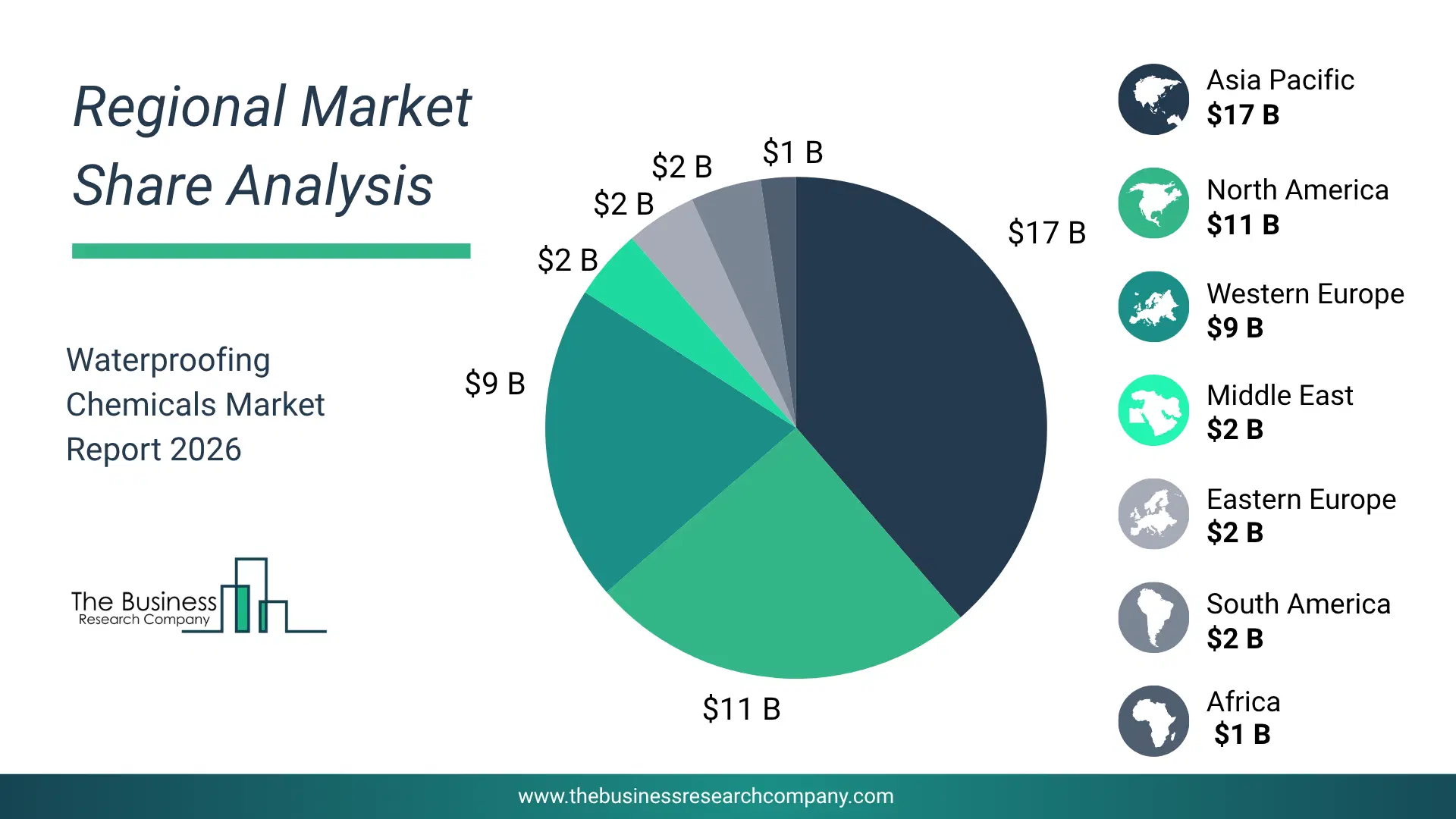
Regional Insights
Asia-Pacific was the largest region in the waterproofing chemicals market in 2025. The regions covered in this market report are Asia-Pacific, South East Asia, Western Europe, Eastern Europe, North America, South America, Middle East, Africa The countries covered in this market report are Australia, Brazil, China, France, Germany, India, Indonesia, Japan, Taiwan, Russia, South Korea, UK, USA, Canada, Italy, SpainWhat Defines the Waterproofing Chemicals Market?
The waterproofing chemicals market consists of sales of hypalon, tar paper with asphalt and bituminous materials, and coated membranes. Values in this market are ‘factory gate’ values, that is the value of goods sold by the manufacturers or creators of the goods, whether to other entities (including downstream manufacturers, wholesalers, distributors and retailers) or directly to end customers. The value of goods in this market includes related services sold by the creators of the goods.How is Market Value Defined and Measured?
The market value is defined as the revenues that enterprises gain from the sale of goods and/or services within the specified market and geography through sales, grants, or donations in terms of the currency (in USD unless otherwise specified). The revenues for a specified geography are consumption values that are revenues generated by organizations in the specified geography within the market, irrespective of where they are produced. It does not include revenues from resales along the supply chain, either further along the supply chain or as part of other products.
This chart presents market attractiveness based on a quantitative evaluation of growth, competition, strategic alignment, and risk, offering a clear view of opportunity areas for decision-making. This chart is for illustrative purposes; the full report contains the complete analysis.

This chart highlights the Total Addressable Market (TAM) by estimating the maximum revenue opportunity using an assumption-driven approach, supporting strategic planning and opportunity sizing across markets. The chart is illustrative; the full report provides a more comprehensive analysis.
What Key Data and Analysis Are Included in the Waterproofing Chemicals Market Report 2026?
The waterproofing chemicals market research report is one of a series of new reports from The Business Research Company that provides market statistics, including industry global market size, regional shares, competitors with the market share, detailed market segments, market trends and opportunities, and any further data you may need to thrive in the waterproofing chemicals industry. The market research report delivers a complete perspective of everything you need, with an in-depth analysis of the current and future state of the industry.Waterproofing Chemicals Market Report Forecast Analysis
| Report Attribute | Details |
|---|---|
| Market Size Value In 2026 | $29.03 billion |
| Revenue Forecast In 2030 | $42.98 billion |
| Growth Rate | CAGR of 11.0% from 2026 to 2030 |
| Base Year For Estimation | 2025 |
| Actual Estimates/Historical Data | 2020-2025 |
| Forecast Period | 2026 - 2030 |
| Market Representation | Revenue in USD Billion and CAGR from 2026 to 2030 |
| Segments Covered | Product, Technology, Application |
| Regional Scope | Asia-Pacific, Western Europe, Eastern Europe, North America, South America, Middle East, Africa |
| Country Scope | The countries covered in the report are Australia, Brazil, China, France, Germany, India, Indonesia, Japan, Taiwan, Russia, South Korea, UK, USA, Canada, Italy, Spain. |
| Key Companies Profiled | Sika AG, BASF SE, RPM International Inc., Mapei S.p.A., Saint-Gobain, Dow Inc., Arkema SA, Henkel AG & Co. KGaA, Carlisle Companies, Soprema Group, MBCC Group, Fosroc International, Tremco Incorporated, Pidilite Industries Ltd., Asian Paints Limited, Berger Paints India Limited, Chembond Chemicals, GCP Applied Technologies, Wacker Chemie AG, Evonik Industries AG, Johns Manville |
| Customization Scope | Request for Customization |
| Pricing And Purchase Options | Explore Purchase Options |