
Waterway Transportation Software Market Report 2026
Global Outlook – By Solutions (Warehousing, Vessel Tracking, Freight Security, Yard Management, Audit And Claim, Ship Broker Software, Maritime Software, Other Solutions), By Services (Managed Services, Consulting Or Customization Services, Training Services), By Deployment Model (On-Premises, Cloud, Hybrid), By Industry Vertical (Consumer And Retail, Oil And Gas, Industrial And Manufacturing, Energy And Mining, Aerospace And Defense, Construction, Chemicals, Pharmaceuticals And Healthcare, Food And Beverages, Other Industry Vertical ) – Market Size, Trends, Strategies, and Forecast to 2030
Waterway Transportation Software Market Overview
• Waterway Transportation Software market size has reached to $81.79 billion in 2025 • Expected to grow to $118.84 billion in 2030 at a compound annual growth rate (CAGR) of 7.5% • Growth Driver: Impact Of Increasing Maritime Trade On Waterway Transportation Software Market • Market Trend: Cloud-Based Solutions Transforming Waterway Transportation • North America was the largest region in 2025 and Asia Pacific is the fastest growing region.What Is Covered Under Waterway Transportation Software Market?
Waterway transportation software refers to digital tools and applications specifically designed to streamline and optimize various aspects of waterborne transportation operations. These software solutions are utilized by businesses and organizations involved in maritime activities, including shipping companies, logistics providers, port authorities, and maritime agencies. The main solutions of waterway transportation software are warehousing, vessel tracking, freight security, yard management, audit and claim, ship broker software, maritime software, and others. Warehousing refers to the tools and systems designed to manage the storage and handling of goods at warehouses located along waterways. It includes features for inventory management, order processing, and logistics coordination within warehouse facilities. The services included are managed services, consulting or customization services and training services, which are deployment through on-premises, cloud and hybrid. The industry vertical are consumer and retail, oil and gas, industrial and manufacturing, energy and mining, aerospace and defense, construction, chemicals, pharmaceuticals and healthcare, food and beverages, and others.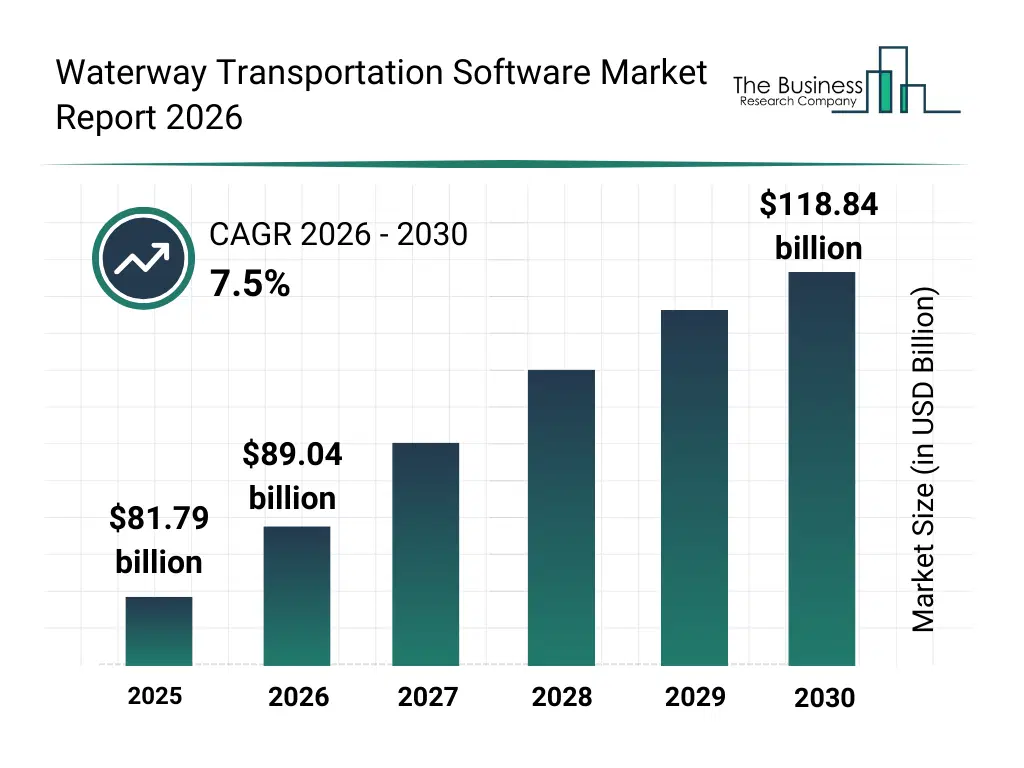
What Is The Waterway Transportation Software Market Size and Share 2026?
The waterway transportation software market size has grown strongly in recent years. It will grow from $81.79 billion in 2025 to $89.04 billion in 2026 at a compound annual growth rate (CAGR) of 8.9%. The growth in the historic period can be attributed to digitalization of shipping operations, growth of global trade, early fleet management software adoption, port automation initiatives, logistics optimization needs.What Is The Waterway Transportation Software Market Growth Forecast?
The waterway transportation software market size is expected to see strong growth in the next few years. It will grow to $118.84 billion in 2030 at a compound annual growth rate (CAGR) of 7.5%. The growth in the forecast period can be attributed to smart port development, ai-driven route optimization, sustainability-focused shipping operations, demand for end-to-end visibility, cloud migration of maritime software. Major trends in the forecast period include adoption of cloud-based maritime platforms, growth of real-time vessel tracking, integration of port management systems, expansion of predictive analytics, demand for freight visibility.
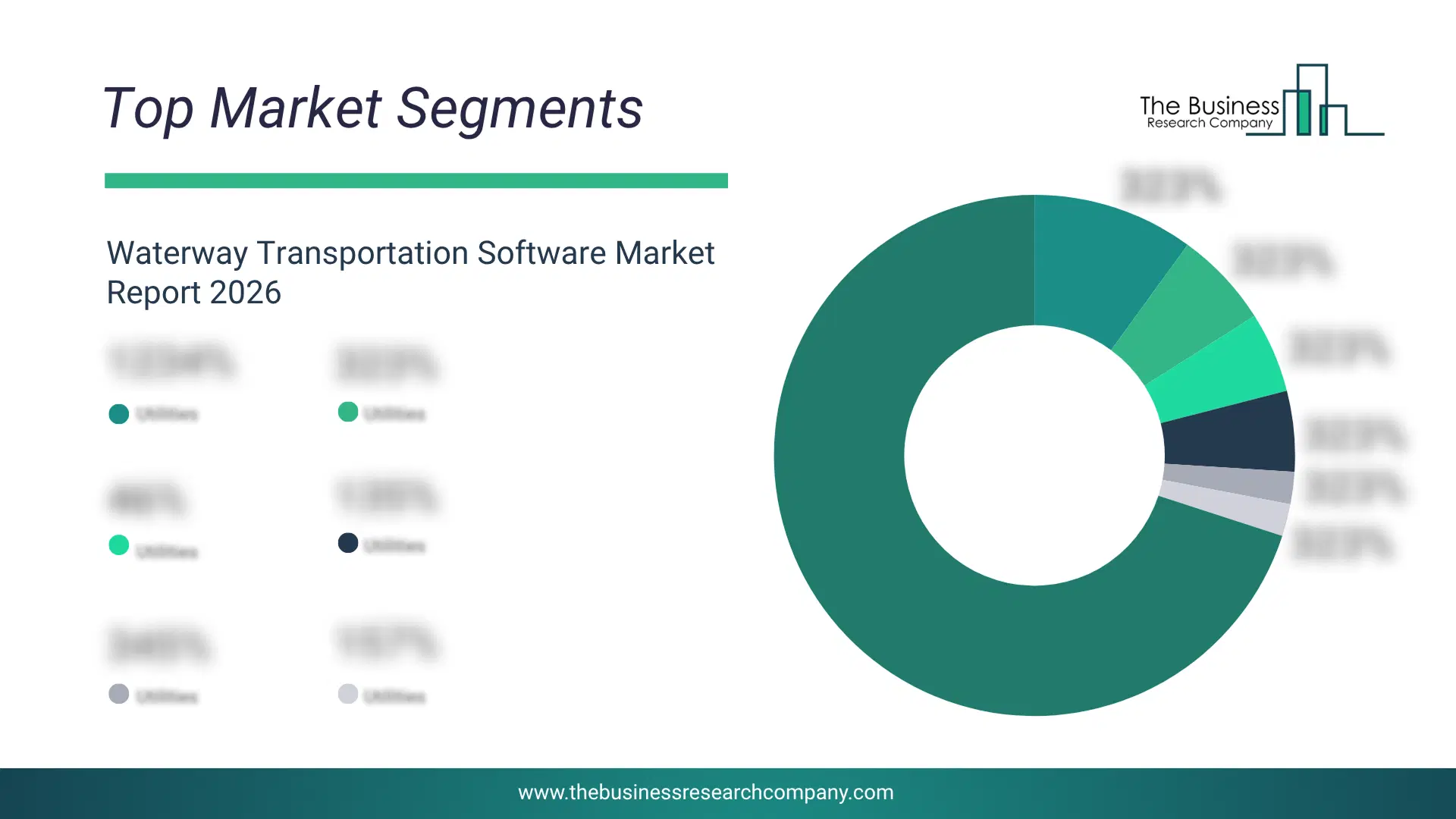
Global Waterway Transportation Software Market Segmentation
1) By Solutions: Warehousing, Vessel Tracking, Freight Security, Yard Management, Audit And Claim, Ship Broker Software, Maritime Software, Other Solutions 2) By Services: Managed Services, Consulting Or Customization Services, Training Services 3) By Deployment Model: On-Premises, Cloud, Hybrid 4) By Industry Vertical: Consumer And Retail, Oil And Gas, Industrial And Manufacturing, Energy And Mining, Aerospace And Defense, Construction, Chemicals, Pharmaceuticals And Healthcare, Food And Beverages, Other Industry Vertical Subsegments: 1) By Warehousing: Inventory Management, Warehouse Operations Optimization 2) By Vessel Tracking: Real-Time Vessel Monitoring, Fleet Management 3) By Freight Security: Cargo Tracking and Monitoring, Risk Management Software 4) By Yard Management: Container Yard Optimization, Terminal Management Software 5) By Audit and Claim: Cargo Claims Management, Compliance And Auditing Solutions 6) By Ship Broker Software: Vessel Chartering Management, Broker-Client Communication 7) By Maritime Software: Marine Fleet Management, Maritime Navigation Solutions 8) By Other Solutions: Port Management Software, Weather Routing And AnalysisWhat Is The Driver Of The Waterway Transportation Software Market?
Increasing maritime trade activities are expected to propel the growth of the waterway transportation software market. Maritime trade activities refer to the commercial exchange of goods and services conducted via sea routes using ships and vessels. Maritime trade is increasing due to globalization, expanded markets, better shipping technology, new routes, and rising global demand for goods, along with improved infrastructure and economic policies. Waterway transportation software is utilized in maritime trade for optimizing vessel scheduling, route planning, cargo logistics, regulatory compliance, and real-time communication among stakeholders. For instance, in September 2023, according to the data published by the United Nations Conference on Trade and Development (UNCTAD), a Switzerland-based intergovernmental body, maritime trade is projected to experience 2.4% growth in 2023, with further increases of over 2% anticipated between 2024 and 2028. Specifically, containerized trade volumes are forecast to rise by 1.2% in 2023. Therefore, the increasing waterborne trade activities will drive the growth of waterway transportation software industry.Key Players In The Global Waterway Transportation Software Market
Major companies operating in the waterway transportation software market report include Maersk A/S, Oracle Corporation, SAP SE, ABB Ltd, Accenture plc, Cognizant Technology Solutions Corporation, Zebra Technologies Corporation, Flexport Inc., DNV GL AS, Descartes Systems Group Inc., Aquatic Informatics Inc., LogiNext Solutions Pvt. Ltd., Jibe, Geniuserp, FourKites Inc., Trans-I Technologies Inc., Bass Software Solutions, Zero North, Veson Nautical Corporation, ABS Wavesight, FRETRON, Nautical Corporation, XPV Water Partners, Danaher Corporation, Hidrovuas do Brasil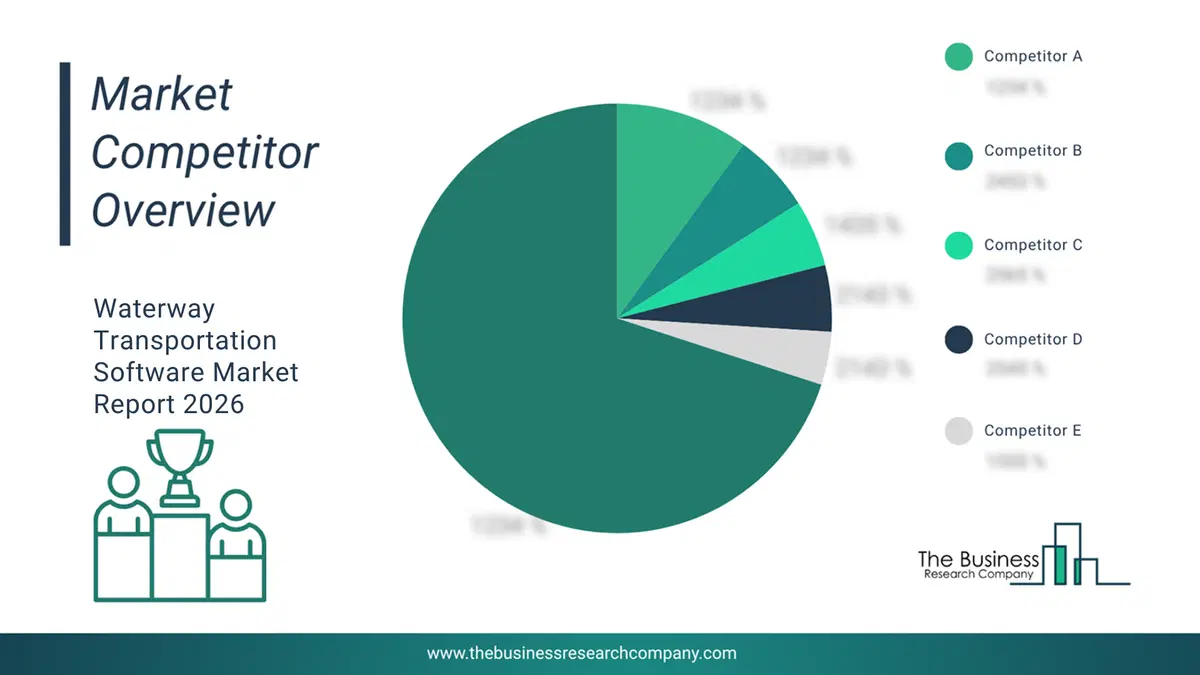
This chart is for illustrative purposes; the full report includes a detailed competitor analysis and comprehensive overview of the top 10 companies in the market.
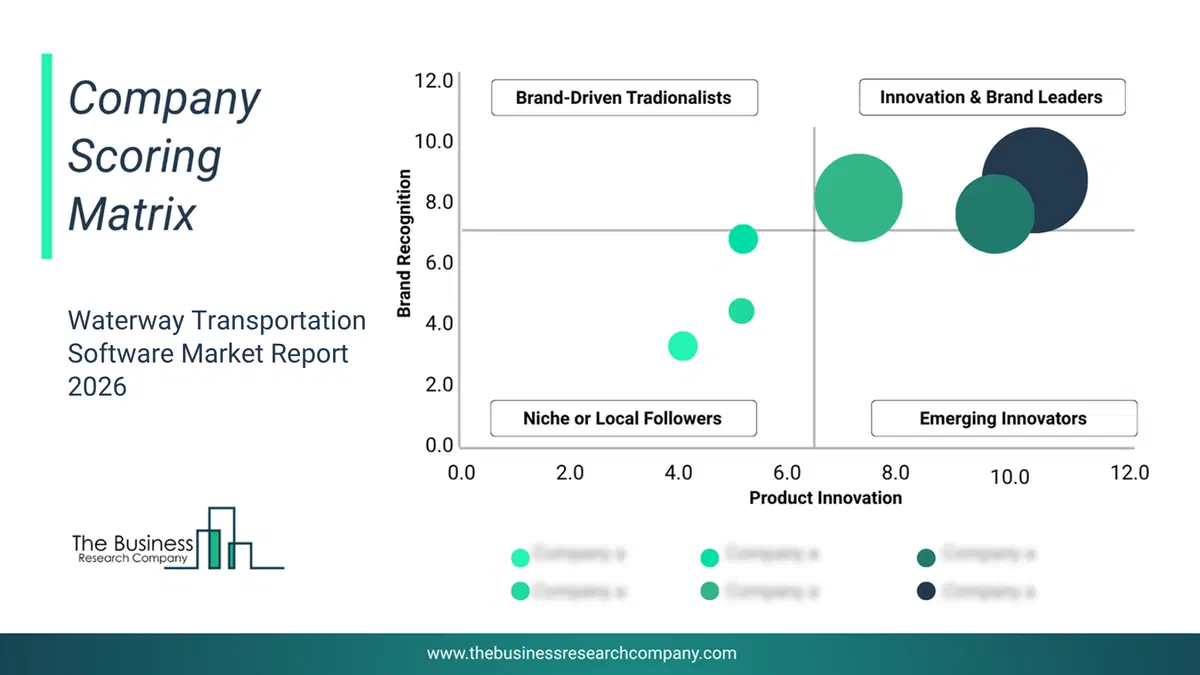
This chart maps companies by product innovation and brand strength, with bubble size indicating relative revenue, helping identify market leaders, challengers, and niche players. This is an illustrative chart; the full report provides a complete and accurate competitive analysis.
Global Waterway Transportation Software Market Trends and Insights
Major companies in the waterway transportation software market are increasing their reliance on technologies such as cloud-based transport management systems to maintain competitiveness and enhance operational efficiency. This cloud-based transport management system provides functionalities such as route optimization, real-time tracking, inventory management, freight scheduling, and performance analytics, accessible from any internet-connected device. For instance, in September 2023, CocoonFMS Ltd., a UK-based logistics software company, unveiled CocoonOPS, its latest transport management system designed to revolutionize operations for freight forwarders. CocoonOPS aims to transform freight forwarding operations, particularly for small and medium-sized businesses, by offering real-time shipment tracking for air, sea, road, and rail, as well as features such as demurrage and detention cost calculations, customizable workflows, automated tasks, and document generation.What Are Latest Mergers And Acquisitions In The Waterway Transportation Software Market?
In February 2025, Tidalis B.V., a Netherlands-based maritime technology and digital solutions company, acquired Made Smart Group B.V. for an undisclosed amount. With this acquisition, Tidalis aims to expand its digital port-call optimization capabilities, strengthen its position in maritime workflow automation, and enhance its portfolio of intelligent, data-driven solutions for shipping, port operators, and wider maritime logistics networks. Made Smart Group B.V. is a Netherlands-based technology company that specializes in providing digital workflow tools, operational planning platforms, and collaboration solutions that improve efficiency, transparency, and coordination across maritime and port operations.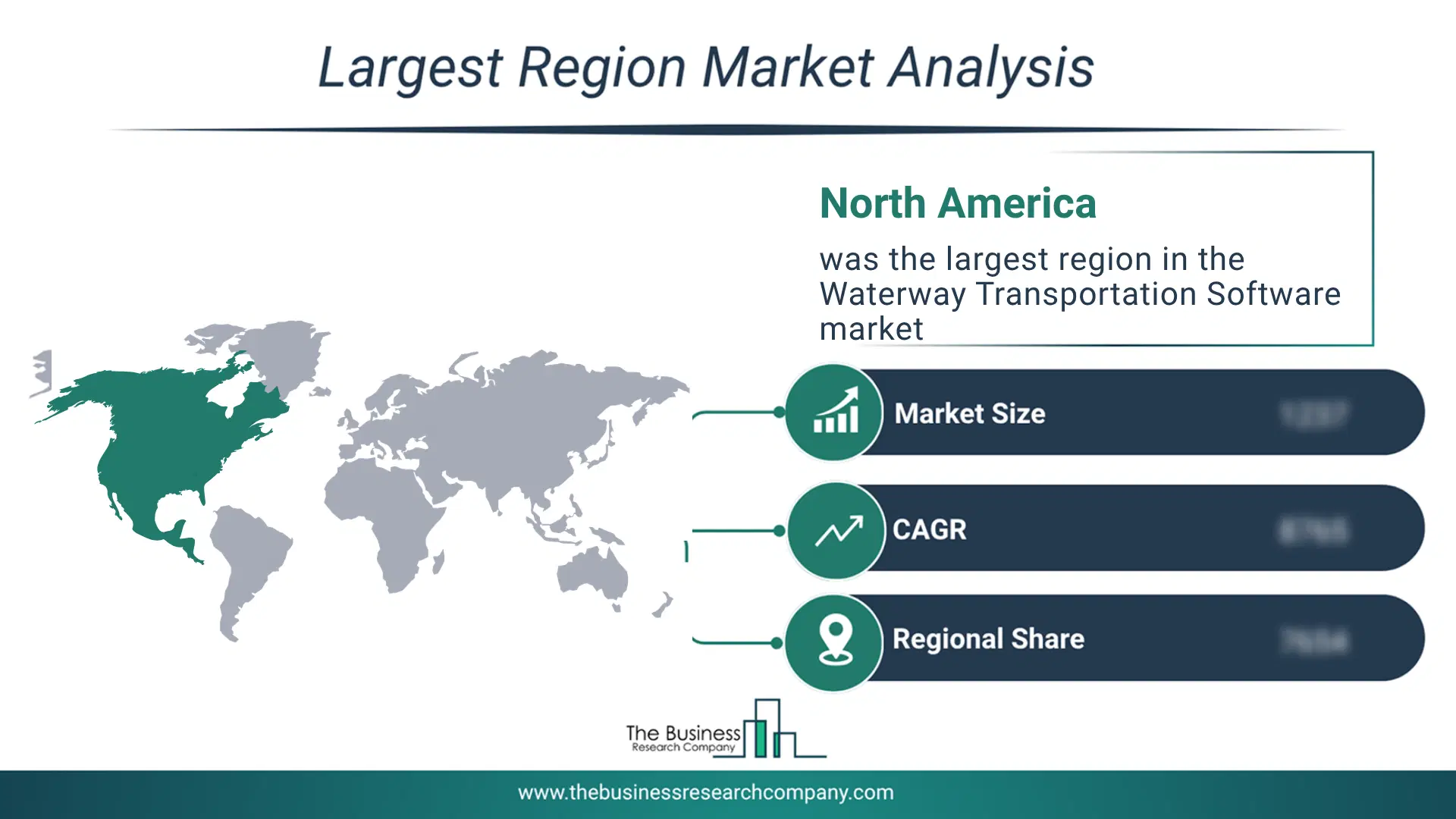
Regional Outlook
North America was the largest region in the waterway transportation software market in 2025. Asia Pacific is expected to be the fastest-growing region in the forecast period. The regions covered in this market report include Asia-Pacific, South East Asia, Western Europe, Eastern Europe, North America, South America, Middle East, Africa. The countries covered in this market report include Australia, Brazil, China, France, Germany, India, Indonesia, Japan, Taiwan, Russia, South Korea, UK, USA, Canada, Italy, SpainWhat Defines the Waterway Transportation Software Market?
The waterway transportation software market consists of revenues earned by entities by providing tracking, scheduling, and managing logistics services for waterway transportation. The market value includes the value of related goods sold by the service provider or included within the service offering. The waterway transportation software market also includes sales of computers, networking devices, sensors, GPS systems, communication devices, and other specialized equipment. Values in this market are ‘factory gate’ values, that is the value of goods sold by the manufacturers or creators of the goods, whether to other entities (including downstream manufacturers, wholesalers, distributors, and retailers) or directly to end customers. The value of goods in this market includes related services sold by the creators of the goods.How is Market Value Defined and Measured?
The market value is defined as the revenues that enterprises gain from the sale of goods and/or services within the specified market and geography through sales, grants, or donations in terms of the currency (in USD unless otherwise specified). The revenues for a specified geography are consumption values that are revenues generated by organizations in the specified geography within the market, irrespective of where they are produced. It does not include revenues from resales along the supply chain, either further along the supply chain or as part of other products.
This chart presents market attractiveness based on a quantitative evaluation of growth, competition, strategic alignment, and risk, offering a clear view of opportunity areas for decision-making. This chart is for illustrative purposes; the full report contains the complete analysis.

This chart highlights the Total Addressable Market (TAM) by estimating the maximum revenue opportunity using an assumption-driven approach, supporting strategic planning and opportunity sizing across markets. The chart is illustrative; the full report provides a more comprehensive analysis.
What Key Data and Analysis Are Included in the Waterway Transportation Software Market Report 2026?
The waterway transportation software market research report is one of a series of new reports from The Business Research Company that provides market statistics, including industry global market size, regional shares, competitors with the market share, detailed market segments, market trends and opportunities, and any further data you may need to thrive in the waterway transportation software industry. The market research report delivers a complete perspective of everything you need, with an in-depth analysis of the current and future state of the industry.Waterway Transportation Software Market Report Forecast Analysis
| Report Attribute | Details |
|---|---|
| Market Size Value In 2026 | $89.04 billion |
| Revenue Forecast In 2030 | $118.84 billion |
| Growth Rate | CAGR of 8.9% from 2026 to 2030 |
| Base Year For Estimation | 2025 |
| Actual Estimates/Historical Data | 2020-2025 |
| Forecast Period | 2026 - 2030 - 2030 |
| Market Representation | Revenue in USD Billion and CAGR from 2026 to 2030 |
| Segments Covered | Solutions, Services, Deployment Model, Industry Vertical |
| Regional Scope | Asia-Pacific, Western Europe, Eastern Europe, North America, South America, Middle East, Africa |
| Country Scope | The countries covered in the report are Australia, Brazil, China, France, Germany, India, Indonesia, Japan, Taiwan, Russia, South Korea, UK, USA, Canada, Italy, Spain. |
| Key Companies Profiled | Maersk A/S, Oracle Corporation, SAP SE, ABB Ltd, Accenture plc, Cognizant Technology Solutions Corporation, Zebra Technologies Corporation, Flexport Inc., DNV GL AS, Descartes Systems Group Inc., Aquatic Informatics Inc., LogiNext Solutions Pvt. Ltd., Jibe, Geniuserp, FourKites Inc., Trans-I Technologies Inc., Bass Software Solutions, Zero North, Veson Nautical Corporation, ABS Wavesight, FRETRON, Nautical Corporation, XPV Water Partners, Danaher Corporation, Hidrovuas do Brasil |
| Customization Scope | Request for Customization |
| Pricing And Purchase Options | Explore Purchase Options |