
Weapon Fuze Market Report 2026
Global Outlook – By Type (Mechanical Fuzes, Electrical Fuzes, Electronic Fuzes, Proximity Fuzes, Multifunctional Fuzes), By Platform (Airborne, Land, Naval), By Application (Artillery Shells, Mortars, Aerial Bombs, Missiles, Naval Weapons), By End-User (Military, Defense Contractors, Government Agencies, Commercial, Research Institutions) – Market Size, Trends, Strategies, and Forecast to 2030
Weapon Fuze Market Overview
• Weapon Fuze market size has reached to $2.77 billion in 2025 • Expected to grow to $3.86 billion in 2030 at a compound annual growth rate (CAGR) of 6.8% • Growth Driver: Surge In Defense And Security Fueling The Growth Of The Market Due To Rising Geopolitical Tensions And Military Modernization • Market Trend: Accelerating Weapon Fuze Innovation Through Rapid Prototyping And Scalable Capability Platforms • North America was the largest region and fastest growing region.What Is Covered Under Weapon Fuze Market?
A weapon fuze is a critical component of a munition designed to control the timing and manner of its activation or detonation. It ensures that the explosive charge functions under specific conditions, such as upon impact, after a set time, when in proximity to a target, or through remote command. Fuzes are engineered for precision and safety, preventing premature detonation while ensuring effective performance against the intended target. The main types of weapon fuzes are mechanical fuzes, electrical fuzes, electronic fuzes, proximity fuzes, and multifunctional fuzes. Mechanical fuzes are detonation devices that use physical mechanisms such as springs and levers to activate upon impact or pressure, providing reliable and cost-effective performance in harsh environments. These fuzes are used across various platforms, including airborne, land, and naval systems, and find applications in artillery shells, mortars, aerial bombs, missiles, and naval weapons. The end users include military forces, defense contractors, government agencies, commercial entities, and research institutions.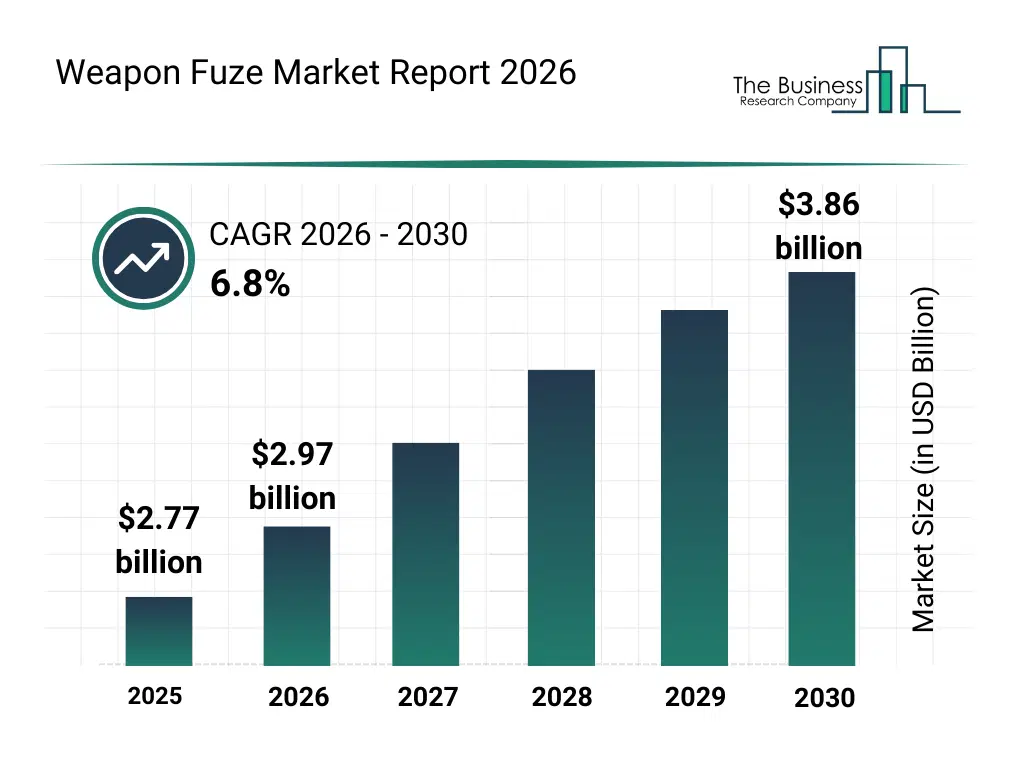
What Is The Weapon Fuze Market Size and Share 2026?
The weapon fuze market size has grown strongly in recent years. It will grow from $2.77 billion in 2025 to $2.97 billion in 2026 at a compound annual growth rate (CAGR) of 7.2%. The growth in the historic period can be attributed to increasing global defense expenditure, advancements in precision-guided munitions technology, rising demand for safety and reliability in military ordnance, adoption of diverse fuze types for specialized missions, consolidation and technological collaborations among fuze manufacturers.What Is The Weapon Fuze Market Growth Forecast?
The weapon fuze market size is expected to see strong growth in the next few years. It will grow to $3.86 billion in 2030 at a compound annual growth rate (CAGR) of 6.8%. The growth in the forecast period can be attributed to growing demand for smart and programmable fuzes, integration of fuze systems with advanced targeting and guidance technologies, rising need for countermeasure-resistant munitions, expansion of defense modernization programs in emerging economies, emphasis on lifecycle support and upgrade services for existing fuze systems. Major trends in the forecast period include rising demand for multi-mode and programmable fuze systems, increasing adoption of advanced proximity detection technologies, growing modernization of artillery and missile systems, expansion of fuze miniaturization for small-caliber munitions, strengthening of safety and reliability standards in fuze design.
Global Weapon Fuze Market Segmentation
1) By Type: Mechanical Fuzes, Electrical Fuzes, Electronic Fuzes, Proximity Fuzes, Multifunctional Fuzes 2) By Platform: Airborne, Land, Naval 3) By Application: Artillery Shells, Mortars, Aerial Bombs, Missiles, Naval Weapons 4) By End-User: Military, Defense Contractors, Government Agencies, Commercial, Research Institutions Subsegments: 1) By Mechanical Fuzes: Impact Mechanical Fuzes, Time Delay Mechanical Fuzes, Pressure Mechanical Fuzes 2) By Electrical Fuzes: Contact Electrical Fuzes, Time Delay Electrical Fuzes, Battery-Operated Electrical Fuzes 3) By Electronic Fuzes: Programmable Electronic Fuzes, Smart Electronic Fuzes, Multi-Mode Electronic Fuzes 4) By Proximity Fuzes: Radar Proximity Fuzes, Optical Proximity Fuzes, Infrared Proximity Fuzes, Magnetic Proximity Fuzes 5) By Multifunctional Fuzes: Combination Impact And Proximity Fuzes, Multi-Sensor Fuzes, Adaptive Programmable FuzesWhat Is Driver Of The Weapon Fuze Market?
The increasing focus on defense and security is expected to propel the growth of the weapon fuze market going forward. Defense and security refer to efforts and systems to protect a nation and its citizens from external threats, internal unrest, and potential risks to stability. The rise in defense and security spending is primarily driven by increasing geopolitical tensions as countries enhance their military capabilities to address threats, protect national interests, and maintain strategic stability amid regional conflicts. Weapon fuze enhances defense and security by enabling precise activation of munitions under specific conditions, such as impact, proximity, or time delay, increasing operational effectiveness, improving target accuracy, minimizing collateral damage, and supporting strategic mission outcomes across land, air, and naval combat scenarios. For instance, in April 2025, according to the Stockholm International Peace Research Institute (SIPRI), a Sweden-based independent institute dedicated to research on conflict, armaments, arms control, and disarmament, global military expenditure reached $2.718 trillion in 2024, marking a 9.4% increase from 2023. Therefore, increasing focus on defense and security is driving the growth of the weapon fuze industry.Key Players In The Global Weapon Fuze Market
Major companies operating in the weapon fuze market are Raytheon Technologies Corporation, Lockheed Martin Corporation, Northrop Grumman Corporation, BAE Systems plc, Thales Group, L3Harris Technologies Inc., Leonardo S.p.A., Singapore Technologies Engineering Ltd, Rheinmetall AG, Elbit Systems Ltd., Israel Aerospace Industries Ltd., MBDA Missile Systems, Diehl Defence GmbH And Co. KG, Saab AB, Poongsan Corporation, ASELSAN A.S., General Dynamics Ordnance and Tactical Systems Inc., Nammo AS, Kaman Corporation, Denel Dynamics, Mesko S.A.
This chart is for illustrative purposes; the full report includes a detailed competitor analysis and comprehensive overview of the top 10 companies in the market.
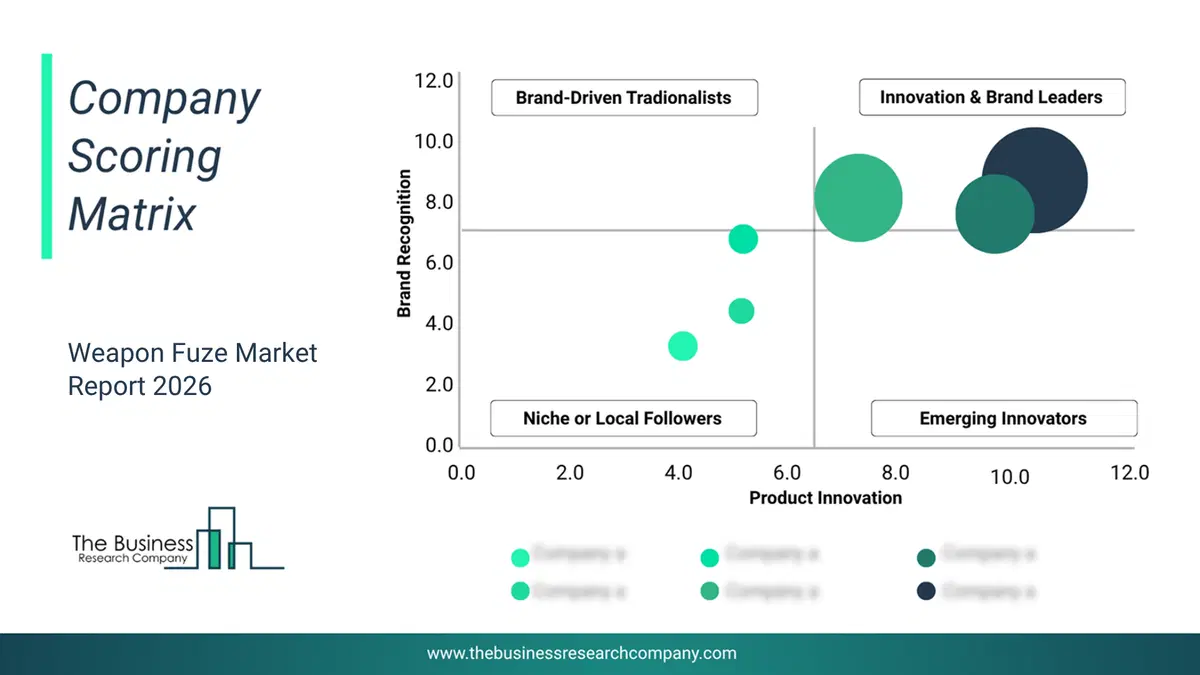
This chart maps companies by product innovation and brand strength, with bubble size indicating relative revenue, helping identify market leaders, challengers, and niche players. This is an illustrative chart; the full report provides a complete and accurate competitive analysis.
Global Weapon Fuze Market Trends and Insights
Major companies in the weapon fuze market are increasingly investing in advanced technologies such as rapid prototyping and scalable capability platforms to strengthen their competitive edge. These innovations accelerate the transition of new technologies from concept to operational deployment, improving battlefield readiness and reducing time-to-field. For example, in September 2025, the U.S. Army launched the Fuze Innovation Program, allocating $750 million annually to support promising companies in rapidly prototyping critical technologies and scaling successful solutions into full-scale programs. The initiative focuses on integrating unmanned aerial systems (UAS), counter-UAS technologies, and electronic warfare capabilities, with contract turnaround times as short as 10 days for existing suppliers. This approach is driving faster innovation cycles within the weapon fuze market, though widespread adoption continues to depend on navigating complex defense procurement processes.What Are Latest Mergers And Acquisitions In The Weapon Fuze Market? Rheinmetall Acquires Expal Systems To Bolster Weapons, Ammunition, And Fuze Capabilities
In August 2023, Rheinmetall AG, a Germany-based arms manufacturing company, acquired Expal Systems for approximately €1.2 billion (1.36 billion). With this acquisition, Rheinmetall aims to significantly expand its ammunition production capacity and product range, strengthen its core business in weapons, ammunition, and propellants, and enhance its ability to meet the growing demand for military equipment and complex ammunition procurement requirements. Expal Systems S.A.U. is a Spain-based defense company specializing in the development and manufacturing of ammunition, weapon fuzes, and related military systems.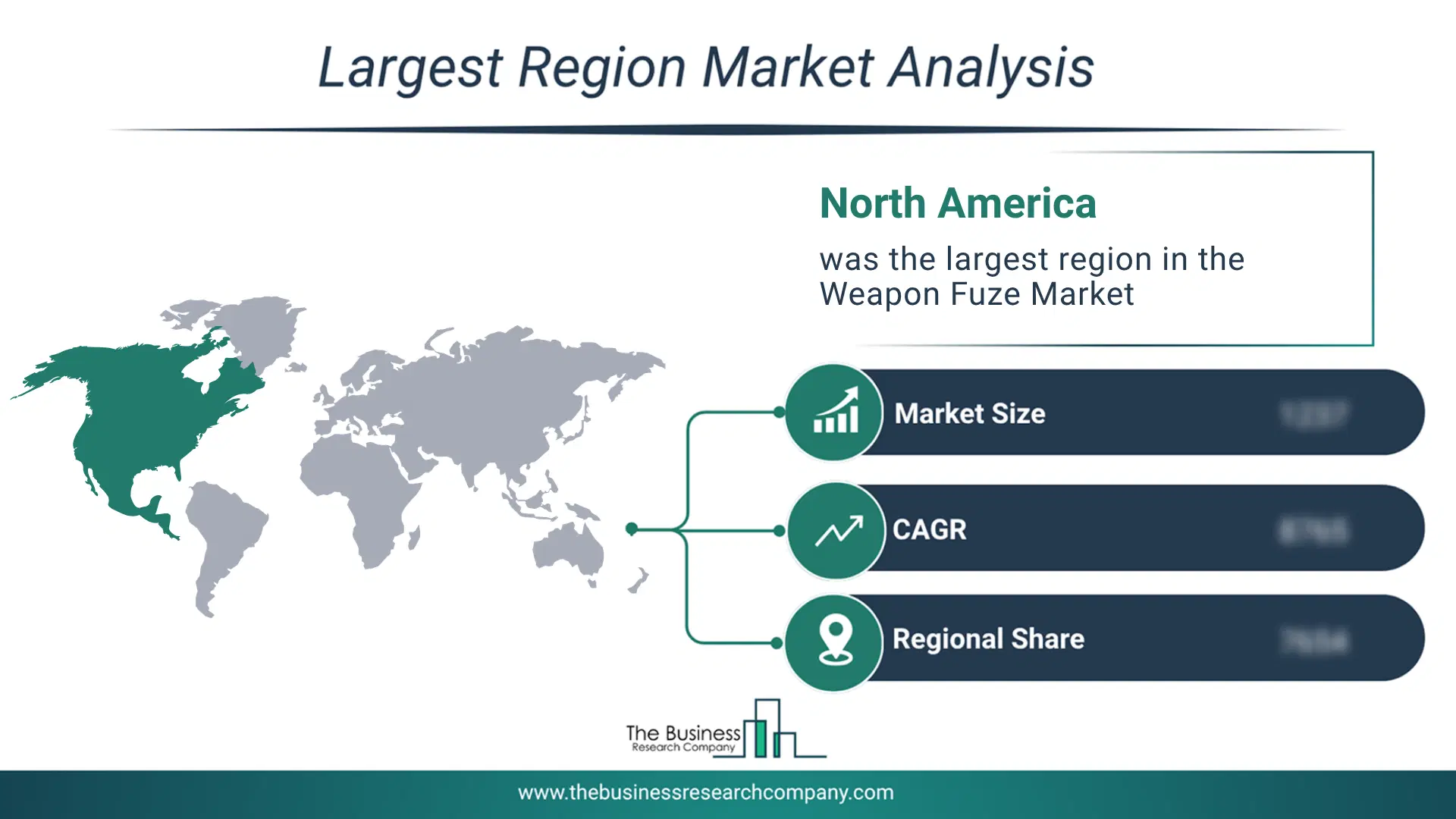
Regional Insights
North America was the largest region in the weapon fuze market in 2025. North America is expected to be the fastest-growing region in the forecast period. The regions covered in the weapon fuze market report are Asia-Pacific, South East Asia, Western Europe, Eastern Europe, North America, South America, Middle East, Africa. The countries covered in the weapon fuze market report are Australia, Brazil, China, France, Germany, India, Indonesia, Japan, Taiwan, Russia, South Korea, UK, USA, Canada, Italy, SpainWhat Defines the Weapon Fuze Market?
The weapon fuze market consists of sales of impact fuzes, time fuzes, command fuzes, inertial fuzes, altitude fuzes, magnetic fuzes, acoustic fuzes, pressure fuzes, optical fuzes, and infrared fuzes. Values in this market are ‘factory gate’ values, that is, the value of goods sold by the manufacturers or creators of the goods, whether to other entities (including downstream manufacturers, wholesalers, distributors, and retailers) or directly to end customers. The value of goods in this market includes related services sold by the creators of the goods.How is Market Value Defined and Measured?
The market value is defined as the revenues that enterprises gain from the sale of goods and/or services within the specified market and geography through sales, grants, or donations in terms of the currency (in USD unless otherwise specified). The revenues for a specified geography are consumption values that are revenues generated by organizations in the specified geography within the market, irrespective of where they are produced. It does not include revenues from resales along the supply chain, either further along the supply chain or as part of other products.
This chart presents market attractiveness based on a quantitative evaluation of growth, competition, strategic alignment, and risk, offering a clear view of opportunity areas for decision-making. This chart is for illustrative purposes; the full report contains the complete analysis.

This chart highlights the Total Addressable Market (TAM) by estimating the maximum revenue opportunity using an assumption-driven approach, supporting strategic planning and opportunity sizing across markets. The chart is illustrative; the full report provides a more comprehensive analysis.
What Key Data and Analysis Are Included in the Weapon Fuze Market Report 2026?
The weapon fuze market research report is one of a series of new reports from The Business Research Company that provides market statistics, including industry global market size, regional shares, competitors with the market share, detailed market segments, market trends and opportunities, and any further data you may need to thrive in the weapon fuze industry. The market research report delivers a complete perspective of everything you need, with an in-depth analysis of the current and future state of the industry.Weapon Fuze Market Report Forecast Analysis
| Report Attribute | Details |
|---|---|
| Market Size Value In 2026 | $2.97 billion |
| Revenue Forecast In 2030 | $3.86 billion |
| Growth Rate | CAGR of 6.8% from 2026 to 2030 |
| Base Year For Estimation | 2025 |
| Actual Estimates/Historical Data | 2020-2025 |
| Forecast Period | 2026 - 2030 |
| Market Representation | Revenue in USD Billion and CAGR from 2026 to 2030 |
| Segments Covered | Type, Platform, Application, End-User |
| Regional Scope | Asia-Pacific, Western Europe, Eastern Europe, North America, South America, Middle East, Africa |
| Country Scope | The countries covered in the weapon fuze market report are Australia, Brazil, China, France, Germany, India, Indonesia, Japan, Taiwan, Russia, South Korea, UK, USA, Canada, Italy, Spain |
| Key Companies Profiled | Raytheon Technologies Corporation, Lockheed Martin Corporation, Northrop Grumman Corporation, BAE Systems plc, Thales Group, L3Harris Technologies Inc., Leonardo S.p.A., Singapore Technologies Engineering Ltd, Rheinmetall AG, Elbit Systems Ltd., Israel Aerospace Industries Ltd., MBDA Missile Systems, Diehl Defence GmbH And Co. KG, Saab AB, Poongsan Corporation, ASELSAN A.S., General Dynamics Ordnance and Tactical Systems Inc., Nammo AS, Kaman Corporation, Denel Dynamics, Mesko S.A. |
| Customization Scope | Request for Customization |
| Pricing And Purchase Options | Explore Purchase Options |