
Wearable Healthcare Devices Market Report 2026
Global Outlook – By Type (Wearable Fitness Trackers, Smart Health Watches, Wearable Electrocardiogram Monitor, Wearable Blood Pressure Monitors), By Distribution Channel (Retail Pharmacies, Online Channels, Other Distribution Channels), By Application (Sports And Fitness, Home Healthcare, Remote Patient Monitoring), By End User (Individuals, Healthcare Providers, Fitness And Wellness Centers, Insurance Companies, Corporate Wellness Programs, Research Institutions) – Market Size, Trends, Strategies, and Forecast to 2035
Wearable Healthcare Devices Market Overview
• Wearable Healthcare Devices market size has reached to $30.75 billion in 2025 • Expected to grow to $54.44 billion in 2030 at a compound annual growth rate (CAGR) of 12.2% • Growth Driver: Rising Prevalence Of Chronic Diseases Driving The Growth Of The Market Due To Increasing Demand For Continuous Health Monitoring And Early Disease Detection • Market Trend: Integration Of Advanced Multi-Metric Sensors Driving Innovation In Wearable Healthcare Devices Through Continuous Health Monitoring • North America was the largest region in 2025 and Asia-Pacific is the fastest growing region.What Is Covered Under Wearable Healthcare Devices Market?
Wearable healthcare devices are portable electronic systems worn on the body to continuously monitor and analyze physiological and health-related data. Equipped with sensors and connectivity features, they track parameters such as heart rate, activity levels, and sleep patterns in real time, supporting preventive care and personalized health management. The main types of wearable healthcare devices include wearable fitness trackers, smart health watches, wearable electrocardiogram monitors, and wearable blood pressure monitors. Wearable fitness trackers refer to sensor-based devices used to continuously monitor physical activity, heart rate, and other health parameters for fitness and preventive healthcare management. They are distributed through retail pharmacies, online channels, and other distribution channels. The various applications involved are sports and fitness, home healthcare, and remote patient monitoring and they are utilized by end users including individuals, healthcare providers, fitness and wellness centers, insurance companies, corporate wellness programs, and research institutions.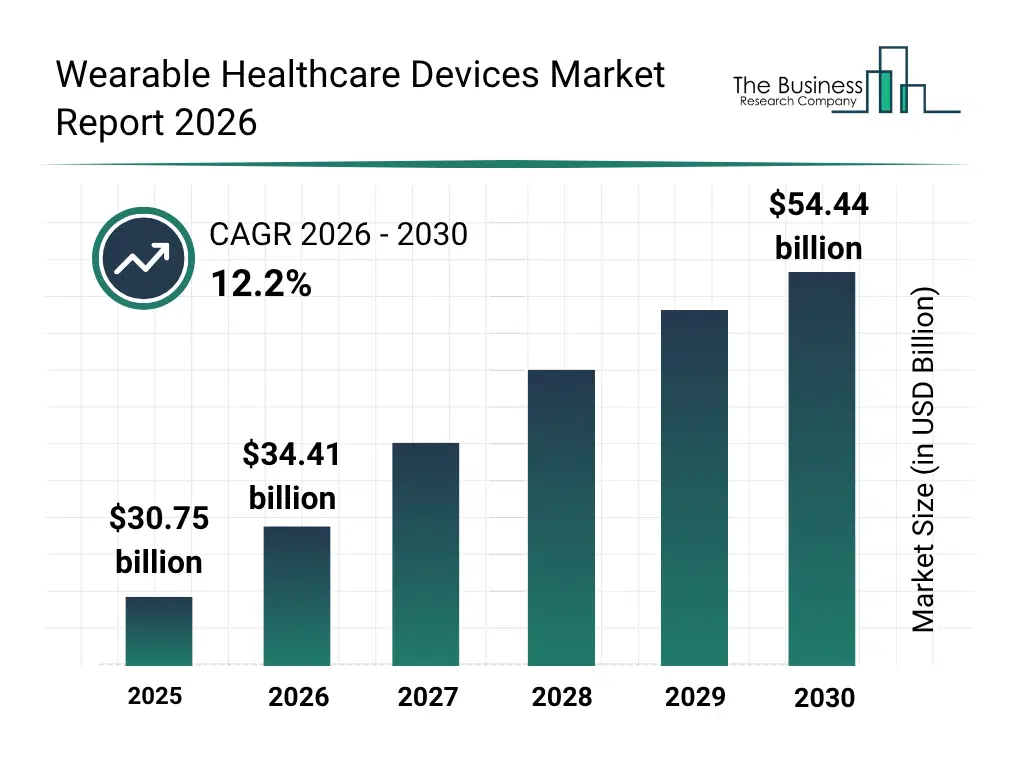
What Is The Wearable Healthcare Devices Market Size and Share 2026?
The wearable healthcare devices market size has grown rapidly in recent years.It will grow from $30.75 billion in 2025 to $34.41 billion in 2026 at a compound annual growth rate (CAGR) of 11.9%. The growth in the historic period can be attributed to increasing consumer awareness of personal health and fitness tracking, rapid adoption of smartphones enabling wearable connectivity, growing prevalence of lifestyle-related diseases, expansion of digital health and telemedicine platforms, declining cost of sensor and wearable technology components.What Is The Wearable Healthcare Devices Market Growth Forecast?
The wearable healthcare devices market size is expected to see rapid growth in the next few years.It will grow to $54.44 billion by 2030 at a compound annual growth rate (CAGR) of 12.2%. The growth in the forecast period can be attributed to rising integration of ai-based personalized health insights in wearables, increasing adoption of remote patient monitoring in healthcare systems, expansion of interoperable cloud health data platforms, growing demand for continuous non-invasive health monitoring devices, advancement in miniaturized biosensors and energy-efficient wearable technologies.Major trends in the forecast period include rising integration of ai-powered predictive health analytics in wearable devices, increasing adoption of continuous remote patient monitoring through connected wearables, expansion of cloud-based health data ecosystems for real-time health tracking, growing use of wearable devices for preventive healthcare and early disease detection, rising demand for multi-parameter biosensor wearables for personalized health insights.
Global Wearable Healthcare Devices Market Segmentation
1) By Type: Wearable Fitness Trackers, Smart Health Watches, Wearable Electrocardiogram Monitor, Wearable Blood Pressure Monitors 2) By Distribution Channel: Retail Pharmacies, Online Channels, Other Distribution Channels 3) By Application: Sports And Fitness, Home Healthcare, Remote Patient Monitoring 4) By End User: Individuals, Healthcare Providers, Fitness And Wellness Centers, Insurance Companies, Corporate Wellness Programs, Research Institutions Subsegments: 1) By Wearable Fitness Trackers: Activity Tracking Devices, Sleep Monitoring Devices, Heart Rate Tracking Devices, Calorie Tracking Devices, Multi Sport Tracking Devices 2) By Smart Health Watches: Advanced Health Monitoring Watches, Lifestyle And Wellness Tracking Watches, Sports Performance Monitoring Watches, Connected Medical Alert Watches, Hybrid Analog Digital Health Watches 3) By Wearable Electrocardiogram Monitor: Continuous Cardiac Monitoring Devices, On Demand Cardiac Recording Devices, Patch Based Cardiac Monitoring Devices, Chest Strap Cardiac Monitoring Devices, Portable Personal Cardiac Monitoring Devices 4) By Wearable Blood Pressure Monitors: Wrist Based Blood Pressure Monitoring Devices, Upper Arm Blood Pressure Monitoring Devices, Continuous Blood Pressure Tracking Devices, Cuffless Blood Pressure Monitoring Devices, Ambulatory Blood Pressure Monitoring DevicesWhat Is The Driver Of The Wearable Healthcare Devices Market?
The increasing prevalence of chronic diseases is expected to propel the growth of the wearable healthcare devices industry going forward.Chronic diseases are long-term medical conditions that develop gradually and require ongoing management, including cardiovascular diseases, diabetes, cancer, and chronic respiratory disorders, and they are affecting a growing proportion of the global population across both developed and developing regions.The prevalence of chronic diseases is primarily driven by sedentary lifestyles and unhealthy dietary habits, which contribute to long-term metabolic and cardiovascular complications.Wearable healthcare devices support this trend by enabling continuous physiological monitoring, facilitating early detection of abnormalities, and improving patient adherence to treatment through real-time health insights.For instance, in December 2023, according to UnitedHealth Group, a U.S.-based health organization, the prevalence of eight major chronic conditions reached record levels in 2023, while diabetes affected approximately 11.5% of adults (around 31.9 million people).Therefore, the increasing prevalence of chronic diseases is driving the growth of the wearable healthcare devices industry.Key Players In The Global Wearable Healthcare Devices Market
Major companies operating in the wearable healthcare devices market are Apple Inc., Samsung Electronics Company Limited, Huawei Technologies Company Limited, Abbott Laboratories Inc., Medtronic PLC, Senseonics Holdings Incorporated, Koninklijke Philips Naamloze Vennootschap, GE HealthCare Technologies Inc., Garmin Limited, Omron Corporation, Dexcom Incorporated, Insulet Corporation, Sotera Wireless Incorporated, Tandem Diabetes Care Incorporated, Ypsomed Holding Aktiengesellschaft, Withings Société par Actions Simplifiée, Owlet Incorporated, AliveCor Incorporated, Qardio Incorporated, ForaCare Suisse AG, Corsano Health Besloten Vennootschap, Movano Health Incorporated, NeuroMetrix Incorporated, Shenzhen Viatom Technology Company LimitedGlobal Wearable Healthcare Devices Market Trends and Insights
Major companies operating in the wearable healthcare devices market are focusing on the integration of advanced multi-metric sensor technologies to enhance health insights and support preventive care. Advanced multi-metric sensors refer to integrated sensing technologies capable of tracking multiple physiological parameters simultaneously, including heart rate variability, body temperature fluctuations, respiratory rate, and activity levels, enabling comprehensive real-time health monitoring. For instance, in August 2023, Withings, a France-based digital health company, launched its next-generation ScanWatch 2 and ScanWatch Light. These devices feature enhanced sensors that enable 24/7 monitoring of additional health metrics beyond standard tracking, including baseline body temperature variation, heart-rate variability, respiratory rate, and female cycle tracking. The devices also incorporate advanced MultiWave PPG sensors and high dynamic range accelerometers to automatically recognize over 40 activities, providing deeper health insights and improving personalized health management.What Are Latest Mergers And Acquisitions In The Wearable Healthcare Devices Market?
In September 2023, Abbott Laboratories, a US-based healthcare technology company, acquired Bigfoot Biomedical for an undisclosed amount. Through this acquisition, Abbott aimed to strengthen its diabetes care portfolio by enhancing digital health capabilities and expanding its presence in connected wearable insulin management solutions to improve patient outcomes and remote monitoring efficiency. Bigfoot Biomedical is a US-based healthcare technology company specializing in wearable-integrated diabetes management devices.Regional Insights
North America was the largest region in the wearable healthcare devices market in 2025. Asia-Pacific is expected to be the fastest-growing region in the forecast period. The regions covered in this market report are Asia-Pacific, South East Asia, Western Europe, Eastern Europe, North America, South America, Middle East and Africa. The countries covered in this market report are Australia, Brazil, China, France, Germany, India, Indonesia, Japan, Taiwan, Russia, South Korea, UK, USA, Canada, Italy, Spain.What Defines the Wearable Healthcare Devices Market?
The wearable healthcare devices market consists of smartwatches, fitness bands, smart rings, wearable electrocardiogram monitors, wearable blood pressure monitors, and wearable glucose monitors. Values in this market are ‘factory gate’ values, that is the value of goods sold by the manufacturers or creators of the goods, whether to other entities (including downstream manufacturers, wholesalers, distributors and retailers) or directly to end customers. The value of goods in this market includes related services sold by the creators of the goods.What is the Market Assessment and Strategic Outlook for the Wearable Healthcare Devices Industry?
The wearable healthcare devices market research report is one of a series of new reports from The Business Research Company that provides market statistics, including industry global market size, regional shares, competitors with the market share, detailed market segments, market trends and opportunities, and any further data you may need to thrive in the wearable healthcare devices industry. The market research report delivers a complete perspective of everything you need, with an in-depth analysis of the current and future state of the industry.What is the Market Assessment and Strategic Outlook for the Wearable Healthcare Devices Market Report 2026?
The wearable healthcare devices market research report is one of a series of new reports from The Business Research Company that provides wearable healthcare devices market statistics, including wearable healthcare devices industry global market size, regional shares, competitors with a wearable healthcare devices market share, detailed wearable healthcare devices market segments, market trends and opportunities, and any further data you may need to thrive in the wearable healthcare devices industry. This wearable healthcare devices market research report delivers a complete perspective of everything you need, with an in-depth analysis of the current and future scenario of the industry.Wearable Healthcare Devices Market Report Forecast Analysis
| Report Attribute | Details |
|---|---|
| Market Size Value In 2026 | $34.41 billion |
| Revenue Forecast In 2035 | $54.44 billion |
| Growth Rate | CAGR of 12.2% from 2026 to 2035 |
| Base Year For Estimation | 2025 |
| Actual Estimates/Historical Data | 2020-2025 |
| Forecast Period | 2026 - 2030 - 2035 |
| Market Representation | Revenue in USD Billion and CAGR from 2026 to 2035 |
| Segments Covered | Type, Distribution Channel, Application, End User |
| Regional Scope | Asia-Pacific, Western Europe, Eastern Europe, North America, South America, Middle East, Africa |
| Country Scope | The countries covered in the report are Australia, Brazil, China, France, Germany, India, Indonesia, Japan, Taiwan, Russia, South Korea, UK, USA, Canada, Italy, Spain. |
| Key Companies Profiled | Apple Inc., Samsung Electronics Company Limited, Huawei Technologies Company Limited, Abbott Laboratories Inc., Medtronic PLC, Senseonics Holdings Incorporated, Koninklijke Philips Naamloze Vennootschap, GE HealthCare Technologies Inc., Garmin Limited, Omron Corporation, Dexcom Incorporated, Insulet Corporation, Sotera Wireless Incorporated, Tandem Diabetes Care Incorporated, Ypsomed Holding Aktiengesellschaft, Withings Société par Actions Simplifiée, Owlet Incorporated, AliveCor Incorporated, Qardio Incorporated, ForaCare Suisse AG, Corsano Health Besloten Vennootschap, Movano Health Incorporated, NeuroMetrix Incorporated, Shenzhen Viatom Technology Company Limited |
| Customization Scope | Request for Customization |
| Pricing And Purchase Options | Explore Purchase Options |